-
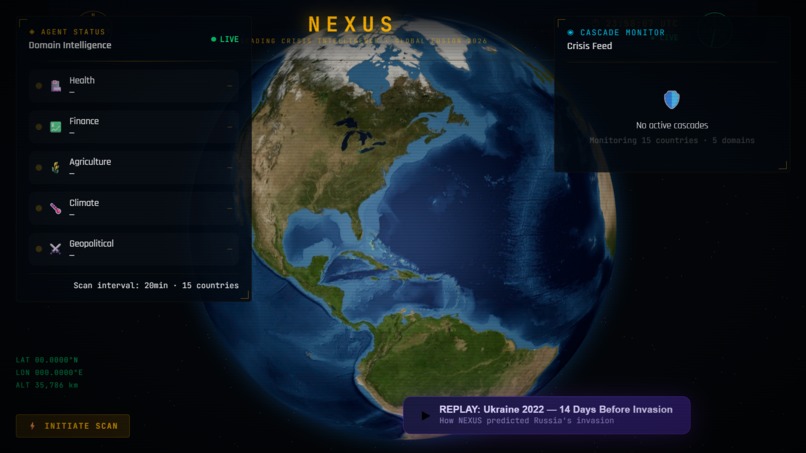
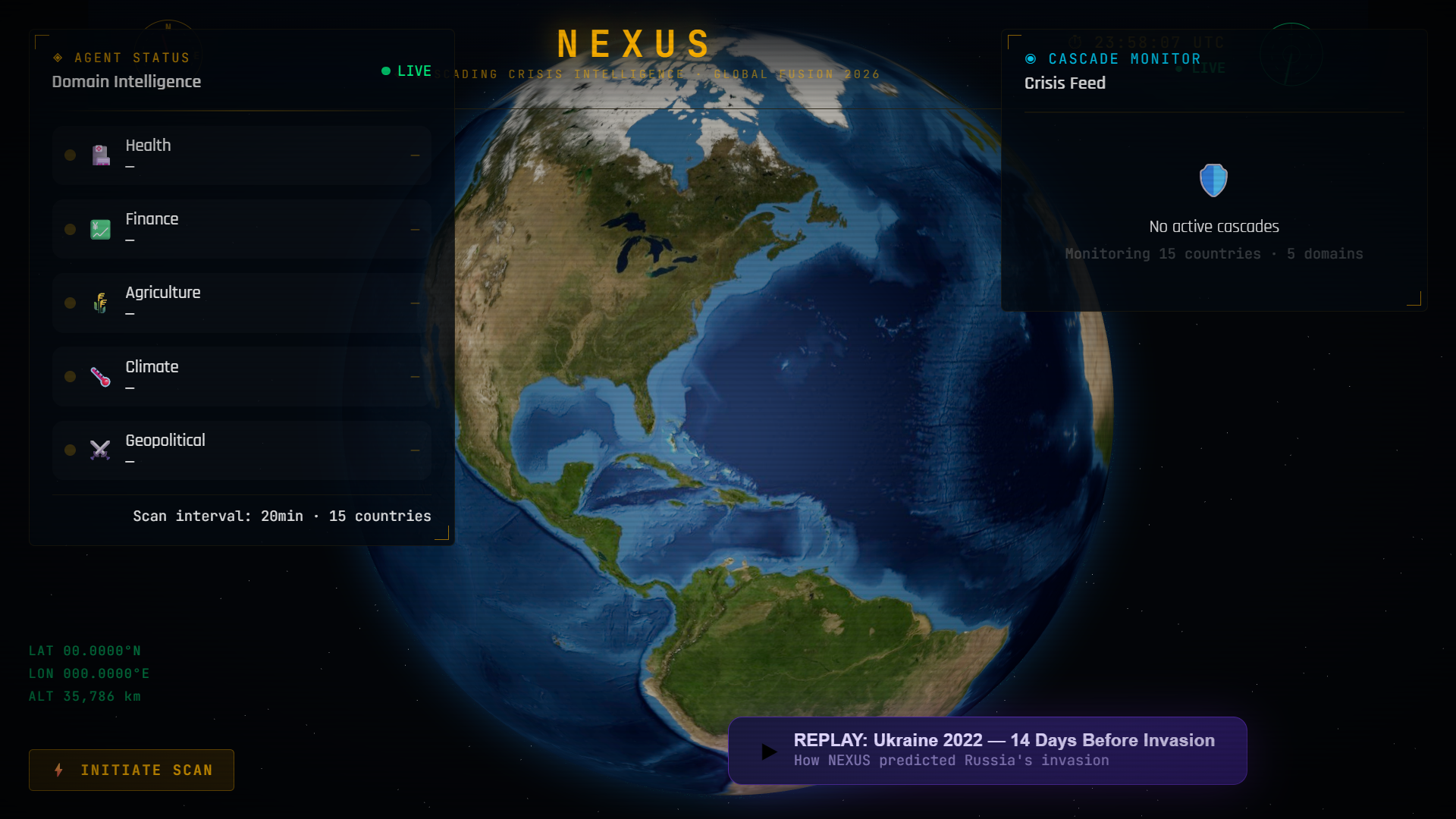
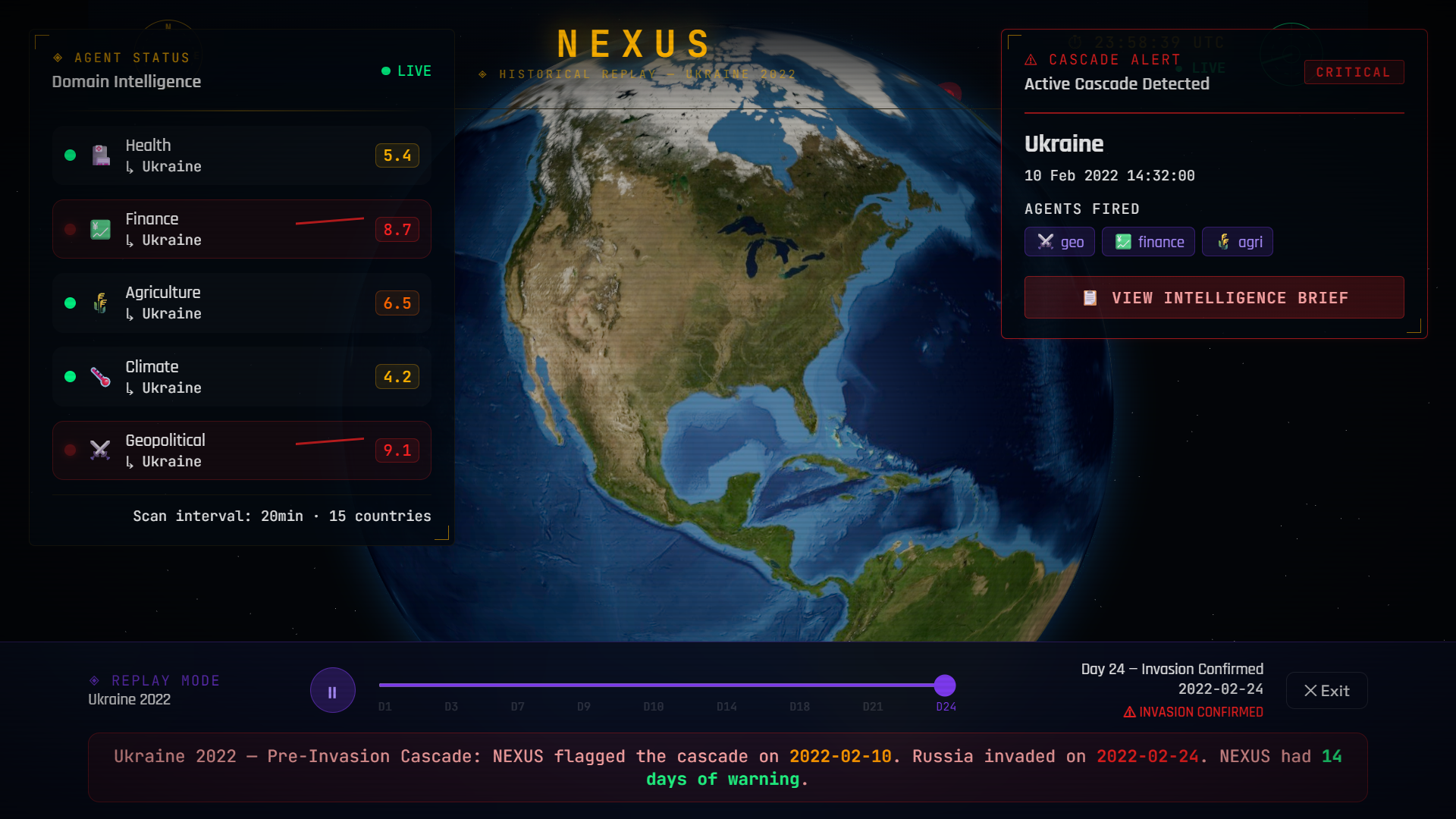
NEXUS global command interface. 5 autonomous AI agents continuously process live environmental and economic APIs to detect crisis patterns
-
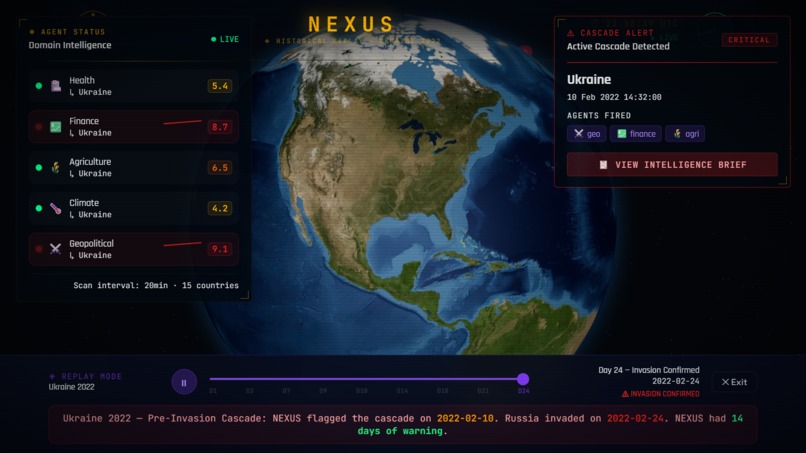
The 3D tactical HUD visualizes intersecting anomalies. When agriculture, finance, and geopolitical thresholds break, a cascade triggers.
-
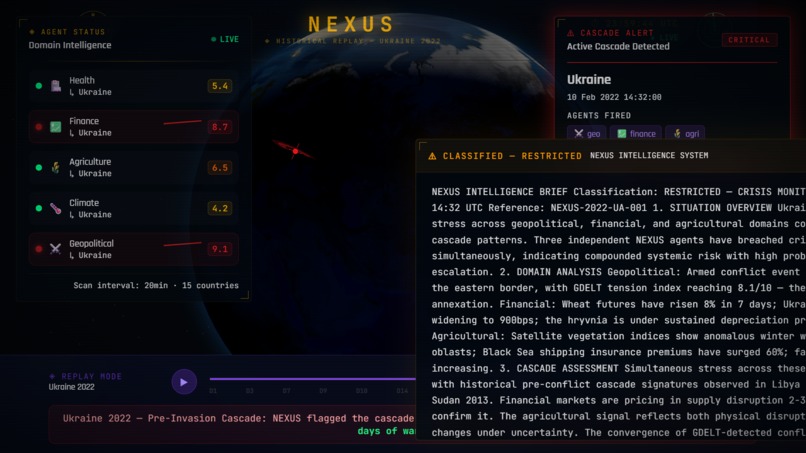
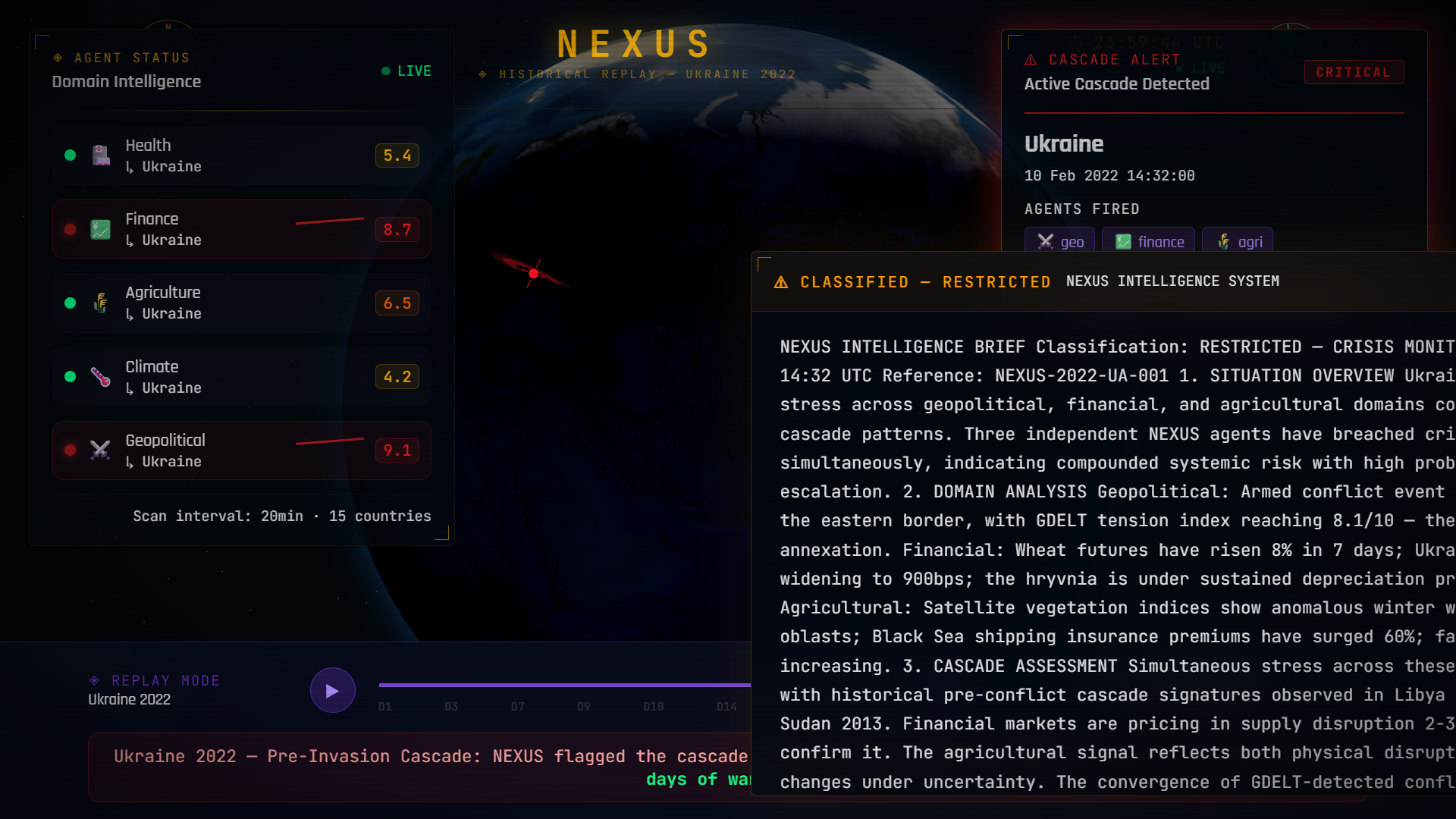
Gemini AI auto-generates classified intelligence briefs, synthesizing raw multi-domain tension signals into actionable predictive reports.
Inspiration
Global crises do not happen in isolation — they cascade.
The COVID-19 pandemic triggered supply chain breakdowns, which led to food inflation and economic instability across multiple countries. Similarly, geopolitical tensions, climate anomalies, and financial shocks often interact in complex ways, amplifying their impact.
Yet today’s global systems monitor these domains in silos:
- Health agencies track disease outbreaks
- Financial institutions monitor markets
- Agricultural systems track crop health
There is no unified system that connects these signals in real time.
We built NEXUS to bridge that gap — an AI system that detects how small signals across domains combine into large-scale crises before they fully unfold.
What it does
NEXUS is a multi-agent AI system that detects early warning signals of cascading global risks.
It continuously ingests real-time data from multiple domains:
- Health (disease indicators, alerts)
- Finance (price fluctuations, economic stress)
- Agriculture (crop stress, weather anomalies)
Each domain is handled by a specialized AI agent that analyzes signals independently.
A central Meta-Orchestrator then combines these signals and detects when multiple domains show stress in the same region — indicating a potential cascading crisis.
When this happens, NEXUS:
- Flags the region with elevated risk
- Explains the contributing signals
- Generates a structured intelligence brief
- Suggests possible intervention strategies
The Intelligence Model (Mathematical Perspective)
To formalize cross-domain risk, we define a simple composite risk model.
Let:
- $D = {d_1, d_2, ..., d_n}$ represent domain agents (health, finance, agriculture)
- $S_i$ be the normalized stress score from domain $d_i$ for a given region
We compute the Cascading Risk Score $R_c$ as:
$$ R_c = \sum_{i=1}^{n} w_i \cdot S_i $$
where:
- $w_i$ represents the importance weight of each domain
- $\sum w_i = 1$
To detect cascading risk, we introduce a threshold condition:
$$ \text{Trigger Alert if } \sum_{i=1}^{n} \mathbb{1}(S_i > \tau_i) \geq k $$
where:
- $\tau_i$ is the stress threshold for domain $i$
- $k$ is the minimum number of stressed domains (e.g., 2 or 3)
This ensures that isolated anomalies do not trigger alerts — only multi-domain convergence does.
How we built it
Backend
- FastAPI for asynchronous processing and API orchestration
- Parallel data ingestion from open APIs (health, finance, agriculture)
Multi-Agent System
- Domain-specific agents simulate independent analysis pipelines
- A Meta-Orchestrator aggregates signals and detects cross-domain patterns
Data Sources
- Health: public health datasets and alerts
- Finance: macroeconomic indicators and price signals
- Agriculture: weather and crop-related datasets
AI Layer
- Google Gemini API for generating structured intelligence briefs and recommendations
Frontend
- React + Vite for fast UI rendering
- Interactive global map visualization for risk zones
- Real-time panels for signals and generated insights
Challenges we ran into
1. Cross-Domain Data Integration
Each domain uses different formats and update frequencies. Normalizing these into a unified signal pipeline required careful schema design.
2. Signal Noise vs Real Risk
Many signals are noisy or insignificant. Designing thresholds to avoid false positives while still detecting meaningful patterns was a key challenge.
3. Real-Time Responsiveness
Fetching and processing multiple data sources introduces latency. We addressed this using caching and optimized asynchronous workflows.
4. Making Complexity Understandable
Translating multi-agent outputs into a simple, intuitive interface required balancing technical depth with usability.
What we learned
- Real-world problems are rarely isolated — systems thinking is essential
- AI becomes far more powerful when combining multiple data sources
- Simplicity in presentation is critical, even for complex systems
- Building reliable demos requires designing for failure, not just success
Impact
NEXUS has the potential to support:
- Governments in early crisis detection
- NGOs in resource allocation
- Supply chain systems in risk mitigation
By identifying risks earlier, even small interventions can prevent large-scale consequences.
What's next for NEXUS
- Expanding to additional domains (climate, geopolitics)
- Improving predictive modeling using historical crisis data
- Integrating real-time social signals for ground-level validation
- Building decision-support tools for policymakers
Conclusion
NEXUS does not try to predict the future.
It analyzes the present — faster and more holistically than any single system today.
By connecting signals across domains, it transforms fragmented data into actionable intelligence.
This is not just monitoring.
This is early warning intelligence for a connected world.
Built With
- docker
- fastapi
- framer-motion
- google-gemini
- javascript
- langchain
- langgraph
- python
- qdrant
- react
- three.js
- vite
- websockets
- zustand

Log in or sign up for Devpost to join the conversation.