-
-

nexus overview
-
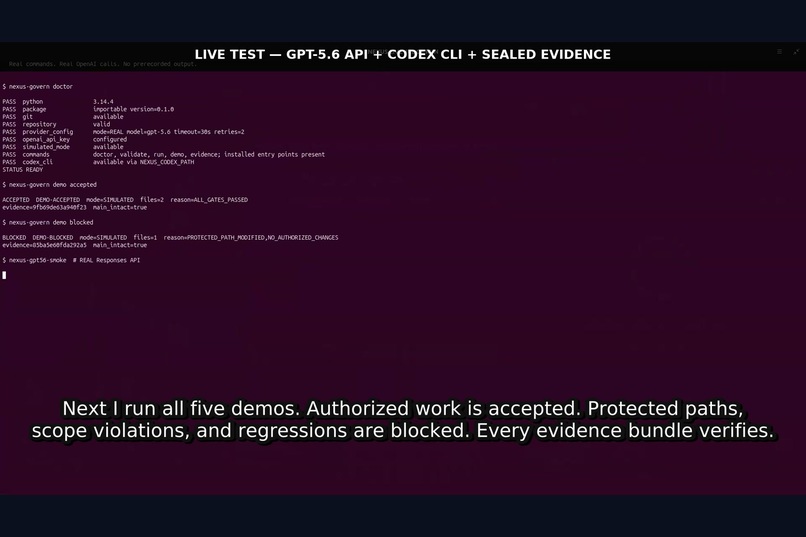
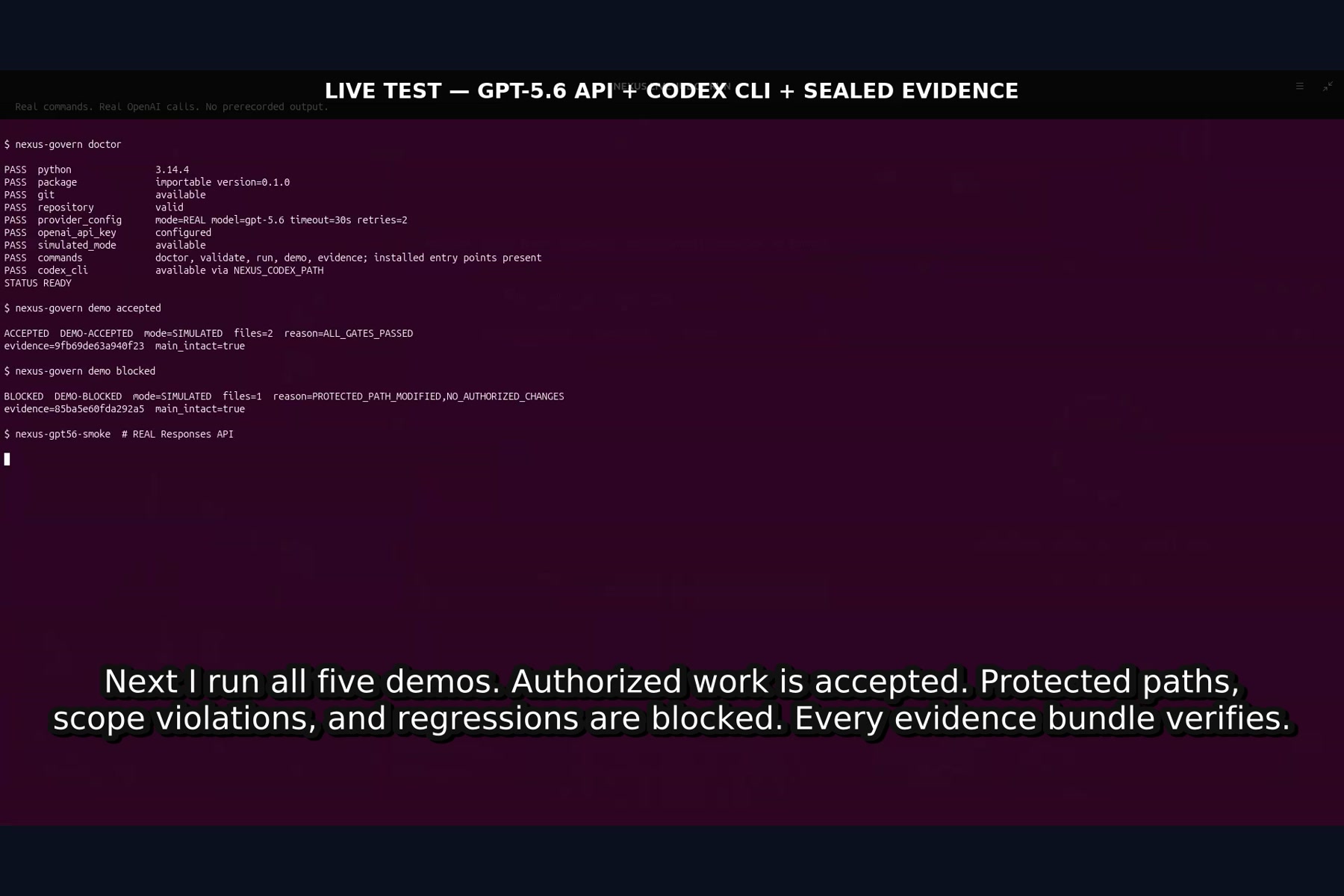
reall goberned test
-
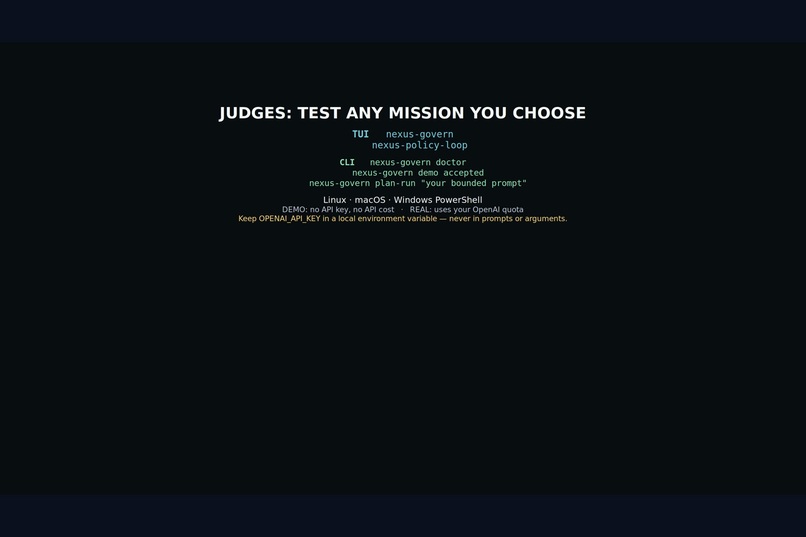
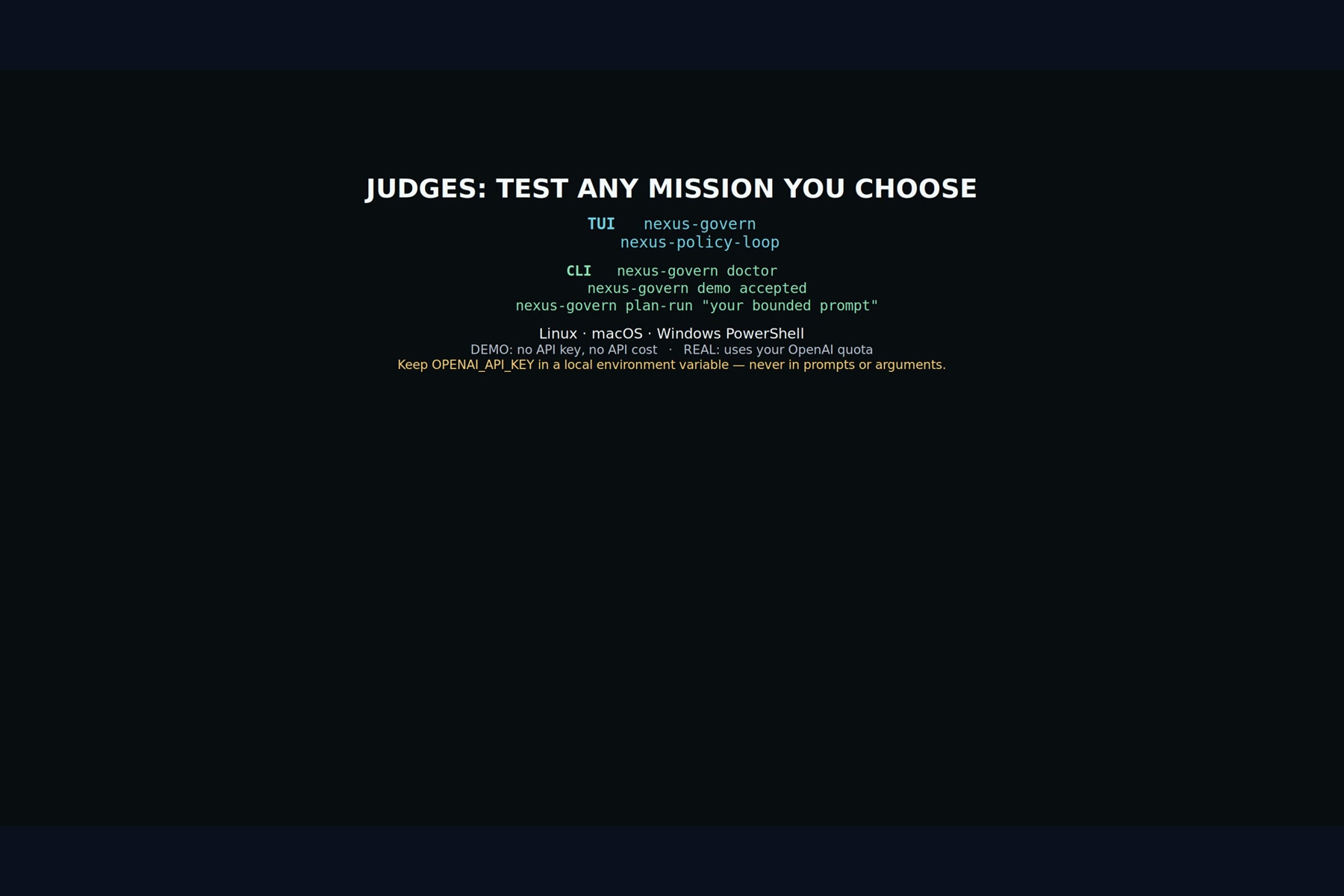
judge invitation

** Inspiration
AI coding agents can produce useful changes quickly, but a successful build does not automatically prove that the change was authorized, stayed within scope, passed the required tests, or left reliable evidence.
We built NEXUS Build Governor to create that missing acceptance boundary:
Codex builds. NEXUS governs.
** What it does
NEXUS converts a human objective into a governed mission with explicit authorized paths, protected paths, required tests, timeouts, and execution limits.
It then:
- Creates an isolated Git worktree.
- Invokes Codex as the bounded code builder.
- Classifies every changed file.
- Runs allowlisted tests.
- Produces a deterministic
ACCEPTEDorBLOCKEDdecision. - Generates a sealed evidence bundle containing reports, JSON, logs, test results, changed files, and an integrity hash.
GPT-5.6 is used for structured mission planning and human-readable post- decision explanations. It is intentionally advisory: it cannot accept, block, merge, or override a mission.
**How we built it
NEXUS is implemented in Python with typed domain contracts, Pydantic validation, Git worktree isolation, pytest-based validation, the OpenAI Responses API, Codex CLI integration, and a Textual terminal interface.
The new NEXUS Policy Loop was developed during Build Week. It gives judges two honest execution paths:
- Deterministic offline demos requiring no API key or quota.
- Real GPT-5.6 and Codex missions using securely configured local credentials.
The interface includes accepted changes, protected-path violations, scope violations, regression blocking, evidence verification, custom real prompts, and judge-ready real mission presets.
**How we used Codex
Codex accelerated implementation, debugging, automated testing, cross- platform terminal integration, orchestration, observability, release hardening, documentation, and submission preparation.
Humans retained the product, security, policy, and authority decisions. Codex acts as the builder, while the deterministic Governor independently evaluates its output.
Primary Codex Session/Thread ID:
019f86f1-81d2-7712-83f0-0df110e98ef6
** How we used GPT-5.6
GPT-5.6 translates human intent into a validated structured mission plan and explains completed governance decisions through the OpenAI Responses API.
Its schemas deliberately contain no authority-bearing decision field. This separation is essential to the project: reasoning remains flexible, while authorization remains deterministic, testable, and auditable.
** Challenges
The main challenge was preventing the same AI that creates a change from authorizing its own work. We addressed this by separating the builder, planner, policy engine, decision engine, and evidence system.
Other challenges included secure API-key handling, honest separation of simulated and real executions, Git worktree isolation, terminal portability, evidence integrity, timeout handling, and making the complete judge path understandable in minutes.
** What we learned
We learned that trustworthy agentic development requires more than a capable model. It requires explicit scope, deterministic gates, isolated execution, reproducible tests, transparent failure states, and evidence that judges and engineering teams can inspect independently.
** Accomplishments
- 147 Governor tests and the demo-project test pass.
- Real GPT-5.6 and Codex execution paths were validated.
- Five deterministic demos cover accepted and blocked outcomes.
- Evidence bundles preserve decisions, changed files, tests, JSON, logs, and integrity verification.
- The project provides judge-oriented CLI and TUI experiences.
- The submitted package runs on Python 3.10+ with cross-platform launch instructions.
** What's next
Future work includes externally signed evidence, CI integrations, multi- repository governance, richer policy packs, additional platform testing, and carefully bounded recovery workflows that never grant models authority over their own output.

Log in or sign up for Devpost to join the conversation.