NEXUS — Autonomous Operations, Governed by Humans
Modern AI agents can reason, use tools, and execute complex workflows, but giving autonomous systems access to real operational infrastructure introduces a critical problem: how do we make autonomy trustworthy?
NEXUS is an autonomous multi-agent operations platform designed to solve this problem.
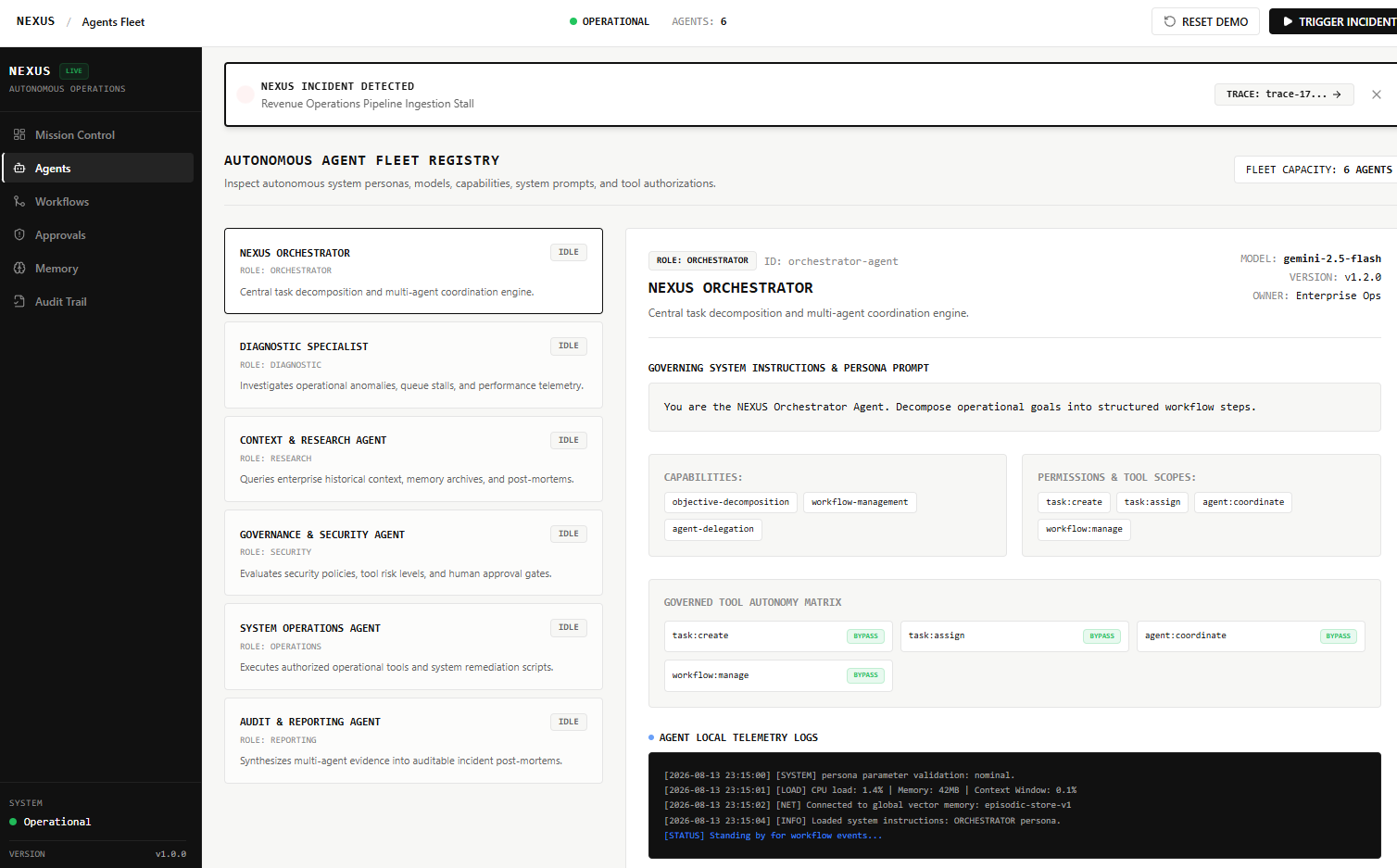
Instead of allowing a single AI agent to independently execute sensitive actions, NEXUS coordinates a specialized fleet of six agents:
- Orchestrator Agent — decomposes operational objectives and coordinates the workflow.
- Diagnostic Agent — analyzes telemetry and identifies potential root causes.
- Research Agent — retrieves historical incidents and organizational knowledge.
- Governance & Security Agent — evaluates actions against security policies and risk levels.
- Operations Agent — executes authorized operational tools.
- Reporting Agent — produces auditable incident reports and preserves operational knowledge.
The Problem
Autonomous AI systems are becoming increasingly capable of operating real software systems. However, autonomy without governance creates significant risks.
A high-risk operation should not simply execute because an AI agent decided it was appropriate.
Organizations need systems that can:
- Investigate incidents autonomously.
- Retrieve relevant organizational context.
- Evaluate proposed actions against policies.
- Stop before sensitive operations.
- Request human authorization when required.
- Execute only approved actions.
- Independently verify the outcome.
- Preserve a complete audit trail.
The NEXUS Approach
NEXUS demonstrates this through a simulated Revenue Operations incident.
A revenue processing pipeline suddenly stops processing transactions:
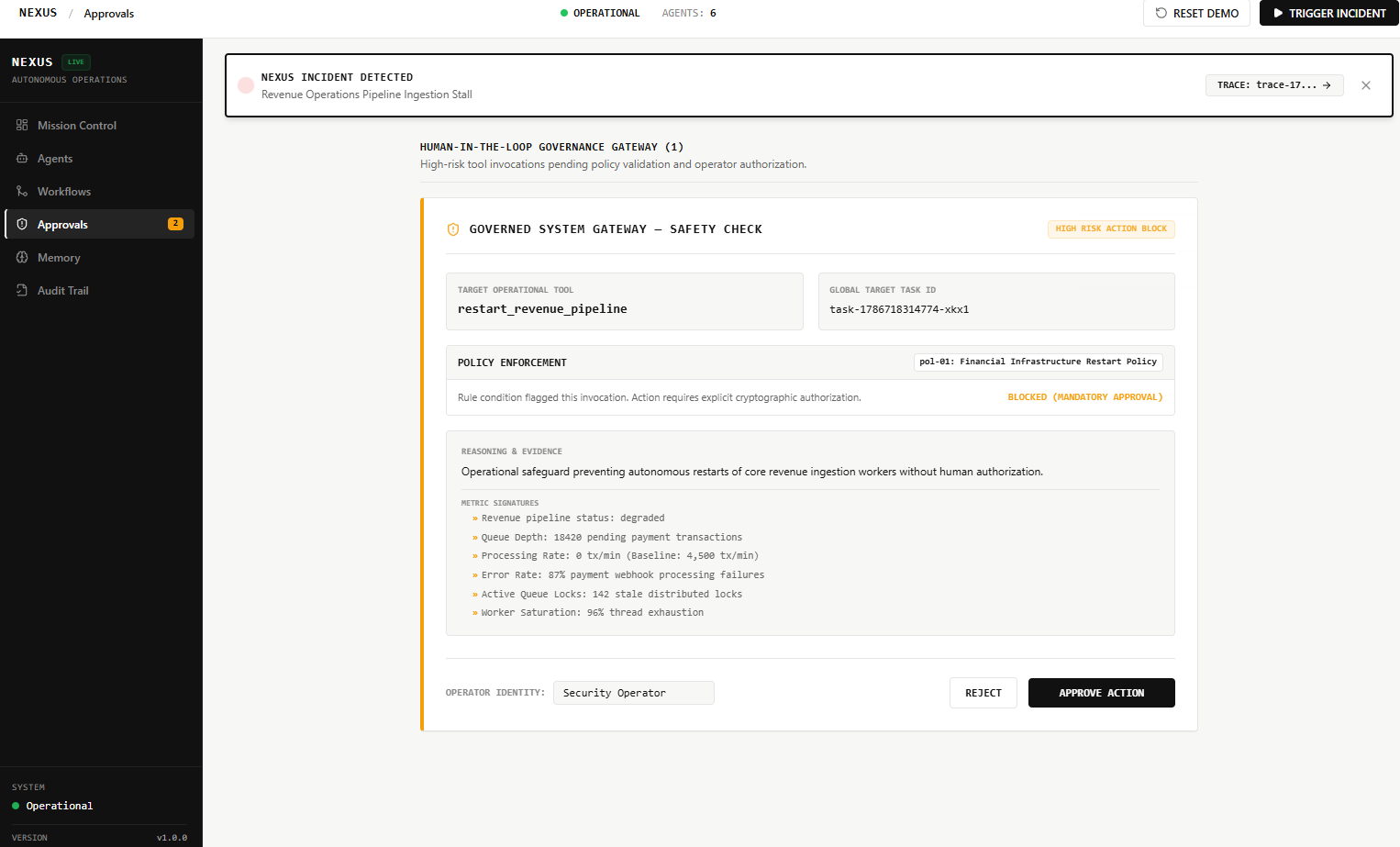
- Queue depth: 18,420
- Processing rate: 0 tx/min
- Error rate: 87%
NEXUS automatically investigates the incident, retrieves historical context, and determines that restarting the revenue pipeline is the appropriate remediation.
However, the operation is classified as HIGH RISK by the governance layer.
Instead of executing immediately, NEXUS pauses the workflow at:
AWAITING_APPROVAL
The operator receives the evidence, risk assessment, applicable policy, and proposed action.
Only after explicit human authorization does the Operations Agent execute the remediation through the Tool Gateway.
NEXUS then independently verifies recovery:
- Processing rate: 4,650 tx/min
- Error rate: 0.1%
- Queue locks: 0
Finally, the Reporting Agent generates an incident report and the entire operation remains traceable through a shared traceId and immutable audit events.
How We Built It
NEXUS is built as a full-stack multi-agent operations platform.
The backend uses Node.js, Express, TypeScript, and Google's Gemini API to power agent reasoning and orchestration.
The system includes:
- Multi-agent orchestration
- Tool Gateway
- Policy Engine
- Human-in-the-loop approval workflow
- Verification Service
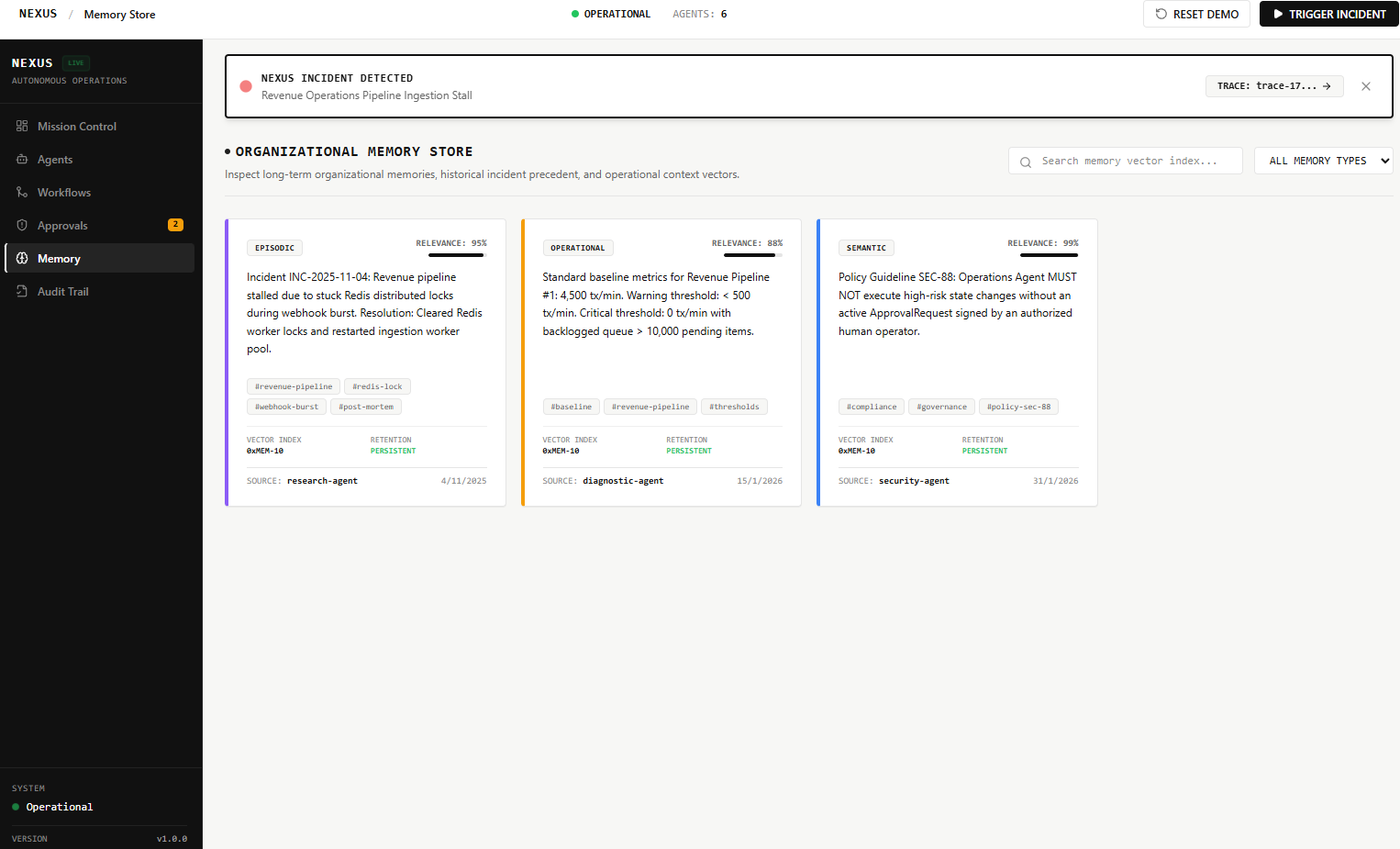
- Organizational memory
- Audit Service
- REST APIs
- Server-Sent Events for real-time telemetry
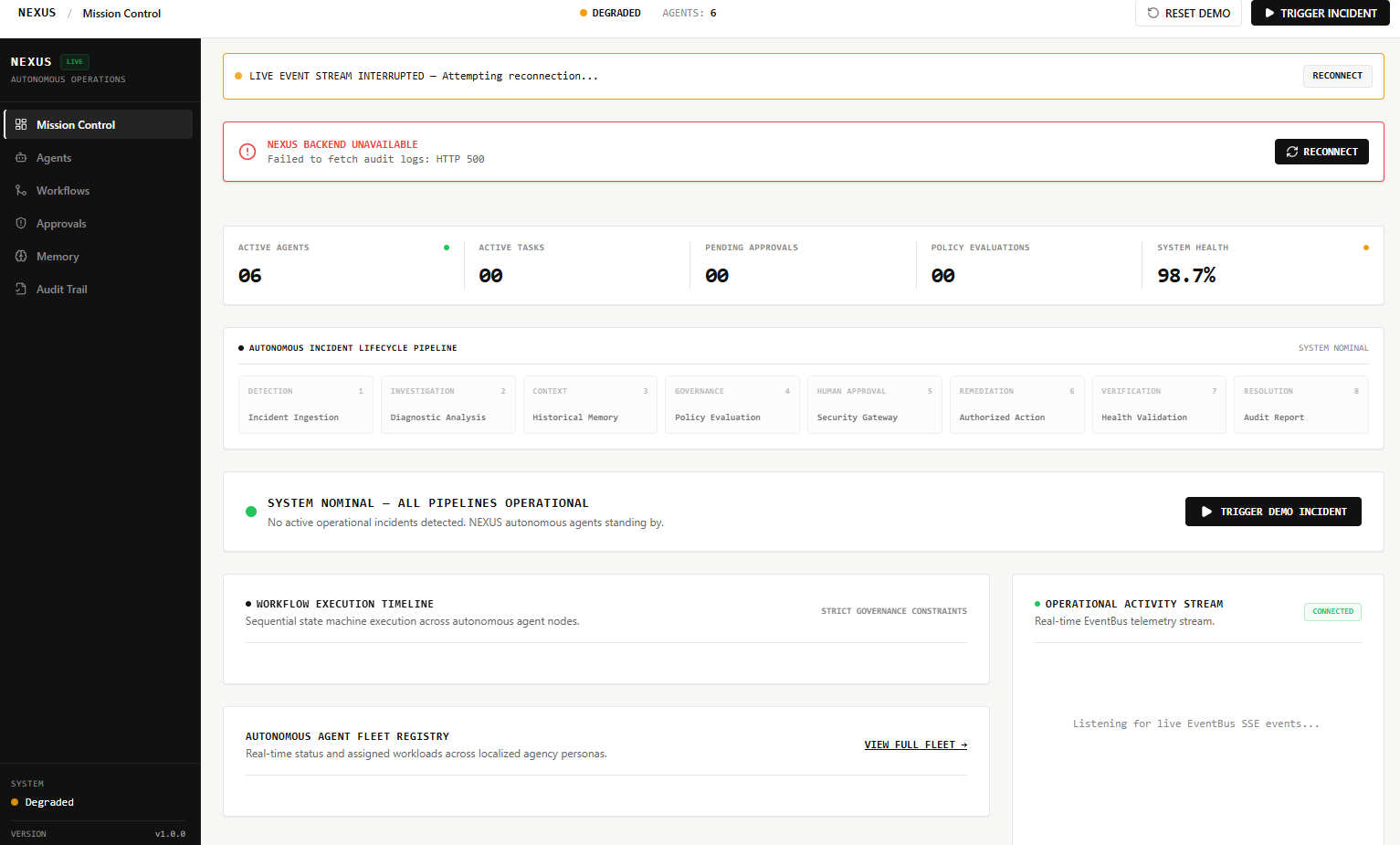
The frontend is a Mission Control interface designed as a professional enterprise operations console.
It provides:
- Live system telemetry
- Agent Fleet visualization
- Workflow state inspection
- Human Approval Center
- Organizational Memory Inspector
- Audit Trail
- Incident Reports
- Real-time SSE activity streams
What We Learned
The biggest lesson was that autonomous AI is not only about giving agents more capabilities.
The harder problem is designing boundaries around those capabilities.
During development, we focused on making the execution path deterministic and observable. Every important operation has a trace, policy evaluation, authorization state, execution state, verification state, and audit event.
This helped us treat AI agents less like isolated chatbots and more like components of an operational system.
Challenges
One of the main challenges was coordinating multiple agents while maintaining a reliable workflow state.
We needed to ensure that:
- unauthorized tools could never execute;
- high-risk operations always paused for approval;
- rejected approvals permanently prevented execution;
- remediation could only happen after authorization;
- recovery was independently verified;
- every operation remained connected through a trace ID;
- the frontend remained synchronized with backend state through SSE.
We also designed the architecture so the repository layer can eventually migrate from deterministic in-memory storage to production persistence without changing the core business logic or API contracts.
Why NEXUS Matters
The future of AI agents will not only depend on how autonomous they become.
It will depend on whether organizations can trust and govern that autonomy.
NEXUS explores a model where agents can investigate and act autonomously while remaining bounded by policies, human oversight, verification, and complete traceability.
NEXUS doesn't just make agents autonomous. It makes autonomy governable.
Built With
- node.js
- react
- restapi
- typescript

Log in or sign up for Devpost to join the conversation.