Inspiration
Community organizations constantly decide where limited resources should go — food, education, outreach, transport — while drowning in messy, incomplete, conflicting information. Chatbots give a single confident answer with no evidence trail. Dashboards show numbers but never recommend. We wanted an AI that investigates instead of answering: one that shows its work, admits uncertainty, and lets humans stay in charge.
What it does
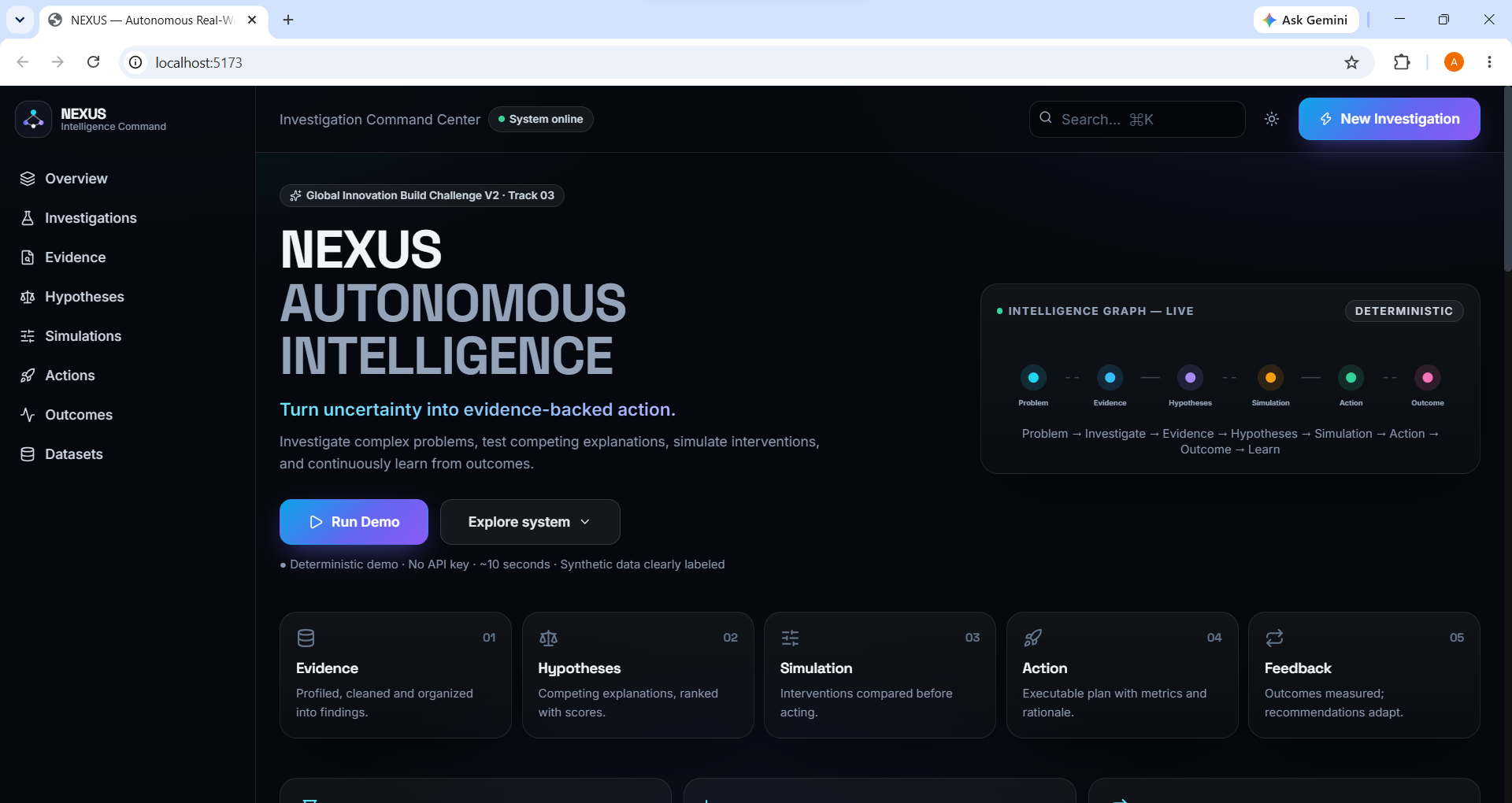
NEXUS — Autonomous Intelligence Command Center turns a messy real-world problem into evidence-backed action through a visible loop:
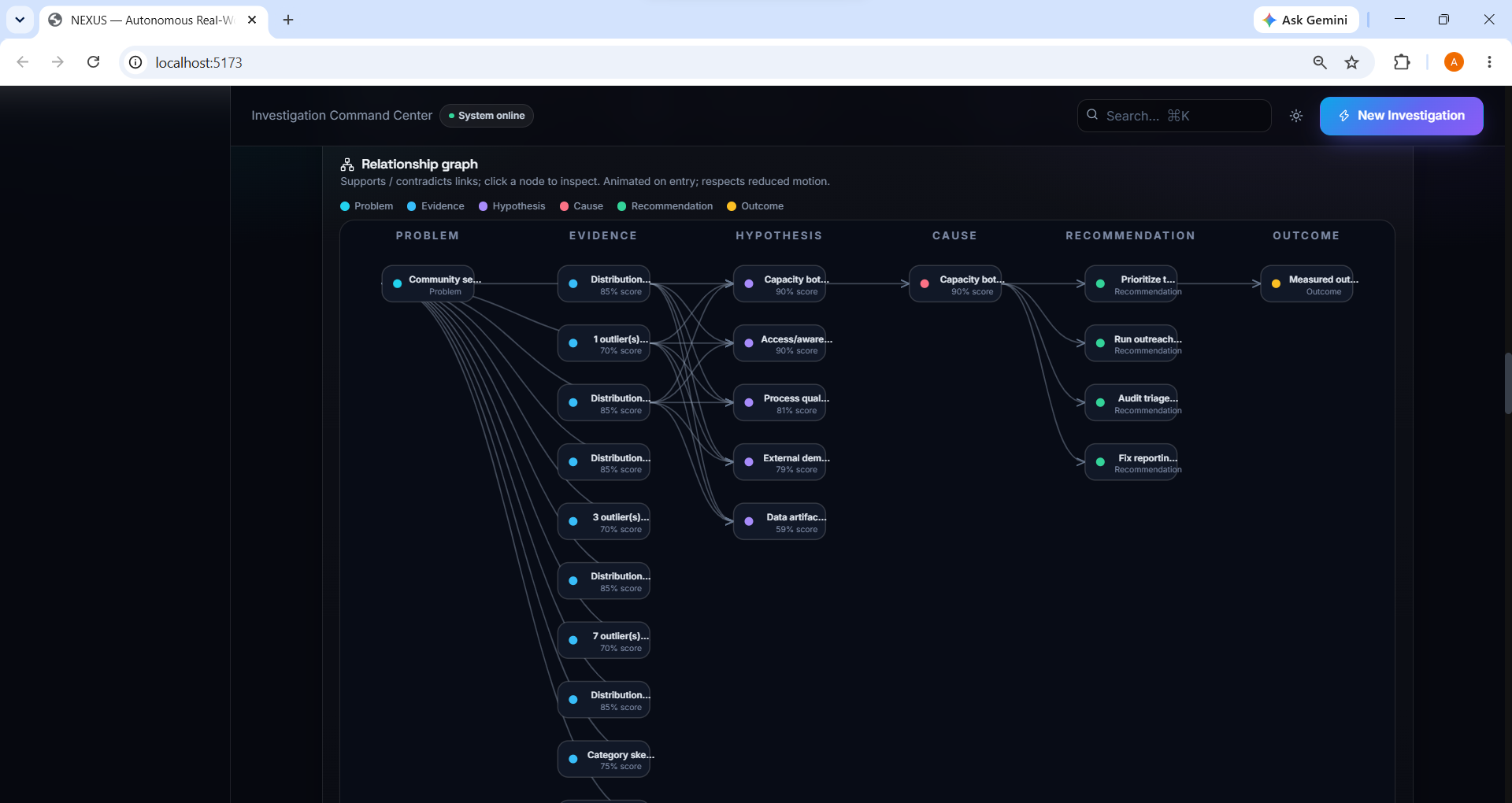
Problem → Evidence → Hypotheses → Simulation → Action → Outcome → Learning
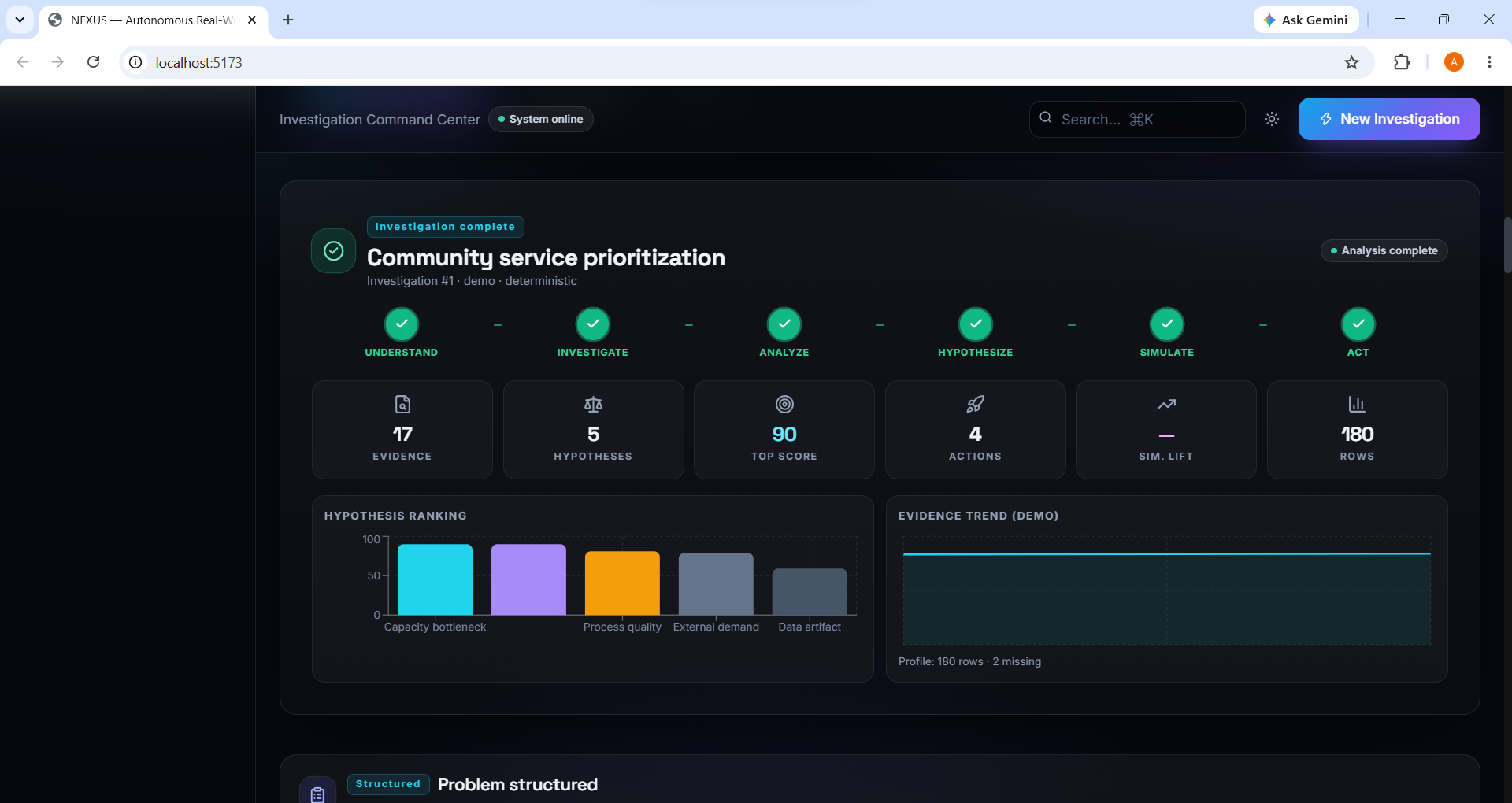
Give it a problem (our demo: community service prioritization across neighborhoods). NEXUS structures it, profiles the data with real statistics, ranks competing hypotheses with evidence-weighted scores, simulates interventions (Baseline vs A vs B — always labeled estimates), recommends an action a human must Accept / Modify / Reject, measures the recorded outcome, and learns. Every screen carries its receipts: an investigation timeline, a downloadable audit receipt, and honest labels everywhere (scores are not probabilities, simulations are not guarantees, demo data is synthetic).
How we built it
- Frontend: React 18 + TypeScript + Vite + Tailwind CSS + Recharts + Lucide icons. Sidebar command center,
⌘Kcommand palette, animated evidence graph (SVG), Scenario Lab charts, dark-first design system with light mode, reduced-motion support, keyboard navigation throughout. - Backend: Python + FastAPI + Pydantic + SQLAlchemy (PostgreSQL-compatible, SQLite locally). A real
InvestigationOrchestratorruns Problem Parser → Evidence Analyzer → Hypothesis Generator/Ranker → Root-Cause Analyzer → Simulation Engine → Recommendation Engine → Feedback Engine. Every stage produces structured, validated output stored in the database. - AI: a provider abstraction (
LLM_PROVIDER=demo|generic). Demo Mode is fully deterministic — pandas/NumPy analysis on a synthetic 180-row dataset — so the 3-minute demo never depends on a paid API. Live mode degrades safely to deterministic output offline. - Validation: 8/8 pytest tests, reproducible simulations (byte-identical re-runs), input validation with proper 422/400/404 handling, secret-free repo.
Challenges we ran into
- Tailwind silently not compiling (missing PostCSS config) made the app look like raw HTML — diagnosed via the 2.8 KB CSS bundle, fixed the pipeline, rebuilt the entire design system.
- Honesty vs impressiveness: resisting the urge to fake progress bars or present scores as probabilities. We made transparency the brand instead — judges respond to it.
- One-click reliability: the demo had to complete in ~10 seconds with zero config, so every external dependency got a deterministic fallback.
Accomplishments that we're proud of
A genuinely working Evidence → Hypothesis → Simulation → Action → Feedback loop (not a mockup), a downloadable investigation receipt, human-in-the-loop review gates, and a demo that runs fully offline.
What we learned
That the hardest part of decision-intelligence UX is communicating uncertainty without losing trust — and that labeling estimates honestly increases credibility instead of reducing it.
What's next for NEXUS
Real LLM reasoning behind the provider abstraction, causal-inference upgrades (propensity scoring, difference-in-differences), auth + shared workspaces, scheduled re-evaluation with drift alerts, and PDF receipt export.
Built With
- accessibility
- ai
- data-visualization
- fastapi
- git
- github
- lucide
- machine-learning
- numpy
- pandas
- postgresql
- pydantic
- pytest
- python
- react
- recharts
- render
- rest-api
- sqlalchemy
- sqlite
- tailwind-css
- typescript
- vercel
- vite

Log in or sign up for Devpost to join the conversation.