-
-
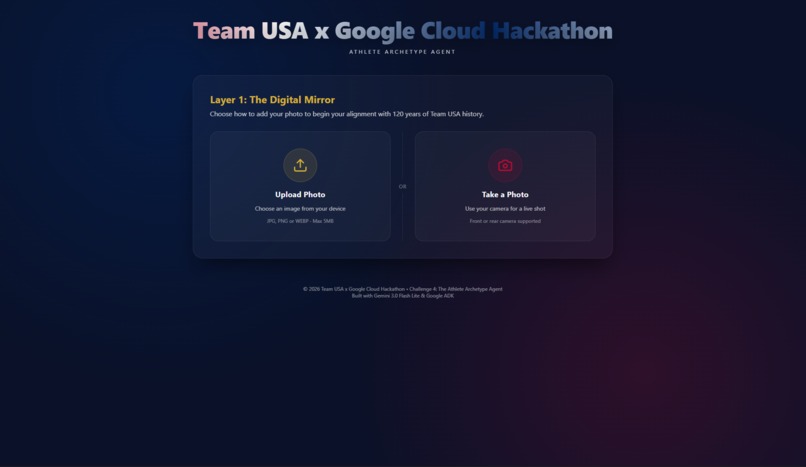
Image Upload Page
-
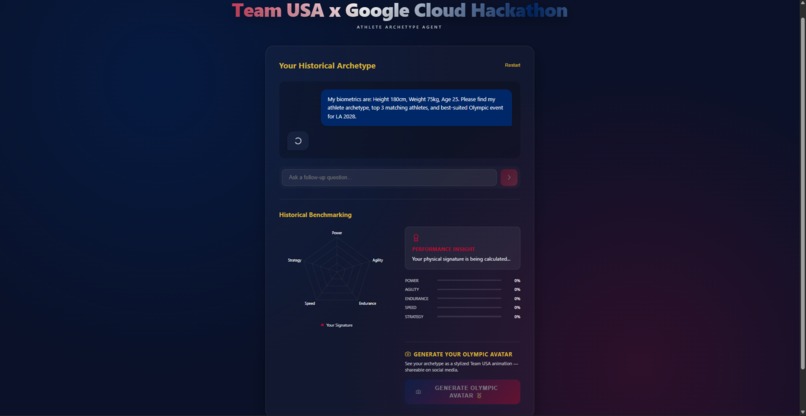
Agent Page
Inspiration
We have all, at some point, watched the Olympics or Paralympics and asked ourselves, "If I'd dedicated myself to a sport, which one would it be?"
Athletics is a fundamentally physical activity, yet it's one with very specific requirements. The center of gravity in a gymnast's form is wildly different from the lever in a rower's stroke and a sprinter's explosive speed contrasts sharply with a marathoner's endurance. We sought to connect the casual fan with the highest-level athletes. We found our inspiration in creating a "Digital Mirror," a sophisticated, interactive AI that, given basic physical metrics and a user's image, can map their form onto 120 years of Team USA history to reveal their true Athlete Archetype.
Additionally, we aimed for absolute design equality. The Olympic and Paralympic movements are two sides of the same coin. Our agent was built from the ground up with a Paralympic Clause ensuring adaptive sports and Paralympic athletes are given the same analytical rigor, historical matching, and celebration as Olympic athletes.
What it does
Nexus Athlete is a multimodal AI platform that enables fans to become athletes.
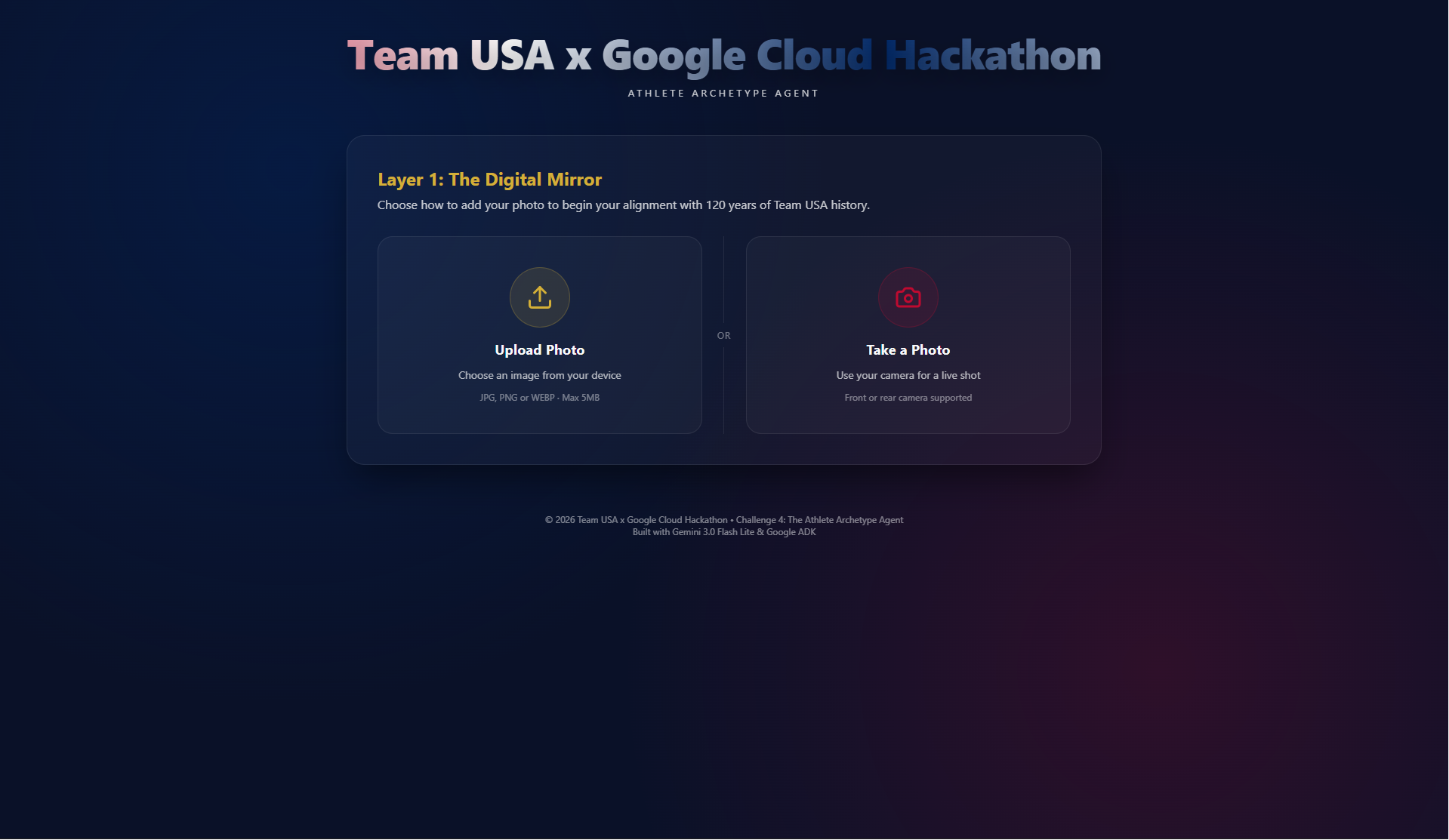
- The Digital Mirror (Multimodal Entry): Users are prompted to grant access to their webcam and take a picture, or to upload an existing photo.
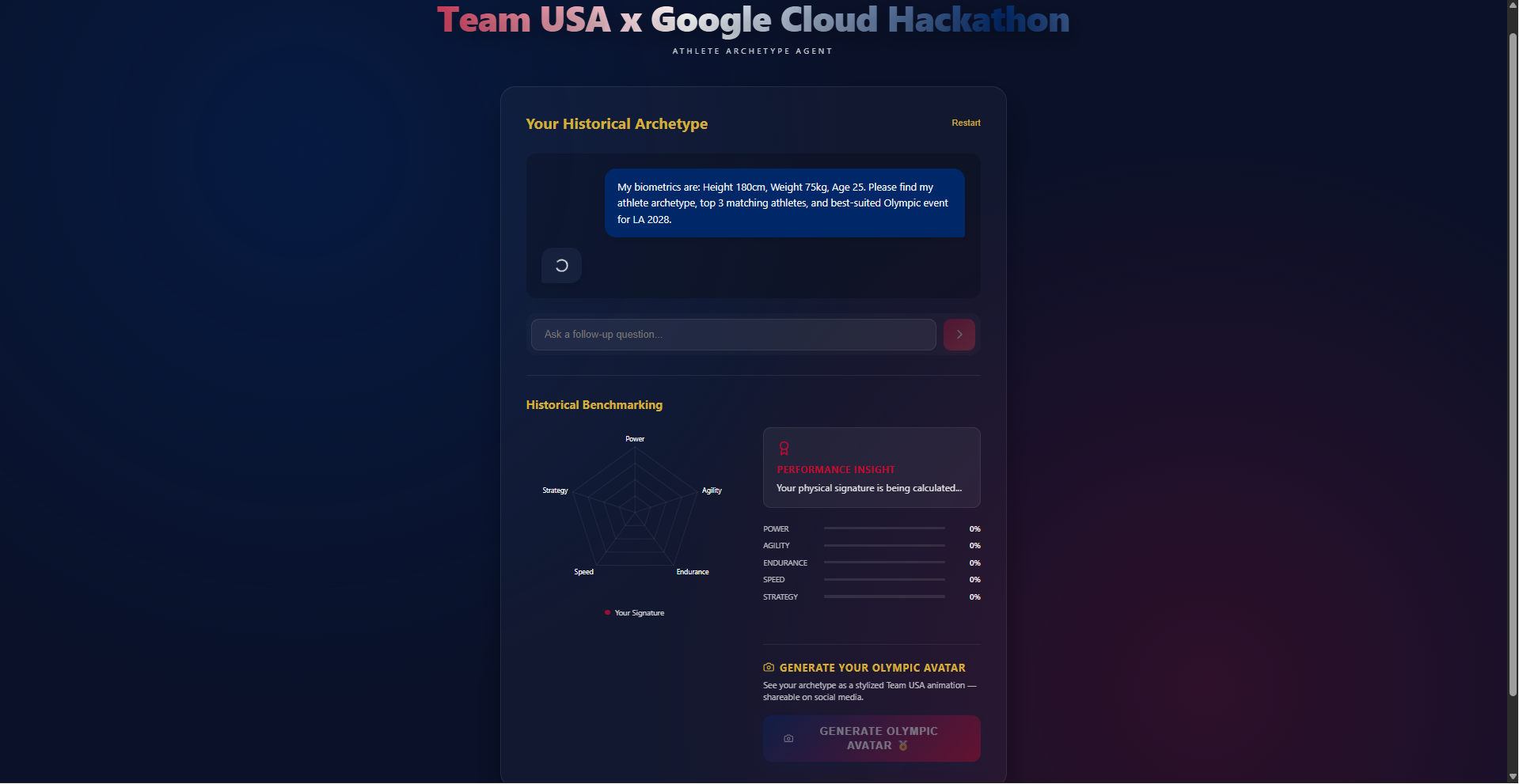
- Biometric Layering: Users then submit basic physical data (height, weight, and age) about themselves.
- Historical Clustering: This data is cross-referenced against a comprehensive dataset that encompasses over 120 years of both Olympic and Paralympic athlete records.
- The Agentic Breakdown: Using Google's Gemini 3.1 Flash-lite, the platform streams a personalized and interactive breakdown of the user's "Physical Signature" (defined as power, agility, endurance, speed, and strategy) outputting an interactive SVG radar chart.
- The Victory Shot: Upon determining an archetype, the platform calls a secondary backend system, which generates an impressive, AI-driven action shot of the user performing as if they were in the chosen sport.
- Social Amplification: Users have the ability to instantly share their Victory Shot and their determined archetype directly to their X, Facebook, LinkedIn, or Instagram profiles using integrated Web Share APIs.
How we built it
We've implemented a modern, decoupled dual-backend architecture to handle the disparate workloads involved with language and image generation.
- The Orchestrator (Backend 1): Using FastAPI, we've wrapped and deployed Gemini 3.1 Flash-lite through Google Agent Development Kit (ADK). The ADK provides session management, telemetry logging (to Google Cloud Storage), and tool execution, ensuring secure communication through Vertex AI.
- The Artist (Backend 2): A separate FastAPI service serves as a dedicated pipeline for Imagen 3 (
imagen-3.0-generate-002) on Vertex AI, rapidly converting the user's base photo and archetype into a dynamic "Victory Shot." - The Data Engine: Google BigQuery ML (
OlympicData.athletearchetypes) is used to perform clustering and querying of over a century of historical data, allowing the agent to perform statistically accurate historical athlete matches against user inputs. - The Frontend: We've developed a lightning-fast React (Vite) SPA with a sleek, dark-mode Glassmorphism UI. Framer Motion is used for seamless micro-animations, Recharts provides the interactive physical signature radar chart, and native Web APIs are leveraged for camera capture and social sharing functionality.
- Deployment: The entire architecture is containerized and deployed using Google Cloud Run.
Challenges we ran into
- Dual-Backend Proxying: Our biggest challenge was handling CORS and connection timeouts between the React frontend and the ADK backend. We ultimately implemented a unified Vite proxy in our dev environment (
vite.config.js) to route traffic to the ADK (/runand/apps) and to the image service (/generate-action-shot) with ease. - Agentic Constraints: LLMs often err on the side of being overly assertive. We initially found that the agent would flatly state that users "WILL BE a Gold Medalist in Rowing." We had to heavily engineer system prompts and apply strict Conditional Phrasing rules to ensure the agent used non-deterministic, analytical language such as "Your metrics suggest a strong alignment with..."
- Social Sharing Limitations: We quickly learned that platforms like Facebook and LinkedIn cannot scrape images from Base64
data:URLs. To avoid the need for a public bucket per user, we implemented a hybrid approach using the native Web Share API for mobile (which supports file passing) and a polished auto-clipboard system for desktop users.
Accomplishments that we're proud of
- The Camera Integration: Creating a custom, responsive webcam interface that included mirroring, corner guides, and flash animations was critical in making the "Digital Mirror" feel like a premium app experience.
- Zero-Latency Feel: Streaming Gemini's responses token-by-token into our Glassmorphism UI provides the illusion that the AI is "thinking" and calculating the user's metrics in real-time.
- The Paralympic Parity: Being able to accurately and respectfully match users to complex Paralympic classifications based on their input was incredibly rewarding and aligned perfectly with the spirit of Team USA.
What we learned
- We learned the substantial architectural benefits of the Google Agent Development Kit (ADK). Its built-in features for tool calling, state management, and Cloud Logging saved us hours of boilerplate Python coding.
- We deepened our knowledge of BigQuery ML and its ability to be easily exposed as an executable tool for an LLM to query dynamically based on natural language context.
- We gained a solid understanding of modern browser APIs, particularly
navigator.mediaDevices(for camera access) andnavigator.share(for social media sharing).
What's next for Nexus Athlete
Our next steps are to implement persistent user profiles. We plan to integrate Firebase Authentication and Cloud SQL so users can save their archetypes, track changes in their biometrics over time, and compare their "Physical Signatures" with their friends on leaderboards.
We also want to expand the BigQuery dataset to include real-time Olympic trials data, so the agent can say, "Your metrics actually match the Team USA athletes qualifying for LA 2028 right now."
Built With
- adk
- css3
- gemini
- google-bigquery
- google-cloud-run
- javascript
- python
- react
- vertex-ai
- vite

Log in or sign up for Devpost to join the conversation.