-
-
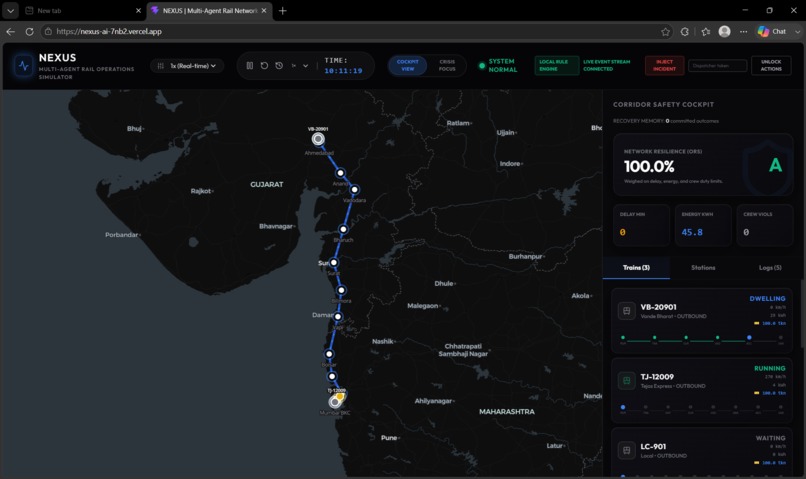
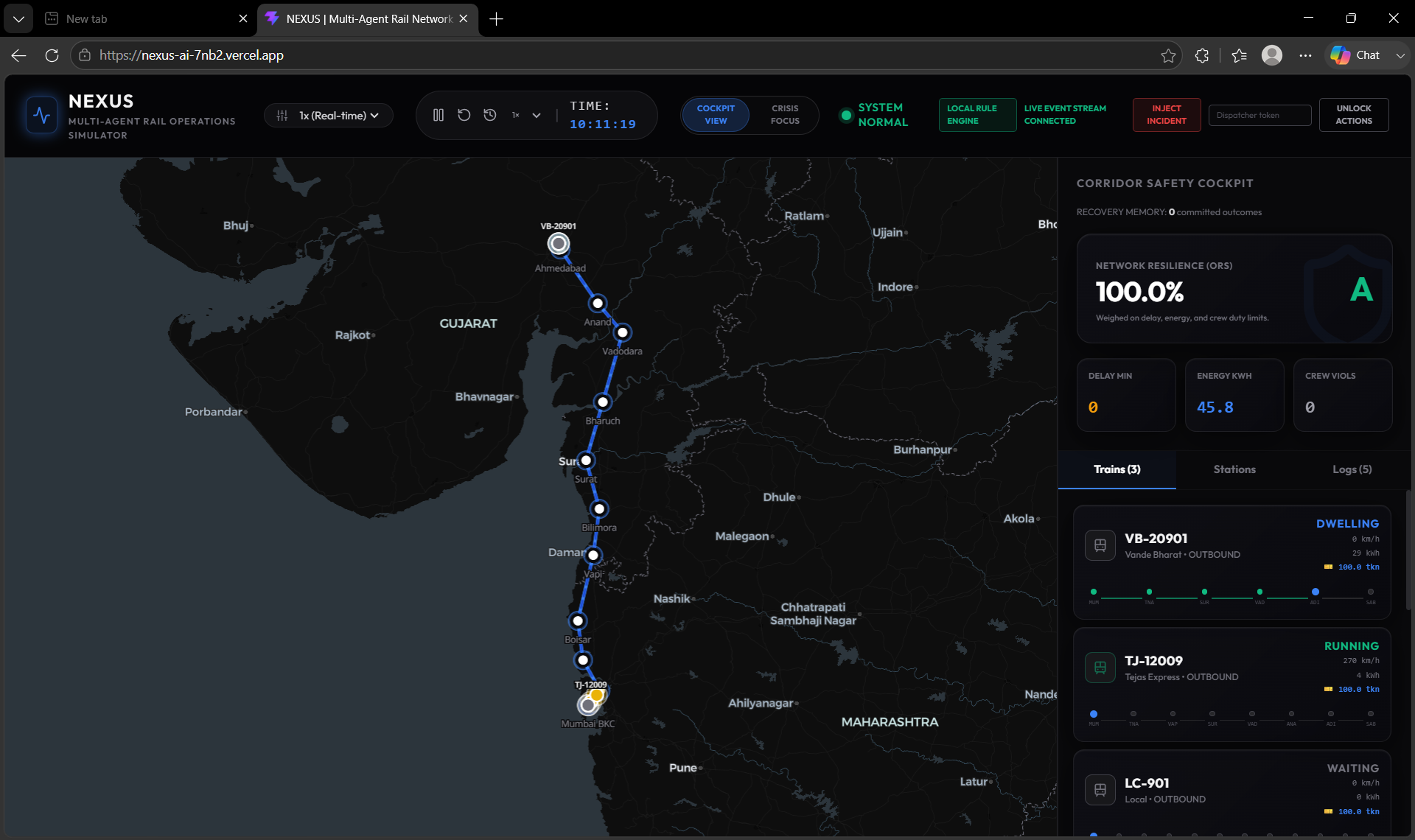
NEXUS AI Live Cockpit: Real-time multi-agent simulation & decision intelligence for critical rail infrastructure.
-
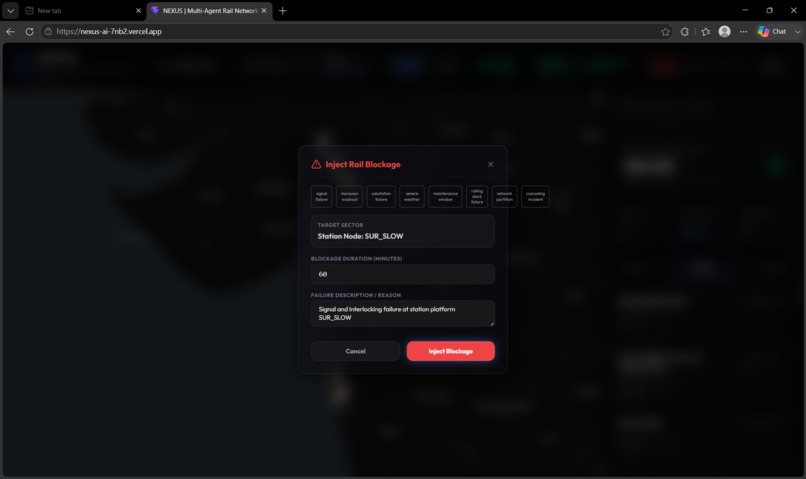
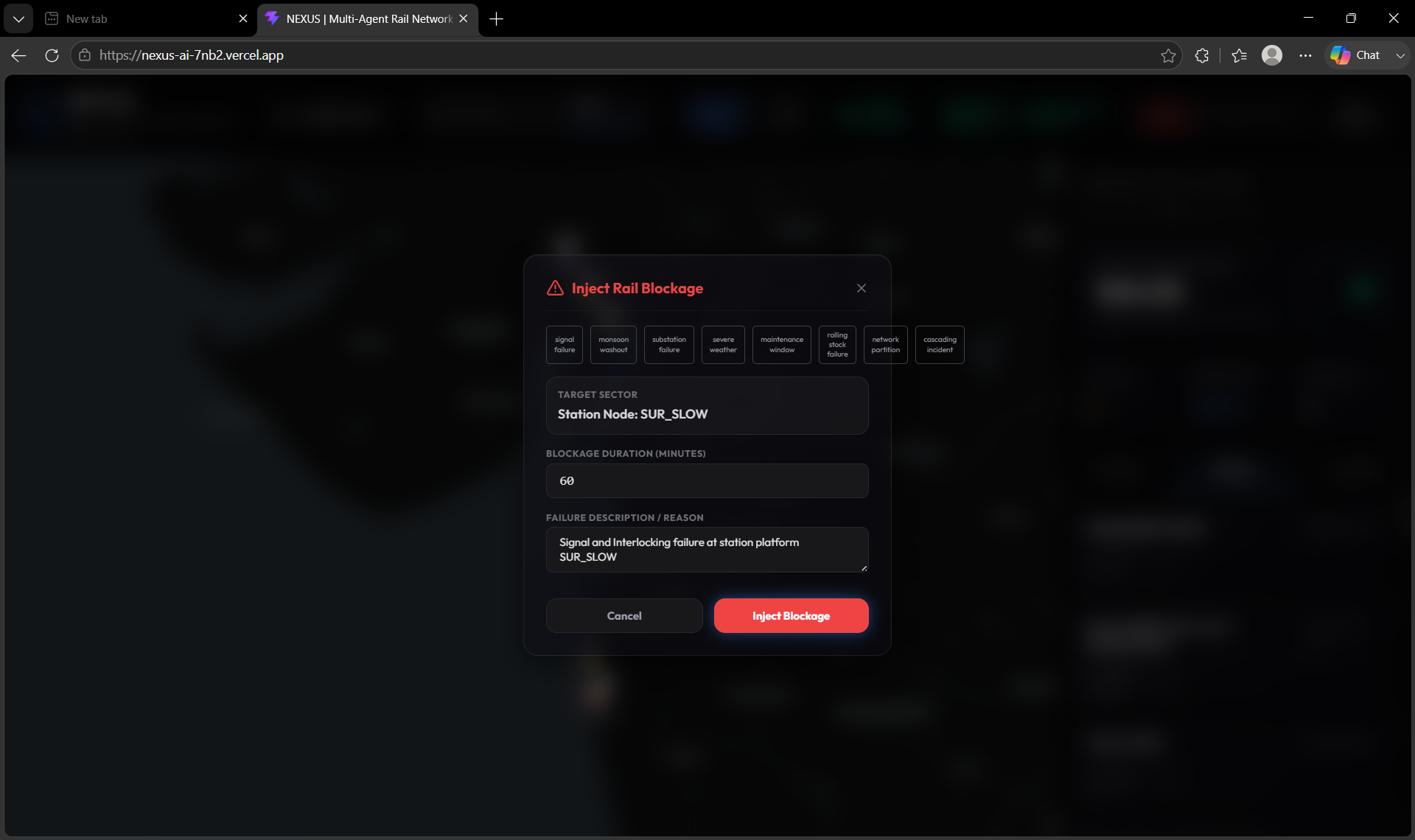
NEXUS AI Crisis Simulator: Injecting synthetic rail blockages & signal failures to test multi-agent resilience.
-
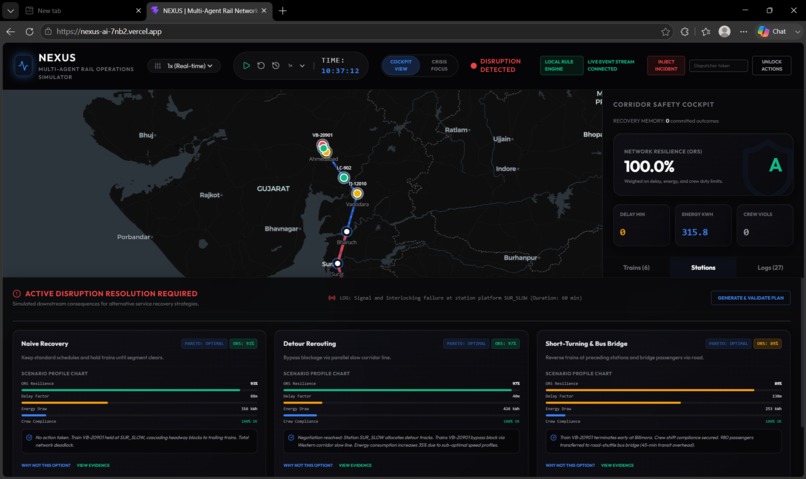
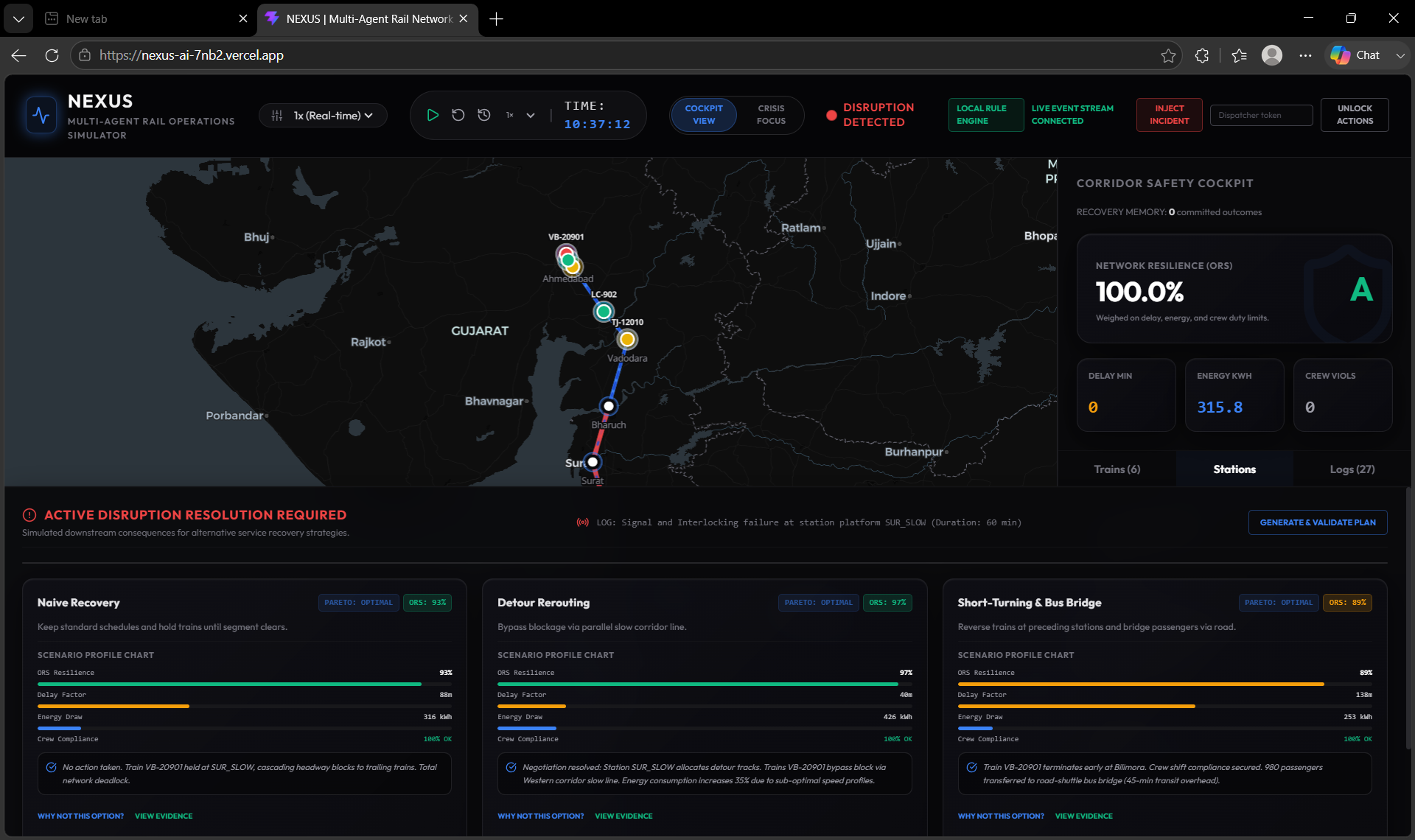
NEXUS AI Autonomous Recovery: Real-time pareto-optimal scenario evaluation & AI plan validation during rail disruptions.
-
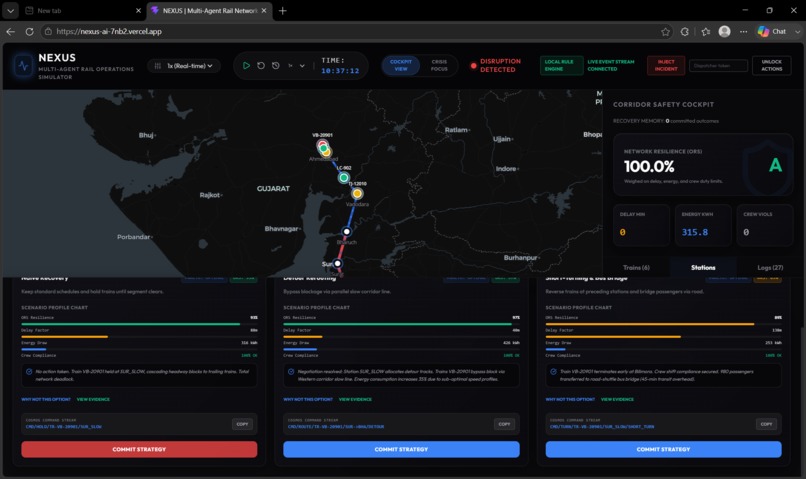
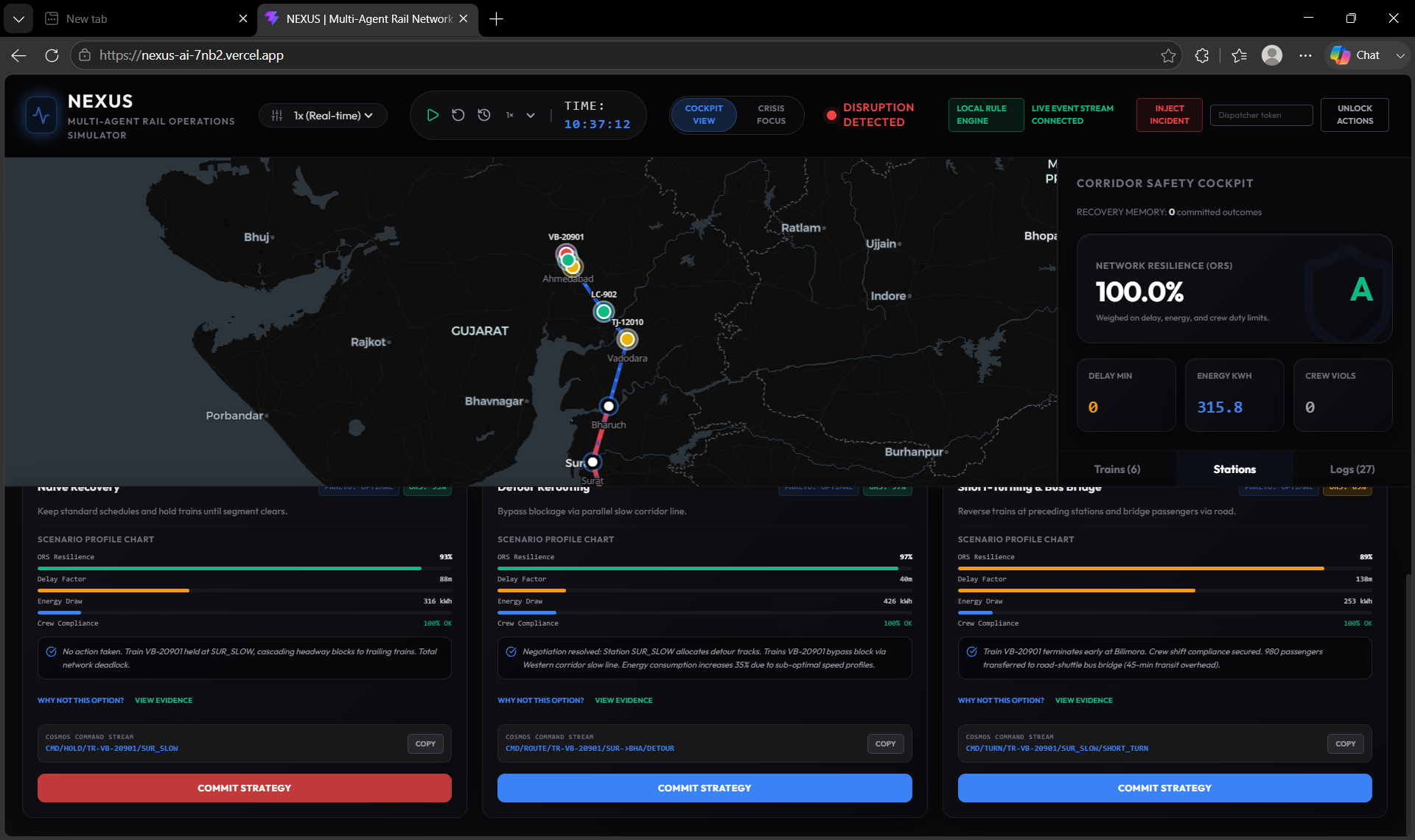
NEXUS AI Decision Cockpit: One-click strategy commitment for multi-agent autonomous train rerouting and crisis mitigation.
INSPIRATION
Critical infrastructure is becoming increasingly complex, but decision-making in areas such as railways, logistics, manufacturing, energy, and smart cities is still often fragmented, reactive, and dependent on human operators processing large amounts of information under time pressure.
We were inspired by a simple question:
"Can AI help humans decide not only what action to take, but also what deserves their attention right now?"
This led us to build NEXUS AI — an AI-native decision-intelligence platform that combines collaborative AI, predictive modeling, simulation, optimization, uncertainty estimation, safety verification, and context-aware attention management.
Our prototype focuses on high-density railway operations, where a single disruption can propagate across multiple downstream trains. The broader vision is to create a reusable intelligence layer for critical infrastructure where AI collaborates with human experts rather than simply replacing them.
WHAT IT DOES
NEXUS AI transforms complex operational data into actionable, explainable, and context-aware decisions.
The system:
• Continuously analyzes operational context.
• Predicts potential disruptions and their downstream effects.
• Generates multiple possible recovery strategies.
• Simulates candidate strategies using a railway Digital Twin.
• Evaluates competing resource priorities using optimization and game theory.
• Estimates model uncertainty and detects unusual operating conditions.
• Verifies candidate decisions against deterministic safety constraints.
• Calculates a Cognitive Review Load Index (CRLI) from 0–100.
• Uses CRLI and operational context to determine what deserves human attention.
• Automatically applies sensible attention defaults: QUIET → BATCH REVIEW → IMMEDIATE INTERRUPT
• Provides an explanation for why a particular default was selected.
• Keeps all defaults editable by the human operator.
• Allows the dispatcher to accept, modify, dismiss, or override recommendations.
The result is a Human-in-the-Loop decision system that does not simply generate more alerts, but intelligently manages what the operator should focus on.
HOW WE BUILT IT
NEXUS was designed as a modular, real-time AI decision-intelligence platform.
FRONTEND
• React • TypeScript • Tailwind CSS • Vite • MapLibre GL • Recharts • Interactive operational dashboard
BACKEND
• Python • FastAPI • REST APIs • WebSocket-based real-time communication
AI & DECISION INTELLIGENCE
• PyTorch • Multi-Head Spatiotemporal Transformer • 318M-parameter Heavy Teacher Model • 1.45M-parameter Edge Student Model • Knowledge Distillation • Mahalanobis Out-of-Distribution Detection • Cognitive Review Load Index (CRLI) • VCG Game-Theoretic Resource Allocation
SIMULATION
• SimPy • NetworkX • Railway Digital Twin • Counterfactual Policy Evaluation
SAFETY & VALIDATION
• Deterministic Safety Gate • Formal Operational Invariants • Property-Based Testing • NEXUS-RailBench • Historical Event Replay
DEPLOYMENT & DEVELOPMENT
• GitHub • Vercel • Render
The architecture separates prediction, simulation, optimization, safety, and attention management into modular components, allowing individual capabilities to be improved without rebuilding the entire system.
CHALLENGES WE RAN INTO
The biggest challenge was not simply building an AI model; it was integrating multiple intelligent and deterministic components into one coherent decision pipeline.
Key challenges included:
• Coordinating multiple decision-making components without producing conflicting recommendations.
• Connecting neural predictions with a physics/operations-aware Digital Twin.
• Evaluating multiple recovery strategies before human commitment.
• Incorporating uncertainty into decision prioritization.
• Designing attention defaults that reduce cognitive overload without hiding important information.
• Making automatically selected defaults editable rather than forcing automation onto the operator.
• Ensuring AI recommendations could not bypass deterministic operational safety constraints.
• Maintaining low latency while combining prediction, simulation, policy generation, safety verification, and REST/API communication.
• Creating an interface capable of presenting complex AI reasoning without overwhelming the human dispatcher.
These challenges led us toward a layered architecture in which each component has a clearly defined responsibility:
AI predicts → Digital Twin simulates → Optimization ranks → Safety verifies → Attention Management prioritizes → Human decides.
ACCOMPLISHMENTS WE ARE PROUD OF
• Built a complete AI-native railway decision-intelligence platform rather than a standalone prediction model.
• Implemented a dedicated context-aware Attention Management Engine.
• Developed CRLI, a 0–100 Cognitive Review Load Index.
• Implemented context-aware default behavior using operational context.
• Made every attention default editable by the human operator.
• Added explainable rationale for automatically selected defaults.
• Built a railway Digital Twin using SimPy and NetworkX.
• Implemented counterfactual evaluation of multiple recovery policies.
• Developed a 318M-parameter Heavy Teacher model.
• Distilled the teacher into a 1.45M-parameter production Edge model.
• Reduced Edge model MAE from 0.460 min to 0.220 min.
• Reduced policy regret from 0.12 to 0.04.
• Achieved 2.10 ms model inference with a 5.6 MB Edge model.
• Achieved 3.297 ms end-to-end p50 latency.
• Achieved 7.937 ms end-to-end p95 latency.
• Built NEXUS-RailBench with five disruption-severity levels.
• Compared against FCFS, fixed-priority rules, greedy heuristics, and OR-Tools CP-SAT/MILP baselines.
• Built a historical event replay framework.
• Achieved 33.5% overall delay reduction in the historical replay evaluation compared with the historical baseline used in the evaluation.
• Performed 100,000 randomized safety-invariant tests.
• Achieved 100% constraint rejection accuracy across the tested encoded safety conditions.
• Observed 0 encoded safety-invariant violations in those tests.
• Achieved 32/32 backend unit tests passing.
• Built the system as a modular architecture that can extend beyond railways.
RESULTS
NEXUS demonstrates measurable performance across intelligence, efficiency, safety validation, and real-time execution.
MODEL RESULTS
• Heavy Teacher: 318M parameters
• Production Edge Model: 1.45M parameters
• Edge footprint: 5.6 MB
• Edge MAE: 0.220 min
• Distilled policy regret: 0.04
LATENCY RESULTS
• Model inference: 2.10 ms
• End-to-end p50: 3.297 ms
• End-to-end p95: 7.937 ms
RAILWAY DECISION RESULTS
• Historical replay delay reduction: 33.5%
• NEXUS-RailBench: 5 disruption severity levels
• Evaluated against: FCFS, fixed-priority rules, greedy heuristics, OR-Tools CP-SAT/MILP
SAFETY VALIDATION
• Randomized operational states: 100,000
• Safety invariants: 4
• Constraint rejection accuracy: 100%
• Encoded invariant violations observed: 0
• Backend tests: 32/32 passing
The results demonstrate that NEXUS can combine advanced AI decision-making with low-latency execution, contextual attention management, simulation-based evaluation, and deterministic safety verification.
WHAT WE LEARNED
NEXUS reinforced an important lesson:
The future of AI is not only about making better predictions. It is also about helping humans manage complexity.
We learned that a useful AI system for high-stakes environments must combine:
• Intelligence • Context • Uncertainty • Simulation • Optimization • Safety • Explainability • Human control
We also learned that automation should not necessarily mean removing humans from the loop.
In high-stakes environments, the better approach is often:
"Automate the cognitive workload, not the human authority."
This principle shaped our Attention Management architecture. Instead of forcing an AI decision onto the operator, NEXUS provides a sensible starting point, explains why it was selected, and allows the human to modify or override it.
WHAT'S NEXT FOR NEXUS AI
Our long-term vision is to evolve NEXUS into a general-purpose Decision Intelligence Platform for critical infrastructure.
NEXT MILESTONES
• Real-time IoT and sensor integration.
• Live railway telemetry and infrastructure data.
• Larger-scale Digital Twins.
• Reinforcement Learning for adaptive operational optimization.
• Advanced Explainable AI.
• Personalized operator attention models.
• Learning from operator overrides and historical decisions.
• Voice-enabled operational assistants.
• Enterprise APIs and third-party integrations.
• Cloud-native high-availability architecture.
• Multi-site and multi-network deployment.
• Autonomous scenario generation and stress testing.
DOMAIN EXPANSION
The same architecture can be adapted to:
• Railways • Logistics • Smart Cities • Manufacturing • Energy Grids • Aviation • Disaster Management • Healthcare Operations • Industrial Automation • Critical Infrastructure
Our ultimate goal is to build an AI operating layer for critical infrastructure where specialized intelligence continuously understands the environment, evaluates possible futures, manages human attention, and helps experts make faster, safer, and more informed decisions.
CORE INNOVATION
NEXUS AI moves beyond:
"AI predicts what will happen."
toward:
"AI understands the context, evaluates what could happen, determines what deserves human attention, provides a sensible default, explains why, and keeps the human in control."
FINAL ONE-LINE DESCRIPTION
NEXUS AI is an AI-native Decision Intelligence Platform that combines predictive AI, Digital Twins, optimization, uncertainty detection, deterministic safety verification, and context-aware attention management to help humans make faster, safer, and more informed decisions in complex critical infrastructure environments.
Built With
- agentic
- ai
- api
- css
- fastapi
- github
- learning
- machine
- multi-agent
- networkx
- predictive
- python
- react.js
- recharts
- render
- rest
- simpy
- systems
- tailwind
- three.js
- typescript
- vercel
- vite
- websockets

Log in or sign up for Devpost to join the conversation.