EXECUTIVE SPECIFICATION SUMMARY – AXIONAI TRADING ECOSYSTEM
1. OVERALL VISION: AXIONAI, THE EXECUTION INTELLIGENCE CORE.
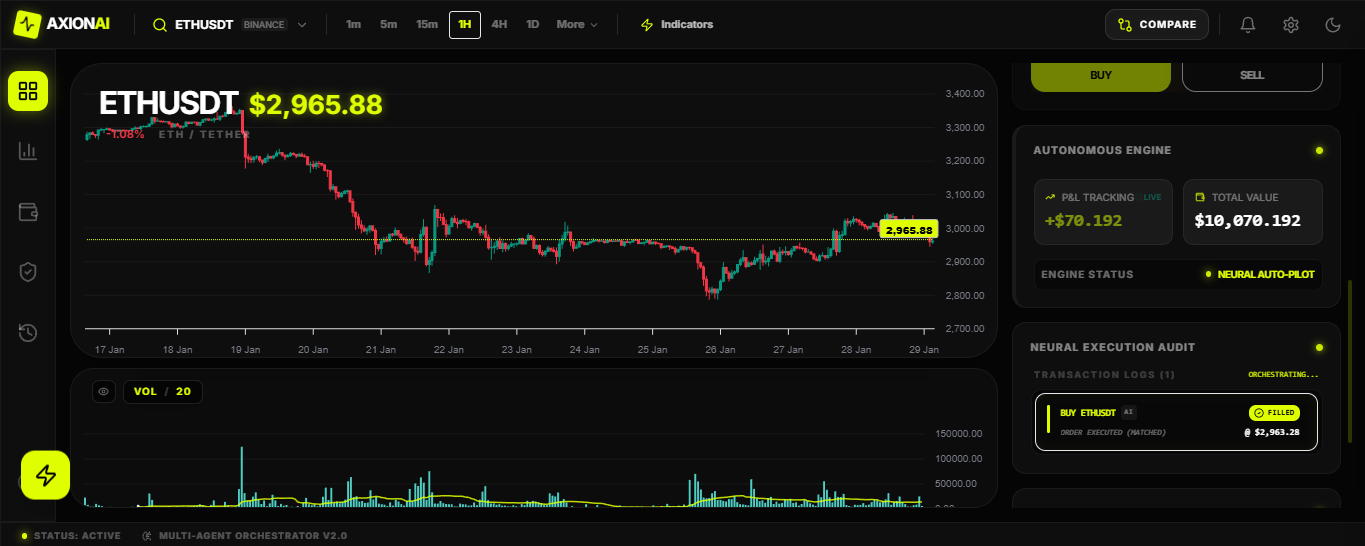
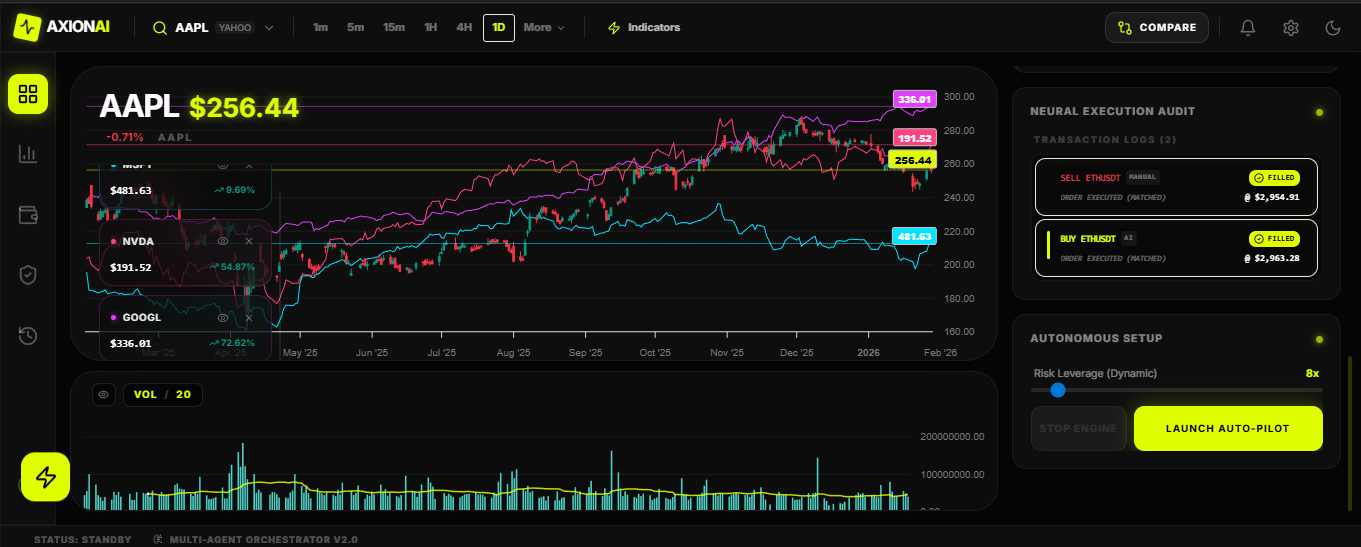
AXIONAI is not a conventional trading platform. It is an intelligent algorithmic command system, engineered to eliminate latency between analysis, decision, and execution. By combining a high-precision glassmorphic interface with a real-time data infrastructure, AXIONAI transforms raw market data into professional-grade execution decisions.
2. CORE ENGINE: LOW-LATENCY DATA INFRASTRUCTURE
Real-Time Data Fabric
- Optimized data pipelines leveraging a Stale-While-Revalidate caching strategy, ensuring instant chart rendering even during extreme market volatility.
Adaptive Timeframe Synchronization
- Automatic alignment of secondary charts with the primary timeframe, enabling frictionless multi-market and cross-asset analysis.
Advanced Neural Visualization
High-density rendering engine supporting:
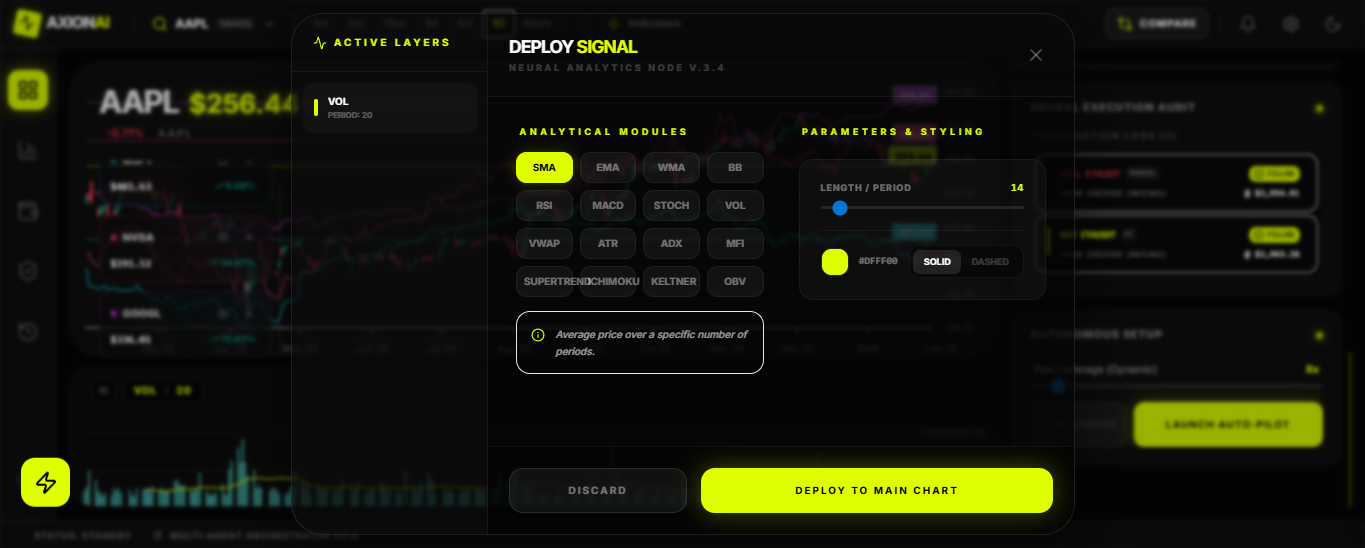
- 16+ simultaneous technical indicators
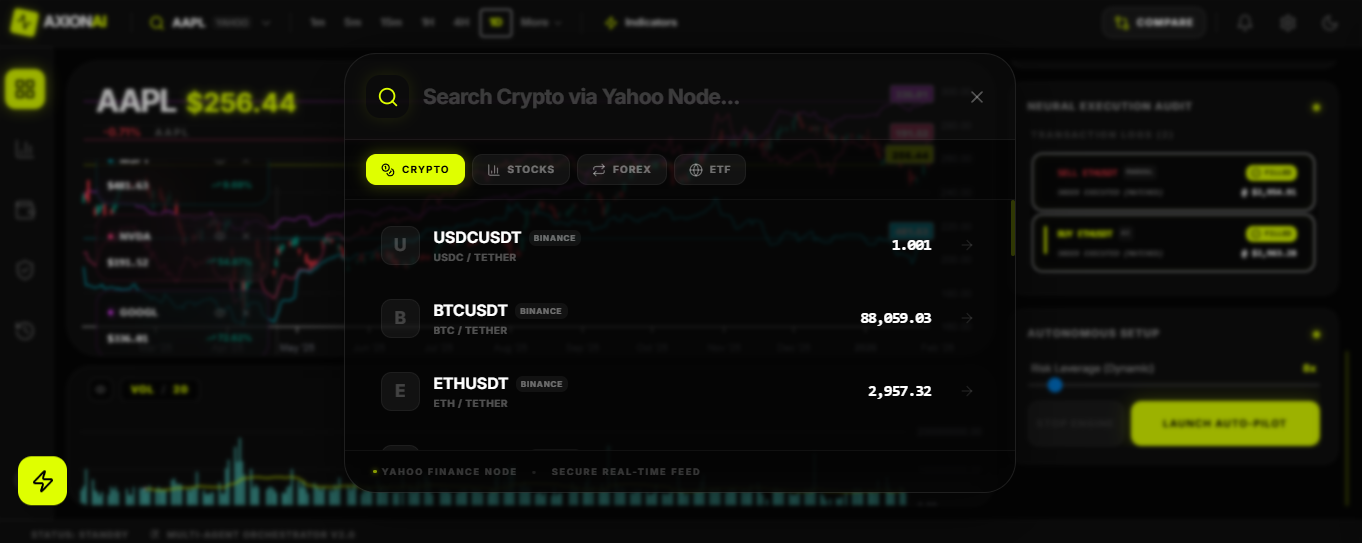
- Multi-asset comparisons (Crypto, Forex, Stocks, ETFs)
- Dynamic cross-symbol overlays
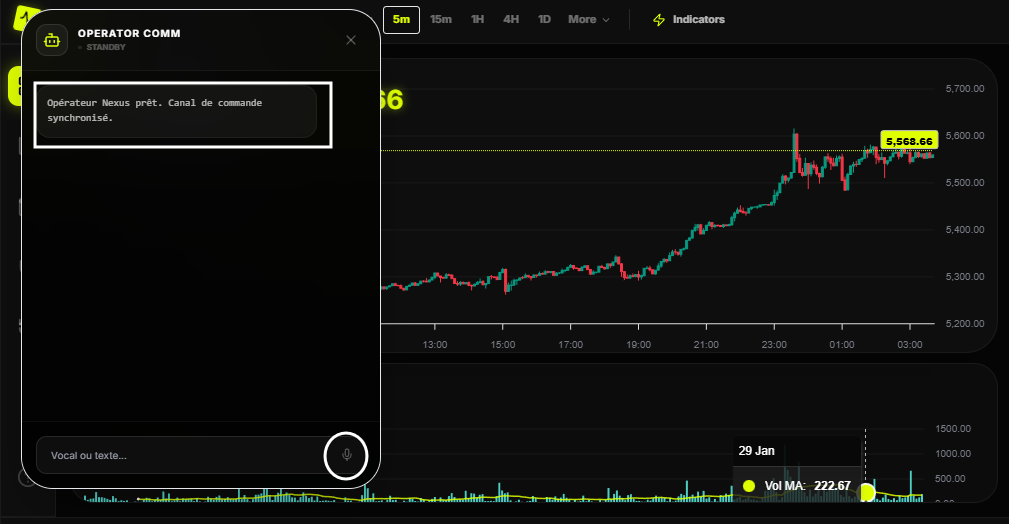
3. AXION OPERATOR: VOICE-DRIVEN AI INTERFACE
The AXION Operator functions as a real-time tactical co-pilot.
Voice-to-Action Control
Full cockpit control via natural voice commands:
- symbol switching
- indicator management
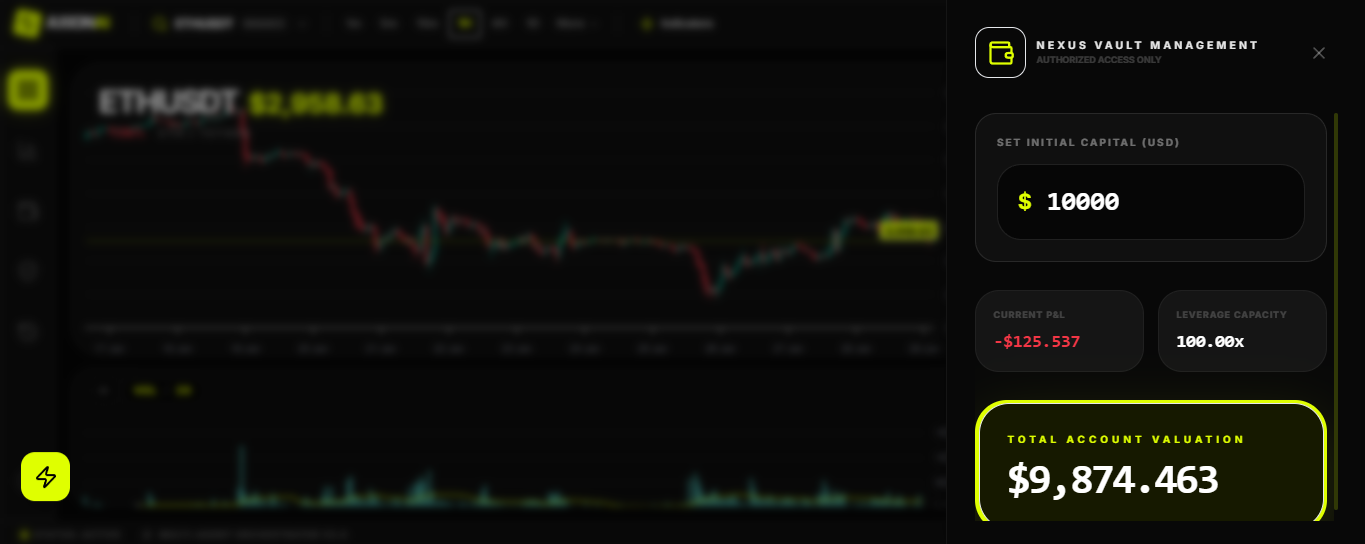
- portfolio access
- complex order execution
Direct UI Manipulation
- The AI directly modifies the interface without manual input.
Context-Aware Intelligence
- The operator analyzes the current chart state to deliver responses grounded in the user’s live visual market context.
4. MANO – MULTI-AGENT NEURAL ORCHESTRATOR
AXIONAI’s intelligence core is powered by a supervised multi-agent architecture, built on next-generation AI models, by using ADK (Agent development Kit)
Multi-Agent Trading System
With Chatbot Integration & Auto-Pilot Execution
1. Chatbot Integration (Inter-Operator Communication)
The Multi-Agent Trading System integrates a conversational Chatbot that acts as the human–system interface.
The system can:
- Request the chatbot to display a specific trading symbol
- Accept voice or text commands
The chatbot can:
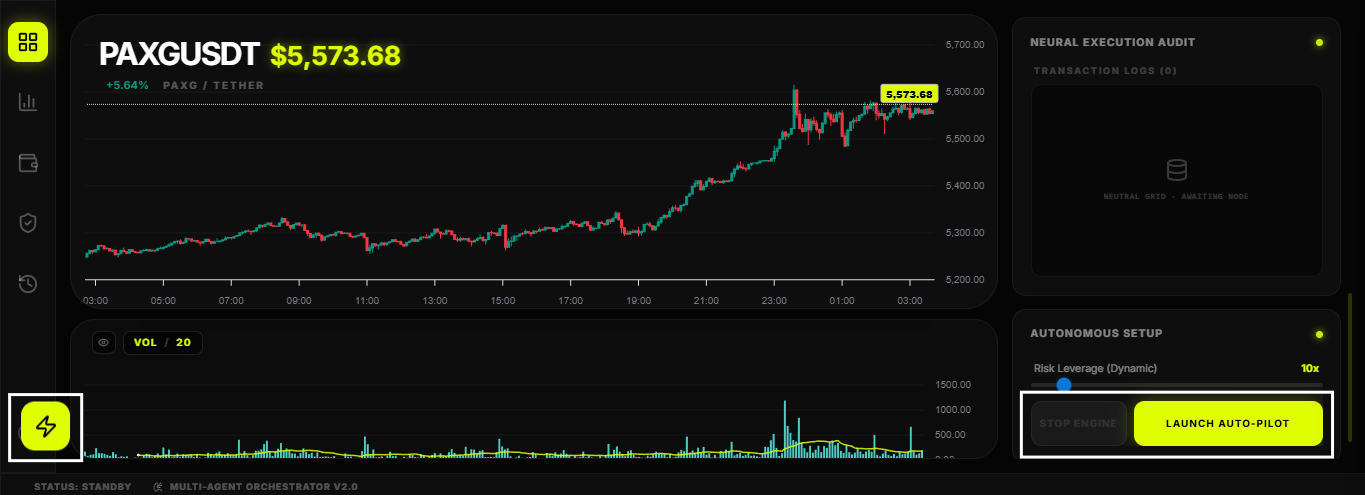
- Launch the trading engine via “Launch Auto-Pilot”
- Stop all operations via “Stop Engine”
- Trigger actions through spoken or written commands
2. Multi-Agent Architecture Overview
The system is composed of independent, specialized, and hierarchical agents acting autonomously as an AI operators.
Each agent has:
- A clearly defined role
- Explicit inputs and outputs
- Limited authority
- A defined priority within the workflow
⚠️ No agent is allowed to execute trades directly.
3. Global Orchestration
SupervisorAgent (Chief Orchestrator)
The SupervisorAgent is the only authority allowed to approve execution.
Responsibilities:
- Orchestrate execution order
- Aggregate agent outputs
- Resolve conflicts
- Enforce risk constraints
- Authorize or block any trade
- Assign a statistical confidence score to every action prior to execution
4. Mandatory Workflow (No Deviation Allowed)
- Market Regime Selection
- Macro & News Context Filtering
- Alpha Signal Generation
- Statistical Validation
- Risk Management Validation
- Portfolio Optimization
- Execution Decision
- Post-Trade Feedback Learning
5. Agent Definitions
AGENT 1 — MarketRegimeAgent
Determines the current market regime:
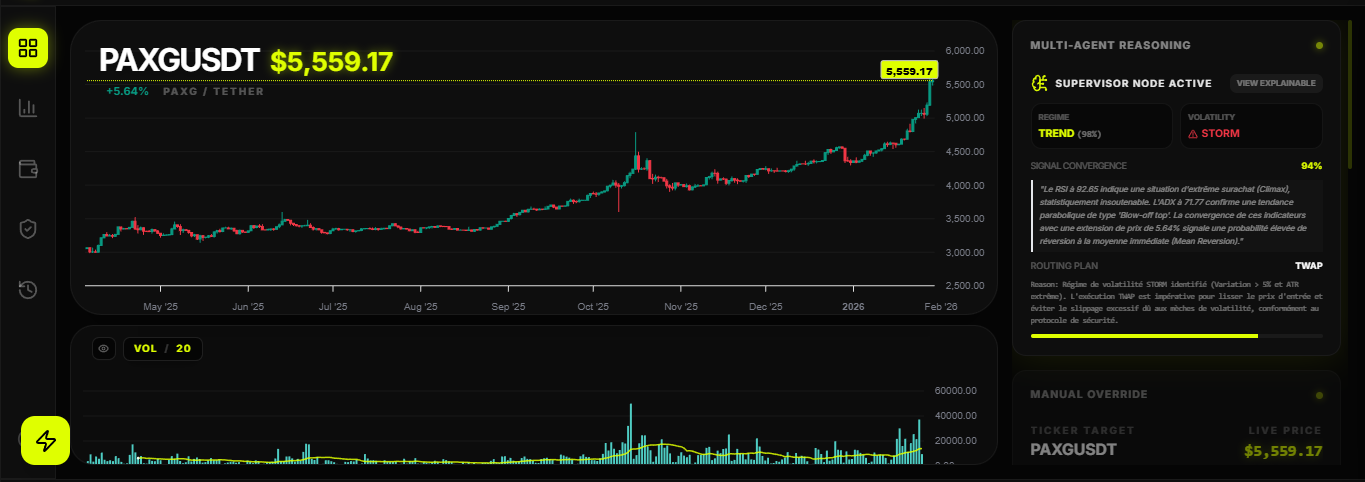
- TREND
- RANGE
AGENT 2 — AlphaEngineAgent
- Structural market analysis
- Uses Binance API and Yahoo Finance API
- Generates raw alpha signals
AGENT 3 — TechnicalSignalAgent
- Identifies alpha signals through multi-indicator convergence
- Adapts indicators based on market regime
AGENT 4 — StatisticalValidationAgent
Validates signals using:
- Z-Score
- Volume confirmation
Rejects statistically insignificant signals.
AGENT 5 — RiskManagementAgent
Dynamically computes:
- Value at Risk (VaR)
- Stop Loss
- Take Profit
- Volatility-adjusted exposure using ATR
- Final risk approval
AGENT 6 — SmartOrderRouterAgent (SOR)
Execution optimization using:
- TWAP
- VWAP
Designed to minimize slippage and market impact.
AGENT 7 — ExitEngineAgent
Manages exits using:
- Trailing Stops
- Fractals
- ATR-based exits
AGENT 8 — FeedbackLearningAgent
- Learns from executed trades
- Updates probabilities and allocations
- Only stateful agent in the system
6. Global Constraints
- No agent can execute trades directly
- Only the SupervisorAgent authorizes execution
- News and Risk agents have veto power
- Every decision must output an explainable JSON
- All agents are stateless except FeedbackLearningAgent
7. Orchestration Wiring
Phase A — Blocking Filters
Sentiment & systemic risk checks (now default phase, not fully functional)
Phase B — Strategy Selection
MarketRegimeAgent → TechnicalSignalAgent
Activates TREND or RANGE indicators
Phase C — Statistical Gatekeeper
TechnicalSignalAgent → StatisticalValidationAgent
Phase D — Risk Core
RiskManagementAgent ↔ PortfolioConstructorAgent
Adjusts position size based on correlation & VaR
8. JSON Communication Matrix
| From | To | Data | Impact |
|---|---|---|---|
| Sentiment | Supervisor | systemic_risk_flag | Veto |
| Regime | Technical | regime_type | Indicator selection |
| Technical | Statistical | trigger_price | Validation |
| Risk | Portfolio | max_loss_per_trade | Allocation |
| Execution | Broker | execution_plan | Orders |
9. Mathematical Modules (LaTeX)
Correlation Engine (30-Day Pearson)
\(\rho_{30} = \frac{\text{Cov}(X,Y)}{\sigma_X \sigma_Y}\)
Rules:
- If ( \rho > 0.80 ) → Capital divided by 2 (not yet fully functional as an operation)
- If ( \rho < 0 ) → Natural hedge enabled
Profit & Loss (P&L) with Leverage
1. Absolute P&L
\(\text{P&L} = (\text{Exit Price} - \text{Entry Price}) \times \text{Position Size} \times \text{Leverage}\)
Where:
- Entry Price = price at which the position is opened
- Exit Price = price at which the position is closed
- Position Size = number of units/contracts
- Leverage = leverage multiplier (e.g. 5×, 10×)
2. Direction-Aware P&L (Long / Short)
\(\text{P&L} = (\text{Exit Price} - \text{Entry Price}) \times \text{Position Size} \times \text{Leverage} \times D\)
Where: \( D = \begin{cases} +1 & \text{for a Long position} \ -1 & \text{for a Short position} \end{cases} \ \)
3. P&L as a Percentage of Capital
\(\ \text{P&L}_{\%} = \left( \frac{\text{Exit Price} - \text{Entry Price}}{\text{Entry Price}} \right) \times \text{Leverage} \times 100 \ \)
This shows how leverage amplifies gains and losses relative to the initial price movement.
4. P&L Relative to Initial Margin
\(\text{P&L}_{\text{margin}} = \frac{(\text{Exit Price} - \text{Entry Price}) \times \text{Position Size}} {\text{Initial Margin}} \) With:
\(\text{Initial Margin} = \frac{\text{Position Value}}{\text{Leverage}}\)
5. Net P&L (Including Fees & Funding)
\(\text{Net P&L} = \text{Gross P&L}\)
- \(\text{Trading Fees}\)
- \(\text{Funding Costs}\)
Fractional Kelly Criterion (Half-Kelly)
\(f = \frac{p \times b - q}{b}\)
Where:
- ( p ) = probability of win
- ( q = 1 - p )
- ( b ) = reward-to-risk ratio
Final allocation: \(f_{final} = 0.5 \times f\)
Value at Risk (VaR)
\(VaR_{\alpha} = Z_{\alpha} \cdot \sigma \cdot \sqrt{t}\)
Constraint: \(VaR_{global} > 3% \Rightarrow \text{Reject new trades}\)
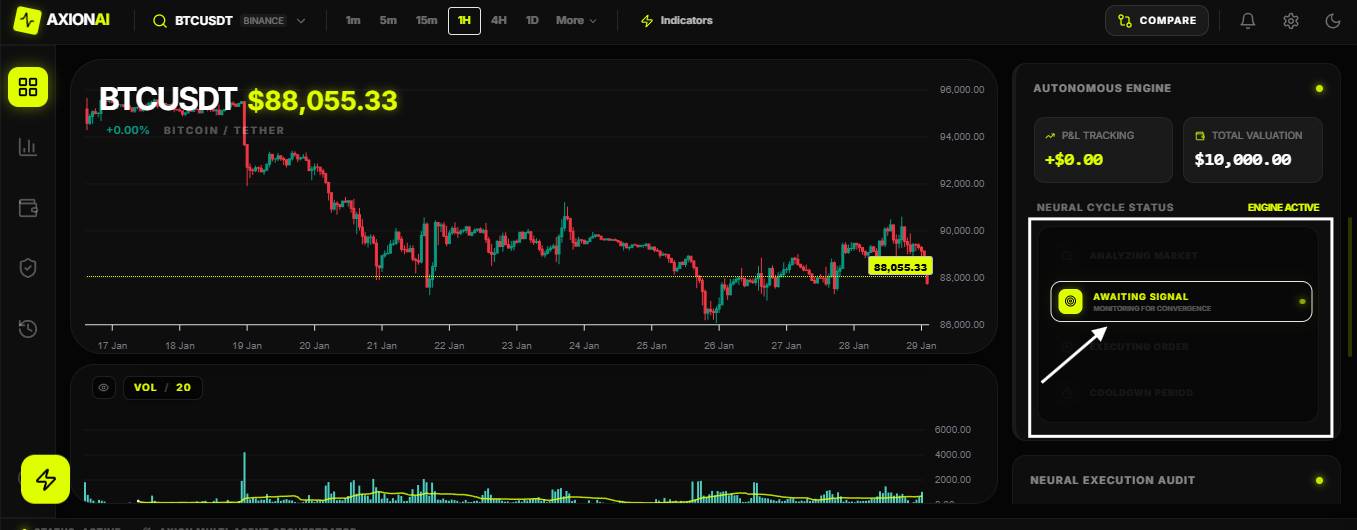
12. Auto-Pilot Logic
When “Launch Auto-Pilot” is triggered:
- Symbol selection
- Full multi-agent analysis
- Risk & statistical validation
- Automatic BUY
- Position monitoring
- Automatic SELL
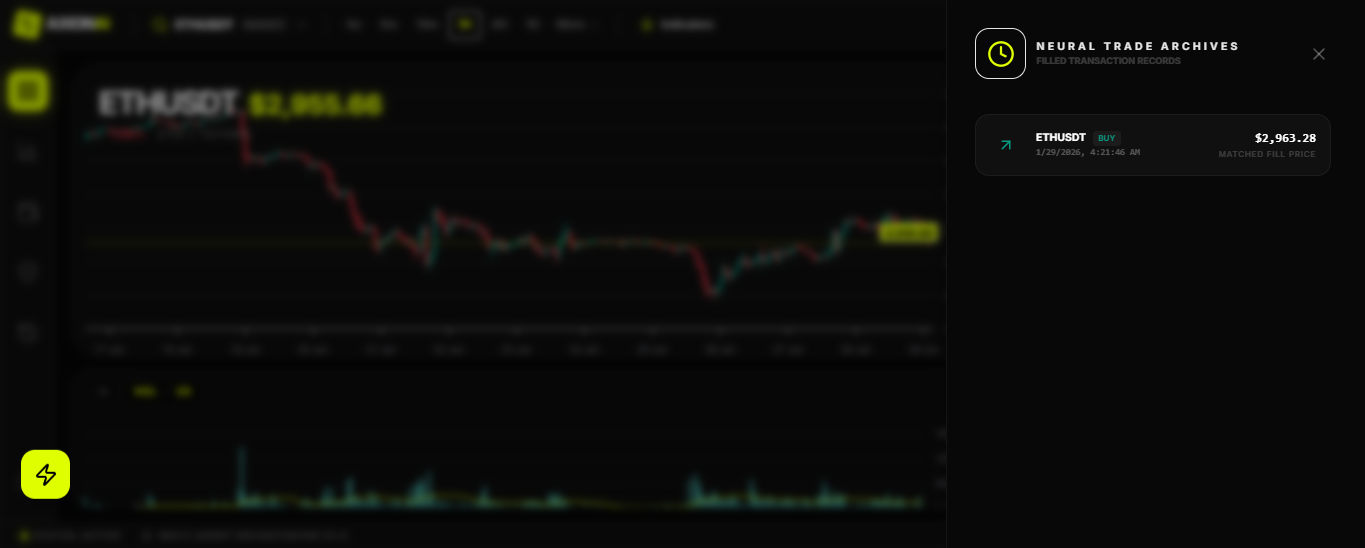
- Audit logging
- Feedback learning
- New cycle begins
- Final validation agent assigning a statistical confidence score to every action prior to execution.
5. AUTO-PILOT: CONTROLLED AUTONOMY
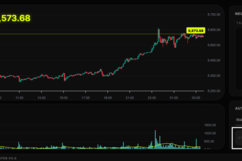
Neural Trading Engine
Cyclic execution engine managing:
- analysis
- decision
- execution
- cooldown phases
Built-in protection against over-trading.
Storm Mode Detection
- Automatic detection of abnormal volatility regimes.
- Auto-Pilot restriction or deactivation during market “storm” conditions.
Transparent Audit Trail
- Every micro-decision is logged in a permanent audit system, ensuring full algorithmic traceability.
6. ANALYTICS & MATHEMATICAL ARCHITECTURE
During execution, AXIONAI continuously processes an advanced mathematical pipeline:
Market Regime Analytics
- ADX and Z-Score calculations to distinguish trending markets from ranging conditions.
Capital Allocation (Kelly-Based Model) (not fully functional)
- Adaptive Kelly fraction modeling to optimize position sizing relative to portfolio equity.
Dynamic Volatility Control
Continuous ATR calculations to dynamically adjust:
- leverage (up to 100x)
- risk exposure
Signal Convergence Engine
- EMA crossover detection (Golden / Death Cross)
Combined with momentum oscillators:
- RSI
- MFI
- Stochastic
CONCLUSION
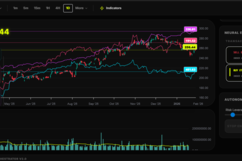
AXIONAI redefines the relationship between trader and machine:
- humans define strategic intent,
- AI orchestrates analysis and execution,
- technology eliminates operational error.
AXIONAI — Built for Precision. Designed for Execution. Ready for Launch.
Difficulties encountered: Unstable internet access and frequent power outages.
Built With
- aistudio
- typscript

Log in or sign up for Devpost to join the conversation.