-
-
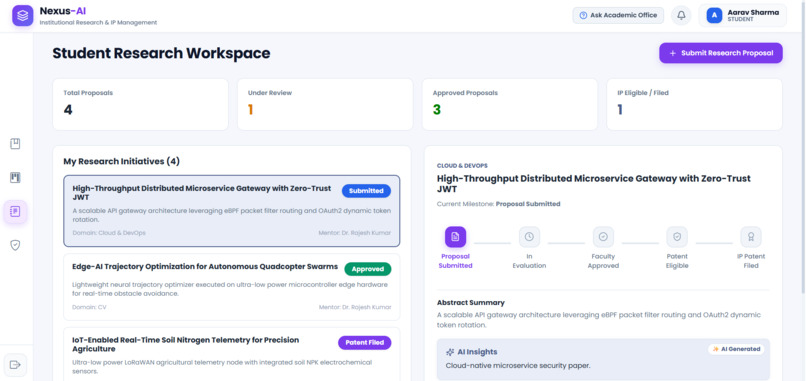
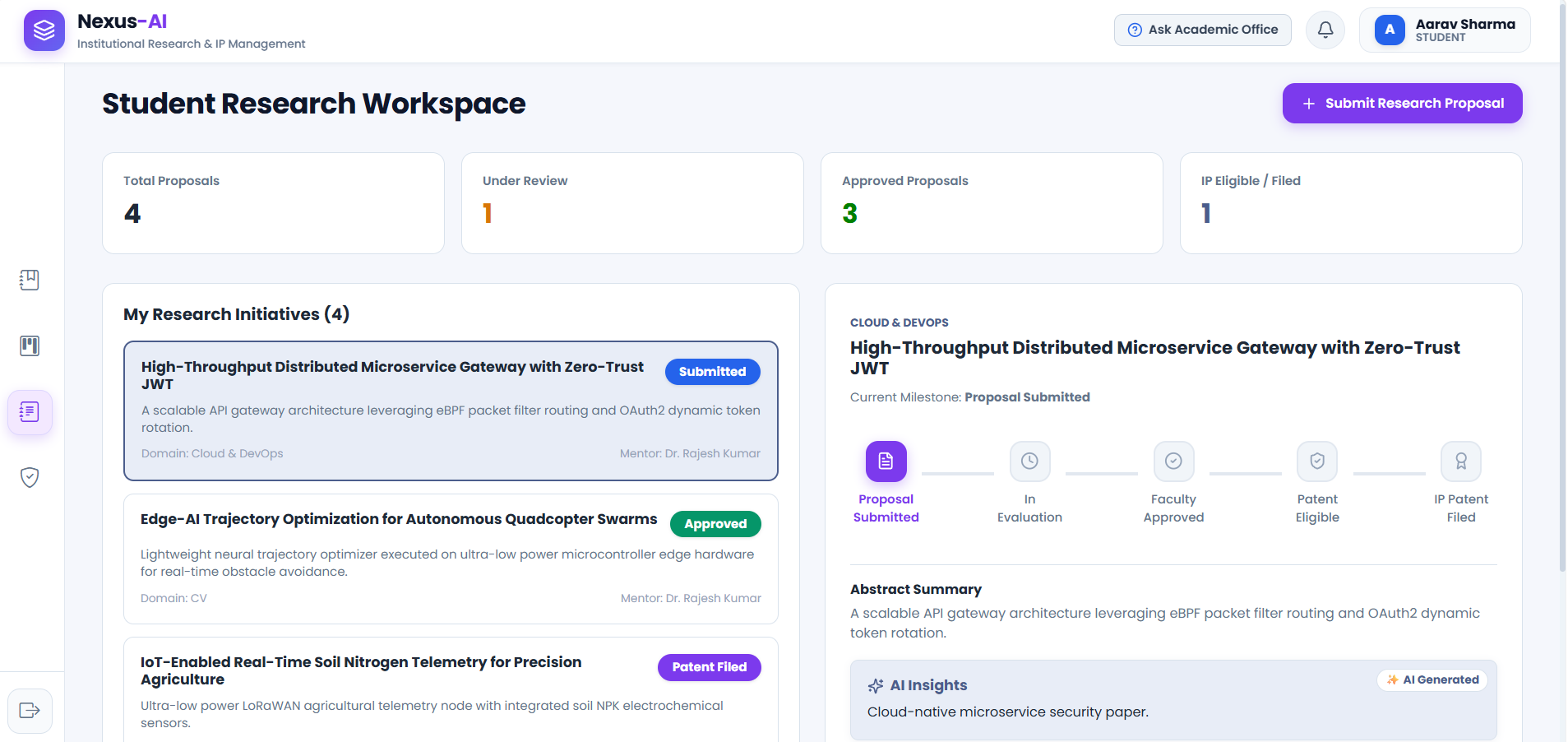
Student dashboard to submit, track, and monitor research proposals through review to patent filing.
Inspiration
Every semester, universities generate genuinely valuable student research—but it lives in scattered spreadsheets, email threads, and disconnected folders. Promising inventions get buried, delayed, or simply lost the moment a student graduates. We wanted to build the system that should have existed already: one place that tracks a project from first idea to filed patent.
What it does
Nexus-AI manages the full academic research lifecycle in one platform: topic selection, faculty allocation, weekly progress tracking, AI-powered novelty analysis, evaluation, and patent filing. A project moves through a defined state machine—SUBMITTED → UNDER_REVIEW → APPROVED → READY_FOR_IP → IP_FILED—so nothing advances without the right review, and nothing gets lost in between.
How we built it
The hardest problem wasn’t any single feature—it was making them work together. We had to design a multi-role workflow secure enough for four different user types, enforce milestone transitions that can’t be skipped or reversed incorrectly, and fit AI analysis into a process that still needs a human to make the final call. Tying academic evaluation to institutional IP filing meant two workflows that are normally handled by entirely separate offices had to share one data model.
Challenges we ran into
The hardest problem wasn’t any single feature—it was making them work together. We had to design a multi-role workflow secure enough for four different user types, enforce milestone transitions that can’t be skipped or reversed incorrectly, and fit AI analysis into a process that still needs a human to make the final call. Tying academic evaluation to institutional IP filing meant two workflows that are normally handled by entirely separate offices had to share one data model.
Accomplishments that we're proud of
We shipped an end-to-end platform that connects students, faculty mentors, academic administration, and IP officers in a single workflow—turning what used to be fragmented, manual coordination into a structured, auditable pipeline. Seeing a project move cleanly from submission to IP-ready status, with every role’s part of the handoff enforced by the system itself, was the moment it felt real.
What we learned
We came out of this with hands-on experience designing enterprise-grade RBAC, building reliable state-based workflows, and integrating AI into a process where accuracy and trust actually matter—not just a demo. It also pushed us to think about full-stack architecture at a scale beyond a typical hackathon project.
What's next for Nexus-AI
Our roadmap: live integration with global patent databases, stronger AI prior-art analysis, automated patent-draft generation, analytics dashboards for academic administrators, and a path to institution-wide deployment. Each of these moves Nexus-AI closer to its real goal—helping universities capture and commercialize the IP they’re already creating.

Log in or sign up for Devpost to join the conversation.