-
-
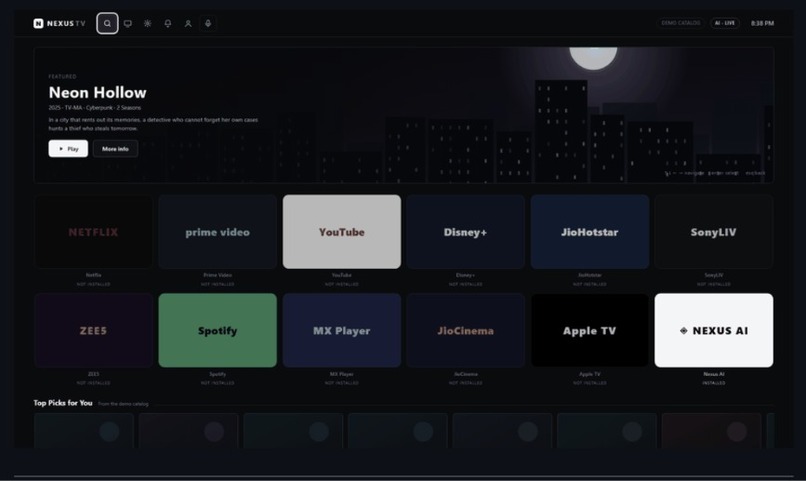
HOME PAGE
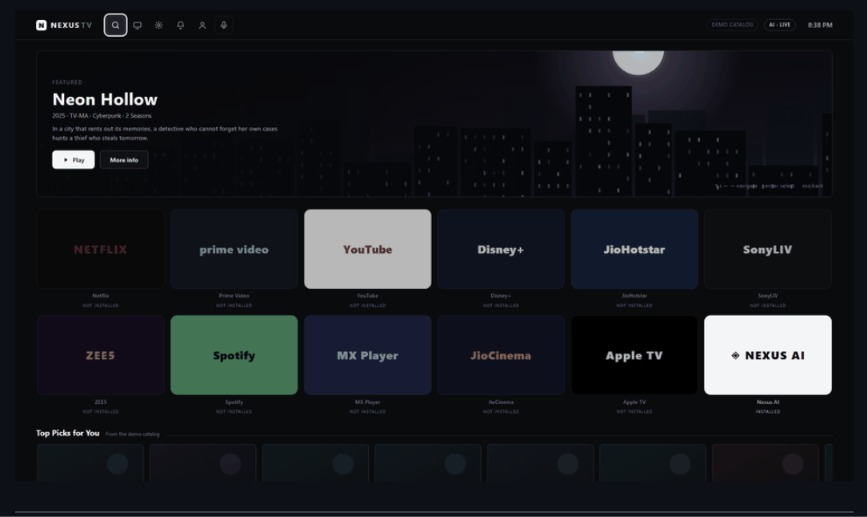
Inspiration
We were inspired by the idea of making television more intelligent, personalized, and intuitive. Traditional TV interfaces often require users to navigate through multiple applications and endless rows of content to find something to watch. We wanted to explore a better experience: a futuristic smart-TV interface that combines entertainment discovery with AI-powered assistance.
This vision led to NEXUS TV, a project focused on making television feel more interactive, intelligent, and user-friendly.
What it does
NEXUS TV is an AI-powered smart-TV application concept designed primarily for Amazon Fire TV. It aims to combine entertainment discovery and intelligent assistance in a single interface.
Our planned features include:
Futuristic TV Interface: A clean, cinematic home screen designed for large displays. Smart Content Discovery: Organized content sections for exploring movies and shows. AI Assistant: A conversational interface for natural-language entertainment recommendations. Watchlist: A convenient way to organize content users want to watch. Remote-Friendly Navigation: An interface designed for directional navigation and selection using a TV remote.
How we built it
We used OpenCode for AI-assisted development and focused on designing a television-first interface with a clear, modular structure. Our design direction emphasizes a cinematic banner, an application launcher, horizontal content rows, and layouts suitable for large screens.
We also considered how AI services such as Amazon Bedrock could support natural-language discovery and recommendations. Further integration and platform testing remain important next steps.
Because we joined the hackathon late, we had less time than anticipated to implement, test, and polish every feature. We prioritized establishing the product direction and core interface rather than claiming functionality that we had not fully verified.
Challenges we ran into
Our biggest challenge was time. We joined the hackathon late and had a limited window to understand the requirements, develop the application, and prepare a submission.
We also faced the challenge of balancing a futuristic visual design with the simplicity expected from a real television interface. Our initial design was too visually busy, so we refined the direction toward a cleaner smart-TV launcher.
Another challenge was distinguishing a visual prototype from a fully functional Fire TV application. Platform compatibility, remote-control navigation, and AI integration all require proper implementation and testing.
As a result, we were unable to complete every feature we originally envisioned within the available time.
Accomplishments that we're proud of
Despite the limited time, we established a clear vision for NEXUS TV and developed a design direction for a more intelligent television experience.
We identified the key elements of our intended interface, including a cinematic home screen, application launcher, content discovery rows, and an accessible AI assistant.
We also learned to prioritize the essential parts of a product, recognize technical dependencies, and distinguish planned functionality from features that have been fully implemented and tested.
We see this submission as an important starting point for a project we want to continue improving.
What we learned
This experience taught us the importance of starting early, understanding platform requirements before implementation, and building a minimum viable product before adding advanced features.
We learned that television applications require careful attention to remote-control navigation, screen readability, performance, and platform compatibility. We also learned that AI-assisted development can accelerate prototyping, but working integrations still need to be implemented and verified.
Most importantly, we learned to manage time realistically and communicate our progress honestly.
What's next for NEXUS TV
Our next goal is to continue developing NEXUS TV beyond the hackathon. We plan to complete the core application, implement and test remote-control navigation, add a persistent watchlist, and integrate a genuine AI service for entertainment discovery.
We also intend to validate the application in a compatible Fire TV development environment, improve its reliability, and investigate support for other television platforms.
Although we could not complete every planned feature before the deadline, our vision remains the same: to create a more intelligent, personalized, and intuitive television experience.


Log in or sign up for Devpost to join the conversation.