-
-
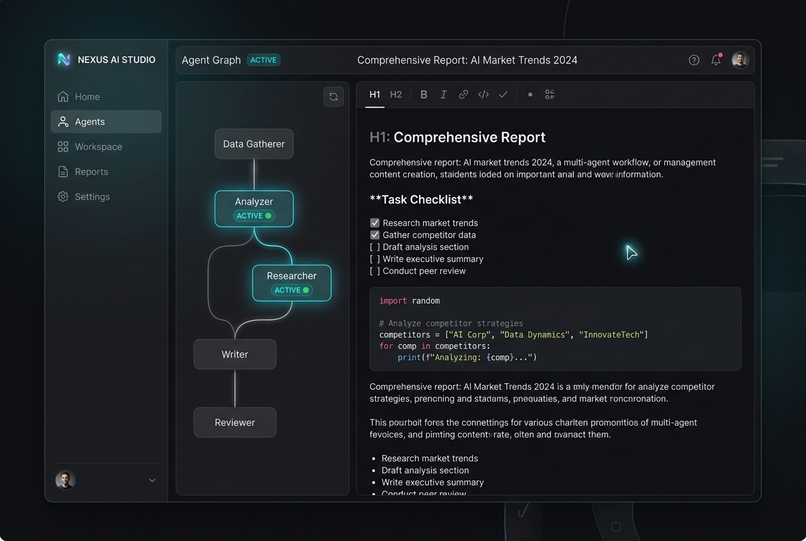
Nexus AI Studio Workspace — Interactive Autonomous Agent Graph Canvas & Master Blueprint Editor
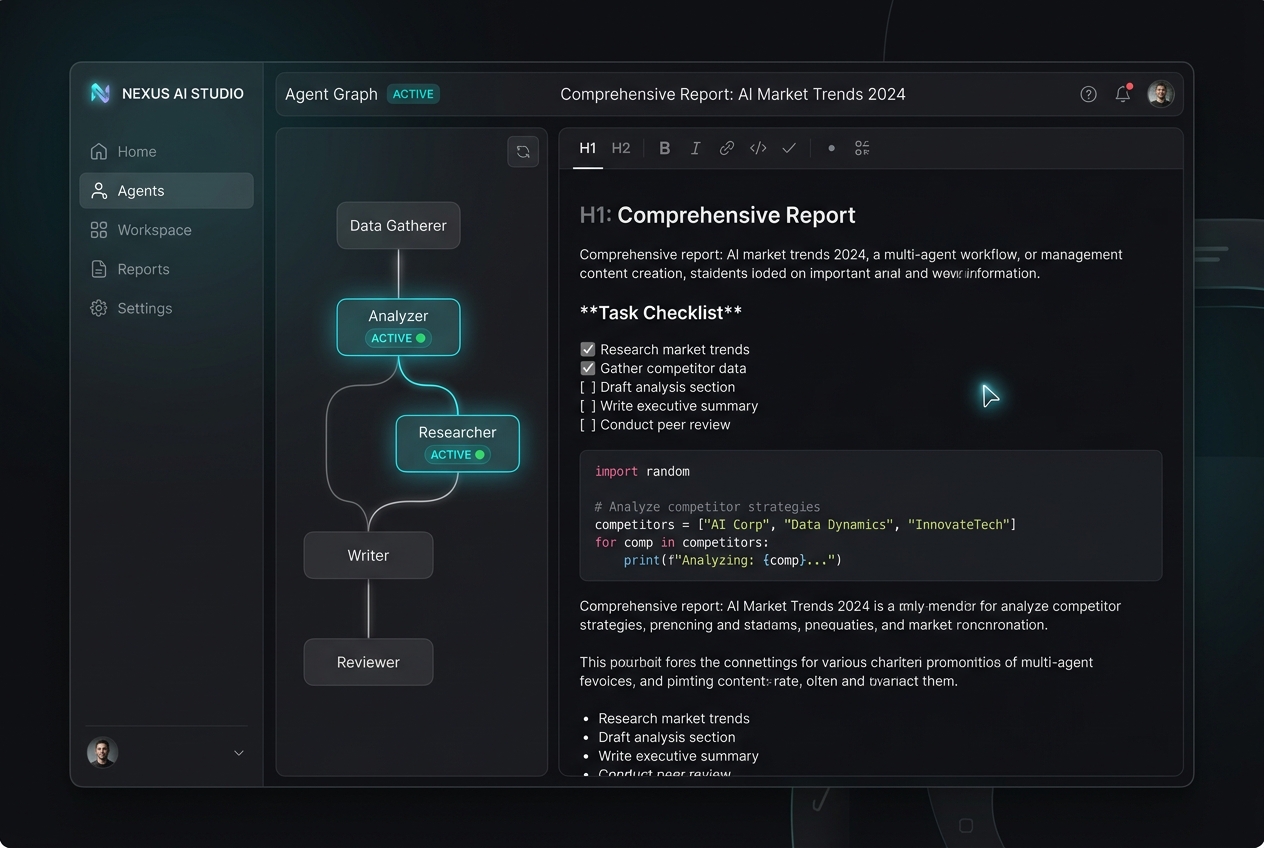
Inspiration
In work, research, education, and daily productivity, people constantly encounter complex real-world objectives — whether designing a distributed system architecture, launching a sustainable brand, mastering a 4-week quantum computing curriculum, or structuring a progressive fitness routine.
Translating a high-level goal into actionable technical blueprints, implementation code, operational checklists, and risk matrices usually takes hours of tedious manual research across fragmented tools. We were inspired to build Nexus AI to bridge this gap: an autonomous copilot that transforms natural language goals into structured multi-agent execution graphs and instant production deliverables.
What it does
Nexus AI is an autonomous multi-agent workflow engine and intelligent copilot. When a user inputs any natural language goal or selects a domain preset, Nexus AI:
- Decomposes Goals: Spawns an execution graph of 4 specialized autonomous agents:
- 🎯 System Planner: Analyzes goal scope, KPIs, and intent constraints.
- 💻 Domain Architect: Models technical/domain architecture and data flows.
- ⚡ Implementation Agent: Drafts concrete code templates and tactical execution plans.
- 🏆 Executive Synthesizer: Compiles the unified Master Deliverable.
- Streams Visual Reasoning: Animates real-time agent execution status on an interactive canvas graph.
- Generates Production Artifacts:
- Master Blueprint: Markdown document featuring technical specifications and risk matrix tables.
- Action Matrix: Operational task checklist with real-time checkmark toggle states.
- Architecture Flow: Mermaid workflow diagram code.
- Delivers Hands-Free Audio Briefings: Uses Web Speech API synthesis to narrate an executive summary for rapid team alignment.
- Operates in Hybrid AI Mode: Features a 100% zero-config offline reasoning engine for instant judging, plus REST integration for live Google Gemini 1.5 Flash API keys.
How we built it
- Frontend Core: Built with React 18, Vite, and a custom Vanilla CSS Design System utilizing obsidian slate dark themes (
#07090e), HSL color tokens, typography (Plus Jakarta Sans & JetBrains Mono), glassmorphic depth panels, and fully responsive layouts. - AI Processing Engine: Built a dual-layer hybrid architecture featuring an offline autonomous reasoning synthesizer alongside direct REST API endpoints for Google Gemini models.
- Interactive UI Components: Custom execution graph canvas, Marked.js live renderer, task state coordinator, and HTML5 Web Speech Synthesis API.
Challenges we ran into
- Latency & Streaming Alignment: Ensuring that visual multi-agent graph nodes stream status updates smoothly without locking the main browser looper thread.
- Zero-Setup Friction vs. Live LLM Integration: Designing a robust offline knowledge synthesizer so judges can evaluate the full application instantly without needing external API keys, while retaining live LLM API support for custom keys.
Accomplishments that we're proud of
- End-to-End Functionality: Delivering a fully interactive system that turns raw prompts into code, checklists, diagrams, and spoken audio briefings in seconds.
- Zero-Cliché Modern UX: Crafting a clean obsidian glassmorphic interface built strictly with Vanilla CSS tokens without relying on heavy framework bloat.
- Open-Source Standard: Fully compliant open-source repository with an explicit MIT License and documentation package.
What we learned
- How to structure modular multi-agent prompt graphs to decompose high-level user intent into distinct tactical roles.
- Best practices for combining Web Speech API synthesis with interactive state management in React.
What's next for Nexus AI
- Integrating vector database RAG memory for custom document uploads.
- Adding a visual drag-and-drop agent graph builder for custom multi-agent workflows.
- Syncing team workspaces with multi-user collaboration tools.
Built With
- artificial-intelligence
- css3
- google-gemini
- html5
- javascript
- markdown
- react
- vite
- web-speech-api


Log in or sign up for Devpost to join the conversation.