-
-
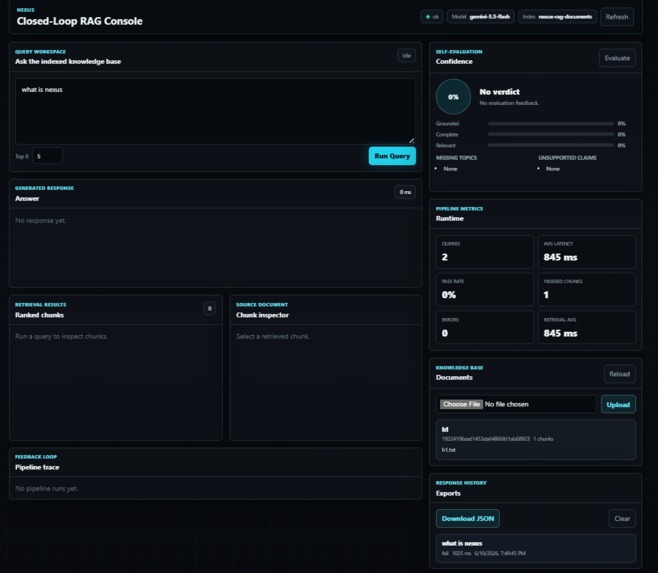
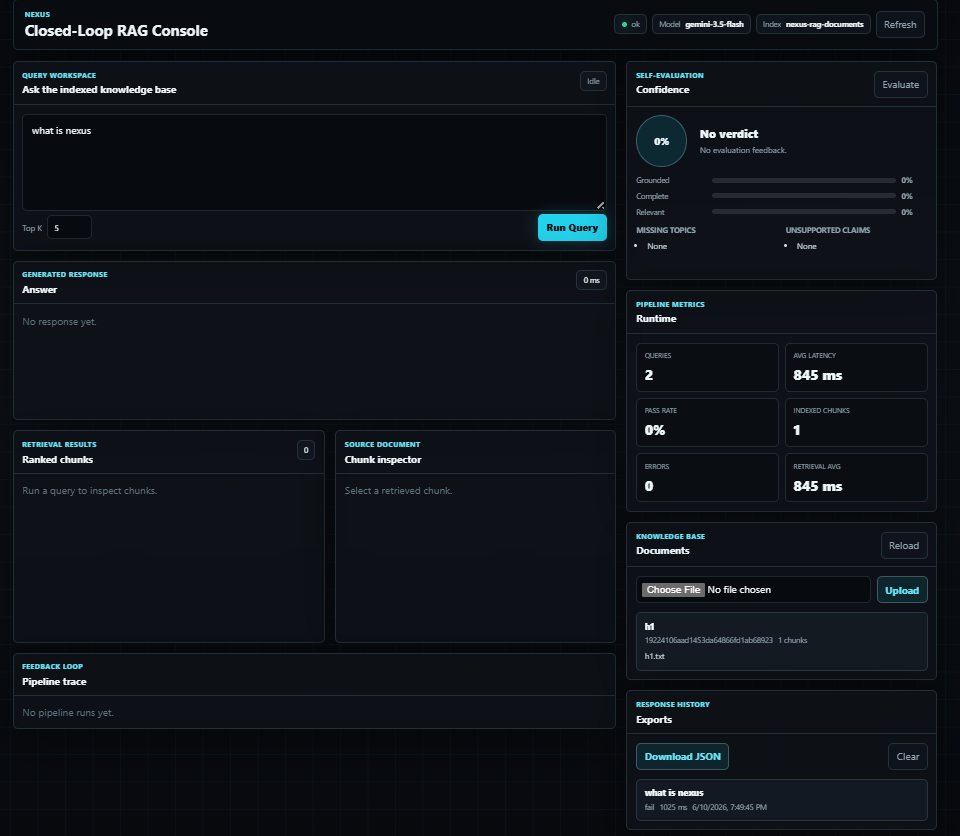
nexus rag_pipeline frontend
Inspiration
As AI and Large Language Models (LLMs) become more widely used, we noticed that they can sometimes generate incorrect information with high confidence. While Retrieval-Augmented Generation (RAG) improves accuracy by retrieving external information, many existing RAG systems still struggle with irrelevant documents, poor context quality, and hallucinations.
This inspired us to build Nexus, a closed-loop RAG pipeline that can evaluate its own responses, identify weaknesses, retrieve better information, and continuously improve the quality of its answers. Our goal was to create a more reliable and trustworthy AI system for real-world applications.
What it does
Nexus is a self-evaluating RAG system designed to improve the reliability and accuracy of AI-generated responses.
The system:
- Retrieves relevant information from a knowledge base.
- Generates an initial response.
- Evaluates the factual accuracy and relevance of the response.
- Identifies missing or weak evidence.
- Performs corrective retrieval when necessary.
- Produces a refined and more trustworthy final answer.
This closed-loop process helps reduce hallucinations and ensures that responses remain grounded in verified information.
How we built it
We built Nexus using a modular architecture consisting of:
- A retrieval layer powered by vector search and document indexing.
- An optimization agent that manages the retrieval and evaluation workflow.
- A self-evaluation module inspired by Self-RAG and Corrective RAG concepts.
- Elastic MCP (Model Context Protocol) to enable secure and standardized communication between AI agents and enterprise data sources.
- Evaluation metrics such as Context Relevance, Groundedness, and Answer Relevance.
Elastic MCP acts as the bridge between the language model and external knowledge systems. Instead of creating custom integrations for every data source, MCP provides a standardized interface that allows the agent to securely access documents, databases, and enterprise resources. This makes the system more scalable, maintainable, and easier to extend.
The system continuously checks whether generated responses are supported by retrieved evidence before presenting them to the user.
Challenges we ran into
One of the biggest challenges was ensuring that retrieved documents were truly relevant to the user's query. Sometimes the retriever returned partially related information, which affected response quality.
Another challenge was implementing reliable evaluation metrics. Measuring answer quality automatically is difficult because multiple responses can be correct while varying in clarity and completeness.
We also faced challenges in designing an efficient feedback loop that improved answers without causing excessive retrieval cycles, increased latency, or unnecessary computational costs.
Accomplishments that we're proud of
- Successfully designed and implemented a complete closed-loop RAG architecture.
- Integrated Elastic MCP to standardize communication between AI agents and enterprise knowledge sources.
- Implemented self-evaluation and corrective retrieval mechanisms.
- Reduced hallucinated responses through iterative feedback loops.
- Built measurable evaluation metrics instead of relying solely on subjective judgments.
- Developed a scalable architecture that can be extended to enterprise applications.
What we learned
Through this project, we learned that retrieval alone is not enough to guarantee accurate AI responses. Reliable AI systems require continuous evaluation, feedback mechanisms, and high-quality context.
We also gained hands-on experience with:
- Retrieval-Augmented Generation (RAG)
- Agent-based AI workflows
- Elastic MCP and standardized AI-to-data communication
- Enterprise search and retrieval systems
- LLM evaluation frameworks
- System architecture and workflow design
One of our key takeaways was understanding how MCP simplifies the integration of AI systems with multiple enterprise tools while maintaining security, scalability, and maintainability.
What's next for Nexus: A Closed-Loop RAG Pipeline
In the future, we plan to:
- Expand Elastic MCP integrations to support additional enterprise platforms.
- Add support for multiple vector databases and knowledge repositories.
- Implement multi-agent collaboration for more advanced reasoning tasks.
- Introduce real-time monitoring and analytics dashboards.
- Improve evaluation accuracy using advanced techniques such as G-Eval.
- Deploy Nexus as a cloud-native platform for enterprise environments.
- Explore autonomous learning mechanisms that allow the system to improve through user feedback over time.
Our long-term goal is to make Nexus a reliable AI assistant framework that combines closed-loop reasoning, self-evaluation, and Elastic MCP-powered enterprise connectivity to deliver accurate, explainable, and trustworthy AI responses.
Built With
- ai-agents
- corrective-rag-(crag)
- elastic-mcp-server
- elasticsearch
- enterprise-search
- g-eval
- https://nexus-rag-pipeline.onrender.com/app
- javascript
- json-rpc-2.0
- large-language-models-(llms)
- model-context-protocol-(mcp)
- python
- rest
- retrieval-augmented-generation-(rag)
- self-rag
- vector-search


Log in or sign up for Devpost to join the conversation.