Inspiration
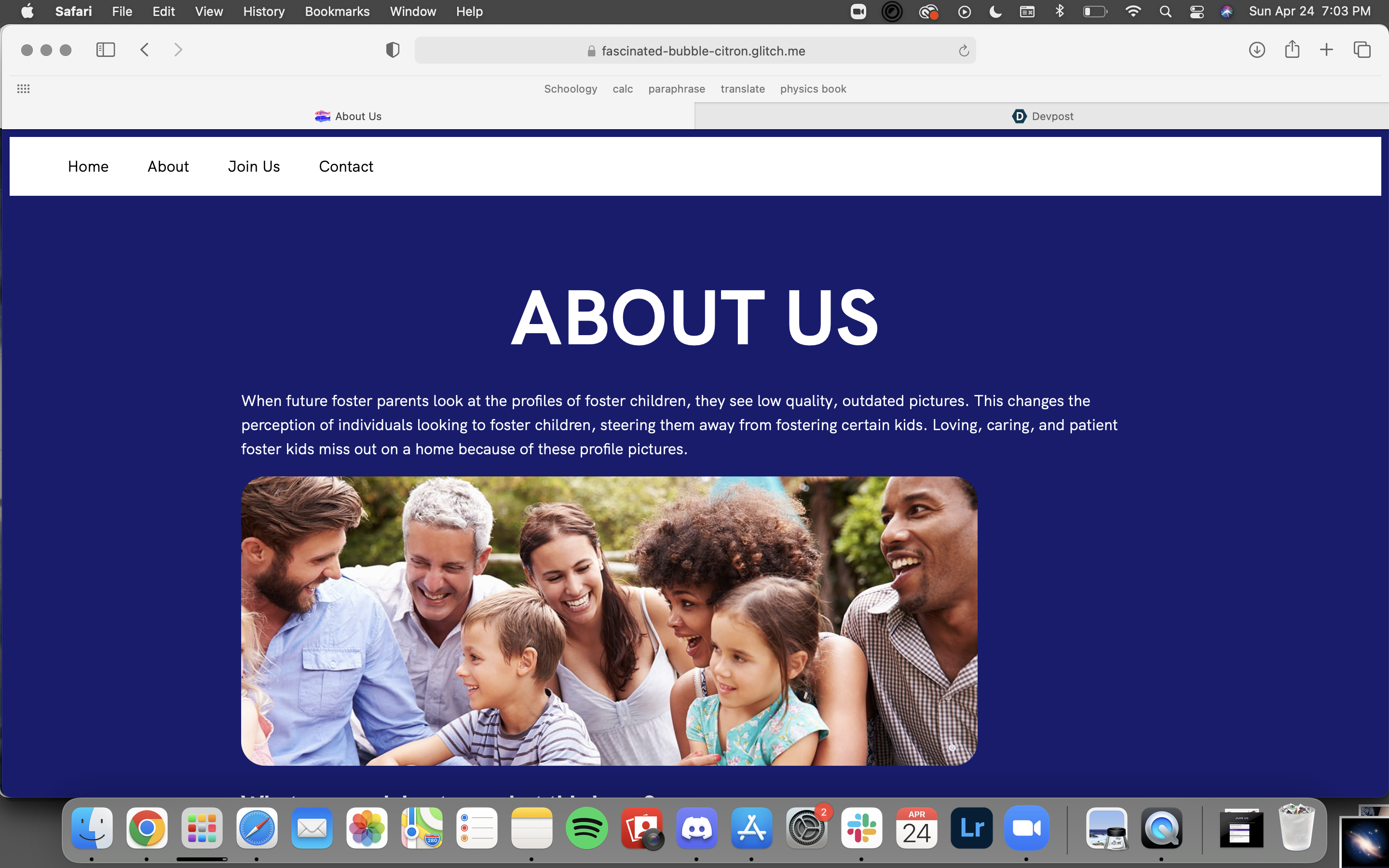
Foster kids around the world are looking for a forever home - parents who are willing to take them in and support them for the rest of their lives. A common way parents scout out potential foster kids is by looking at hundreds of profiles on online databases of local foster homes. Often, a child's profile or profile photo is a make-or-break decision for many parents looking for a child to support forever. Many current online databases don't stress the importance of high-quality profile images, displaying pictures that are low-quality, out-of-date, or don't properly capture the persona of a foster child. This issue is pervasive yet has gone unaddressed due to its lack of perceived importance.
What it does
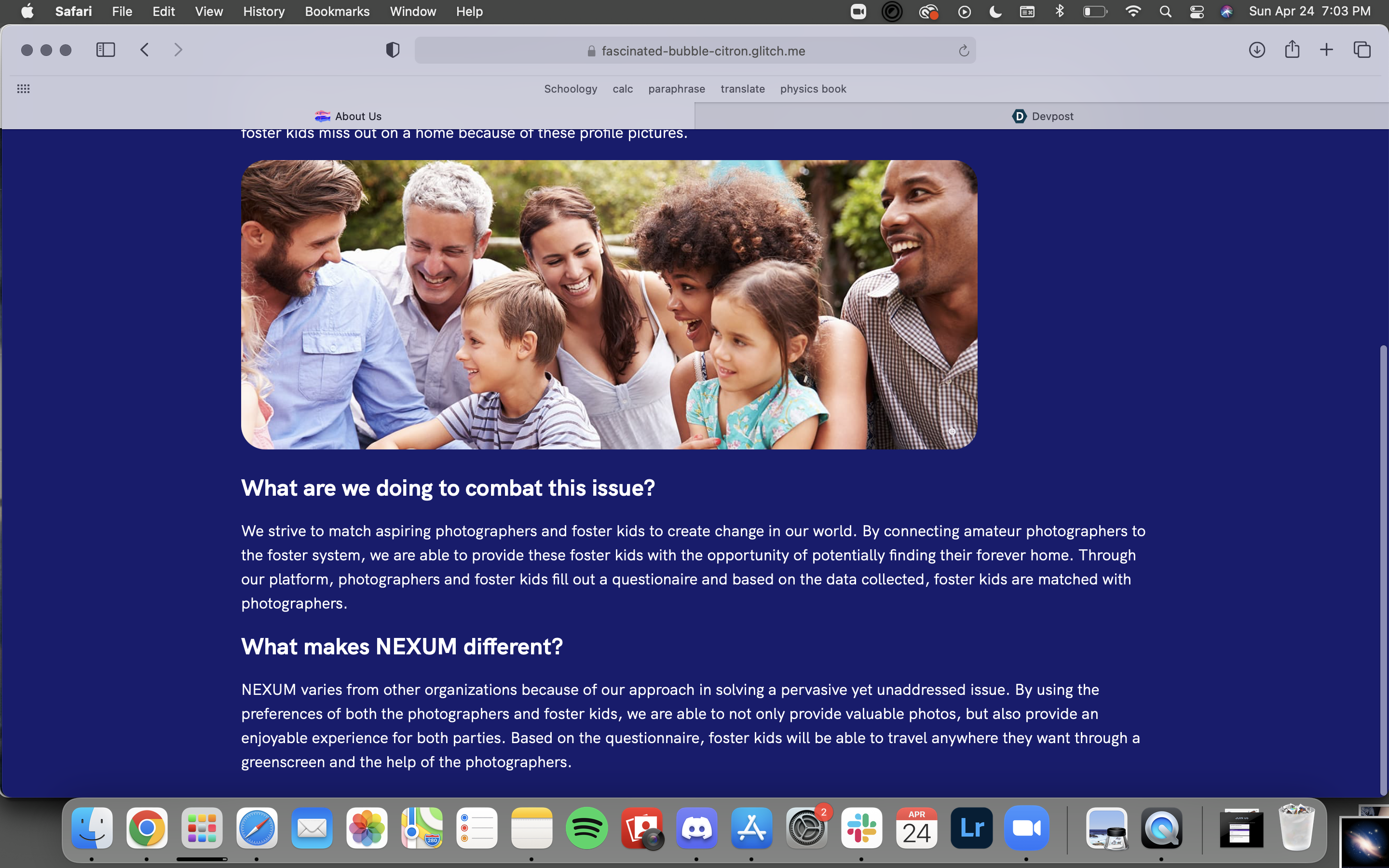
NEXUM is an application that connects foster kids with aspiring local photographers according to their needs. These photographers will help keep the profiles of foster kids regularly updated for potential foster parents by taking high-quality photographs of them periodically. Each foster child has the opportunity to connect with a lifelong photographer mentor, which will not only provide them with much-needed stability in their lives but also help them more effectively connect with potential parents.
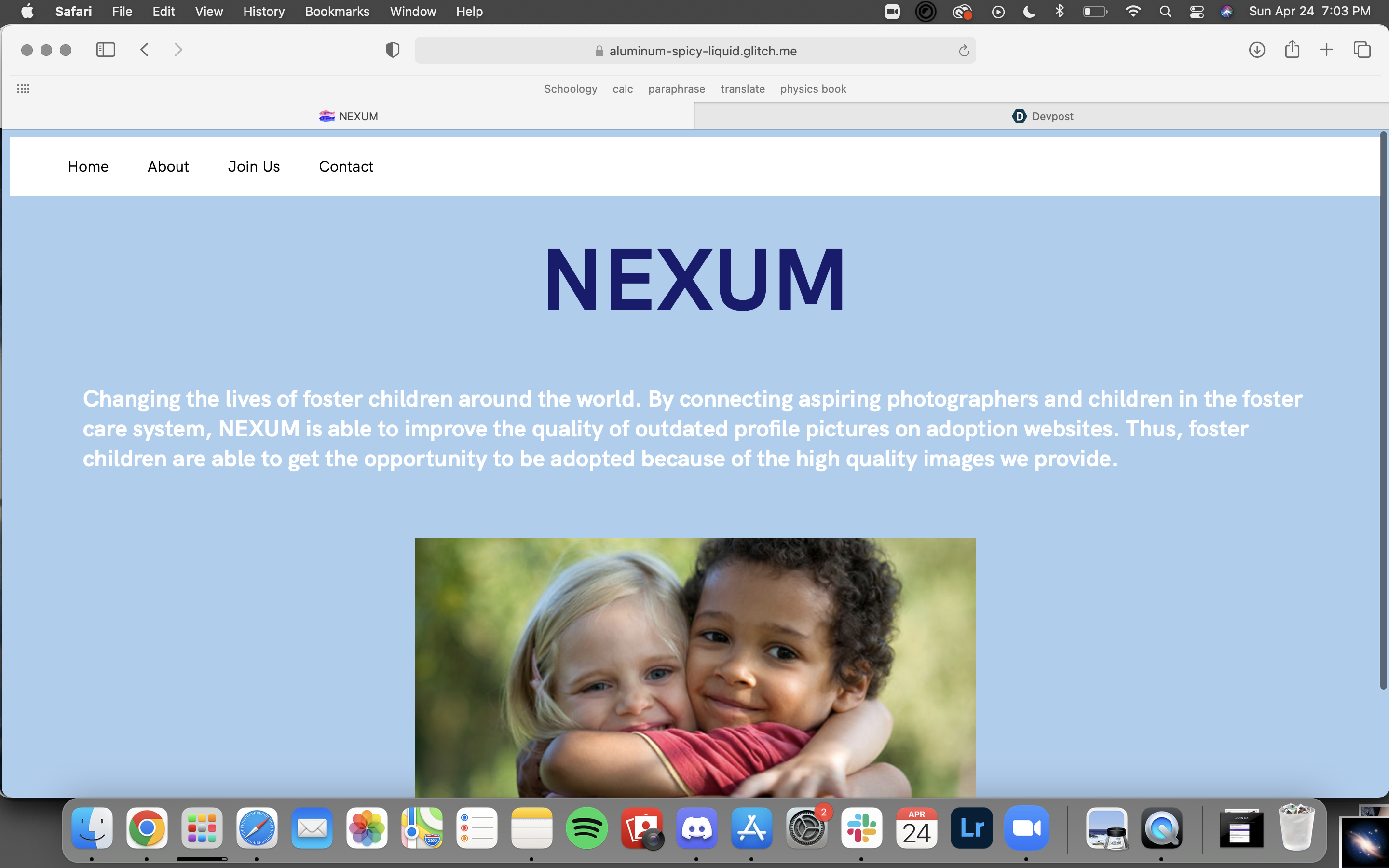
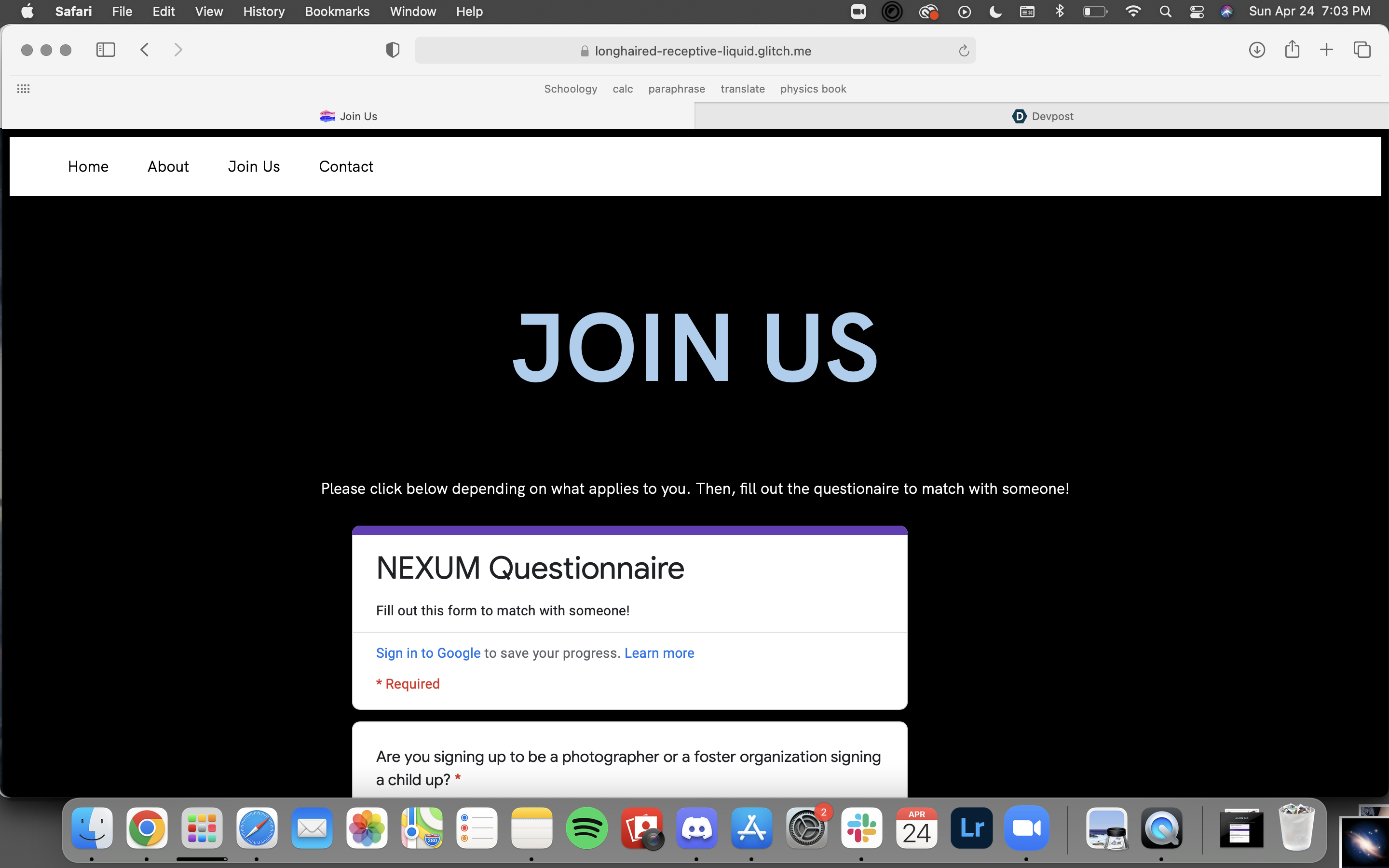
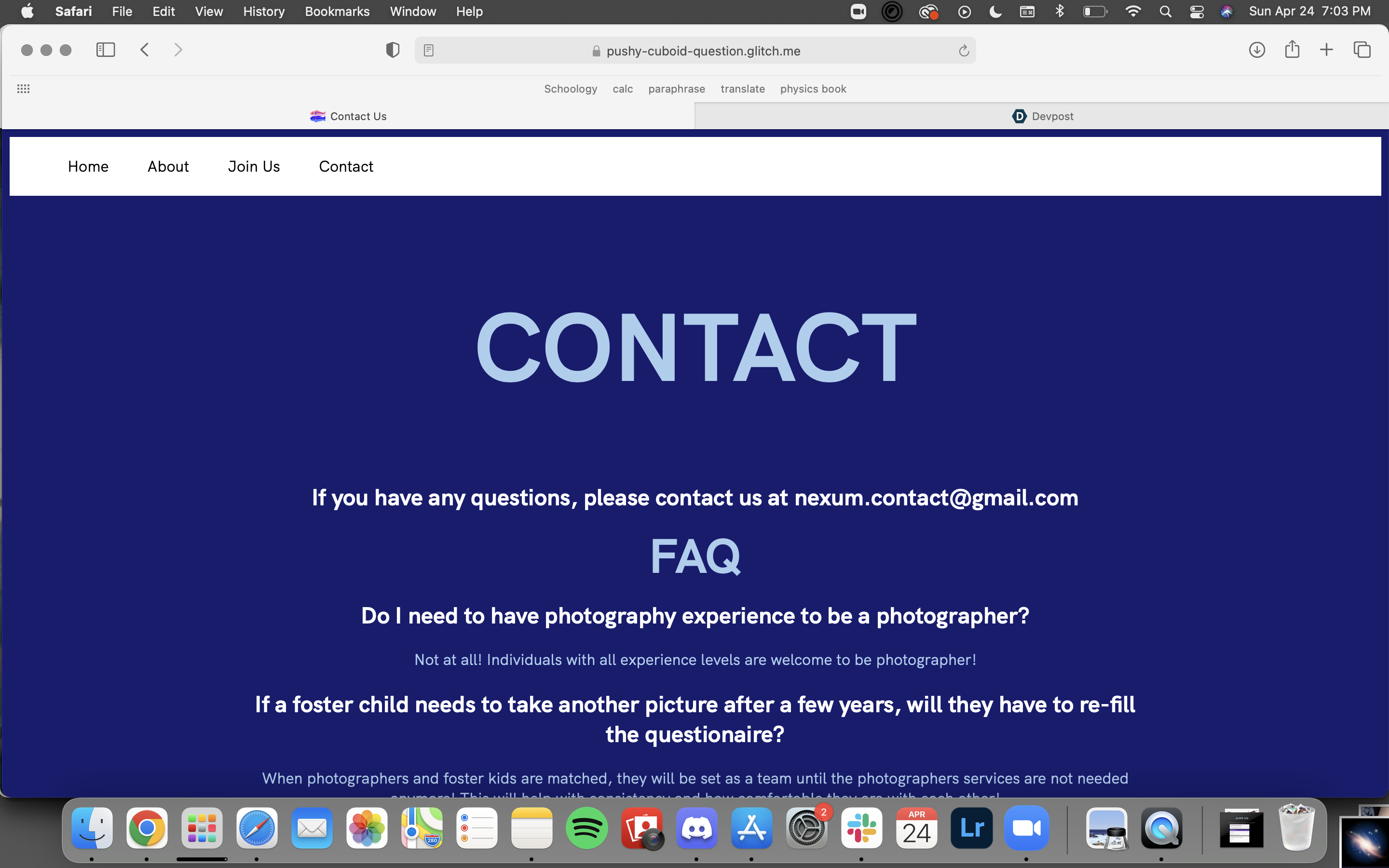
NEXUM is a web-based application that features a home page, about page, questionnaires for both the foster kid and photographer, a basic matching mechanism, and a contact page. Users can select if they are in need of a photographer or are one, and NEXUM will tailor their profile based on a series of preference questions. Photographers will be matched with foster kids based on question-by-question human similarity analysis. Nexum also has a user-friendly design that allows for easy navigation and clarity.
How we built it
NEXUM is built from HTML, CSS, and Javascript components. Its theme colors are light blue and dark blue, which resemble the foster system. There is a universal navigation bar on top that connects all pages of the project. The home page features a button that takes you to the questionnaire prompt page which has options for either a foster child or a photographer. Both questionnaires are embedded forms that collect data for user preferences and transport this data to a central spreadsheet (used as a temporary data holder on a smaller scale). Custom functions on the spreadsheet were created to calculate the compatibility of the photographer with the foster child. The application was created on a platform called Glitch and several projects were href linked and tied together via the central menu bar.
Challenges we ran into
One major dilemma was data storage, as once we got both questionnaires working there was no way to link both sets of data in a way that we could match a photographer and foster child. One solution we thought of was using the common, accessible platform Google Sheets and implementing its built-in Javascript functions and ability to store rows of data in our project. Another challenge we ran into was calculating compatibility in an effective way. We tried out different methods. Adding up the total score from the corresponding choices picked did not fulfill the intended goal at all, and there was no way to do a question-by-question analysis. What we decided to do was use Google Sheets javascript functions and boolean logic to determine the number of matches between photographer and recipient answers.
Accomplishments that we're proud of
One major thing we were proud of was being able to learn rather unfamiliar languages and software within a few hours of the hackathon and learning new techniques and methods as we went. We researched online to establish a base for our HTML project and started editing smaller things from there. We also used some of our Java/JS knowledge for the behind-the-scenes questionnaire work. Another thing we are proud of is being persistent in finding the correct data storage solution for our project. It was a really unique problem to start with, and it wasn't enough to just add up the scores and assign matches from there. We did a question-by-question analysis using boolean logic on Google sheets, which ended up effectively pairing up matches. All in all, we are proud of ourselves for going out of our comfort zone in terms of language and software used.
What we learned
NEXUM was a project that challenged our boundaries with HTML and CSS and caused us to think critically about how to store data in the most efficient way while also preserving user-friendliness and clarity of the site.
What's next for Nexum
We tackled a lot of the basic groundwork and framework generation for NEXUM. Although the data solution we used was effective, if NEXUM were brought to the market, we would need a much more durable platform for large-scale data storage. Data encapsulation would be another issue of interest, as protecting the information of foster kids is crucial. We would need to find a data storage solution that is able to cover up any pieces of data from being hacked or revealed to the public. Another big step is promoting NEXUM with both photographers and foster systems. Our first audience would be foster homes themselves to gain a large base of kids in need before scouting out photographers. The issue Nexum aims to solve is relatively unaddressed but has such a large, invisible scope.
Built With
- css
- forms
- glitch
- html
- javascript
- sheets

Log in or sign up for Devpost to join the conversation.