-
-
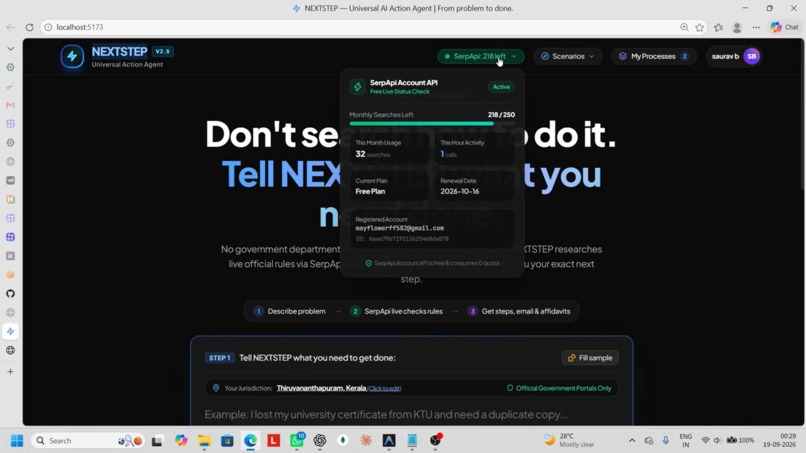
main page
-
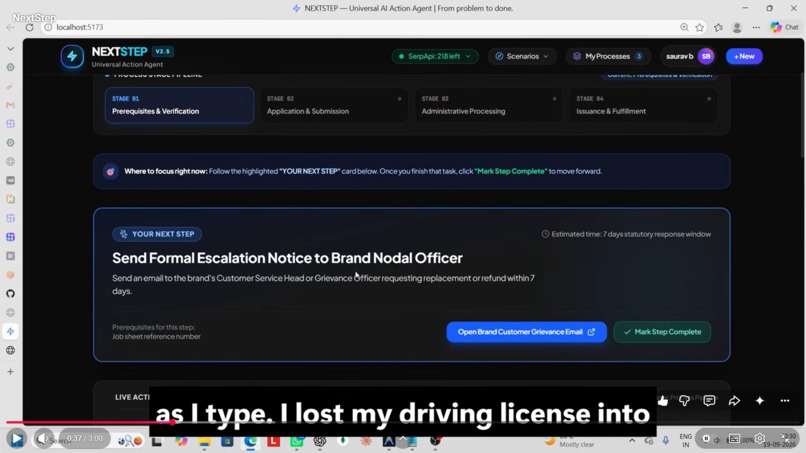
sub page 1
-
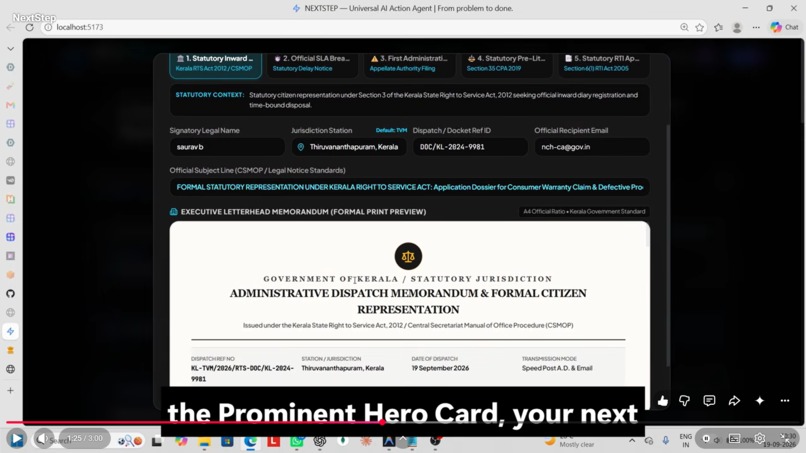
sub page 2
-
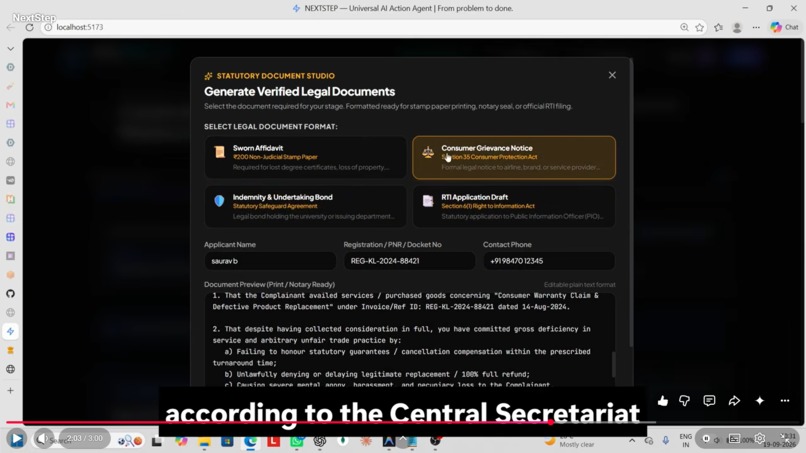
sub page 3
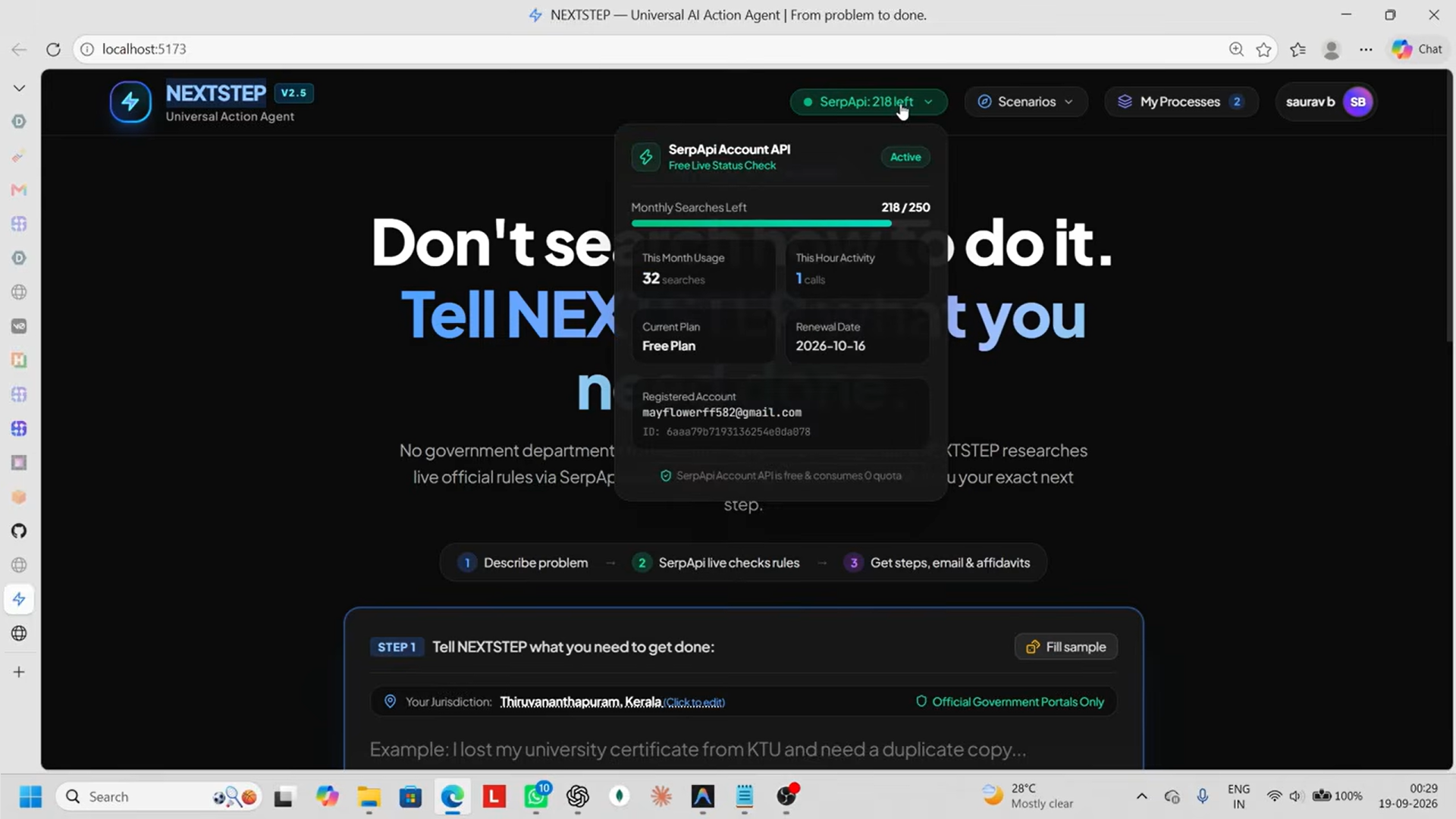
Inspiration
Dealing with government services, university procedures, consumer complaints, and administrative processes often feels unnecessarily complicated.
A simple question like:
“What do I need to do next?”
can lead to hours of searching through government websites, outdated guides, confusing forms, jurisdiction-specific rules, and scattered information.
We wanted to change that.
Instead of making people search for how to solve a problem, we built NEXTSTEP — an AI Action Agent that turns a real-world problem into a clear, executable action plan.
The goal was simple:
Don't search for how to do it. Just tell NEXTSTEP what you need to get done.
What it does
NEXTSTEP takes a user's situation and transforms it into a location-aware, actionable process.
💡 Smart "Did You Mean?" Suggestions
As users describe their problem, Gemini analyzes their intent and suggests relevant procedural variations.
For example:
"I lost my driving licence"
can become:
- Report Lost Driving Licence
- Apply for Duplicate Driving Licence
- Check Driving Licence Replacement Procedure
Users can immediately select the relevant path.
📍 Jurisdiction Intelligence
Procedures can vary depending on location.
NEXTSTEP resolves the relevant jurisdiction hierarchy:
Country → State → City → Competent Authority
This helps prevent users from following procedures meant for another region.
🔍 Live Web Research
NEXTSTEP uses SerpApi to perform real-time searches across web and Maps results.
The system researches:
- Official procedures
- Application portals
- Required documents
- Fees
- Deadlines
- Authorities
- Contact information
Sources are categorized into:
🟢 Official — Government/university portals 🔵 Trusted — Established and recognized sources 🟡 Supporting — Secondary guides and explainers
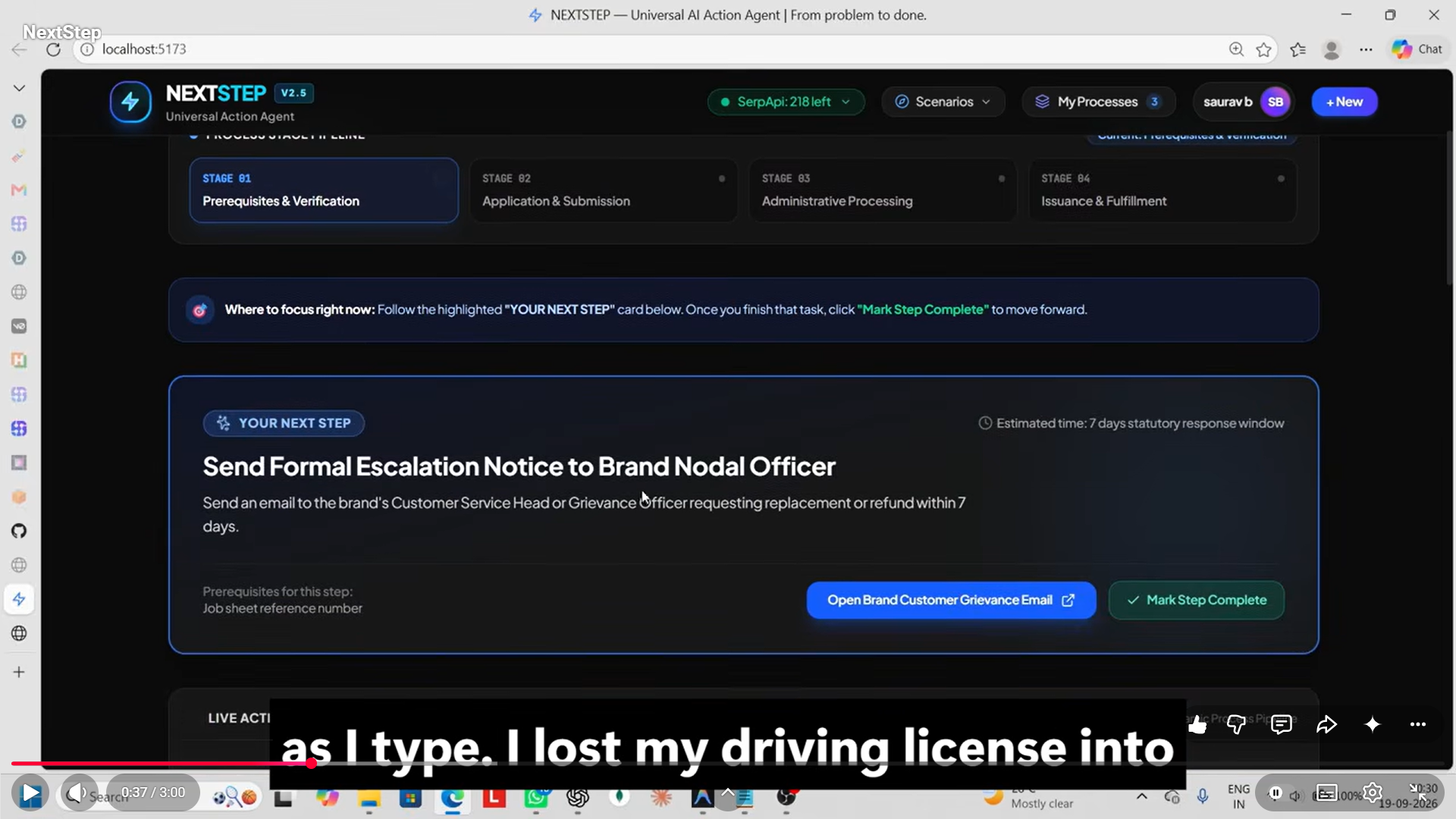
🎯 "YOUR NEXT STEP"
Instead of overwhelming users with information, NEXTSTEP identifies the immediate action that should be taken.
The dashboard highlights:
- The next required action
- Prerequisites
- Required documents
- Estimated timeline
- Official portal
- Relevant authority
🗺️ Process Pipeline & Action Map
The complete process is represented through stages:
Prerequisites & Verification → Application & Submission → Administrative Processing → Issuance & Fulfillment
An interactive action map also visualizes branches, decisions, and outcomes.
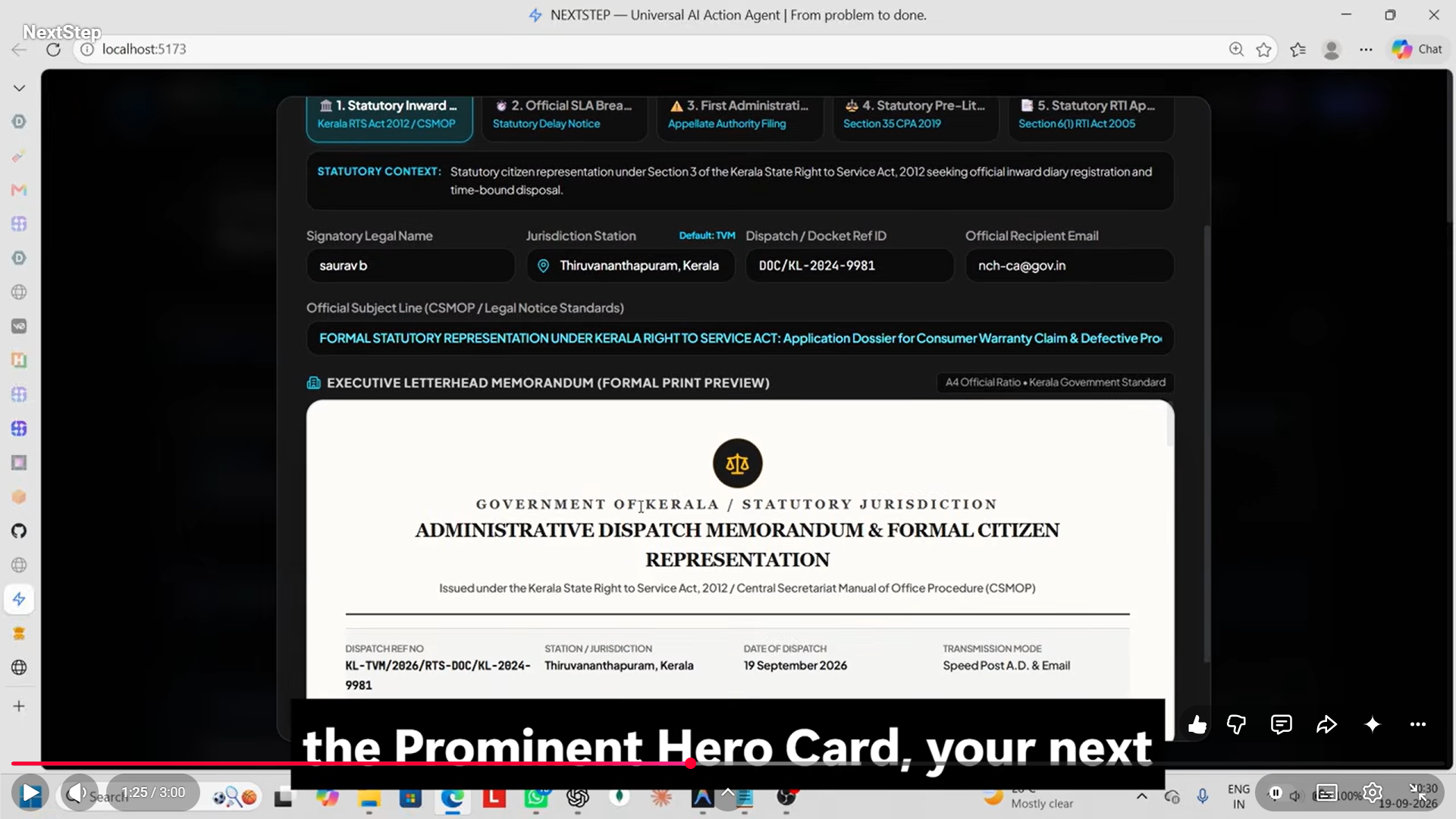
📧 Administrative Email Studio
NEXTSTEP can generate structured administrative correspondence based on the user's situation.
It can populate relevant case information and provide:
- Recipient
- Subject
- Formal body
- Reference information
- Required clauses
- Expected response timelines
Users can also use Open in Gmail to launch a pre-filled email.
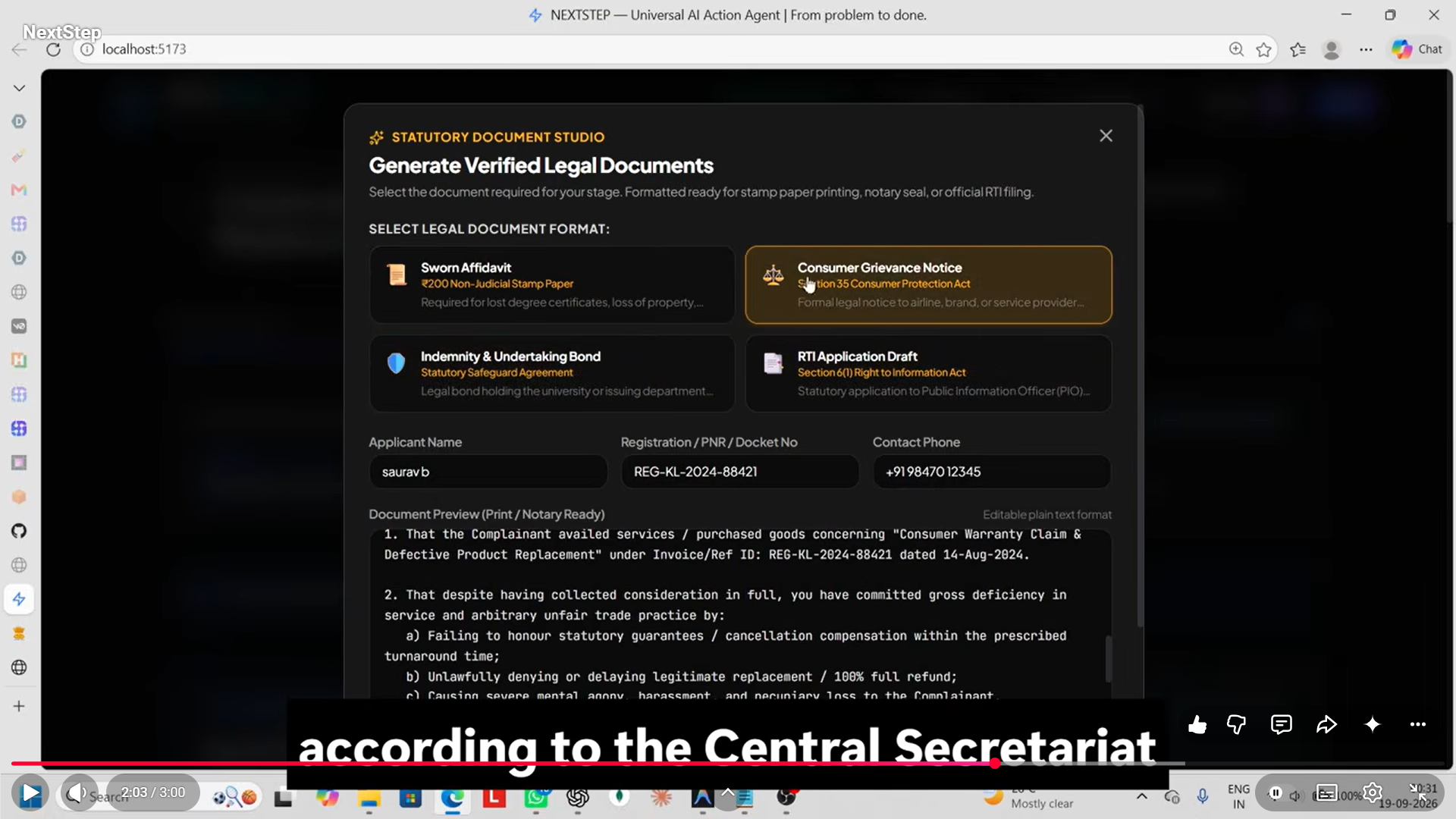
📜 Statutory Document Drafting
NEXTSTEP can generate structured templates for scenarios such as:
- RTI applications
- Consumer pre-litigation notices
- Affidavits
- Formal representations
These are intended as drafting assistance and should be reviewed against the applicable requirements before submission.
⚡ Fast Path Engine
Users can tell NEXTSTEP which documents they already have.
For example:
Already have:
- Aadhaar
- FIR copy
- Application number
The engine recalculates the process and removes unnecessary steps.
🧠 Process Memory
NEXTSTEP maintains case information using SQLite.
Example metadata:
applicant_name
reference_number
contact_phone
application_date
This information can automatically populate future correspondence and documents.
Custom fields can also be added when a case requires additional information.
🔄 Adaptive Replanner
Real-world processes rarely go exactly as expected.
If an authority sends a new requirement, rejection, clarification, or SMS, users can paste the response into NEXTSTEP.
The system analyzes the new information and dynamically updates the process.
How we built it
NEXTSTEP uses a React + Vite frontend, FastAPI backend, SQLite database, Gemini for reasoning, and SerpApi for live web intelligence.
Architecture
User Situation / Problem
          ↓
TaskComposer
(Gemini Intent Analysis)
          ↓
Contextual Questions
          ↓
Jurisdiction Resolver
          ↓
SerpApi Research
(Web + Maps)
          ↓
Source Analyzer
          ↓
Gemini Process Generator
          ↓
Action Dashboard
     ↙     ↓      ↘
Next Step  Process  Documents
           Memory
              ↓
        User Action
              ↓
      Authority Response
              ↓
    Adaptive Replanner
              ↓
      Updated Process
Frontend
We built the interface using:
- React 19
- Vite
- Tailwind CSS
- CSS Grid
- Lucide React
The UI focuses on reducing cognitive overload by making the next action visually dominant while keeping the complete process accessible.
Backend
The backend is powered by:
- Python
- FastAPI
- Pydantic
- SQLite
FastAPI handles the application API, process generation workflow, search orchestration, source processing, and persistent case information.
AI Layer
Google Gemini 2.5 Flash powers:
- Intent understanding
- Procedural suggestions
- Contextual question generation
- Information synthesis
- Process generation
- Adaptive replanning
Search Intelligence
SerpApi provides live search capabilities so NEXTSTEP can retrieve current information instead of relying entirely on static model knowledge.
Search results are analyzed and organized before being presented to the user.
Challenges we ran into
1. Turning vague problems into structured workflows
Users don't naturally describe problems in a structured format.
Someone might say:
"My licence is lost and I don't know what to do."
The system needs to understand the intent, identify missing information, determine the relevant jurisdiction, and convert the situation into executable steps.
We solved this through Gemini-powered intent analysis and minimal contextual questioning.
2. Keeping information jurisdiction-aware
Administrative procedures can change depending on the user's location.
A procedure applicable in one state, city, or department may not apply elsewhere.
We therefore designed a jurisdiction resolution layer before generating the final action plan.
3. Avoiding unreliable AI answers
An AI-generated answer is not enough when users need real-world procedures.
NEXTSTEP combines Gemini reasoning with live SerpApi research and source classification so that the generated process can be connected back to current web sources.
4. Designing for action instead of information
Our biggest UX challenge was avoiding another information-heavy AI interface.
Instead of presenting a long explanation first, we designed the dashboard around:
YOUR NEXT STEP
The user can then explore supporting documents, sources, stages, and alternatives when needed.
5. Replanning after authority responses
A static checklist breaks when reality changes.
If an authority asks for an additional document or rejects an application, the process must adapt.
This led us to build the Adaptive Replanner, allowing new authority responses to become inputs to the workflow.
Accomplishments we're proud of
We're proud that NEXTSTEP goes beyond simply answering questions.
It connects several capabilities into one workflow:
Understand → Research → Verify → Plan → Draft → Act → Replan
We are especially proud of:
- Building a complete AI action-agent workflow
- Combining Gemini reasoning with live SerpApi research
- Creating jurisdiction-aware process generation
- Making the immediate action the center of the UI
- Building a visual process pipeline and action map
- Adding persistent process memory
- Creating the Fast Path Engine
- Building adaptive replanning based on authority responses
- Generating ready-to-edit administrative and statutory document drafts
- Supporting direct Gmail workflow integration
Most importantly, we built NEXTSTEP around a simple principle:
AI should not only tell people what something means. It should help them figure out what to do next.
What we learned
Building NEXTSTEP taught us that an effective AI application is not simply about choosing a powerful model.
The surrounding system matters just as much.
We learned how to:
- Combine LLM reasoning with external search
- Design AI workflows around real-world tasks
- Handle location and jurisdiction context
- Build source-aware AI responses
- Create stateful AI processes
- Design interfaces around actions rather than information
- Build adaptive workflows that respond to new inputs
- Balance automation with user control
- Structure FastAPI services around asynchronous AI workflows
- Connect AI-generated outputs to practical user actions
One of our biggest lessons was:
The best AI experience may not be the one that gives the longest answer — it may be the one that makes the next action obvious.
What's next for NEXTSTEP
NEXTSTEP is currently focused on administrative and procedural problem solving, but the underlying architecture can expand much further.
Future versions could include:
🌍 More jurisdictions
Expand beyond the initial regional focus to support additional states and countries.
🏛️ More government services
I
Built With
- ai
- fastapi
- generative-ai
- google-gemini
- google-maps
- javascript
- lucide-react
- pydantic
- python
- react
- rest-api
- serpapi
- sqlite
- tailwind-css
- typescript
- vite

Log in or sign up for Devpost to join the conversation.