-
Landing Page
🎓 NextStep
Empowering learners from all walks of life to discover, aspire, and achieve their educational goals.
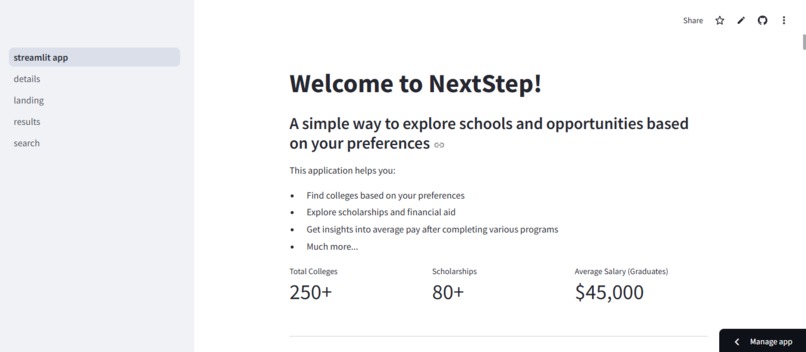
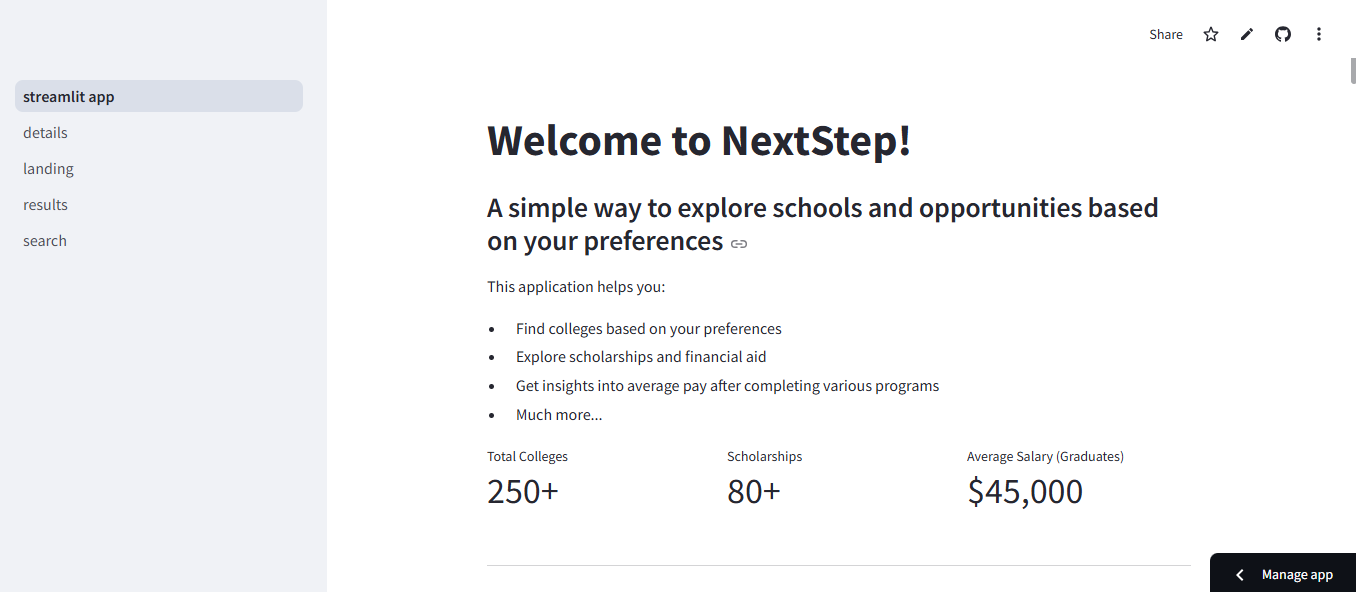
This application helps users explore schools and opportunities, providing insights into colleges, scholarships, financial aid, and more.

Inspiration
Many students—especially those unaware of higher education’s impact—miss out on crucial opportunities. Our team wanted to address this gap by creating a platform that highlights the value of higher education, provides customized college recommendations, and helps students see a clearer path to a brighter future.
“Education is the most powerful weapon which you can use to change the world.” — Nelson Mandela
Why Education Matters
- Higher Earning Potential: Bachelor’s degree holders can earn up to 40% more over a lifetime than high school graduates.
- Better Job Security: College graduates have significantly lower unemployment rates.
- Career Growth: Many emerging fields (e.g., technology, healthcare) require or strongly prefer a college degree.
- Improved Quality of Life: Educated individuals often experience better health, increased civic participation, and greater life satisfaction.
What It Does
- Personalized School & Program Recommendations: Users input their interests and location preferences, and NextStep suggests relevant colleges.
- Scholarships & Financial Aid: Provides awareness of aid options that can make higher education more accessible.
- Interactive Maps: Visualize nearby colleges based on user-selected filters.
- Insights & Statistics: Offers data-driven charts, salaries, and growth projections to illustrate the benefits of higher education.
How We Built It
- Front-end: Implemented with Streamlit, ensuring an intuitive, interactive interface.
- Data & Modeling:
- A simple RAG (Retrieval-Augmented Generation) approach to personalize recommendations.
- Databases/CSV datasets for scholarships and college information.
- A simple RAG (Retrieval-Augmented Generation) approach to personalize recommendations.
- Location Services: Geopy for distance calculations and mapping coordinates.
- Deployment: Hosted via Streamlit Cloud for easy access and sharing.
Challenges We Ran Into
- Data Quality & Availability: Finding up-to-date, complete scholarship and college datasets was tricky.
- User Experience: Ensuring a minimal learning curve for non-tech-savvy users required iterative design improvements.
- Scalability: Balancing performance with the complexity of location-based filtering and dynamic data retrieval.
Accomplishments That We're Proud Of
- Comprehensive MVP: We delivered a working prototype that covers the full journey—search, results, and details.
- User-Centric Design: Simple navigation, readable charts, and clear calls to action for next steps.
- Team Collaboration: Efficiently split tasks across data, frontend, and design, merging them into a coherent product.
What We Learned
- RAG Model Integration: Experimenting with retrieval-augmented generation to improve recommendation accuracy.
- UI/UX Considerations: Designing for clarity and inclusivity, especially for users who may be new to digital tools.
- Project Management: Iterative sprint planning, version control, and regular syncs kept us on track.
What's Next for NextStep
- More Data Sources: Integrate additional scholarship providers and college partnerships.
- Mentorship & Community: Add forums or mentorship channels to connect students with current undergraduates and professionals.
- Mobile App: Enhance accessibility through a lightweight mobile version.
- In-depth Financial Guidance: Tools to compare tuition, ROI, and personalized financial planning.
NextStep Tech Stack
Here’s a high-level overview of the tools and technologies powering NextStep:
Frontend & UI
- Streamlit: A Python-based framework for quickly building interactive web apps.
- Altair or Plotly (Optional): For data visualization (charts, graphs, etc.).
- PyDeck (Optional): To display maps and visualize geospatial data in 3D.
- Streamlit: A Python-based framework for quickly building interactive web apps.
Backend & Data Processing
- Python: The main language for data handling, business logic, and model integration.
- Geopy: For geospatial calculations (distances, coordinates).
- Pandas: For data manipulation, filtering, and loading CSV/dataset files.
- RAG Model (Retrieval-Augmented Generation, optional advanced feature): Used GPT-4o-mini, Langchain, Pinecone vector database for personalized recommendations by combining user input with a knowledge base or LLM.
- Python: The main language for data handling, business logic, and model integration.
Database / Data Storage
- CSV Files (https://collegescorecard.ed.gov/data/): Utilized the dataset from US Government's Department of Education.
- Database: MongoDB
- CSV Files (https://collegescorecard.ed.gov/data/): Utilized the dataset from US Government's Department of Education.
Deployment
- Streamlit Cloud: Quick and easy hosting for testing and demonstrations.
- Streamlit Cloud: Quick and easy hosting for testing and demonstrations.
Version Control / Collaboration
- Git & GitHub: For source code management, version control, and team collaboration.
- Git & GitHub: For source code management, version control, and team collaboration.
Development Environment
- VS Code: Common IDE with
.devcontainersupport for a consistent coding environment. - Python 3.9+: Ensures compatibility with the latest packages and Streamlit features.
- VS Code: Common IDE with
Project Structure
NextStep/
└── my_streamlit_app/
    ├── .devcontainer/
    │   └── devcontainer.json
    ├── .streamlit/
    │   └── config.toml
    ├── pages/
    │   ├── landing.py
    │   ├── search.py
    │   ├── results.py
    │   └── details.py
    ├── utils/
    │   └── model.py
    ├── README.md
    ├── streamlit_app.py
    └── requirements.txt

Log in or sign up for Devpost to join the conversation.