-
-
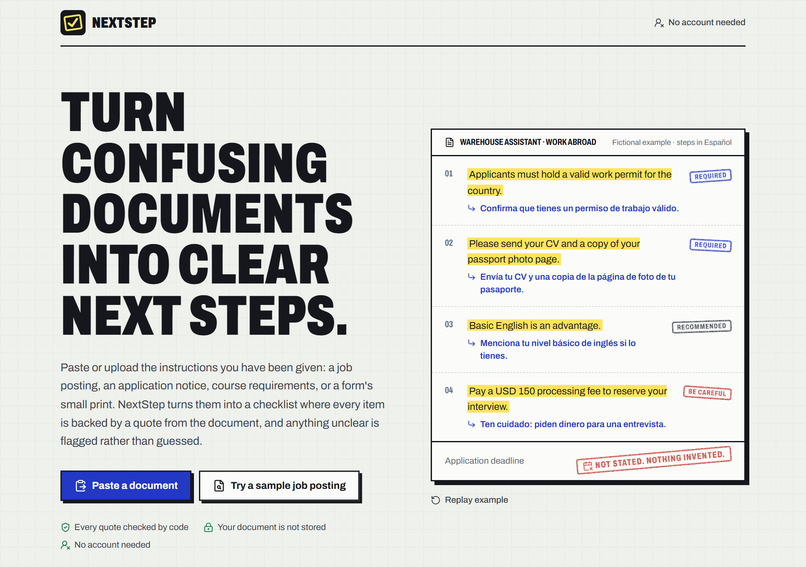
Home
-
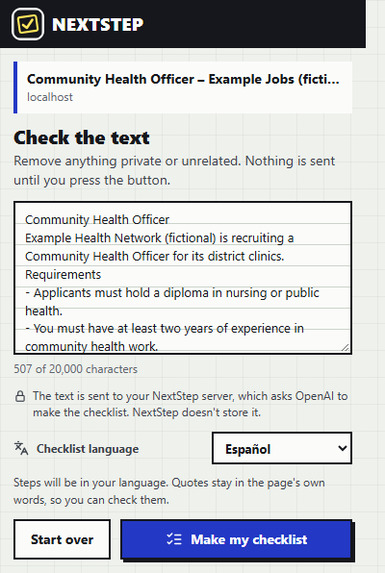
Extension popup
-
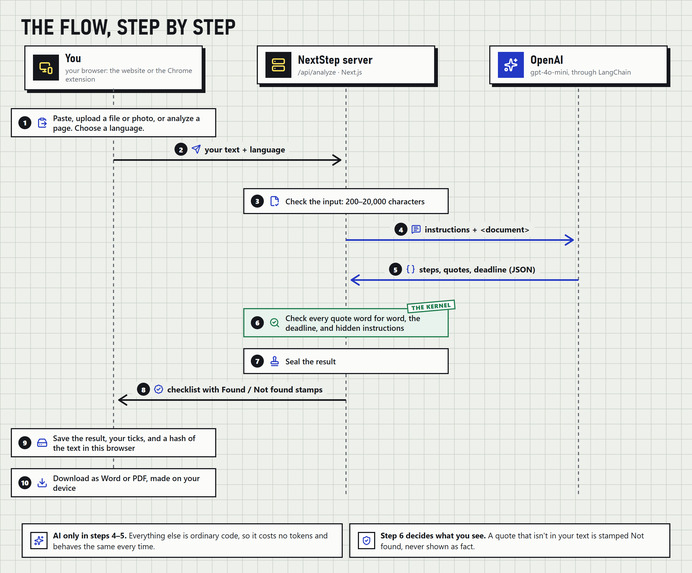
Flow
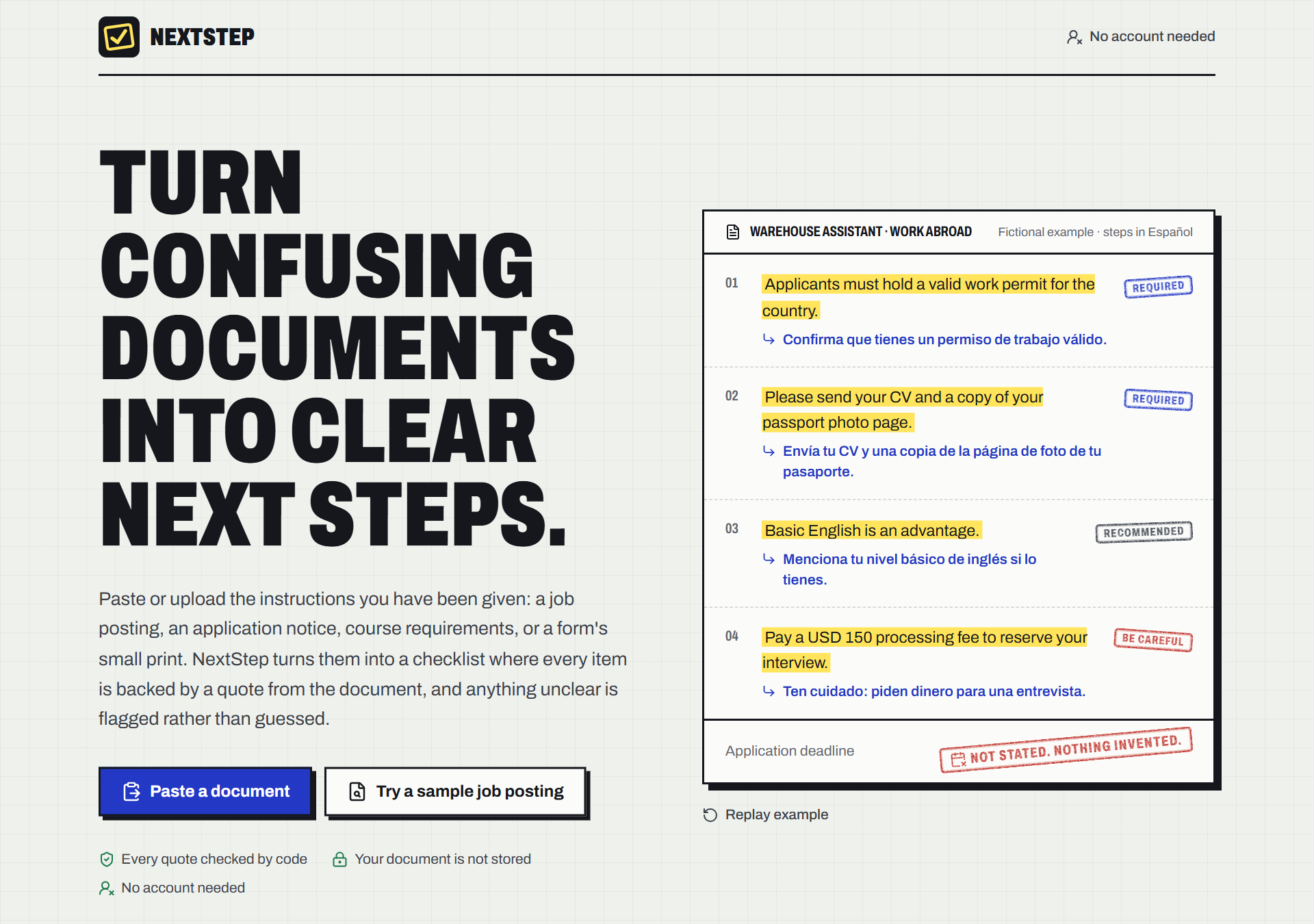
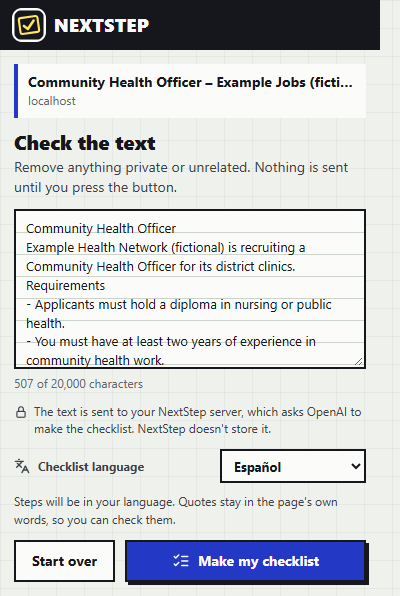
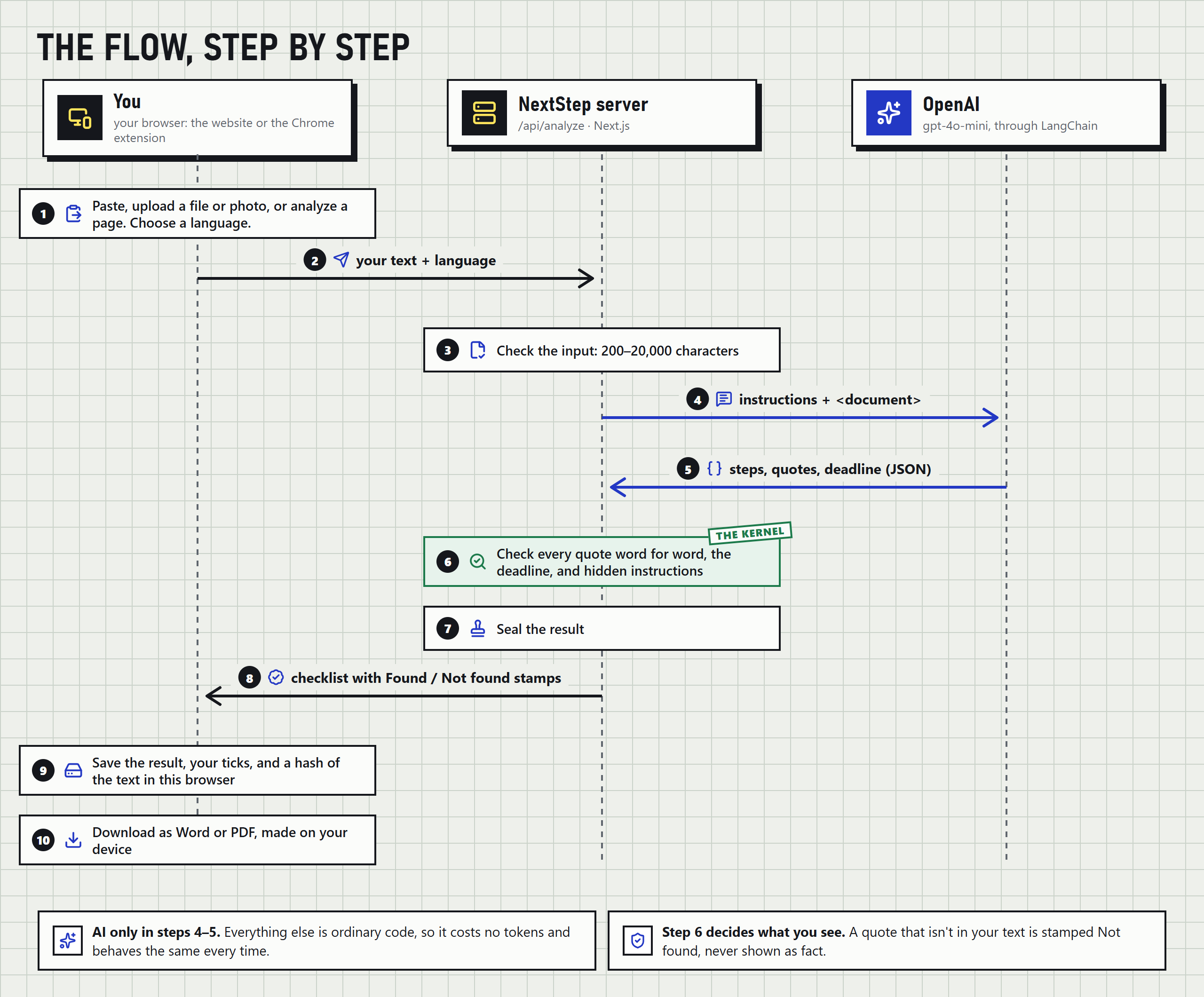
What it does
- Turns long job postings, scholarship notices, and confusing instructions into prioritized checklists.
- Checks extracted requirements against quotations from the original document.
- Flags unclear or unsupported deadlines instead of guessing.
- Supports multilingual checklists, document uploads, and a Chrome extension.
Who it is for and why it matters
NextStep is intended for job seekers, students, scholarship applicants, and people who need to act on documents that are difficult to read, especially when a document is written in a language they do not comfortably understand.
Real-world data from project research
- 304 million international migrants in 2024, according to the United Nations Department of Economic and Social Affairs (UN DESA).
- Reported losses from job and employment-agency scams in the United States rose from \$90 million in 2020 to \$501 million in 2024, according to the Federal Trade Commission (FTC).
These figures provide context for why accessible instructions and caution around suspicious job offers matter. They do not, by themselves, prove that NextStep prevents scams.
Sources linked in the project research: - UN DESA: https://www.un.org/en/global-issues/migration - FTC: https://www.ftc.gov/news-events/news/press-releases/2025/03/new-ftc-data-show-big-jump-reported-losses-fraud-125-billion-2024
What I learned
The project was planned and built with the Devpost Learn AI Basics
skill pack in Claude Code:
https://github.com/challengepost/learn-ai-basics. Its six-step process
guided the work from understanding the learner and scoping a proof of
concept, through requirements and technical planning, to building,
testing, reviewing, and preparing the project for submission. The
repository includes planning and build records such as
devpost/scope.md, devpost/prd.md, devpost/spec.md, and
devpost/checklist.md.
Lessons supported by the project work include:
- AI-generated answers can contain plausible but unsupported details.
- Code-based quotation and deadline checks help identify results that need verification.
- Prompt instructions alone are not enough for important safety and reliability guarantees; code-level checks and regression tests matter.
- Testing real documents, multiple languages, and browser behavior can uncover issues that unit tests alone may miss.
- Planning before coding and reviewing each build slice made it easier to work through the project in stages.
For the final submission, make sure the learning reflection also includes the specific challenge and lesson that best reflect your own experience building NextStep.
Built With
- chrome
- docx
- gsap
- jspdf
- langchain
- mammoth
- next.js
- openai
- pdf.js
- react
- tailwindcss
- tesseract.js
- typescript
- vercel
- vitest
- zod
