-
-
NextMove | AI Causality Engine powered by Gemini 3.0 & Hydra Protocol
Inspiration
We live in an era of instant communication, but our brains haven't evolved to keep up. Everyone has sent a text message in the heat of the moment to a boss, an ex, or a friend that they immediately regretted. The "Undo Send" button isn't enough; we needed a time machine.
I wanted to build something that doesn't just check your grammar (like Grammarly) but checks your fate. What if an AI could simulate the causality of your message? What if it could show you the social fallout 5 minutes into the future, before you even hit send?
That question gave birth to NextMove.
What it does
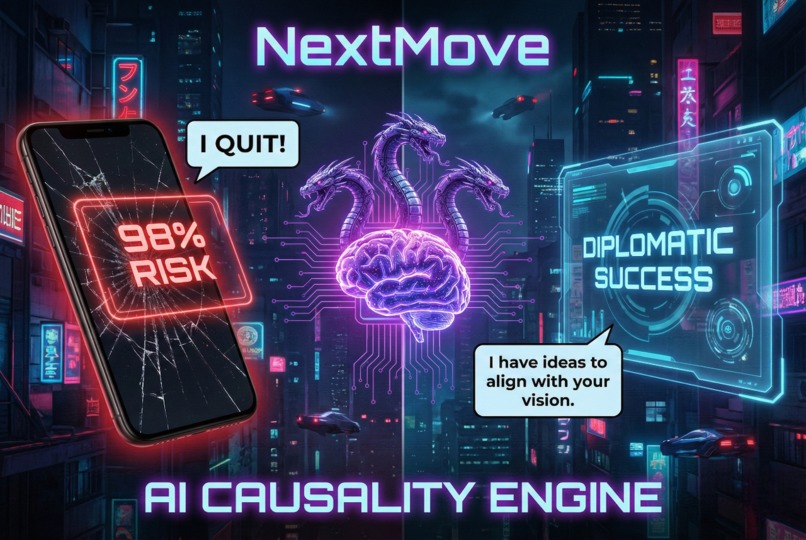
NextMove is an AI Causality Engine. It acts as a hyper intelligent filter between your impulse and reality.Predicts the Future: You type a risky message (e.g., "I quit, your vision is terrible").Visualizes Risk: The engine calculates a Social Risk Score ($S_r$) and visualizes it as a shattered glass interface if the risk is high.Diplomatic Intervention: If the risk exceeds 70%, the "Diplomatic Neural Node" activates. It rewrites your aggressive text using FBI-style hostage negotiation tactics (Tactical Empathy) to achieve your goal without burning the bridge.
How we built it
The biggest challenge was balancing IQ vs. Latency. We needed the profound reasoning of Gemini 3.0 to understand human emotion, but the speed of Gemini 2.5 Flash to make it feel real-time.We built a custom architecture called the Hydra Protocol:$$\text{Hydra}(x) = \begin{cases} \text{Gemini 3.0} & \text{if } \text{Complexity}(x) > \theta \ \text{Gemini 2.5 Flash} & \text{if } \text{Complexity}(x) \le \theta \end{cases}$$Frontend: Vanilla JS with a custom Glassmorphism UI (TailwindCSS) to give it a futuristic, "Black Mirror" aesthetic.Backend: Firebase Functions (Node.js) acts as the secure orchestrator. We keep our API keys server-side using environment variables (.env).The Brain: We chain prompts. First, a lightweight call to Gemini 2.5 Flash assesses the "Risk Vector." If high, we pass the payload to Gemini 3.0 Preview for the heavy lifting of rewriting the text.
Challenges we ran into
The "Windows Trap": Managing secure environment variables on Windows was a nightmare. We spent hours fighting invisible file extensions (.env.txt) and "Zombie Processes" holding onto localhost ports.
Prompt Engineering: Teaching the AI to be "diplomatic" without sounding like a corporate robot was tough. We had to use "Few-Shot Prompting" to teach it Tactical Empathy using phrases like "It seems like..." and "I feel..." rather than just apologizing.
Latency: Calling Gemini 3.0 for every keystroke was too slow. We implemented a "debounce" strategy and the Hydra routing system to ensure the UI remained buttery smooth (60fps).
Accomplishments that we're proud of
The UI: It genuinely looks like software from 2030. The "Shattered Screen" effect when risk is high is a visceral user experience.
The "Diplomatic Node": Watching the AI take a hateful, angry text and turn it into a professional, persuasive argument that actually gets what you want feels like magic.
Security: We didn't take shortcuts. The app is fully secure with server side key handling, making it production ready.
What we learned
Building NextMove was a crash course in AI orchestration and defensive programming.
Prompt Engineering is Psychology: We learned that treating the LLM like a calculator doesn't work for nuanced tasks. To get Gemini 3.0 to be "diplomatic" without being patronizing, we had to use Chain-of-Thought (CoT) prompting. We taught the model to first analyze the user's emotional state internally before generating the external response.
Latency is the Enemy of UX: We discovered that users perceive intelligence as "instant." Waiting 3 seconds for a brilliant answer feels worse than waiting 0.5 seconds for a good one. This forced us to innovate with the Hydra Protocollearning how to balance model size (Parameters) against speed (Tokens/sec).
Security is Non-Negotiable: The struggle with Windows environment variables and .env files taught us the hard way why DevOps is critical. We learned how to properly secure API keys on the server-side (Firebase Functions) rather than exposing them in client-side code, a lesson that will stick with us for every future project.
What's next for NextMove - AI Causality Engine
The engine is live, but the roadmap is huge:
Voice Mode: Integrating Gemini Live to intercept angry phone calls in real-time.
Browser Extension: A Chrome plugin that overlays NextMove onto Gmail, WhatsApp, and Slack.
Multimodal Analysis: Using Gemini's vision capabilities to analyze screenshots of chat history for better context.
NextMove isn't just a tool; it's a second chance.
Built With
- css3
- firebase
- firebase-function
- generative-api
- git
- github
- google-cloud
- google-gemini-api
- html5
- javascript
- node.js
- tailwindcss
- vscode

Log in or sign up for Devpost to join the conversation.