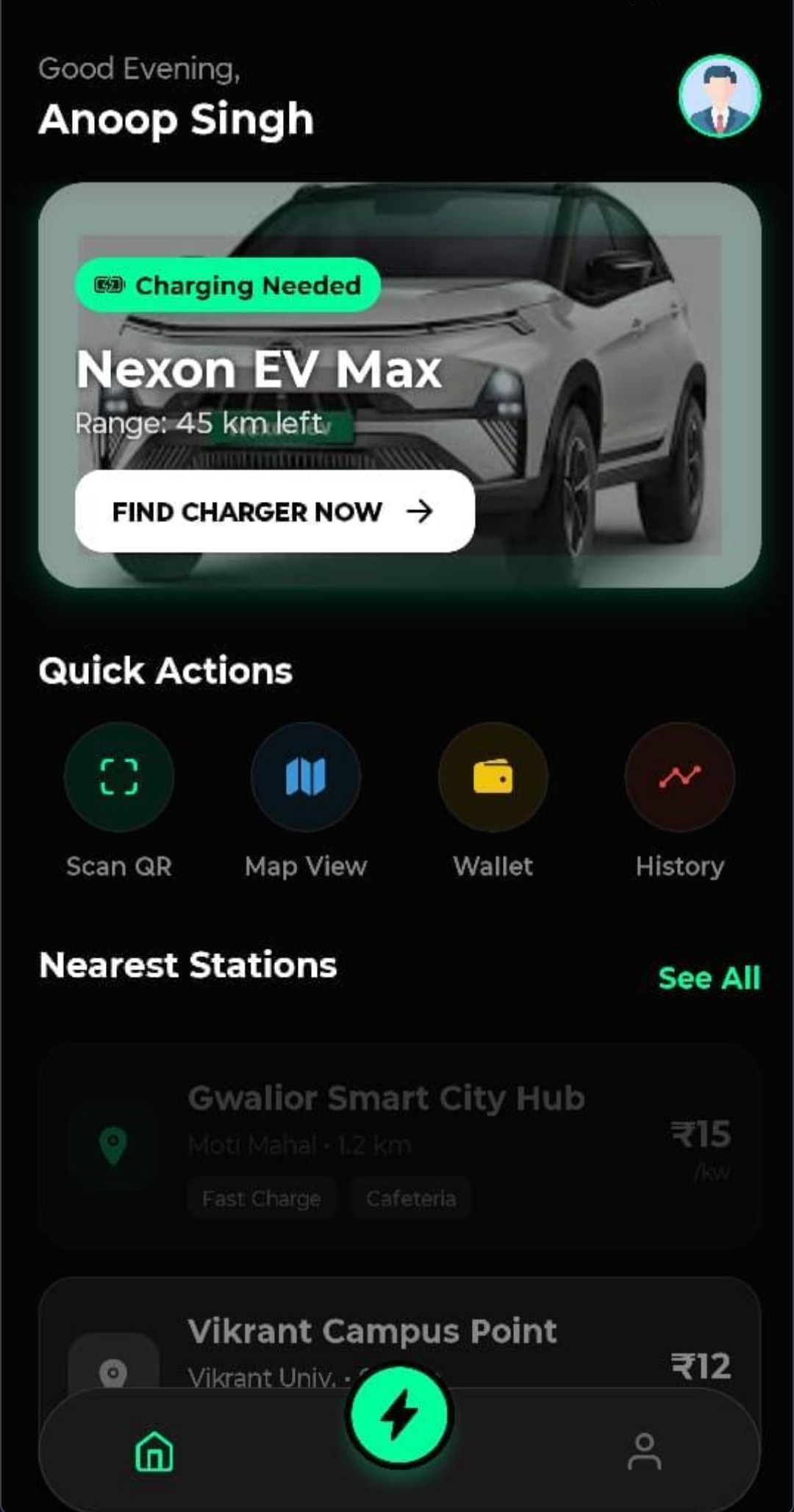
What it does NextCharge is an intelligent, IoT-driven EV charging station designed to eliminate Range Anxiety. Unlike traditional "dumb" chargers, NextCharge: Communicates: Uses a vernacular AI voice interface to guide users in their local language. Monitors: Provides real-time health diagnostics of the charger to ensure it's never "Out of Order." Optimizes: Uses AI to manage power distribution, preventing battery overheating and grid surges. How we built it We adopted a multi-layered tech stack to ensure reliability and speed: Hardware: Built using the ESP32 microcontroller for its dual-core processing and built-in WiFi/Bluetooth. We integrated ACS712 sensors for current monitoring and DS18B20 for thermal tracking.
Software Backend: We used Firebase Realtime Database to sync hardware data with the user app instantly. User Interface: A mobile application developed with React Native (Expo) to provide a seamless cross-platform experience. AI Engine: A Python-based logic layer that calculates the charging efficiency using the formula: \eta = \frac{P_{out}}{P_{in}} \times 100 Where \eta is efficiency, and we ensure it stays above 95\% through dynamic load balancing.
Challenges we ran into Network Latency: In remote areas, syncing IoT data with the cloud was slow. We optimized the MQTT protocol to handle low-bandwidth scenarios. Thermal Management: During fast charging, the heat dissipation (Q = I^2Rt) was high. We had to design an automated cooling system and a software-level "Current Throttle" algorithm. Vernacular NLP: Training the AI to be concise yet helpful in local languages was a massive iteration process. 🏆 Accomplishments that we're proud of Zero-Failure Prototype: Successfully ran a 48-hour continuous stress test without thermal throttling or data loss. User Inclusivity: The "Talking Interface" made the technology accessible to senior citizens and non-tech-savvy users in Gwalior. Incubation Interest: Received positive feedback from university mentors for potential campus implementation. 🎓 What we learned Full-Stack IoT: I learned that building hardware is 20\% soldering and 80\% debugging edge cases in firmware. Data Integrity: Managing real-time streams in Firebase taught me the importance of structured NoSQL databases. Empathy-Driven Design: As a founder, I learned that a product isn't successful if it's just "fast"—it must be "trustworthy." 🔮 What's next for NEXTCHARGE The roadmap for NextMatrix Tech includes: Solar Integration: Utilizing renewable energy to power the stations directly. Predictive Maintenance: Using ML models to predict component failure before it happens. Expansion: Partnering with local businesses in Gwalior to create a "NextCharge Grid" by 2027.


Log in or sign up for Devpost to join the conversation.