-
-
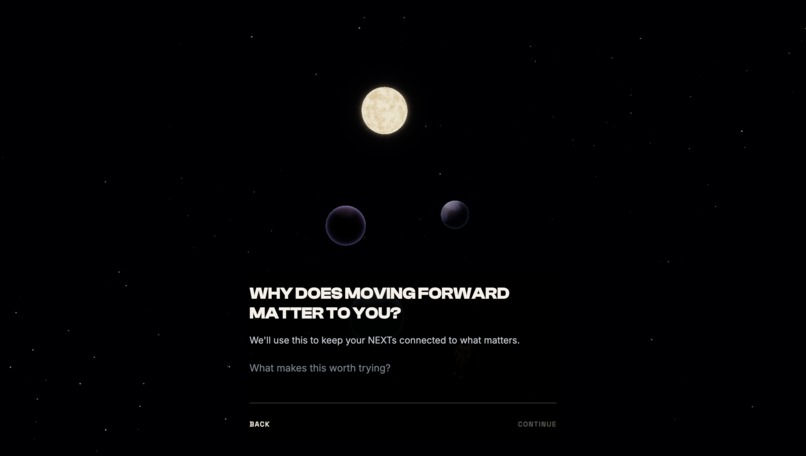
Onboarding Questions
-
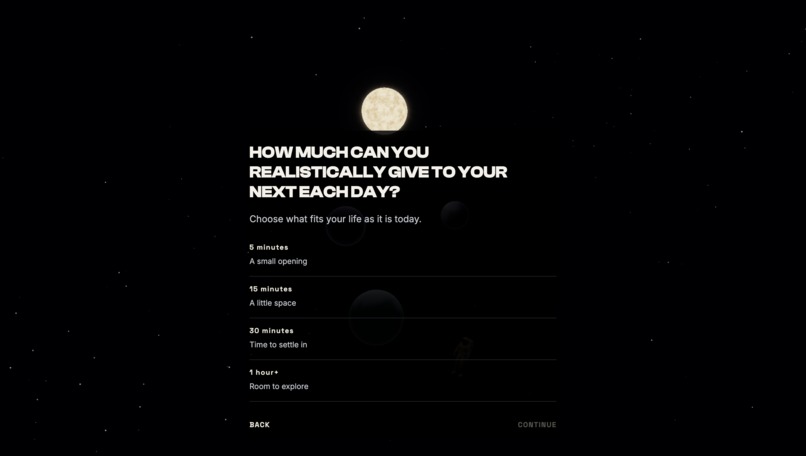
Onboarding Questions
-
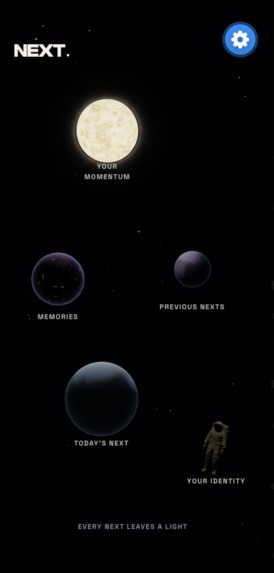
Homepage
-
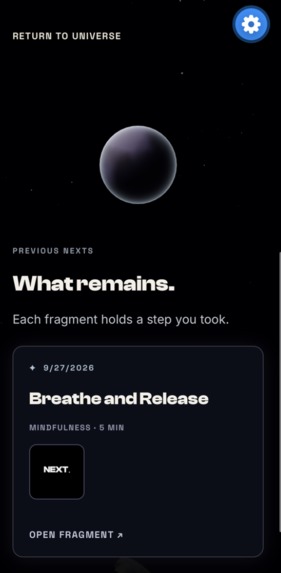
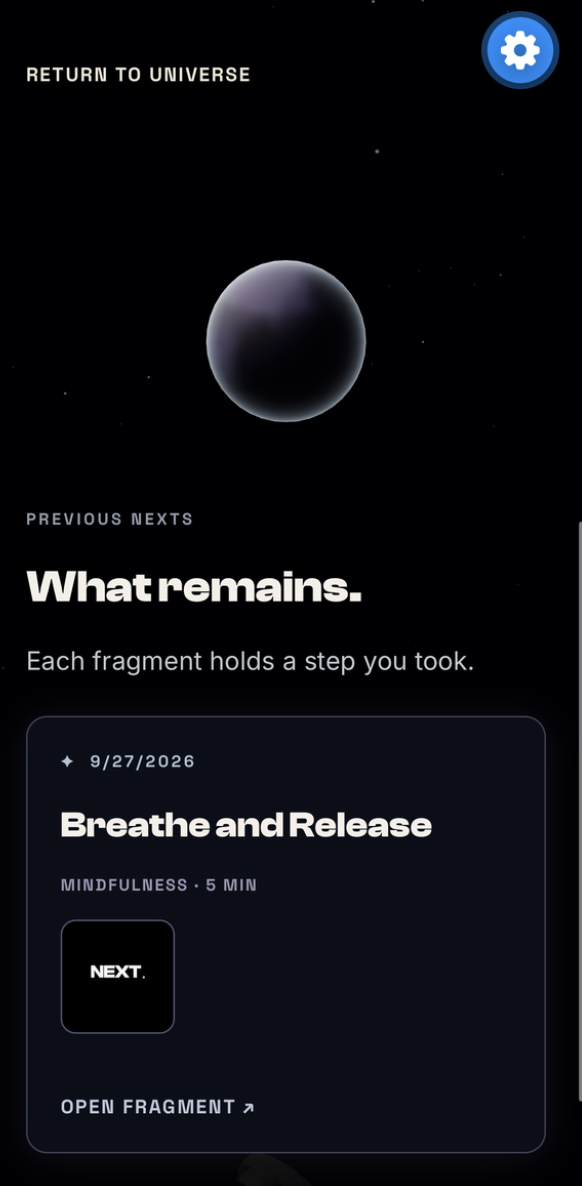
Previous Tasks
-
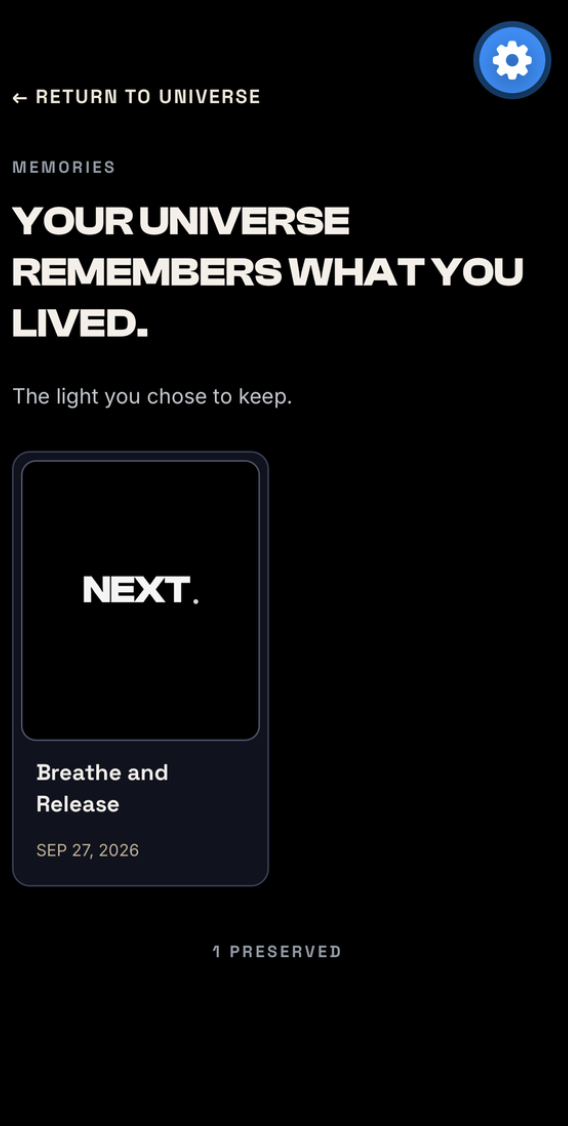
Memories
Inspiration
NEXT started from something personal.
There have been times in my life when I knew I wanted to move forward, but I genuinely didn't know what "moving forward" was supposed to look like. When you're going through something difficult, thinking about the entire future can feel overwhelming. Even when you know where you eventually want to be, figuring out what to do today can be the hardest part.
I realized that sometimes you don't need a perfect plan for the next year. You just need one meaningful step.
That became the idea behind NEXT.
I wanted to build something that could understand where someone is right now, where they want to go, and turn that uncertainty into a single action they can actually take. I also didn't want it to feel like another productivity app filled with checklists, percentages, and notifications.
I wanted progress to feel like something you could experience.
So NEXT turns your journey into a universe that grows with you.
What it does
NEXT is an AI-powered personal growth experience that gives you one meaningful next step at a time.
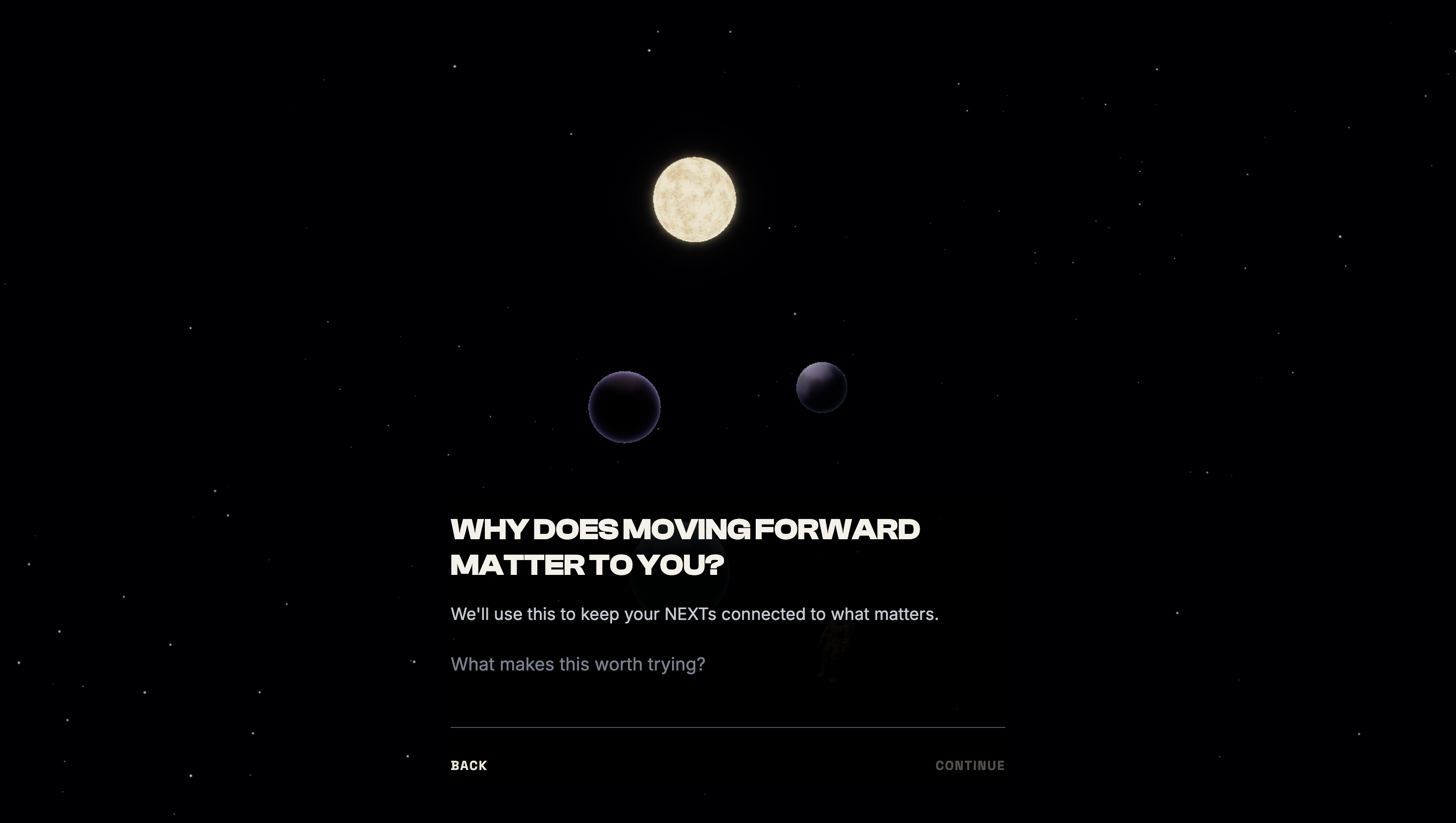
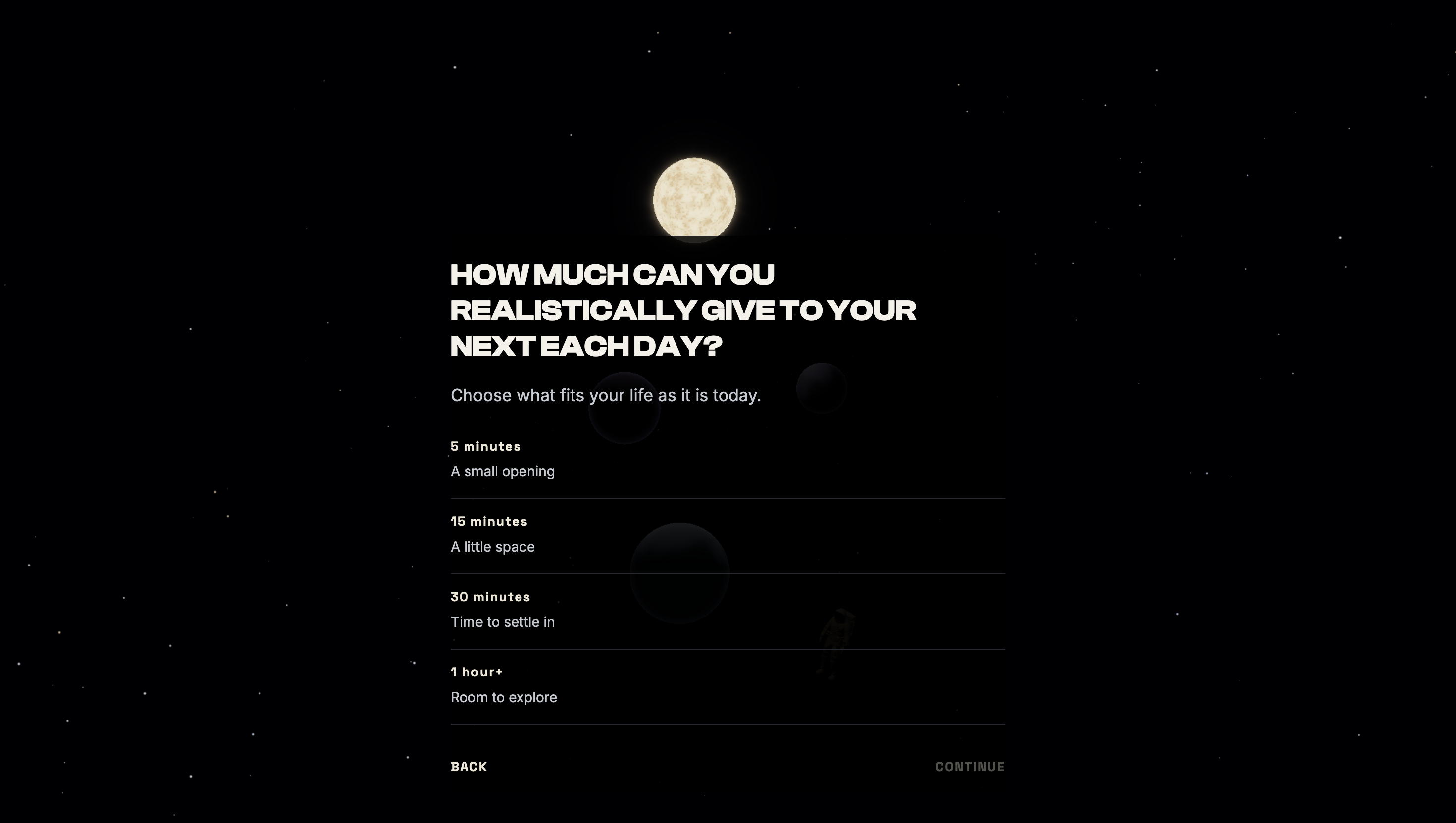
The experience begins by learning about you: where you are, what you're trying to move toward, what may be holding you back, and what kind of action feels realistic right now.
That context is sent through NEXT's backend to Google Gemini, which generates a personalized action: your NEXT.
Not a 30-day plan.
Not twenty habits to track.
Just one thing to do next.
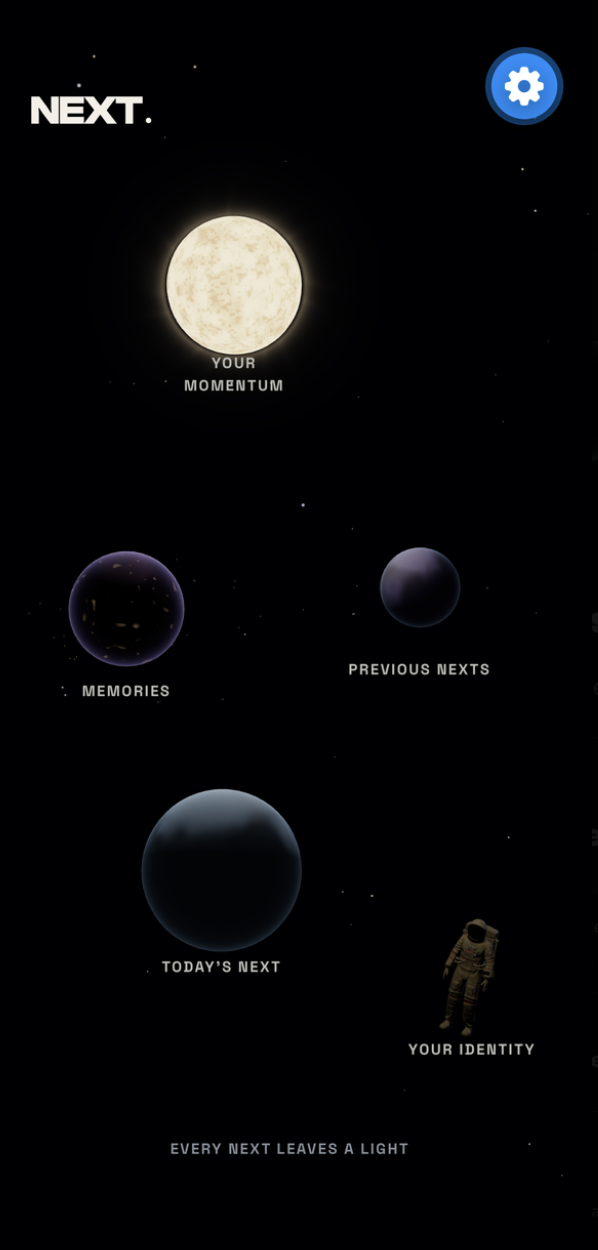
From there, the experience becomes a living 3D universe.
- Today holds your current NEXT.
- History preserves what you've completed.
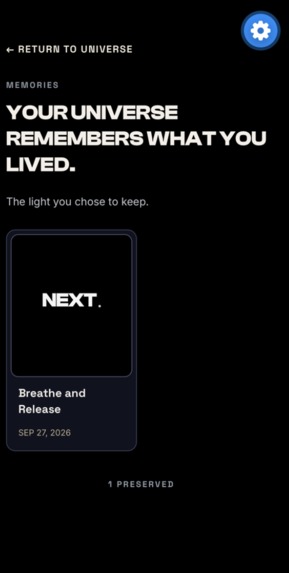
- Memory collects photos from the moments you chose to capture.
- The Hero Star represents your momentum and grows brighter as you build consistency.
- Your astronaut represents you and gives you access to your personal Journey.
- Time Capsules let you leave reflections for the person you're becoming.
When you complete a NEXT, it becomes part of your history and changes the universe around you. You can attach a photo so the experience doesn't only remember what you did, but also preserves a piece of what that moment looked like.
The goal is to make progress feel less like updating a task manager and more like watching evidence of your life accumulate around you.
How we built it
NEXT was built with React Native, Expo, Expo Router, TypeScript, Three.js, Expo GL, Node.js, and the Google Gemini API.
The mobile experience is built in React Native with Expo, while the universe is rendered as an interactive 3D environment using Three.js and Expo GL. The planets, Hero Star, astronaut, lighting, shaders, camera movement, and interactions combine to make the interface itself part of the storytelling.
For AI generation, the client sends the user's personalization context to a separate Node.js backend. The backend communicates with Gemini and returns structured NEXT content to the app.
Keeping this server-side was important because the Gemini API key never needs to be embedded in the client application.
The app also includes local persistence so a user's completed NEXTs, memories, progress, and journey can survive between sessions.
A major design goal throughout development was making the experience feel cinematic without making it impractical. The opening sequence, lightspeed transition, identity experience, camera movement, glowing interfaces, celestial interactions, and completion sequences were designed to make doing something in the real world feel consequential inside the digital world.
Challenges we faced
One of the biggest challenges was combining a traditional mobile interface with an interactive 3D environment.
It wasn't enough to make the universe look good. Planets still needed to behave like usable interface elements. Touch targets, camera projection, dragging, tapping, animation, navigation, and performance all had to work together on an actual phone.
Another challenge was integrating Gemini reliably.
During development, the app initially appeared to be generating NEXTs correctly while it was actually falling back to local generation. Tracing the complete request path revealed an invalid Gemini structured-response configuration in the backend. Fixing that taught me the importance of testing the entire AI pipeline rather than assuming that a successful-looking UI means the model actually responded.
Photos introduced another set of challenges. They needed to be selected reliably, remain available after a reload, stay associated with the correct completed NEXT, and appear in Memories without creating a second source of truth.
There was also a constant balance between visual ambition and performance. NEXT uses animated 3D objects, custom visual effects, a rigged astronaut model, gesture interaction, and cinematic transitions, but it still has to run on a phone. I had to repeatedly choose restrained effects over adding complexity simply because it looked impressive.
Finally, designing for Reduce Motion made me think differently about animation. Motion couldn't be the only thing communicating state or meaning. Important interactions still needed to make sense when automatic movement was reduced.
What I learned
This project taught me that building with AI is about much more than making an API request.
The quality of an AI experience depends on the context you provide, the structure you expect back, what happens when the model is unavailable, and how the generated result becomes part of the rest of the product.
I also learned a huge amount about React Native, Expo, 3D rendering, shaders, gesture handling, state persistence, mobile performance, and designing interactions that cross the boundary between a 2D application and a 3D world.
But the biggest thing I learned was about product design.
At first, it was tempting to keep adding features. Over time, the more important question became: does this make the user feel like they're moving forward?
That question shaped everything from generating only one NEXT at a time to making completed actions become permanent parts of the universe.
AI-assisted development
We used OpenAI Codex as a coding assistant during the hackathon to help implement features, debug issues, and move faster. Our team focused on the product idea, user experience, visual direction, feature decisions, testing, and iteration. Gemini is the AI used inside the finished product, while Codex was used primarily as a development tool
Accomplishments I'm proud of
I'm especially proud that NEXT became more than an AI prompt wrapped in an interface.
Gemini is an important part of the experience, but the product continues after generation. A generated NEXT becomes something you do in the real world, completing it changes your persistent state, photos become memories, completed actions become history, consistency affects your Hero Star, and the universe gradually becomes a representation of your journey.
I'm also proud of how much of the interface is custom. Instead of building the main experience around conventional cards and dashboards, I explored how planets, stars, light, depth, camera movement, and an astronaut could function as navigation while still carrying meaning.
Most importantly, I built something inspired by an experience I actually understood.
What's next for NEXT
There is a lot more I would like to explore.
A production version would need real authentication, secure cloud synchronization across devices, a permanently hosted backend, stronger account and privacy controls, and deeper accessibility testing.
I'd also like Gemini to understand a user's journey over longer periods of time so that future NEXTs can respond not only to their initial answers, but to what they've actually accomplished and reflected on.
The universe itself could evolve further as well. Different kinds of progress could leave different visual traces, memories could form constellations, and long-term chapters of someone's life could become distinct regions of their universe.
But I want to preserve the principle that started the project:
NEXT should never overwhelm you with everything you could become.
It should help you answer a much smaller question:

Log in or sign up for Devpost to join the conversation.