-
-
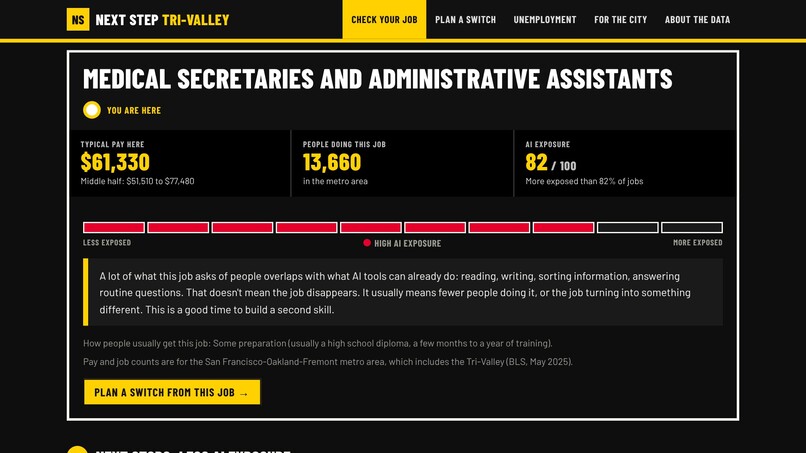
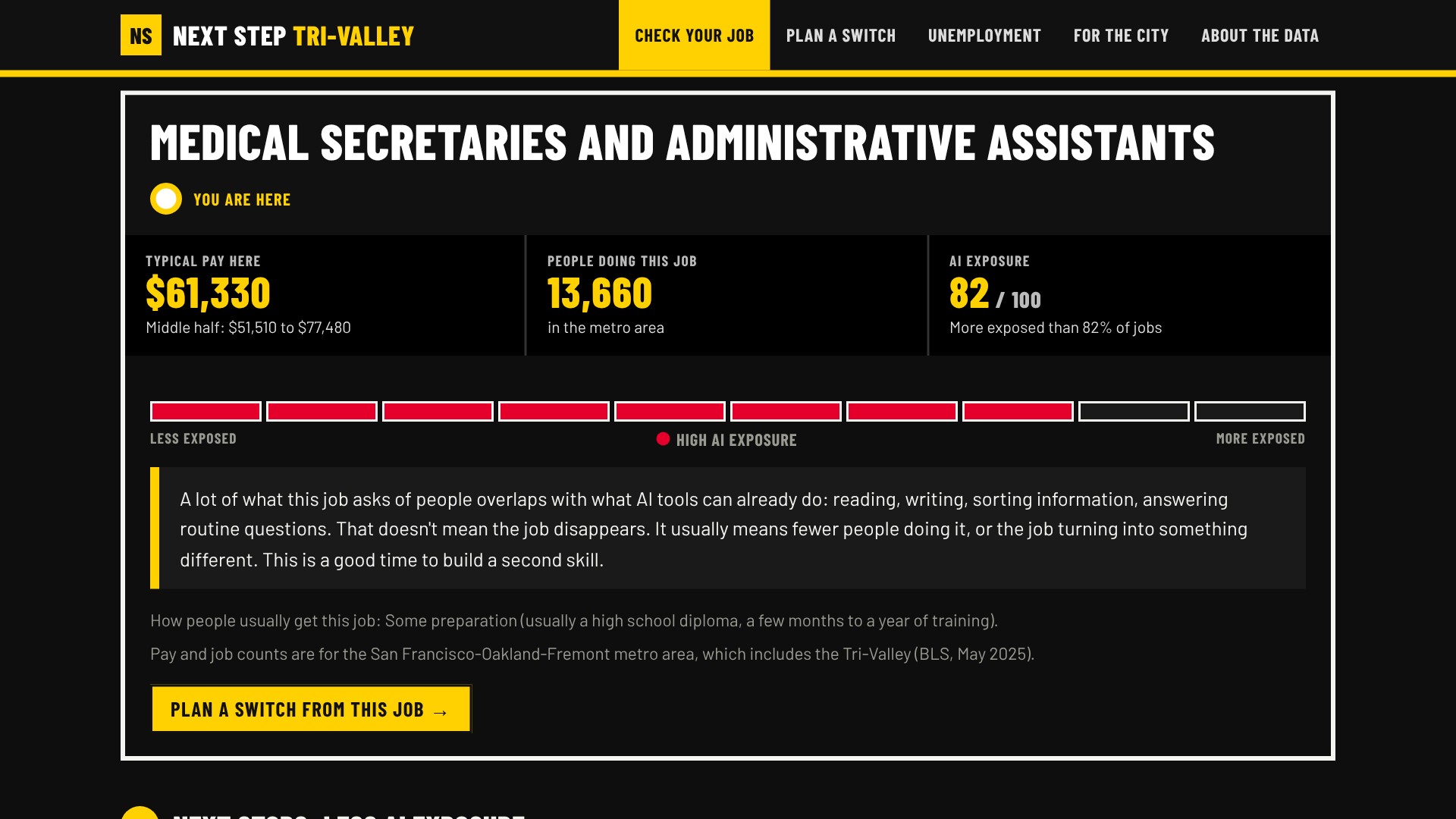
Your job as a station sign: local pay, how many people do it, and AI exposure.
-
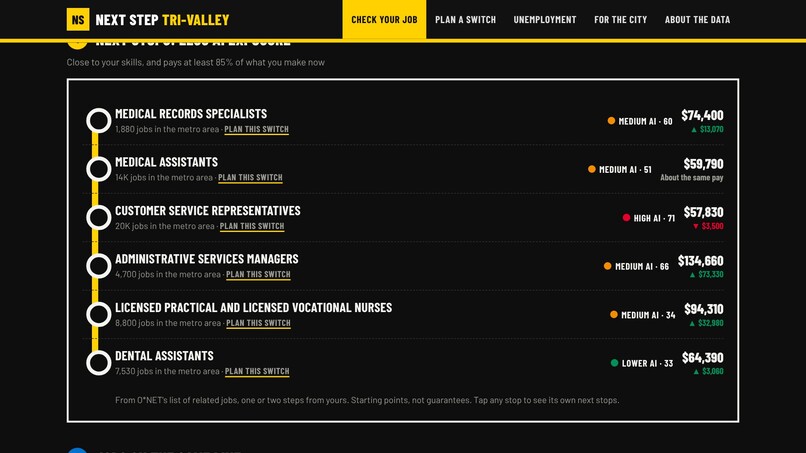
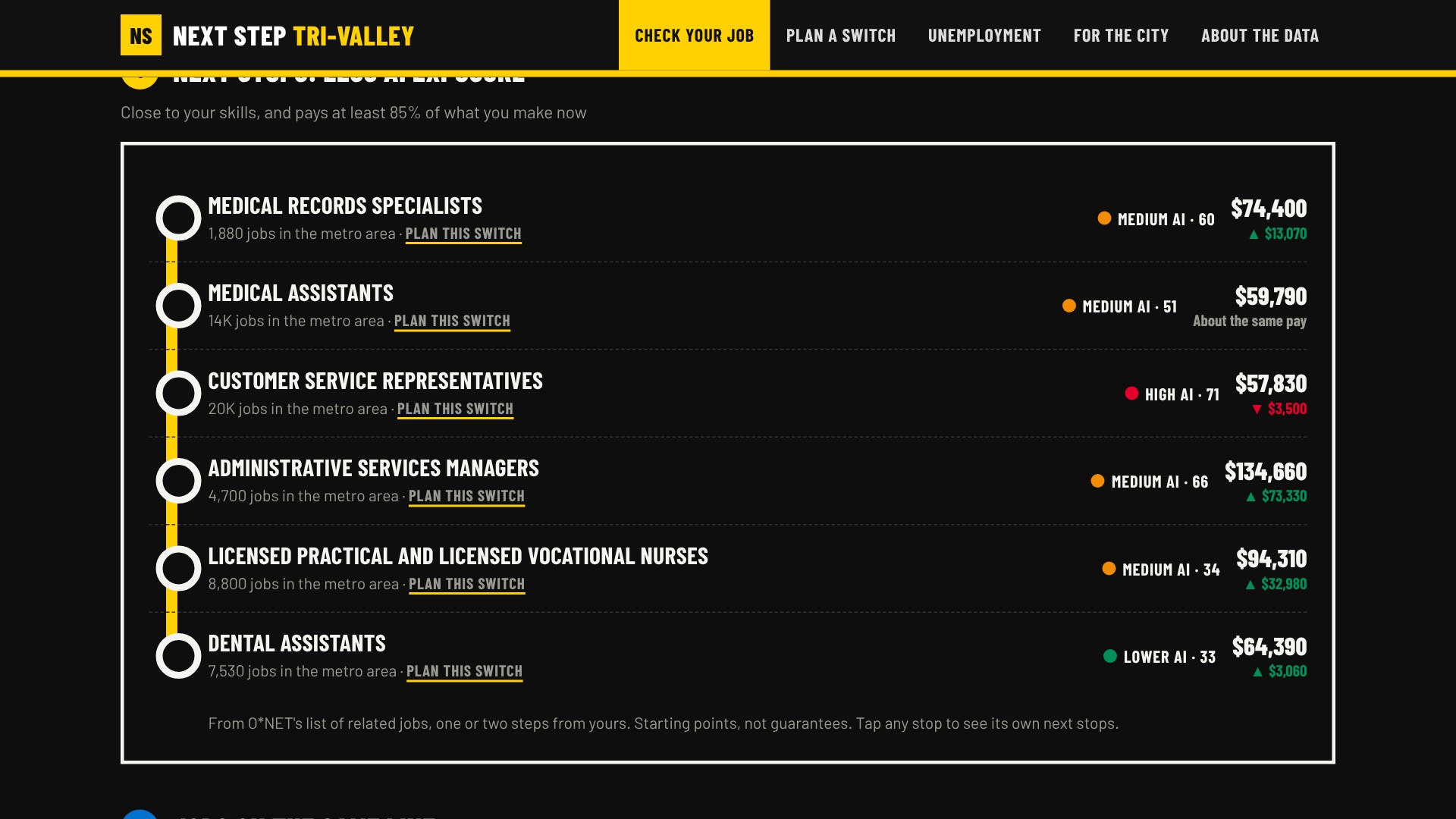
Next stops: nearby jobs that use your skills, are less exposed to AI, and pay close to what you make.
-
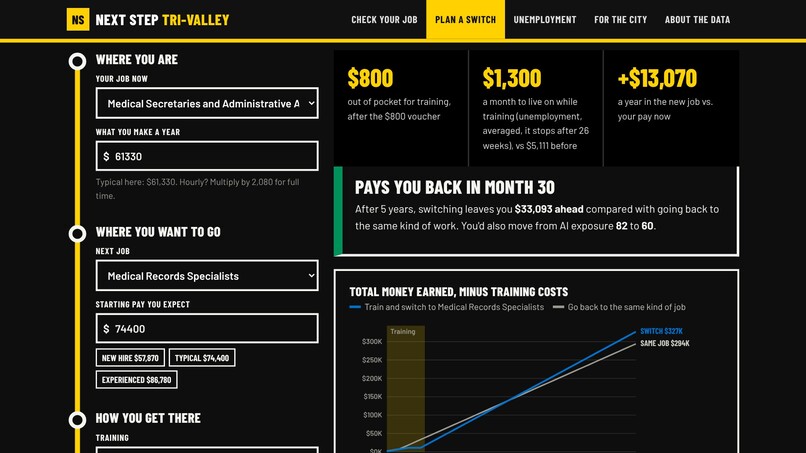
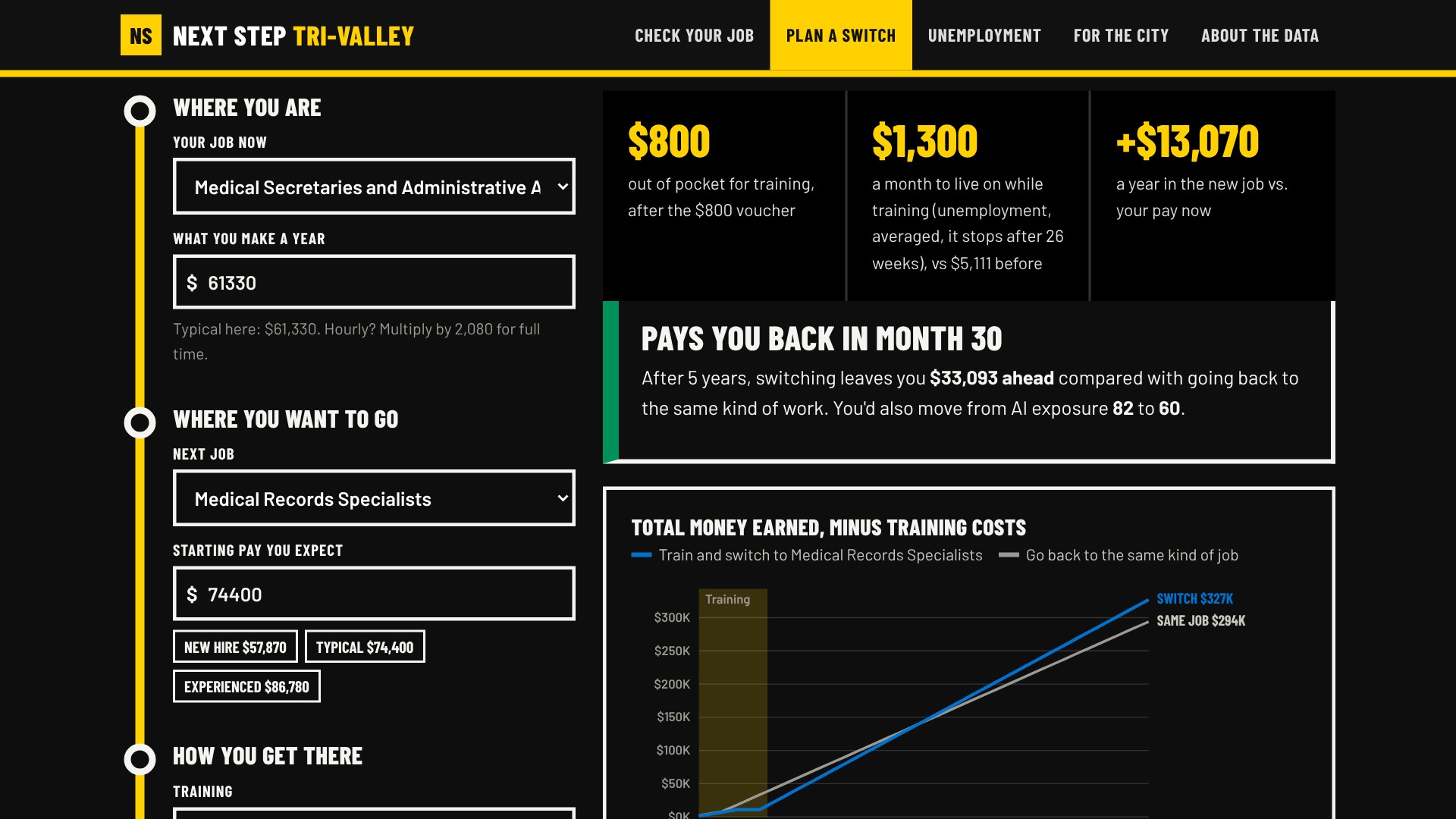
Switch planner: training cost, money while training, new pay, and the month it pays you back.
-
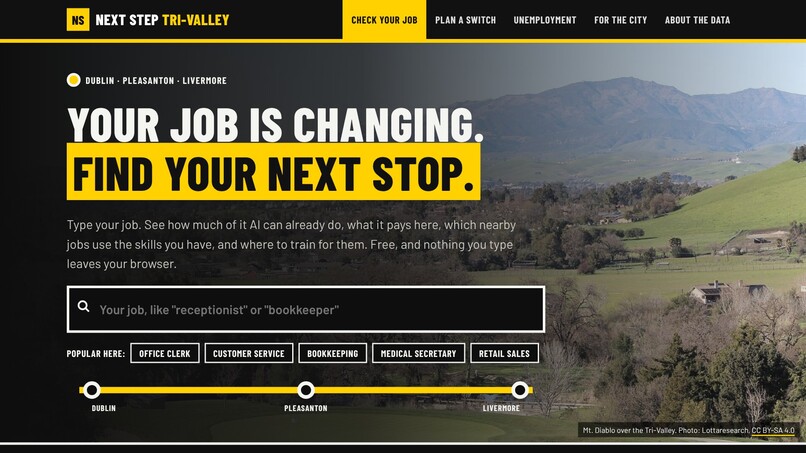
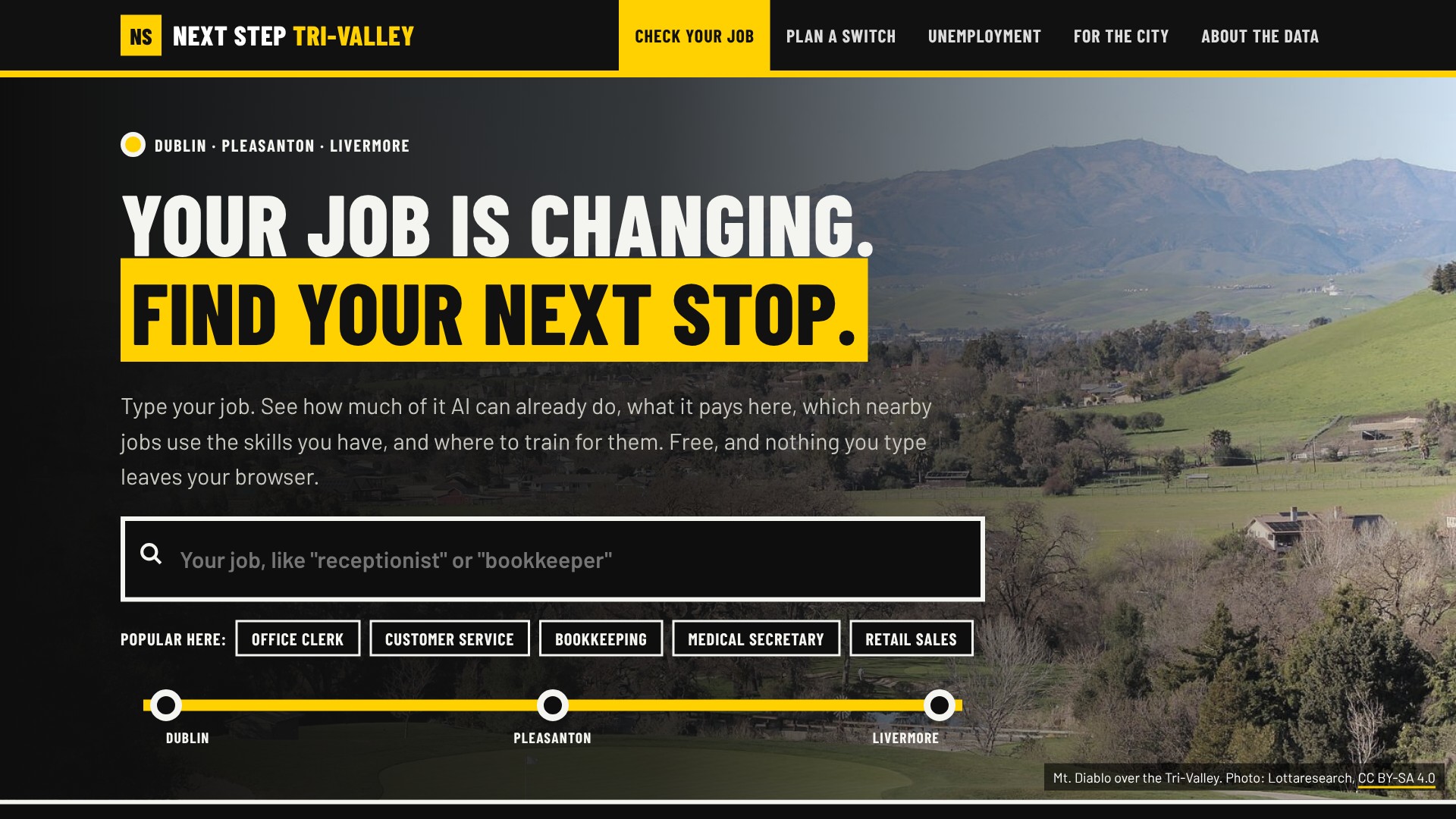
Type your job. Local Tri-Valley photos rotate behind the search.
-
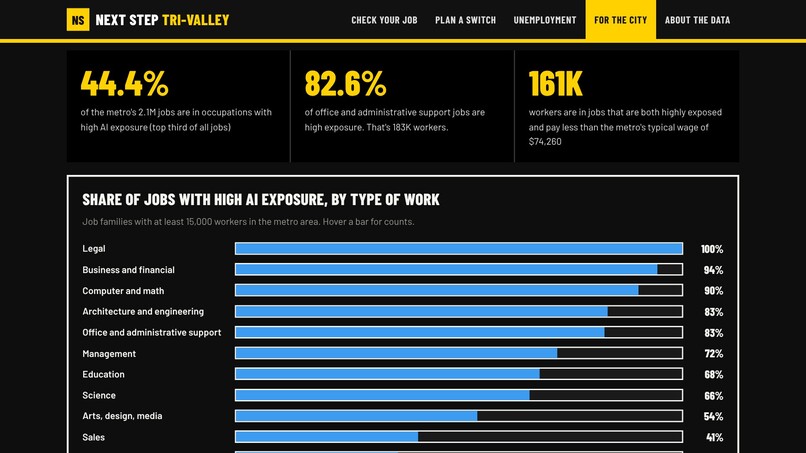
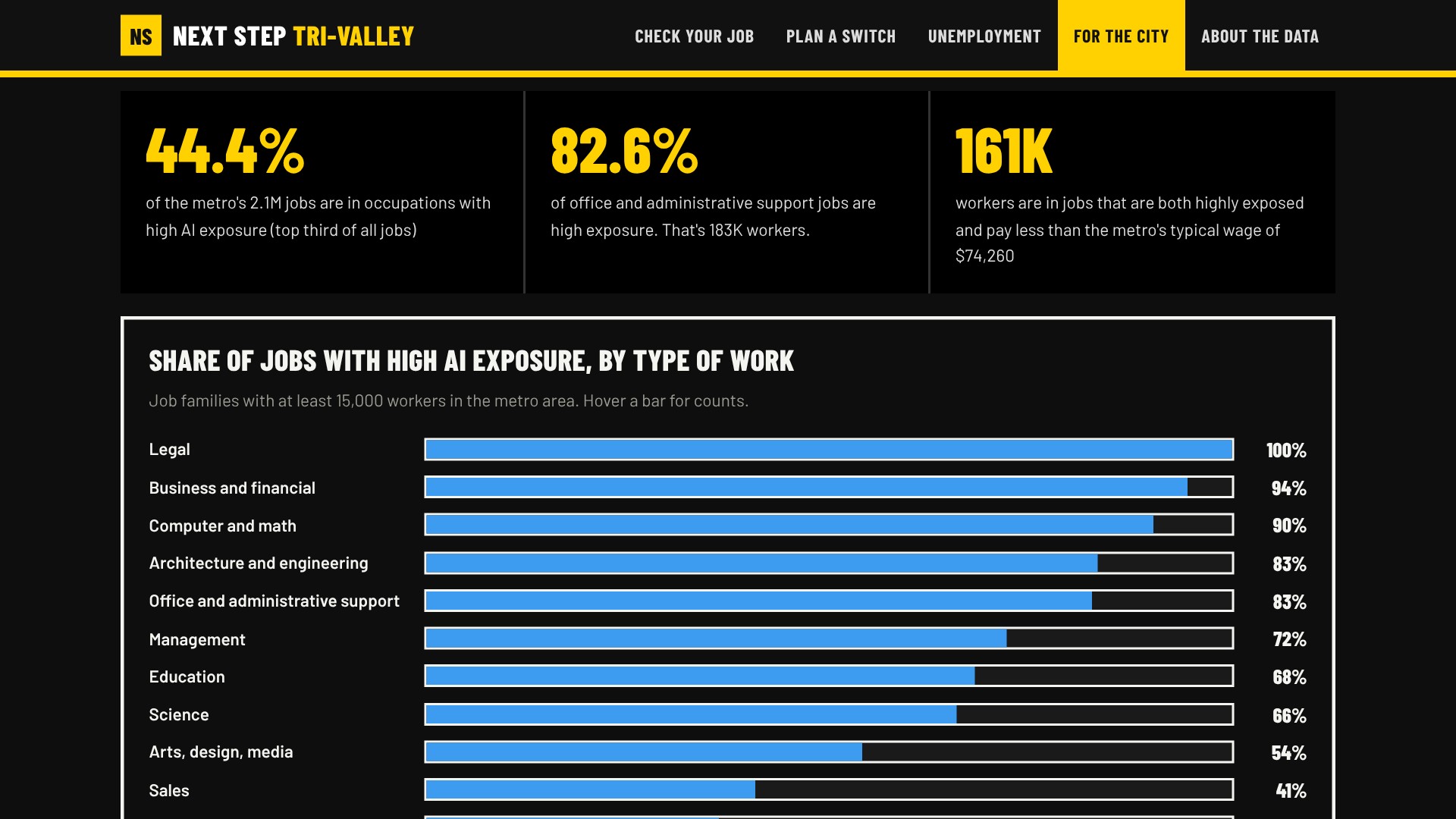
For the city: who in our region is most exposed, and what a $40K voucher pilot would cover.
Try it: https://abhinavjag.github.io/next-step-tri-valley/
What is the specific problem, and how do you know it's real?
Picture a medical secretary at a clinic in Pleasanton. Ten years on the job. The clinic adopts software that handles scheduling and records, and the front office shrinks. They file for unemployment and get a check, but nobody tells them which job to aim for next or where to train for it nearby.
I started seeing this problem in the data first. For my research paper, The Safety Net Was Not Built for This (published in NHSJS in 2026), I matched AI exposure scores to wage data for hundreds of jobs. Office and administrative jobs kept standing out. They're among the most exposed to AI and among the lowest paid.
When I ran the same numbers for our own metro area for this project, it was worse than I expected.
- 83% of office and administrative support jobs in the San Francisco-Oakland-Fremont metro area are in the top third for AI exposure. That's about 183,000 workers.
- About 161,000 people work in jobs that are highly exposed to AI and pay less than the area's typical wage of $74,260. They have the least savings to fall back on.
- If they're laid off, California unemployment tops out at $450 a week. That cap hasn't moved since 2005, and it doesn't pay for a new skill.
I took this to my own city. I spoke at a Dublin City Council meeting and proposed a $40,000 reskilling voucher pilot to a council member, at $800 per worker. While putting that proposal together, I kept finding the same thing: the help already exists, but it's scattered, and almost nobody knows to look for it. Las Positas College has certificates for exactly the jobs these workers could move into. The Tri-Valley Career Center offers free coaching and training scholarships. California Training Benefits lets people keep their unemployment while they train, but only if they ask before their 16th week.
What it does
You type your job, using everyday words like "bookkeeper" or "front desk," and you get:
- What it pays here and how many people do it, from federal wage data for our metro area.
- An AI exposure score from 0 to 100, with a plain explanation of what it means and what it doesn't.
- Moves toward less AI exposure. These are jobs one or two steps from yours that are clearly less exposed, still pay at least 85% of what you make now, and don't need much more training.
- Jobs that use the skills you already have, from the Department of Labor's list of related jobs.
- Where to train nearby. Las Positas College programs matched to the jobs you could move into, with tuition-free options shown first.
- Free local help, like the Tri-Valley Career Center, California Training Benefits, and the community college fee waiver.
It also has a switch planner. A worker picks their job and the job they want, sets the training, and says whether they were laid off. The planner shows the out-of-pocket cost, what they'd live on while training (unemployment keeps paying under California Training Benefits), the new pay, and the month the switch pays them back, with a 5-year chart comparing both paths. There's also an unemployment estimate built on EDD's benefit table, and a For the city page. That page shows local leaders which kinds of work are most exposed, lists the largest jobs that are both exposed and underpaid, and shows what a $40,000 reskilling voucher pilot at $800 per worker would cover. It's the pilot I've proposed to the Dublin City Council.
The whole thing runs in the browser. There's no account and no tracking, and nothing a worker types is sent anywhere. That matters for someone who just lost their job and doesn't want to hand over personal details.
How I built it
- Data: BLS Occupational Employment and Wage Statistics (May 2025) for the San Francisco-Oakland-Fremont metro area, which includes Dublin, Pleasanton and Livermore. AI Occupational Exposure scores from Felten, Raj and Seamans. O*NET 30.3 related occupations and job zones. The Las Positas College catalog, plus EDD and Tri-Valley Career Center pages for the help section.
- Pipeline: A Python script joins the three datasets. The exposure scores use an older job-code list, so I used the official BLS crosswalk to match 83 jobs whose codes changed. The script turns each score into a percentile and finds "next step" jobs by walking two steps through O*NET's related-jobs network with filters for exposure, pay and training level. It writes one JSON file.
- Site: Plain HTML, CSS and JavaScript with no framework, hosted free on GitHub Pages. It works on phones, supports dark mode, and the charts have a table view for screen readers.
- AI disclosure: I used Claude, an AI assistant from Anthropic, to help write the code, collect and process the public data, and draft the text on the site. I chose the problem, the features, and which local programs and help to include. I tested the site myself and checked its numbers against my published research.
Challenges I ran into
- Matching job codes across datasets. The AI exposure scores use the 2010 job list, while wages and O*NET use the 2018 list. I used the BLS crosswalk to bridge them. 52 jobs still couldn't be matched, so I left them out and said so on the site rather than guessing.
- The first version of "next jobs" wasn't useful. O*NET's closest matches for office workers were almost all other office jobs, which are just as exposed to AI. I added a second step through the network and filters so the tool suggests moves that are actually less exposed without a big pay cut.
- No Tri-Valley-only wage data. BLS publishes wages for the whole metro area, not for individual cities. I used the metro numbers and labeled them clearly everywhere.
- Being honest about what exposure means. A high score isn't a prediction that a job will disappear. I wrote the explanations to say what the score measures and what it doesn't.
Accomplishments I'm proud of
I turned findings from my published paper into something a worker can actually use in under a minute. I'm also proud that the For the City page ties straight to a real proposal I made to my city council.
What I learned
Real government data is messy. Job codes don't match between datasets, and wages aren't published city by city. I also learned that the most useful help, like California Training Benefits, is often the least known.
What's next
- Share it with the Tri-Valley Career Center and ask the City of Dublin to link it from its economic development page.
- Add Spanish, Chinese and Hindi versions, since many Tri-Valley workers are more comfortable in those languages.
- Add more local programs, like Chabot College, adult schools and apprenticeships.
- Use it to find and sign up workers for the voucher pilot if the city funds it.
Built With
- css3
- github
- html5
- javascript
- playwright
- python

Log in or sign up for Devpost to join the conversation.