Inspiration
Next Move started as something I built for myself long before it became a product.
Every Wednesday, I would spend around two hours reflecting on my week. I'd write everything on my mind into a notes app, copy it into ChatGPT, ask it to identify recurring signals, manually organize those signals into different areas of my life, work with it to identify what deserved my attention the most, refine the next move until it felt right, then find time for it in my calendar.
By the end, I always had one clear action that made my present moment feel more manageable.
It worked.
The problem was that it took almost two hours, involved a lot of repetitive prompting, and far too much copying and pasting between tools.
One day I realized something:
The value wasn't the prompts. The value was the sequence.
That realization became Next Move.
I showed the workflow to a few friends in their thirties who were juggling work, relationships, health, finances and everything else life throws at you. The most common reaction was:
"That would actually be really useful."
So I decided to build it.
What it does
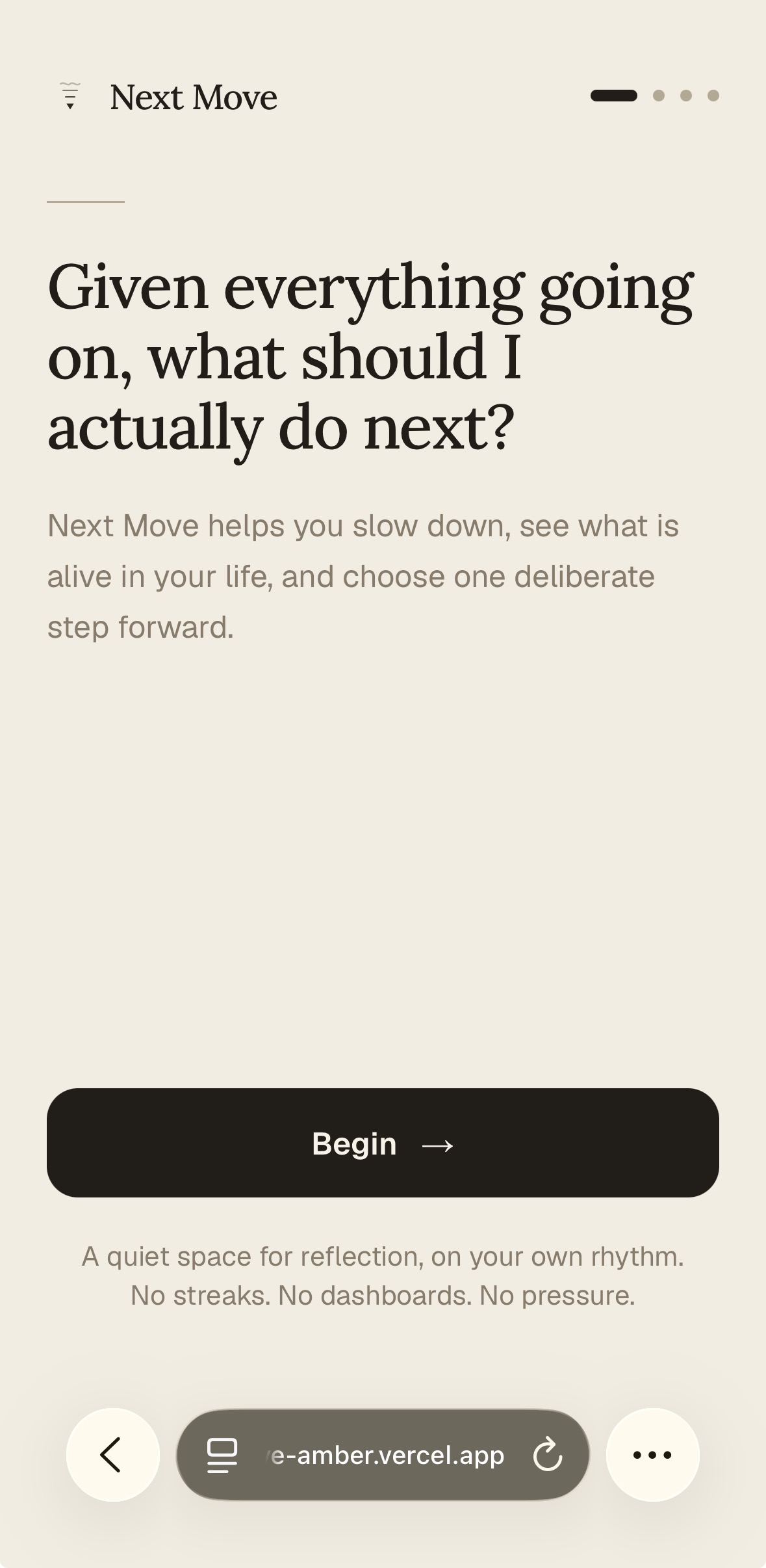
Next Move helps people decide what deserves their time and attention next.
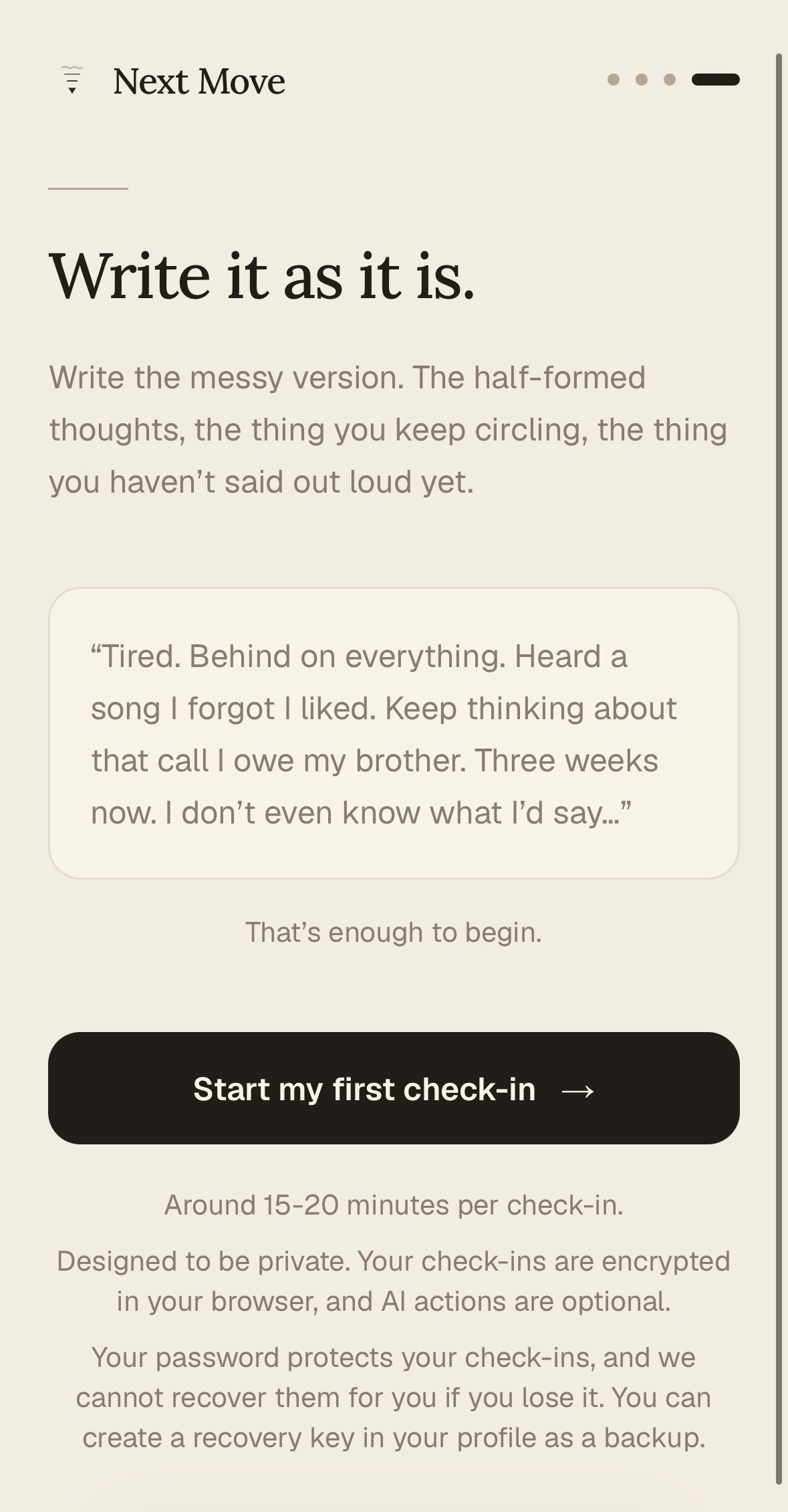
Instead of asking users to organize their lives into endless task lists, it starts by letting them empty everything that's currently on their mind.
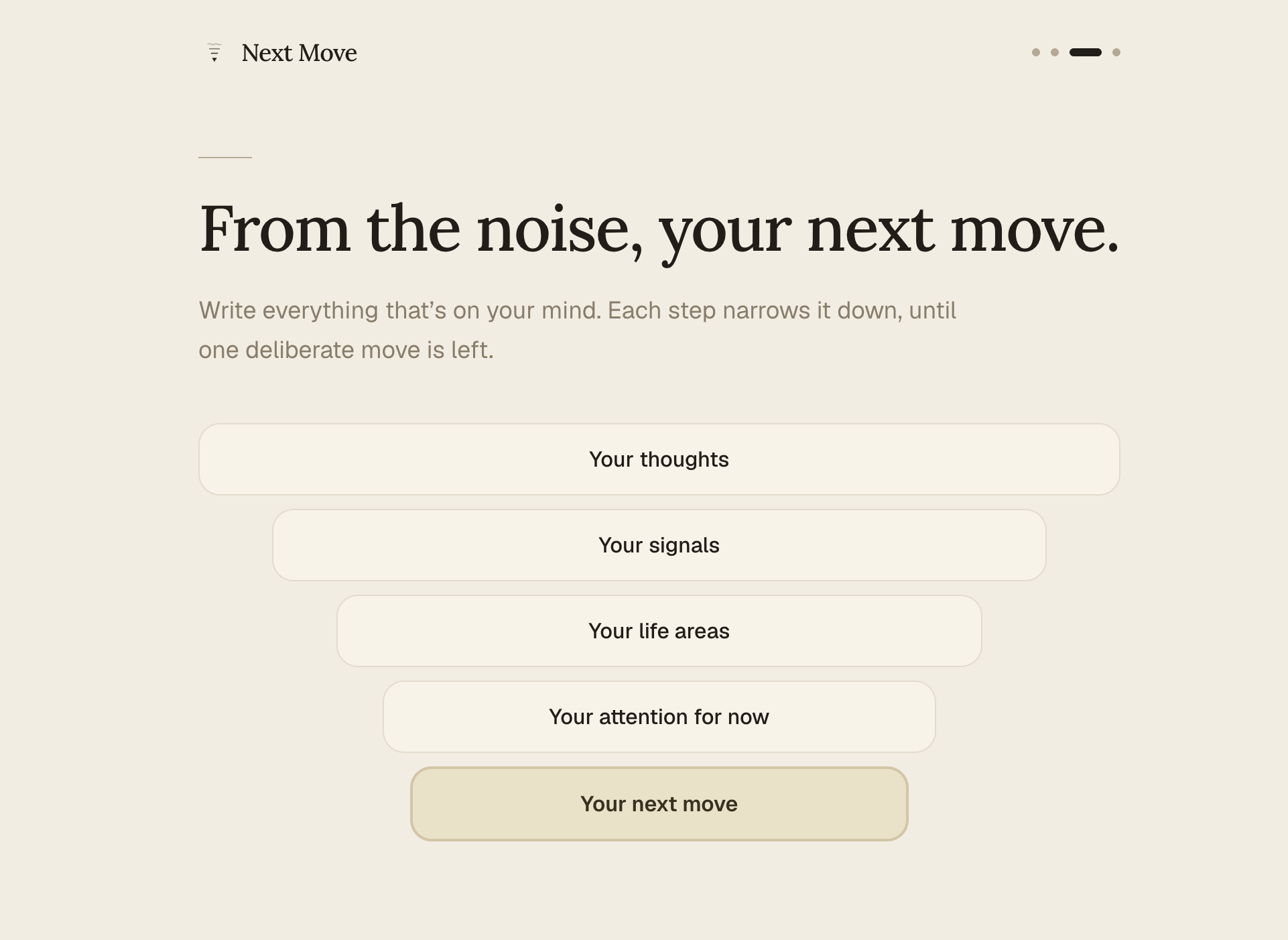
From there, GPT-5.6 transforms that reflection through a series of deliberate reasoning steps:
- Extract recurring signals.
- Group those signals into six life areas.
- Identify the thread that deserves attention right now.
- Suggest one deliberate next move.
- Remember everything else as persistent threads.
Instead of trying to optimize every part of life, Next Move answers one question:
"Given everything going on in my life, what should I deliberately move forward next?"
Choosing one thread shouldn't feel like abandoning the others, which is why unresolved topics become persistent threads that remain available in future check-ins.
How I built it
Technology
- Next.js
- TypeScript
- Tailwind CSS
- Supabase
- OpenAI API
- Vercel
Using GPT-5.6
GPT-5.6 powers the entire reflection pipeline.
Rather than acting as a coach or therapist, it performs a sequence of reasoning tasks:
- Understand unstructured thoughts.
- Extract meaningful signals.
- Organize them into life areas.
- Identify the current central tension.
- Suggest one realistic next move.
A significant part of the work went into prompt engineering and context engineering to make every stage feel deliberate, concise and grounded.
Using Codex
Although I'm a senior mobile engineer, this project is a web application.
Throughout Build Week I treated Codex as another senior engineer on the team.
Instead of asking it to "build the app", I used it the same way I'd collaborate with another experienced developer:
- Designing the architecture.
- Defining technical constraints.
- Reviewing generated implementations.
- Iterating on UX details.
- Refactoring code.
- Fixing bugs.
- Maintaining code quality.
Codex dramatically accelerated development while still keeping me responsible for every architectural and product decision.
Challenges we ran into
The hardest problem wasn't writing code.
It was designing an AI experience that doesn't feel like an AI coach.
Early prompts produced generic motivational advice.
That wasn't the product I wanted.
The goal became helping users think more clearly, not telling them how to live.
Another challenge was reducing AI output.
The first versions generated far too much text.
I learned that clarity often comes from generating less, not more.
Finding the right balance between context, brevity and usefulness became one of the biggest design challenges.
Designing an experience that feels reflective without becoming therapy or another productivity app was equally difficult.
Accomplishments that we're proud of
- Turned a personal two-hour reflection workflow into a guided AI experience.
- Built a reasoning pipeline that consistently transforms messy thoughts into one deliberate next move.
- Created a product that feels different from both journaling apps and task managers.
- Kept the user in control throughout every AI-assisted step.
- Built privacy into the product from day one using authenticated access and Row Level Security.
- Successfully collaborated with Codex as an engineering partner throughout implementation.
What we learned
Building with LLMs is as much a product design problem as an engineering problem.
The biggest improvements didn't come from changing models. They came from changing questions.
We also learned that people don't necessarily want AI to solve their lives. They want help making one meaningful decision with greater clarity.
Finally, we learned that AI becomes far more valuable when it participates in a well-designed workflow instead of answering isolated prompts.
What's next
- Persistent Threads are the next major evolution of Next Move. Today they're user-created. Tomorrow they'll become living context that evolves across every check-in.
A persistent thread might be:
- Deciding whether to buy an apartment.
- Navigating a difficult relationship at work.
- Building confidence to finally join an acting class.
As users complete more check-ins, the product develops a richer understanding of their ongoing life context.
Future work includes:
- AI-generated and evolving persistent threads.
- Better long-term reasoning across check-ins.
- Recognition of recurring life patterns.
- Calendar integration that intelligently proposes the best time for the chosen next move.
- Richer context shared between reasoning stages.
Our long-term vision isn't to build an AI that manages someone's life. It's to build one that helps people decide where their time and attention belong next.
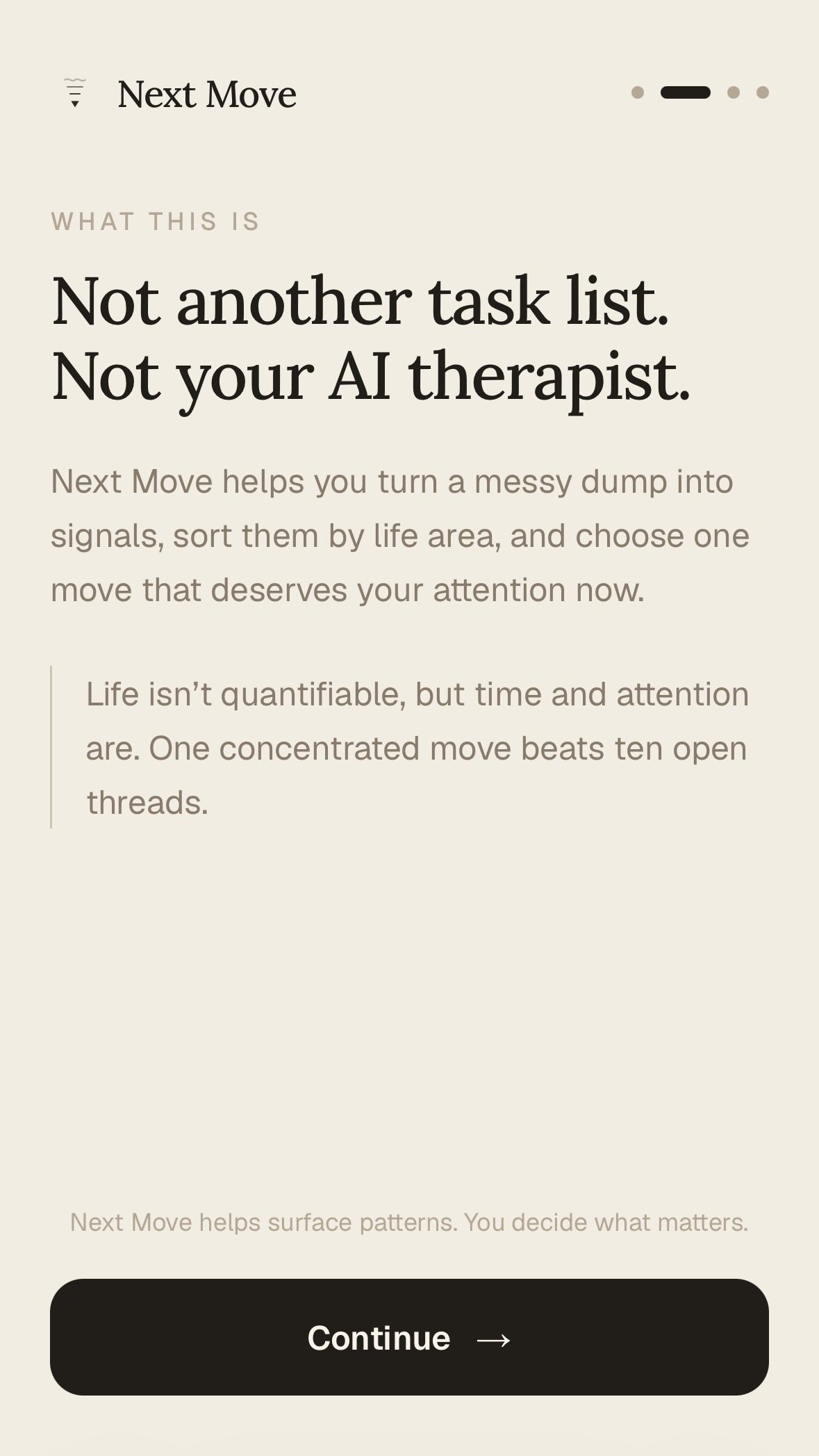
Life isn't quantifiable, but time and attention are.
One concentrated move beats ten open threads.
Built With
- next.js
- openaiapi
- supabase
- typescript
- vercel

Log in or sign up for Devpost to join the conversation.