NEXORA — Autonomous Commerce Intelligence
Negotiate. Verify. Transact.
Inspiration
Millions of consumers and companies buy items on their own each day, despite thousands of other people needing the same item at the same time. This fragmented purchase pattern lowers negotiation leverage, results in extra costs, and exposes the consumer to untrustworthy sellers and ambiguous agreements.
From this question came the idea for NEXORA:
How would the commerce experience be improved if artificial intelligence were able to unite buyers, negotiate on their behalf, evaluate the trustworthiness of a seller, and facilitate transparency in the process?
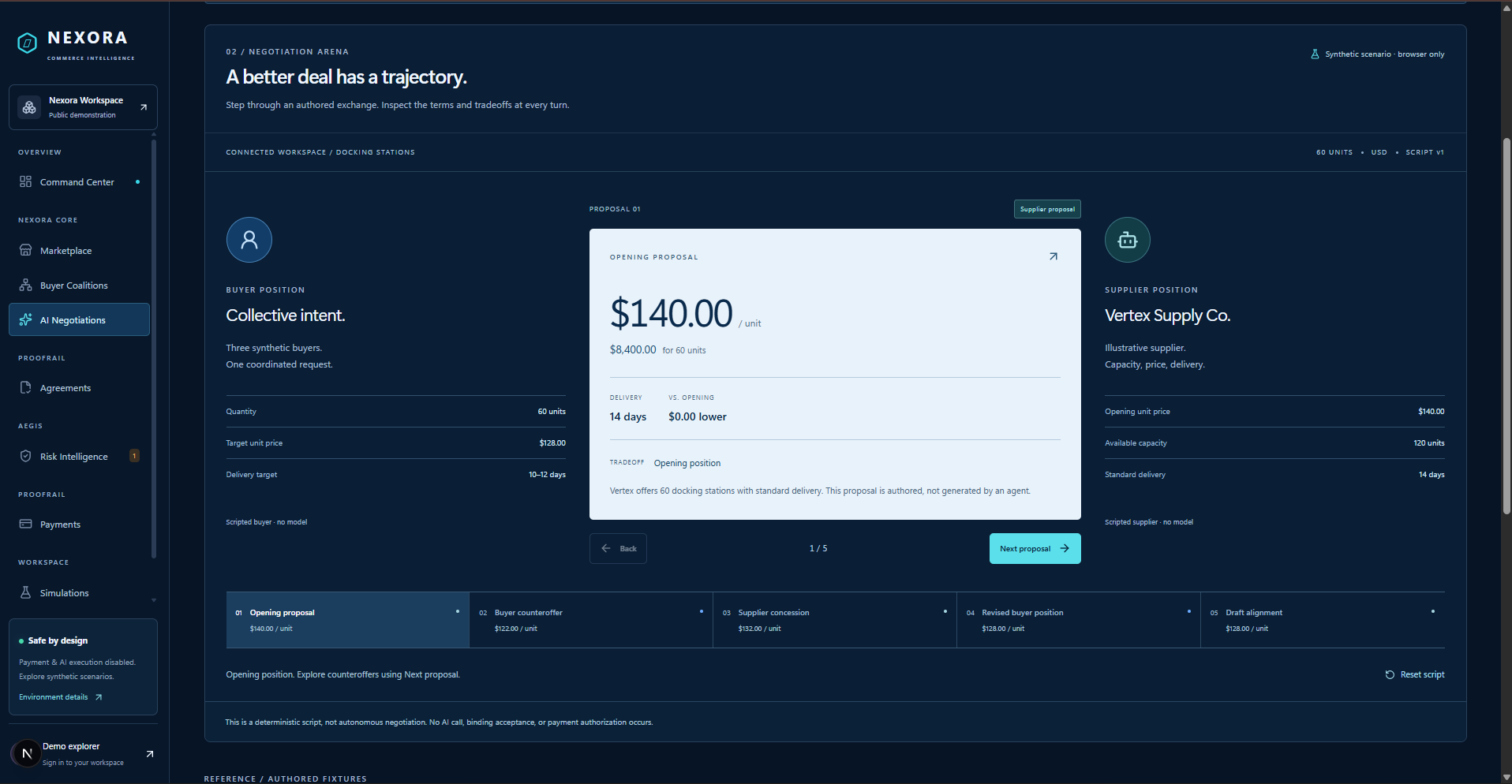
We did not want to develop just another marketplace or AI-driven chatbot. We wanted to investigate the possibilities of using several intelligent systems simultaneously to enhance the entire buying process, from identifying the need for certain goods collectively, through negotiation, risk evaluation, agreement verification, and payment transaction.
What it does
NEXORA integrates three interlinked intelligence systems:
- NEXORA CORE – Collective Purchasing and Intelligent Negotiation
NEXORA CORE assists buyers in finding ways for grouping their purchasing needs into larger buying consortia.
Instead of negotiating individually, buyers have the opportunity to create purchasing consortia that strengthen their bargaining power.
This is intended to assist with:
Intelligent buyer-demand matching and buying consortium creation. Comparison and competitive bidding of suppliers' offers. Negotiations based on artificial intelligence with multiple agents. Savings calculations and transparent benefit distribution. Purchasing advice based on data analysis.
The intention is straightforward: provide individuals with negotiating leverage that only large enterprises could enjoy previously.
- PROOFRAIL - Evidence-Based Agreement and Transactions Verification
A negotiated deal becomes practically meaningless if the set terms are not met.
PROOFRAIL helps overcome this problem by offering an evidence-based agreement and verification solution.
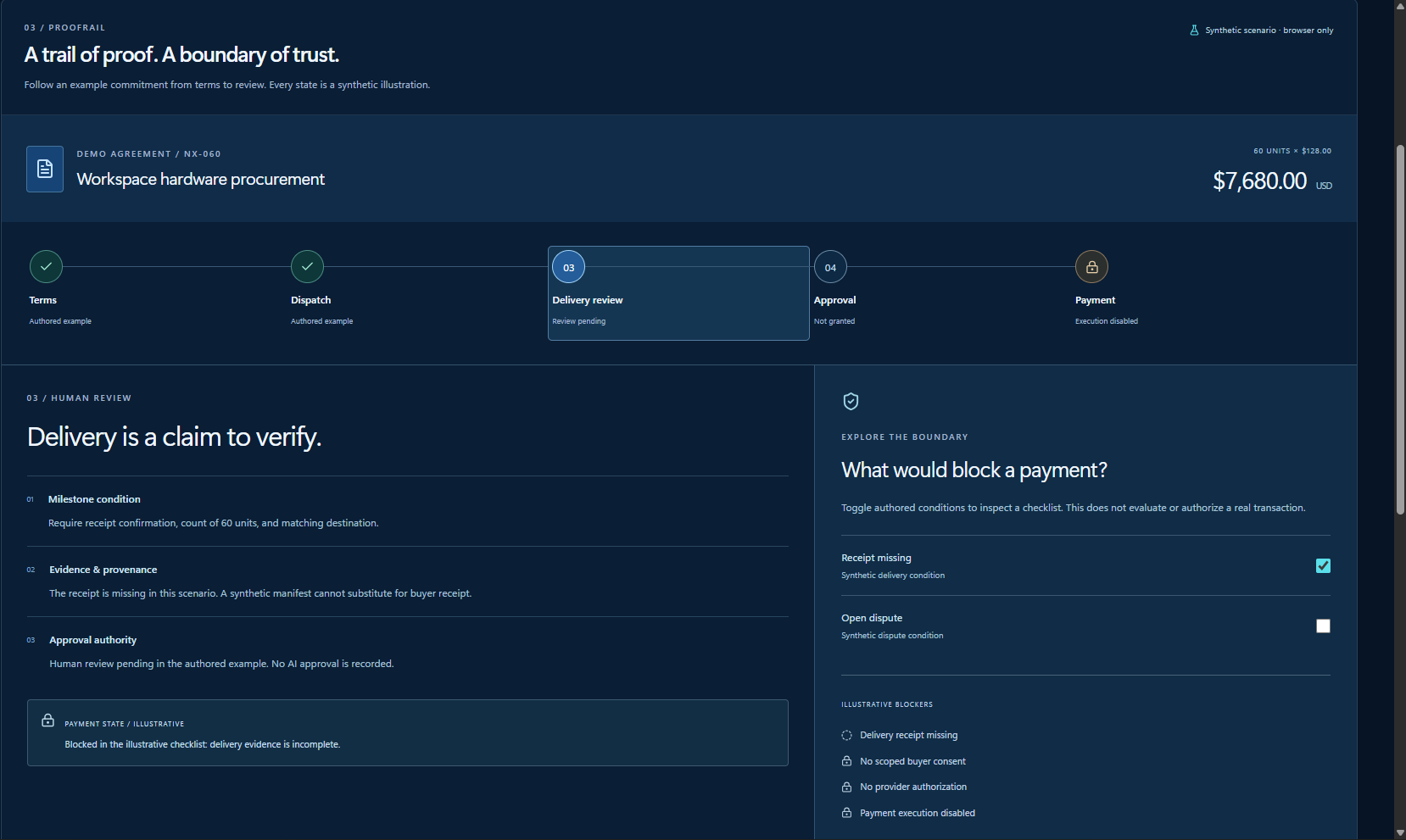
The system is intended for structuring commercial agreements, their milestone verification, evidence, dispute resolution process, and transaction conditions transparency.
Not based only on trust, buyers and suppliers can strive for agreements that have verifiable information behind them.
- AEGIS - Supplier Risk Intelligence and Fraud Detection
Affordability must never be achieved at the cost of security.
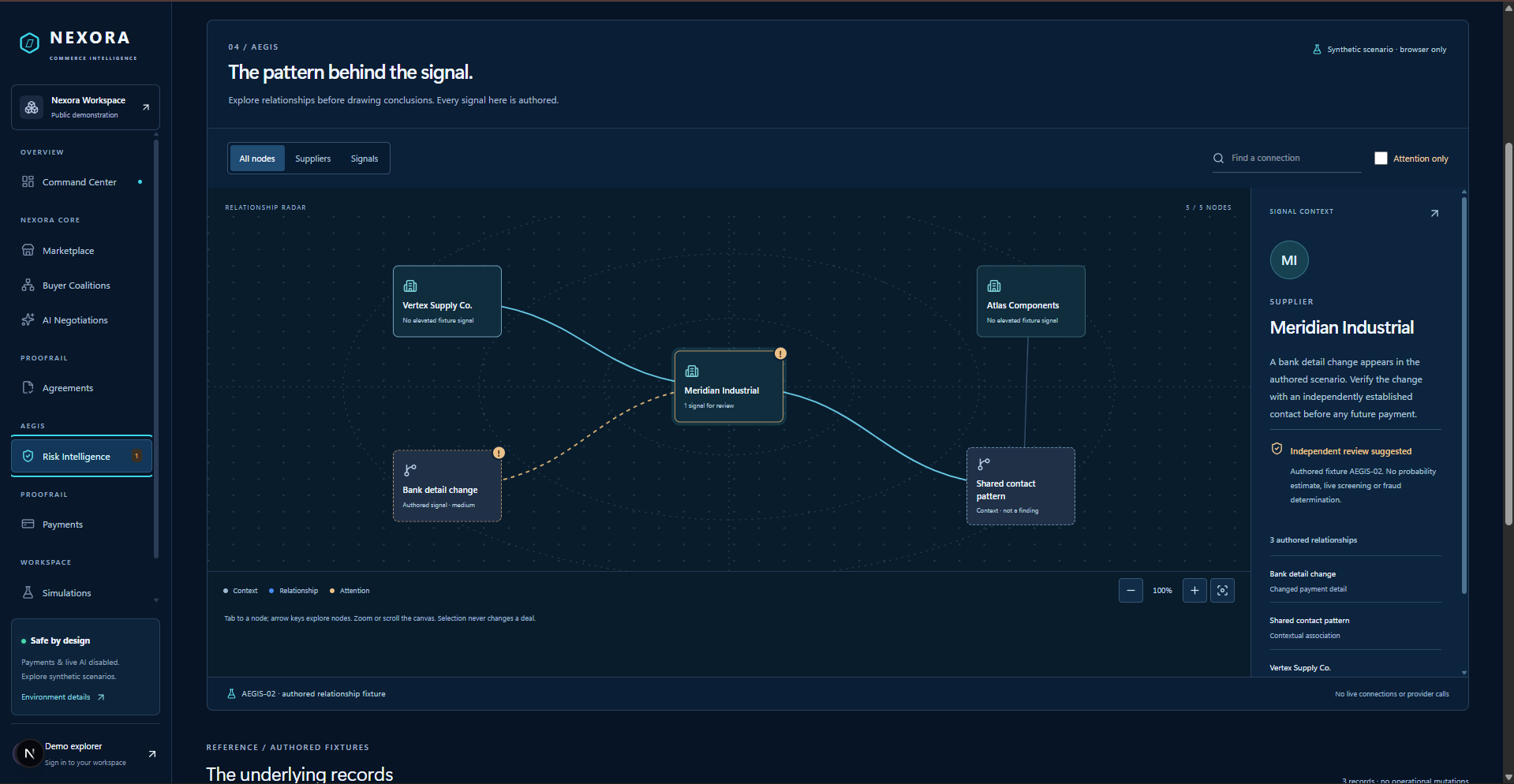
AEGIS is a risk-intelligence layer developed by NEXORA to monitor supplier's activities, detect suspicious connections, reveal unusual commercial activity, and interpret possible risk signs.
With the implementation of the risk intelligence into the purchasing process, NEXORA wants to enable users to consider not only price but also trustworthiness of the offer. Interactive Experience in Commerce Intelligence
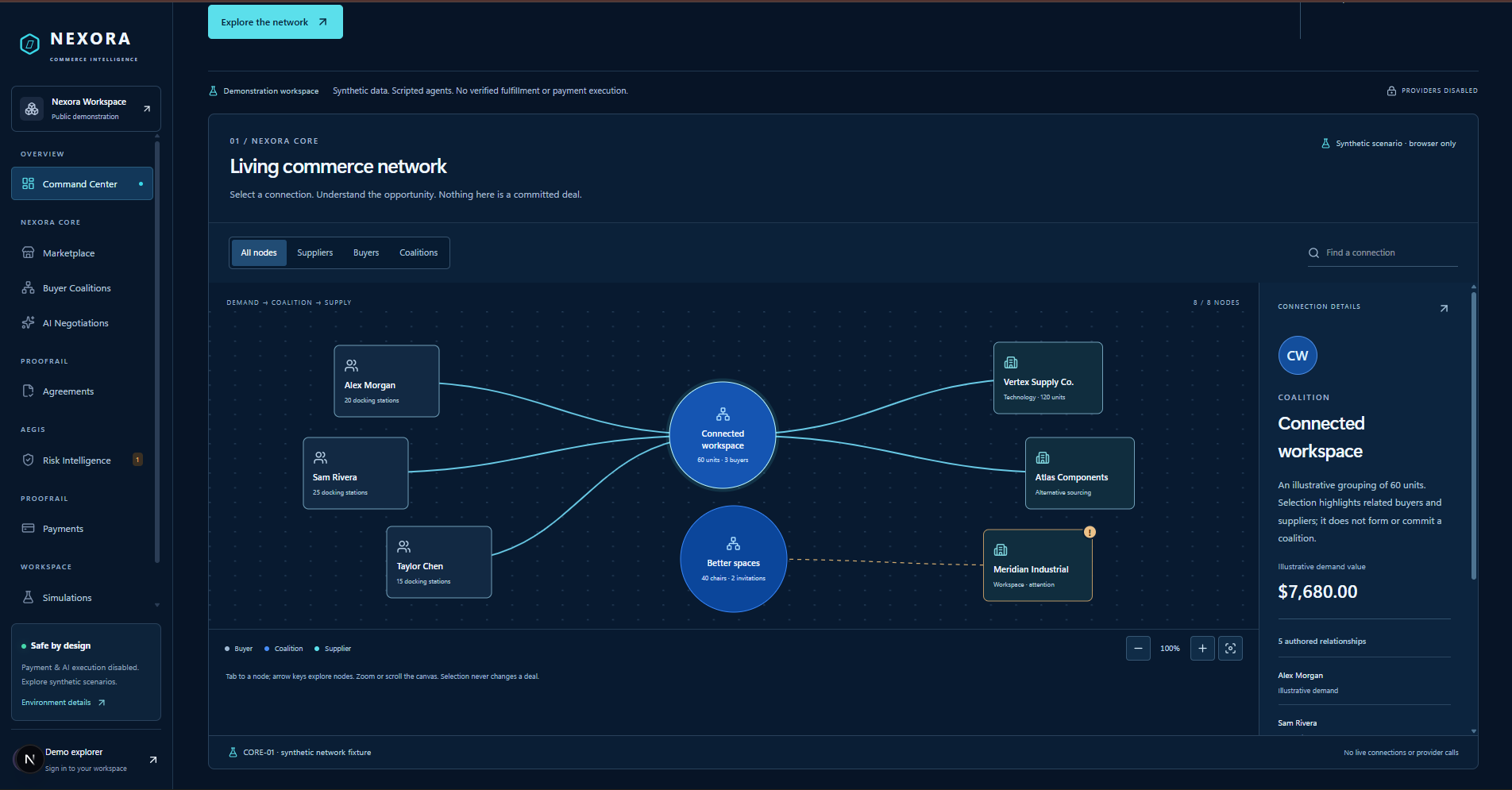
We have also created a unique interface where all these ideas converge.
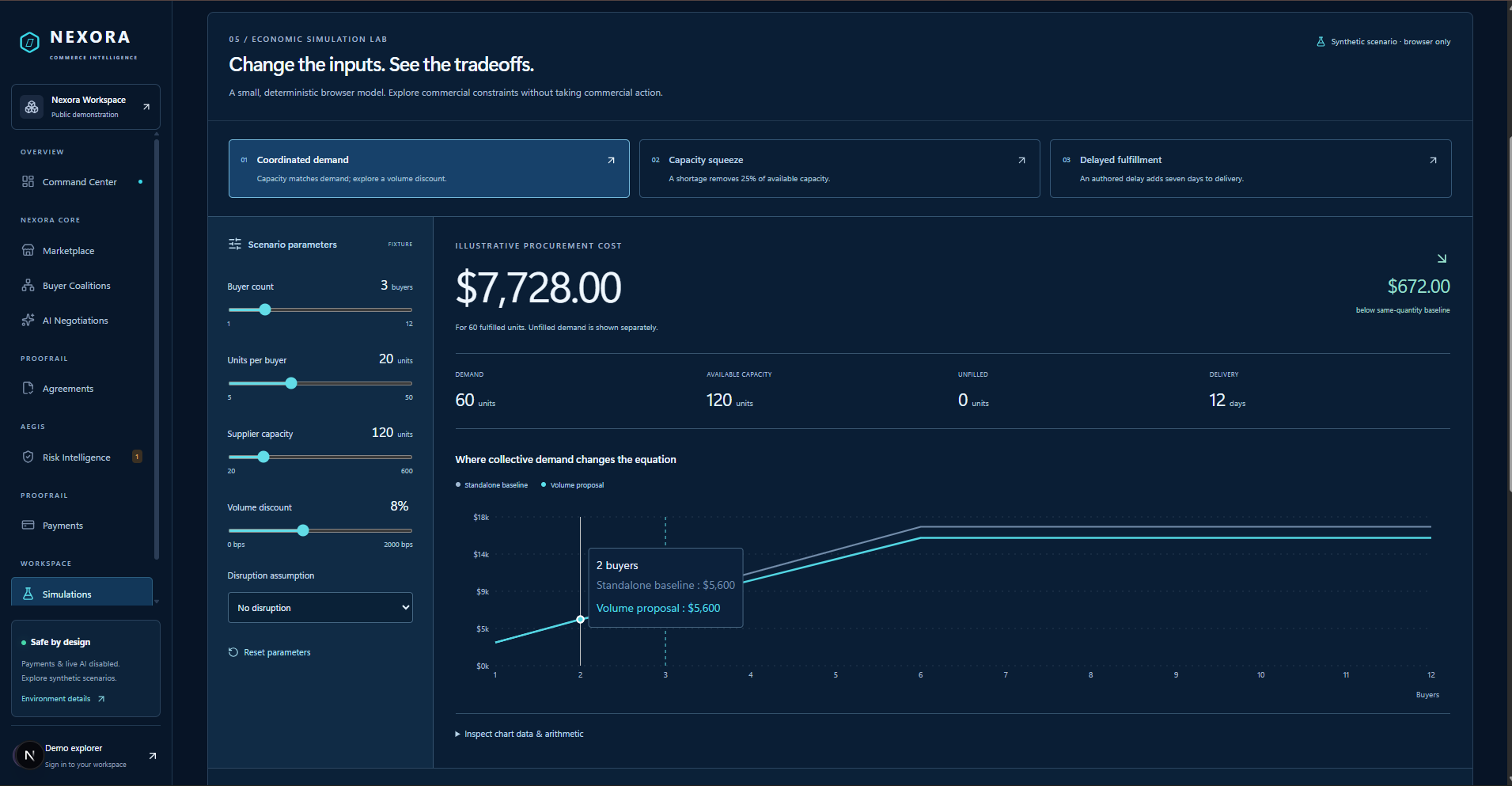
It features a commerce relationship network, negotiation proposal playback, visualization of evidence lifecycles, supplier relationship radar, and economic simulation lab.
With these interfaces, users can analyze how various procurement options, supplier behaviors, and market dynamics may affect the outcome.
In today’s visual scenarios, the data used is always explicitly marked as synthetic to avoid confusion with real-world commerce operations.
How we built it
The concept of our NEXORA was modular commerce platform rather than just a set of disjointed features.
As for the technical base:
Next.js and TypeScript for the architecture of the application. Tailwind CSS for a responsive, custom-built UI. PostgreSQL with Neon as hosting provider for persistent storage of application data. Prisma ORM for database modelling, migrations and type-safe database access. Better Auth for authentication and authorization by organizations. Automated unit tests, integration tests and browser tests for validation of functionality.
The architecture is built upon three major domains: commerce coordination, agreement verification and risk intelligence.
The frontend design is not based on usual dashboard approach – we designed the financial command center in the style of an editorial where users will be able to interact with networks, proposal timetables, risk visualizations and simulation controls.
The backend consists of PostgreSQL foundation with migrations, synthesis of demo data, authorizations and testing connectivity.
The general architecture provides for development direction towards AI negotiation services and payment integration via PayPal Sandbox with authorized users and deterministic policy checks for payments.
Challenges we ran into
Developing the NEXORA system was quite difficult since we were not just building a marketplace but a full-fledged ecosystem of commerce intelligence with interconnected collective purchasing, AI negotiations, supplier risk assessment, agreement validation, and payments.
First, one of the greatest challenges was related to the design of a scalable architecture without harming its security and stability. We had to make sure that all of the buyer information, supplier offers, financial transactions, and organizational permissions will be handled in a secure manner.
Secondly, developing an intuitive interface for the visualization of complicated information was another challenge. In particular, we had to build not just a standard dashboard, but commerce networks, negotiation visualizations, evidence timelines, and supplier relations analysis.
Finally, another technical challenge we encountered was infrastructure-related issues related to Neon PostgreSQL, Prisma migrations, database connection, and authentication. It was important to do everything carefully in order to not break any functionality of the existing components.
In addition, the most important challenge was related to the balancing of the AI automation and financial decisions.
Accomplishments that we're proud of
And we’re particularly proud of our achievement of taking a grand vision and turning it into a functioning technical stack with an interactive demo experience to illustrate how intelligent commerce would look.
The distinct NEXORA command center with the interactive buyer-supplier network, proposal negotiation replay, evidence lifecycle inspection, AEGIS supplier risk visualization, and an economic simulation lab was created successfully.
We managed to implement a functional cloud database infrastructure with Neon PostgreSQL and Prisma, establish a foundation for authentication and role-based authorization, and apply migrations and seeding demonstration data for the database.
As well as creating the platform based on the three complementary systems:
NEXORA CORE: Collective purchases and intelligent negotiations. PROOFRAIL: Agreement and transaction validation powered by evidence. AEGIS: Supplier risk and fraud intelligence.
Not as separate features but rather components of one interconnected commerce ecosystem.
What we’re really proud of about this project is the engineering behind it. In particular, our recent database verification passed 48 unit tests, four PostgreSQL integration tests, TypeScript, ESLint, and production build.
This has become our solid foundation for further implementation of the intelligence layers of NEXORA.
What we learned
NEXORA has showed that the construction of an intelligent platform implies far more efforts than mere integration of AI models.
We understood the necessity of creating a robust architecture before applying complicated features. Separation of commerce operations, negotiation intelligence, risk assessment, and payment authorization simplifies the maintenance and development of the platform.
We gained a lot of experience with Next.js, TypeScript, Prisma, Neon PostgreSQL, authentication, roles, and automatic testing.
Moreover, we realized the importance of explainability in fintech systems. A system is not supposed just to make recommendations or detect suspicious transactions; it is supposed to provide explanations for those recommendations.
The distinction between a good simulation and a ready production system became one more thing that we have learned. Now we can clearly separate demo data from real commercial operations and verify the infrastructure before starting the financial processes.
Above all, we have understood that the most useful innovation is created when different technologies work together to solve some problem.
What's next for NEXORA
Our next objective is to convert NEXORA into a full-fledged commerce intelligence platform.
This will include implementing persistent buyer purchase requests, supplier marketplaces, and intelligent coalition formation where buyers will be able to pool their demand and leverage better purchase options.
Further, we will incorporate multi-agent AI negotiation where intelligent agents will be able to evaluate supplier offers, compare them and suggest mutually beneficial agreements.
As far as PROOFRAIL is concerned, we are planning to develop structured digital agreements, milestone verifications, evidences submission, and dispute management work-flows.
For AEGIS, we are going to build explainable supplier risk score generation, behavioral anomalies, and suspicious relationships analysis.
We are also considering implementing PayPal Sandbox integration for testing the authorization payment work-flows and exploring the deployment and operational integrations that enable a scalable commerce platform.
In the long run, we see NEXORA enabling students, SMEs, purchasing communities, and organizations to benefit from the power of collective bargaining and intelligent commerce.
Ultimately, we aim at making commerce more collaborative, transparent, secure, and accessible with the help of AI which assists people in making better commercial decisions.
Built With
- ai-agents
- better-auth
- css3
- git
- github
- html5
- javascript
- machine-learning
- multi-agent-systems
- neon
- next.js
- node.js
- paypal
- paypal-sandbox
- playwright
- postgresql
- prisma
- prisma-migrate
- react
- render
- rest-api
- tailwind-css
- typescript
- vitest

