Inspiration
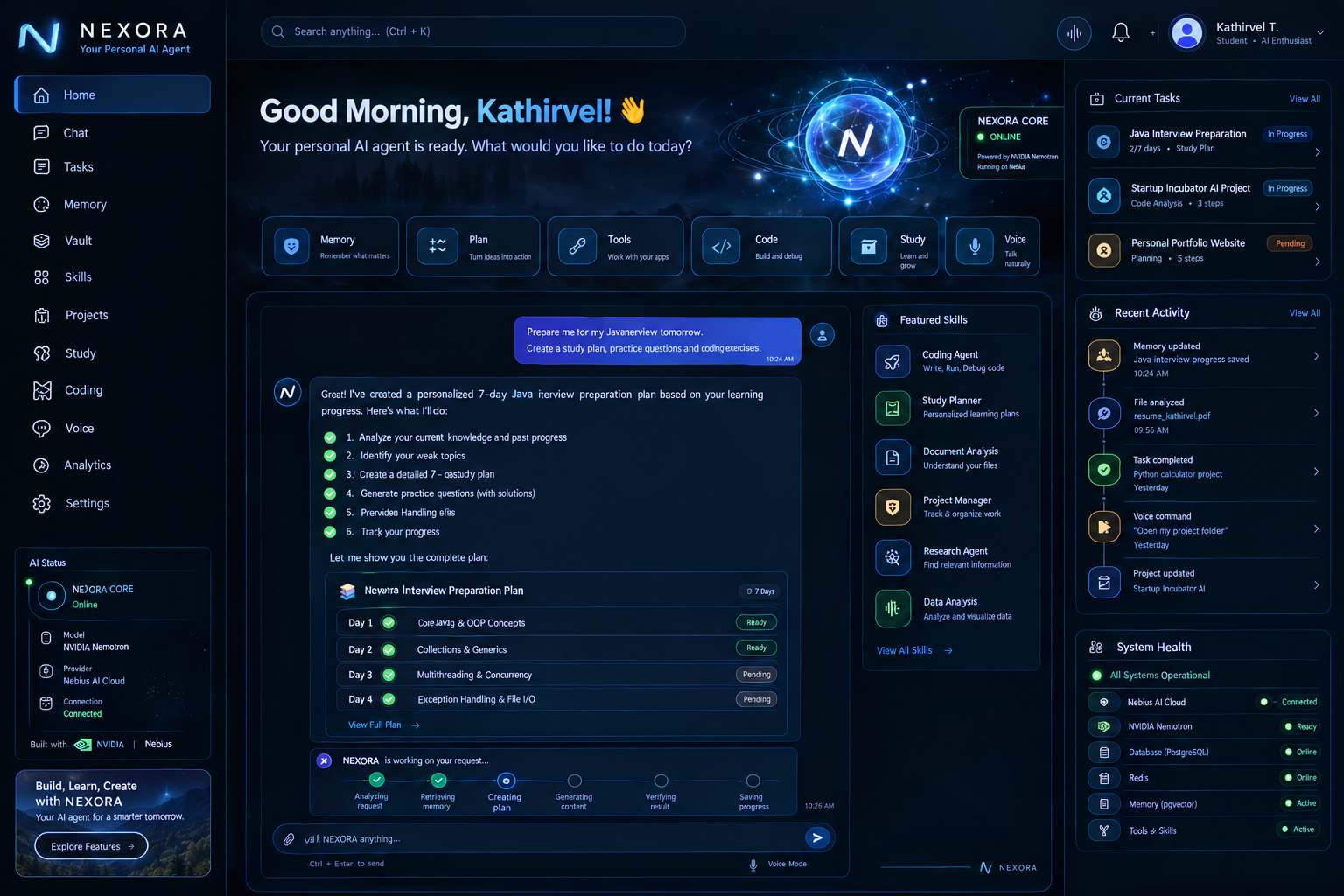
The idea for NEXORA came from my interest in AI assistants like JARVIS. I wanted to build something that was more useful than a normal chatbot.
Most AI assistants can answer questions, but they often don't remember the user's previous work or actually help complete a multi-step task. I wanted to create a personal AI that could understand my goals, remember useful information, make a plan, use tools, and help me complete the work.
That idea became NEXORA — Personal AI Agent.
The main concept is simple:
Remember. Plan. Execute. Verify.
I also wanted to explore how NVIDIA's open-source AI models could be used with Nebius to build a practical agent rather than just another AI chat application.
What it does
NEXORA acts as a personal AI workspace that can help users with everyday tasks and projects.
It can:
- 🧠 Remember useful information and previous context
- 🎯 Understand goals and break them into smaller tasks
- 🤖 Create and execute multi-step workflows
- 🛠️ Select and use different tools
- 💻 Help write, debug, and test code
- 📁 Analyze uploaded documents and files
- 📚 Create personalized study plans
- 📊 Analyze data
- 🔎 Search relevant information from the user's knowledge
- 🎤 Support voice-based interaction
- 🔐 Ask for permission before sensitive actions
- 📋 Track tasks, projects, and activity
For example, instead of asking:
"Give me Java interview questions."
A user can say:
"Prepare me for my Java interview tomorrow."
NEXORA can understand the goal, retrieve relevant memory, create a plan, generate practice questions, identify weak areas, and save useful progress.
The AI reasoning layer uses NVIDIA Nemotron through Nebius, making the model an important part of the agent's planning and decision-making process.
How we built it
We built NEXORA as a full-stack AI application.
The frontend was developed using React, TypeScript, Vite, Tailwind CSS, Framer Motion, and Recharts. We focused on creating a clean futuristic interface instead of making it look like a basic chatbot.
The backend uses Python and FastAPI to manage authentication, conversations, agents, memory, tools, files, and task execution.
For persistent data, we use PostgreSQL, with vector-based retrieval for semantic memory, and Redis for temporary state and background workflows.
The AI layer is built around NVIDIA Nemotron, accessed through Nebius.
The main workflow is:
User Request
     ↓
NEXORA Agent
     ↓
Memory Retrieval
     ↓
Goal Understanding
     ↓
Task Planning
     ↓
Skill Selection
     ↓
Tool Selection
     ↓
Execution
     ↓
Verification
     ↓
Final Result
     ↓
Memory Update
We also added a permission system so the AI cannot simply perform sensitive actions without user approval.
For coding tasks, we designed the execution environment to be restricted rather than giving the AI unrestricted access to the user's computer.
Challenges we ran into
One of our biggest challenges was making the AI behave like an actual agent instead of just generating text.
An LLM can produce a good answer, but completing a real task requires managing multiple steps, tools, errors, and state. We had to design an orchestration layer that could create plans, execute them, handle failures, and verify the results.
Memory was another challenge. We didn't want to save every conversation because that would create a lot of unnecessary information. We worked on a system that stores useful information and retrieves only relevant memories when they are needed.
Security was also a major concern. Once an AI can use tools and execute actions, giving it too much freedom can be dangerous. We therefore added permission levels and approval steps for higher-risk operations.
We also had to think about prompt injection, especially when the AI works with uploaded documents and tool results. External content is treated as untrusted data instead of automatically being treated as instructions.
Finally, making the application feel responsive while AI tasks were running was challenging. We used streaming, real-time updates, and clear task statuses so users can see what is happening.
Accomplishments that we're proud of
We are especially proud that NEXORA goes beyond a simple AI chatbot.
The agent can connect several important pieces together:
AI + Memory + Skills + Tools + Planning + Execution + Verification + Security
We are also proud of the persistent memory system. It allows NEXORA to maintain useful context across interactions instead of starting from zero every time.
Another accomplishment is the agent task workflow. Users can give NEXORA a high-level goal, and the system can turn it into smaller steps and track their progress.
We are also proud of integrating NVIDIA Nemotron with Nebius as a real part of the application's AI architecture.
The permission system is another feature we consider important because we wanted to build an AI that is helpful while still keeping the user in control.
Most importantly, we built NEXORA as a working full-stack system rather than only creating a UI prototype.
What we learned
The biggest lesson we learned is that building an AI agent is very different from building a chatbot.
A chatbot mainly needs to generate a useful response.
An agent needs to manage:
Memory
Planning
Tools
Execution
Errors
Permissions
Verification
Security
We learned that the model itself is only one part of the solution. The surrounding architecture is what allows the AI to become useful in real-world workflows.
We also learned how important user control is when building autonomous systems. An AI should not automatically do everything it is technically capable of doing.
Working with NVIDIA Nemotron and Nebius helped us understand how powerful AI models can be connected to real applications and used as part of an agentic workflow.
Most importantly, we learned that good AI products need to be designed around real user problems, not just around the capabilities of an AI model.
What's next for NEXORA — Personal AI Agent
NEXORA is only the beginning.
Our next goal is to make it more capable while keeping it safe and easy to control.
We want to add:
- More reusable AI skills
- More tool integrations
- Better long-term memory
- Personal knowledge graphs
- More advanced coding agents
- Improved voice interaction
- Multimodal understanding
- Calendar and productivity integrations
- More autonomous workflows
- Better background task execution
- Local and edge AI capabilities
- Physical AI and robotics integration
The long-term vision is to make NEXORA a personal AI layer that can understand a user's goals, knowledge, projects, and workflows and help turn ideas into completed tasks.
We don't want NEXORA to simply answer:
"What should I do?"
We want it to eventually help answer:
"Let's get it done." 🚀
NEXORA
Remember. Plan. Execute. Verify.
Powered by NVIDIA Nemotron. Built with Nebius.
Built With
- ai-agents
- docker
- fastapi
- framer-motion
- generative-ai
- github
- large-language-models
- machine-learning
- nebius-ai-cloud
- nvidia-nemotron
- open
- pgvector
- postgresql
- python
- rag
- react
- redis
- rest-api
- tailwind-css
- typescript
- vector-database
- vite
- websockets

Log in or sign up for Devpost to join the conversation.