Nexome
Tagline: The first variant-discovery engine that thinks in pedigrees, not single patients.
Track: Medical
1. Project Description
What We Built
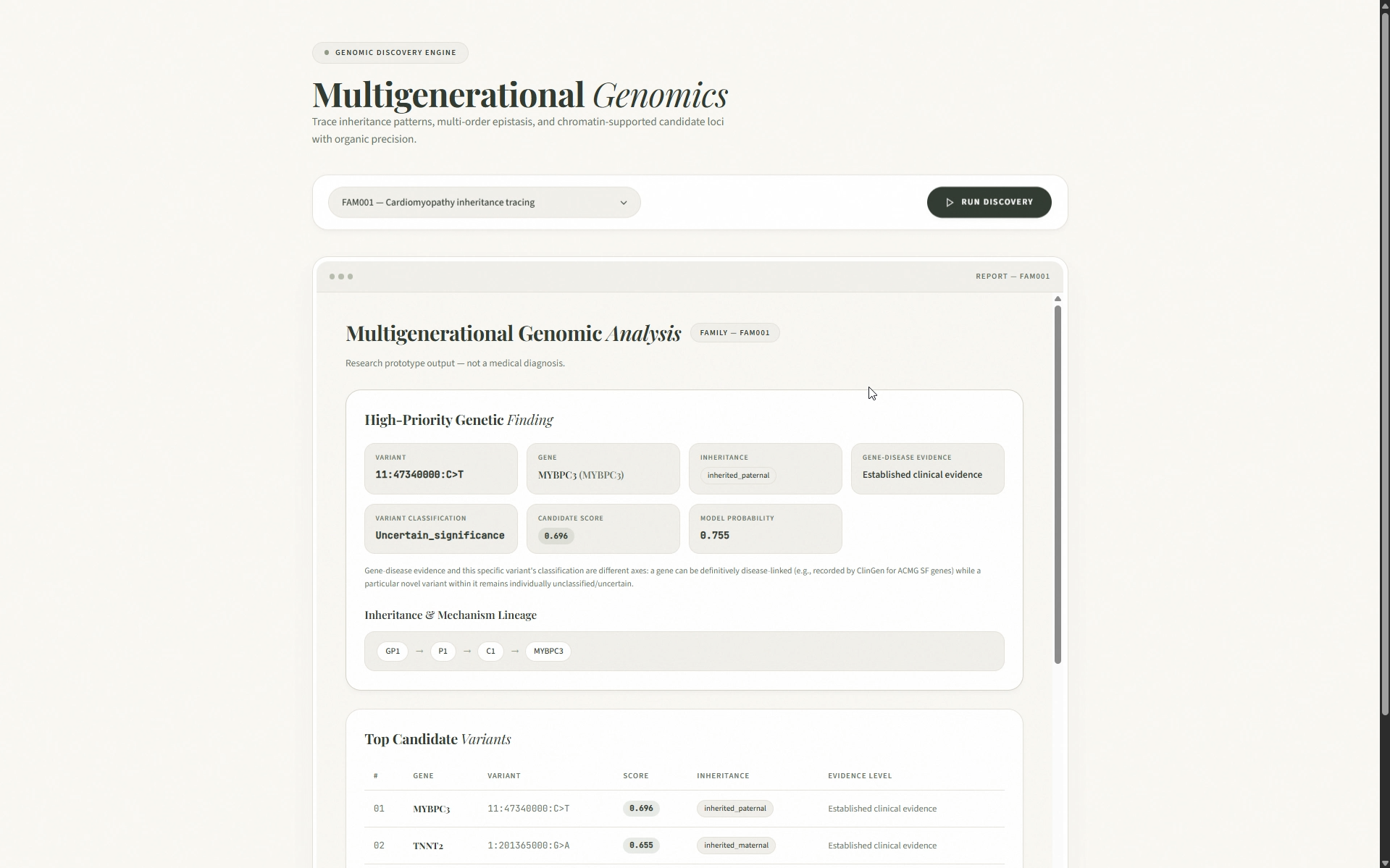
Nexome is an AI-powered, family-aware genomic analysis platform.
It analyzes a complete seven-person family:
- 4 grandparents
- 2 parents
- 1 child
Instead of analyzing variants independently, Nexome connects:
- Family inheritance
- Variants
- Genes
- Diseases
- Pathways
- Gene interactions
- Regulatory elements
- Chromatin context
- Machine-learning predictions
The Problem
Traditional genomic analysis often focuses on:
Individual → Variant → Disease
This can miss:
- Multigenerational inheritance patterns
- Variants inherited from different family branches
- Higher-order interactions between genes
- Regulatory variants affecting distant genes
- Biological information contained in the family structure
The Solution
Nexome changes the analysis to:
Family → Inheritance → Genes → Pathways → Interactions → Regulation → AI → Candidate Discovery
The system provides:
- Pedigree analysis for maternal, paternal, biparental, and de novo inheritance.
- Genomic indexing for efficient variant and regulatory-region lookup.
- Knowledge graphs connecting genomic and biological entities.
- Hypergraph analysis for 2 to 4 gene combinations.
- Chromatin analysis for regulatory variants and potential target genes.
- Machine learning for candidate prioritization.
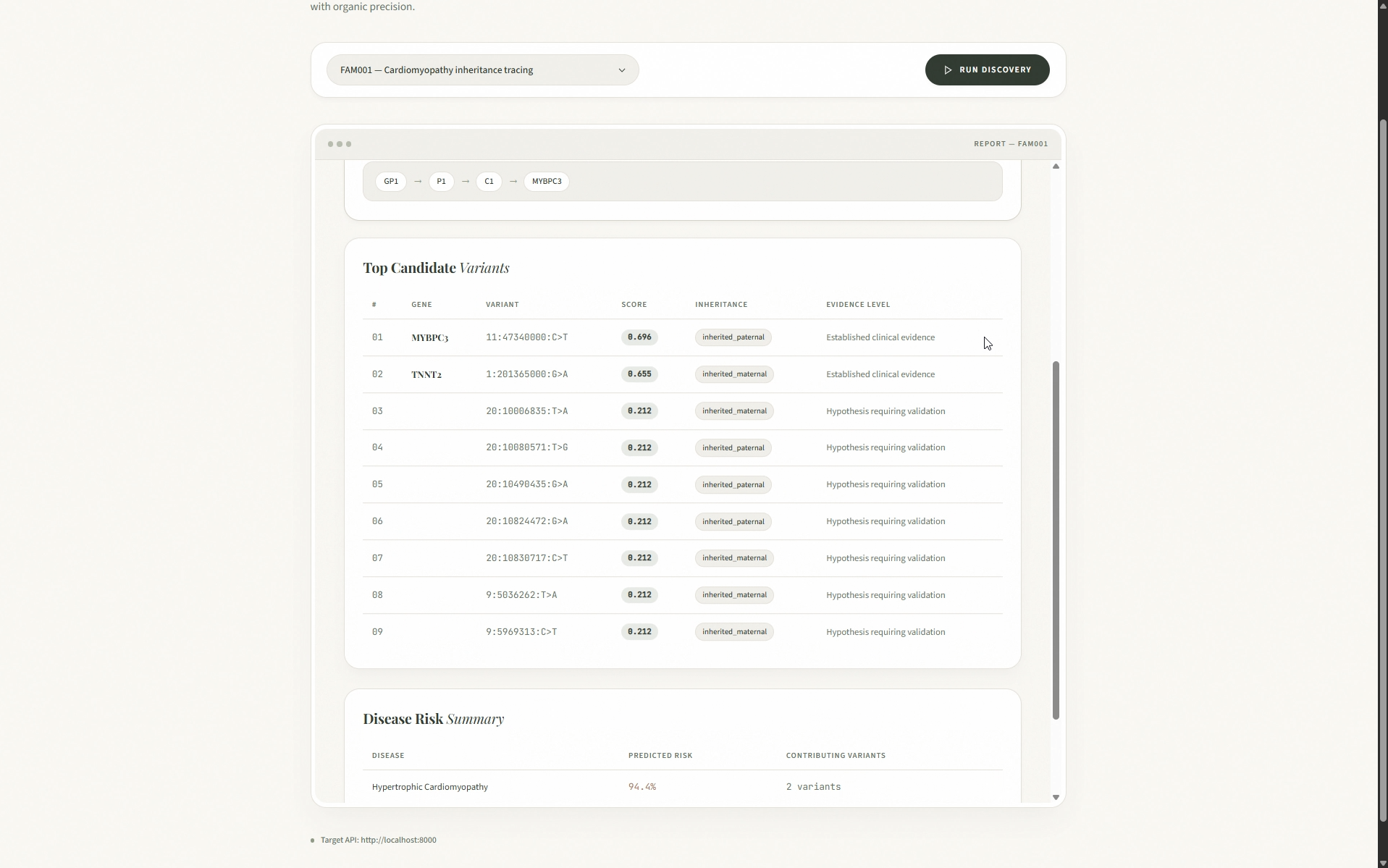
- Explainable scoring showing why each candidate was prioritized.
- Evidence tiers separating established findings from computational hypotheses.
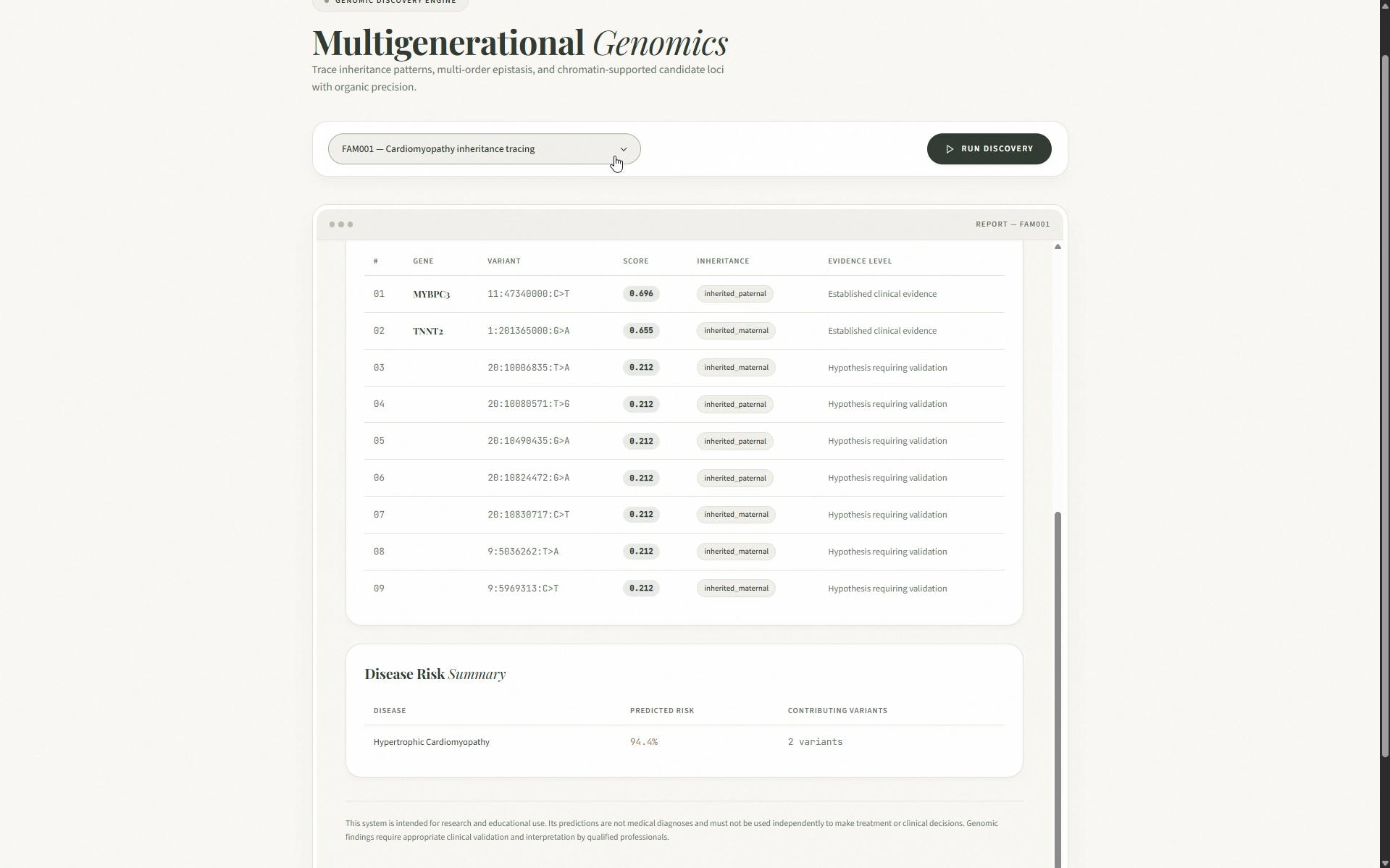
Nexome is designed as a research and educational prototype, not a clinical diagnostic system.
2. AI Usage
AI is a core part of Nexome's analysis pipeline.
Machine Learning
Nexome trains and compares:
- Logistic Regression
- Random Forest
- Gradient Boosting
- Multilayer Perceptron
The models use a shared 13-feature genomic representation.
Features include:
- Variant characteristics
- Inheritance
- Functional severity
- Disease evidence
- Pathway relevance
- Epistasis
- Chromatin support
- Model-derived evidence
The best model is selected using cross-validation.
Evaluation includes:
- AUROC
- AUPRC
- F1
- Sensitivity
- Specificity
- MCC
- Brier score
- Calibration
- Precision@K
- Recall@K
The classifier achieves approximately 0.64 AUROC on the synthetic benchmark.
Graph-Based AI
Nexome uses graph computation to model:
- Family relationships
- Variant relationships
- Gene relationships
- Disease relationships
- Pathway relationships
- Regulatory relationships
Relatedness-weighted graph diffusion allows genomic information to be interpreted through the family's structure.
Hypergraph AI
Nexome uses hypergraphs to analyze combinations of:
- 2 genes
- 3 genes
- 4 genes
The combinations are constrained by shared biological pathways.
Statistical models compare individual, pairwise, and higher-order combinations to estimate additional predictive information.
Chromatin Intelligence
Nexome models regulatory variants using temporal chromatin graphs.
This helps connect:
Regulatory Variant → Chromatin Context → Potential Target Gene
Chromatin trajectories are simulated for demonstration purposes.
Explainable AI
Nexome produces an interpretable Candidate Score using:
- Rarity
- Inheritance
- Functional severity
- Disease evidence
- Epistasis
- Chromatin support
- Pathway relevance
- Model attribution
Each finding receives an evidence tier:
- Established Clinical
- Strong Database
- Model-Supported
- Hypothesis
3. AI Tools Disclosure
Claude
AI pair programmer for code generation, debugging, code review, architecture, and documentation
AI Used in Nexome
The application itself uses:
- Scikit-learn for machine learning
- Logistic regression for statistical learning and epistasis analysis
- Random Forest for candidate prediction
- Gradient Boosting for candidate prediction
- Multilayer Perceptron for neural-network-based prediction
- Graph-based intelligence for family and biological relationships
- Hypergraph analysis for higher-order gene combinations
- Model attribution for explainable candidate prioritization
AI therefore contributes directly to the application's core workflow:
Family Data → Feature Engineering → AI Models → Candidate Prioritization → Explainable Evidence
4. GitHub Repository
Repository: https://github.com/SharGIT-prog/Nexome
The repository contains:
- Complete source code
- AI training pipeline
- Synthetic datasets
- Example families
- Analysis pipeline
- API
- Frontend
- Tests
- Documentation
- Generated reports
5. Team Members
Sharanya R
Individual Contributor
Contributions: Project ideation, system architecture, implementation, AI/ML pipeline, genomic analysis, testing
6. Technologies Used
- Python 3.12
- scikit-learn for AI and machine learning
- NumPy for numerical computing
- pandas for data processing
- SciPy for scientific computing
- NetworkX for graph analysis
- FastAPI + Uvicorn for the API
- Pydantic for validation
- PyYAML for configuration
- pytest for testing
- HTML/CSS/JavaScript for frontend and reports
- Docker for deployment
7. What Was Created
Nexome includes:
- Pedigree-aware inheritance engine
- Multigenerational variant tracing
- Genomic interval indexing
- Heterogeneous biological knowledge graph
- Pathway-constrained hypergraph
- Higher-order epistasis analysis
- Temporal chromatin model
- Relatedness-weighted graph diffusion
- Machine-learning prediction pipeline
- Explainable Candidate Score
- Four-tier evidence framework
- Automated testing suite
- FastAPI backend
- Interactive HTML reports
Three Discovery Modes
Inheritance
Traces variants from:
Grandparents → Parents → Child
Epistasis
Identifies potentially informative combinations across multiple genes and family branches.
Chromatin
Connects regulatory variants with potential distant target genes through chromatin context.
8. Dataset and External Resources
Reference Dataset
Nexome uses the:
ACMG Secondary Findings v2.0 gene panel
This provides real clinical gene reference data.
Synthetic Data
The following are synthetic:
- Example family variants
- Training cohort
- Temporal chromatin trajectories
No real patient genomes are included.
APIs
No authenticated third-party API keys are required.
Third-Party Libraries
Open-source libraries are listed in requirements.txt.
No pre-existing application was used as the project foundation.
9. Scientific Integrity
Nexome follows several safeguards:
- Research and educational use only.
- No clinical diagnosis claims.
- Synthetic genomic data for demonstrations.
- Simulated chromatin data is explicitly identified.
- Epistasis represents statistical association, not biological proof.
- Evidence is separated into four confidence tiers.
- Gene-level evidence is separated from variant-level evidence.
- Sensitive real genomic data should remain outside version control.
- HGVS notation is not fabricated when transcript-aware annotation is unavailable.
10. Limitations
- Example variants are synthetic.
- Training data is synthetic.
- Chromatin trajectories are simulated.
- The AI model is not clinically validated.
- Gene coordinates require independent verification for research use.
- Epistasis findings do not prove molecular mechanisms.
- Nexome is not a clinical diagnostic system.
11. Future Improvements
- Real ClinVar integration
- Real gnomAD integration
- Ensembl VEP integration
- Real chromatin datasets
- Larger real-world family cohorts
- Stronger AI validation
- Improved epistasis models
- Improved chromatin models
- Trainable graph neural networks
- Secure clinical workflows
- Authentication and audit logging
Built With
- css
- fastapi
- html
- javascript
- networkx
- numpy
- pandas
- pydantic
- pytest
- python
- pyyaml
- scikit-learn
- scipy
- uvicorn

Log in or sign up for Devpost to join the conversation.