-
-
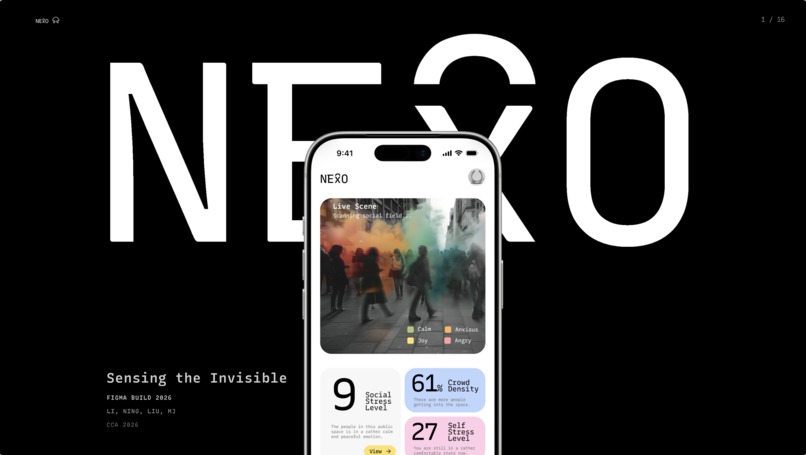
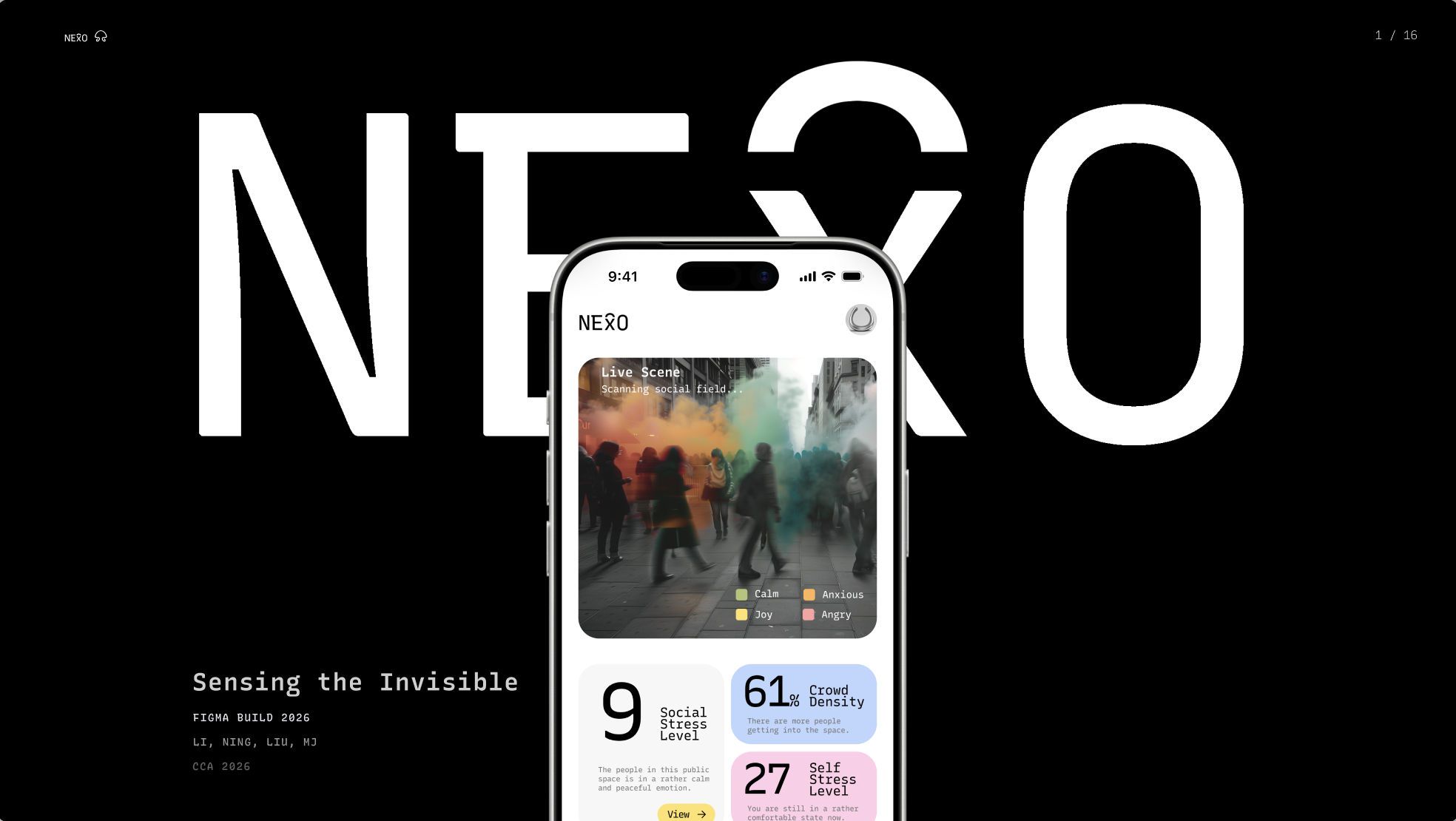
Nexo
Inspiration
People often feel socially overwhelmed in crowded or tense environments but can't articulate why. They know something feels off—they just don't have the language to understand it.
Humans constantly detect subtle social signals from others—through breathing patterns, chemical cues, and physiological responses—but most of this perception happens below conscious awareness. We saw an opportunity to design an interface that makes these invisible signals legible, helping users build awareness of how environments affect them.
What it does
NExO is a speculative interaction system combining a minimal wearable sensor with a companion mobile app.
The Wearable
The sensor sits on the bridge of the nose and detects both personal and environmental signals:
- Personal sensing: Detects subtle physiological signals from the user's skin to estimate current stress level.
- Environmental sensing: Measures shifts in volatile organic compounds (VOCs) and CO2 concentration. Research suggests people emit different chemical signatures depending on emotional state—stress, anxiety, relaxation.
- Olfactory feedback: The device releases subtle scent cues—calming scents when relaxed, alerting scents when tension rises—allowing users to intuitively sense the space without checking a screen.
The App
The companion app serves as the primary interface, offering:
- Live Map — real-time color-coded visualization of social atmosphere across locations
- Memory Record — a longitudinal view showing how different spaces affect the user over time
- Personalized prompts — contextual suggestions when stress levels spike
- Calibration — where users actively train the system to understand their personal emotional responses
- Settings & Device — device management hub for the wearable sensor
How we built it
Research & Framing
We began with secondary research on environmental psychology and sensory perception. We explored how people currently gauge social comfort—relying on gut feelings they can't fully explain. This shaped our design goal: help people recognize what they're already sensing, rather than replace intuition with something new.
Ideation & Concept Development
We explored multiple form factors before landing on the nose clip—chosen for proximity to breath and minimal visual presence. Early sketches tested earpiece and wristband alternatives, but nose placement felt most aligned with sensing the environment.
App Information Architecture
The app is structured around these core views:
- Live Map for in-the-moment awareness
- Memory Record for reflection, insights, and pattern recognition
- Day, Weekly, Monthly Recap for a personal archive of emotional environments over time
We prioritized glanceability—users should understand the emotional state of a space in under two seconds.
Prototyping
We built interactive prototypes to test the color system (cool tones for calm, warm tones for tension) and notification logic. We iterated on when and how to prompt users without adding to their stress.
Challenges we ran into
- Data legibility — Translating complex environmental signals into simple, intuitive visuals without oversimplifying.
- Notification design — Balancing helpfulness with intrusiveness. Alerts about stress shouldn't cause stress.
- Wearable form factor — Designing something subtle enough to wear in public without self-consciousness.
- Calibration UX — Creating an onboarding flow that trains the system to individual users without feeling tedious.
Accomplishments that we're proud of
- Designed a clear interaction flow between hardware and software
- Created a visual system that communicates emotional data at a glance
- Framed the experience as enhancing existing human perception rather than replacing intuition
- Built the Memory Map as a tool for genuine self-reflection, not just data logging
What we learned
Designing for invisible data is hard. The interface's job isn't to show everything—it's to show what's useful, when it's useful. We also learned that wearables succeed when they disappear; the best interaction is the one users barely notice.
What's next for NExO
- User testing the Live Map color system for clarity and emotional resonance
- Refining the calibration onboarding flow
- Exploring how Memory Map patterns could inform personalized recommendations
- Investigating accessibility—how does this work for users with scent sensitivities?
Built With
- figma
- figmamake


Log in or sign up for Devpost to join the conversation.