Inspiration
What it does
How we built it
NexHeal AI
Inspiration
Modern software systems rely heavily on APIs and distributed services. When an API fails, engineers often spend valuable time diagnosing logs, identifying root causes, and manually recovering services. Existing monitoring tools can detect issues, but they rarely provide intelligent diagnosis or automated recovery. We built NexHeal AI to transform traditional monitoring into an intelligent self-healing platform that can detect failures, analyze root causes using AI, and automate recovery actions to reduce downtime and improve reliability.
What it does
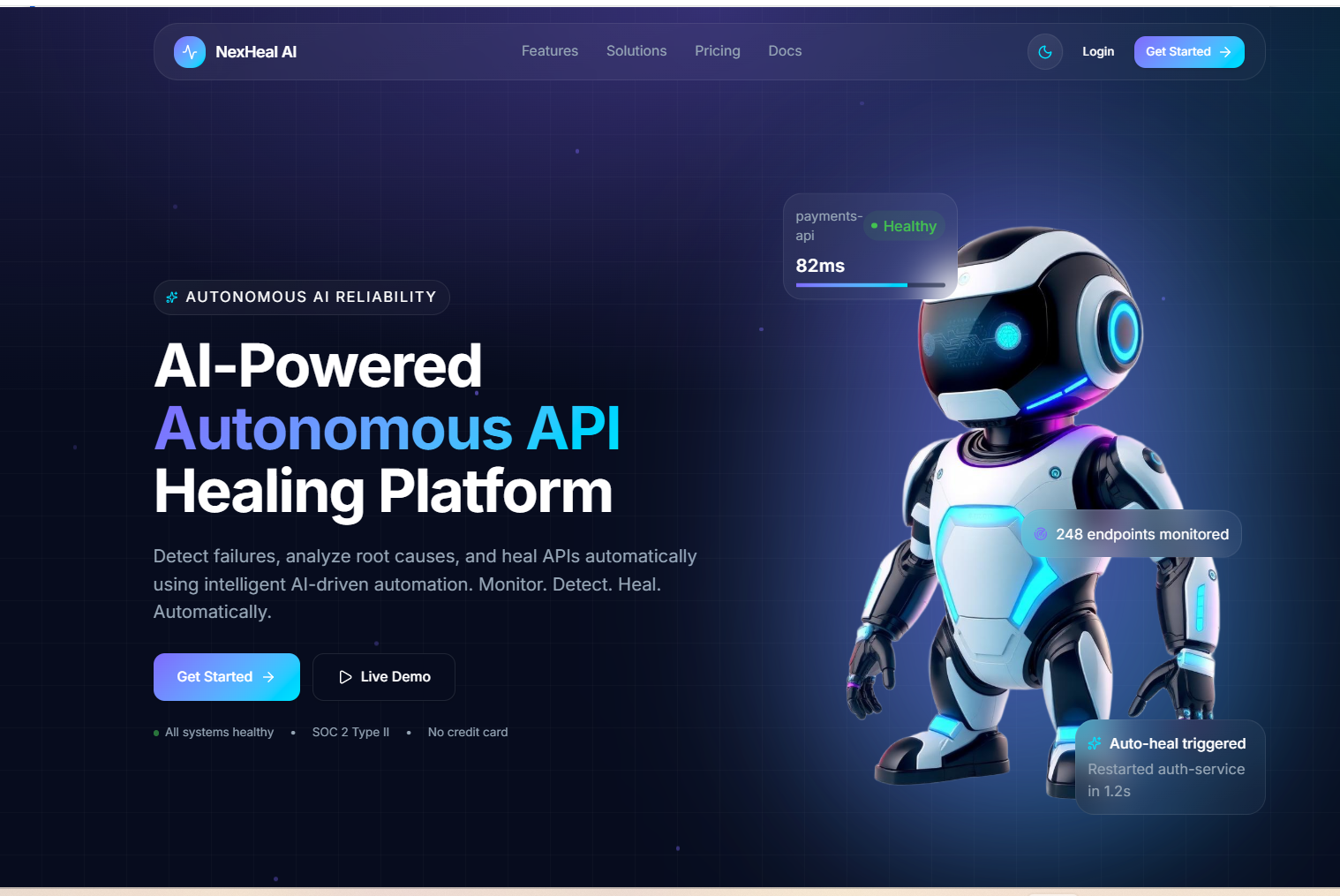
NexHeal AI is an AI-powered Autonomous API Healing Platform that continuously monitors APIs, websites, and backend services. The platform can:
- Monitor API health and uptime
- Detect failures and performance degradation
- Analyze logs and metrics using AI
- Identify root causes automatically
- Send real-time notifications and alerts
- Suggest or execute healing actions
- Generate downloadable incident reports
- Provide an AI chatbot for incident explanation Instead of only notifying users about failures, NexHeal AI helps them understand and resolve issues faster. ## How we built it ### Frontend
- React
- Tailwind CSS ### Backend
- FastAPI
- Python ### Database
- MongoDB ### AI Layer
- Groq API
- Llama Models
- Ollama (Local AI Support) ### Monitoring & Infrastructure
- Prometheus
- Docker
- Kubernetes (healing simulation) ### Features Implemented
- Authentication & Protected Routes
- API Monitoring Dashboard
- Real-Time Notifications
- AI Root Cause Analysis
- Self-Healing Engine
- Incident Reporting
- AI Chatbot Assistant ## Challenges we ran into One of the biggest challenges was designing a system that not only detects failures but also understands them. We had to:
- Connect monitoring data with AI analysis
- Design meaningful root-cause prompts
- Create safe healing workflows
- Build a real-time notification system
- Integrate multiple technologies into a unified platform Balancing automation with user control was also important, so we implemented approval-based healing workflows. ## Accomplishments that we're proud of
- Built a complete AI-powered monitoring platform
- Integrated AI-driven root cause analysis
- Created automated healing workflows
- Developed a modern monitoring dashboard
- Added incident reporting and chatbot assistance
- Designed a scalable architecture for future expansion ## What we learned
Through this project we gained practical experience in:
- AI-powered observability
- API monitoring
- DevOps workflows
- Incident management
- FastAPI backend development
- Real-time systems
- AI integration using Groq and LLMs
We also learned how AI can significantly reduce incident response time when combined with monitoring and automation.
What's next for NexHeal AI
Future enhancements include:
- Predictive failure detection
- Advanced anomaly detection
- Multi-cloud monitoring
- CI/CD integration
- Enterprise observability features
- Team collaboration workflows
- Intelligent rollback automation
- Infrastructure-wide autonomous healing
Our vision is to build a platform where systems can detect, diagnose, and recover from failures with minimal human intervention.
Challenges we ran into
Accomplishments that we're proud of
What we learned
What's next for NexHeal AI
Built With
- ai
- css
- docker
- fastapi
- groq
- jwt
- kubernetes
- learning
- llama
- machine
- mongodb
- ollama
- prometheus
- python
- react
- tailwind
- websockets

Log in or sign up for Devpost to join the conversation.