Inspiration
Gen AI is everywhere; nearly eight in ten companies have deployed gen AI in some form, but roughly the same percentage report no material impact on earnings. We wanted to make a product to help businesses track their AI usage and be able to pull valuable insights from their investments.
What it does
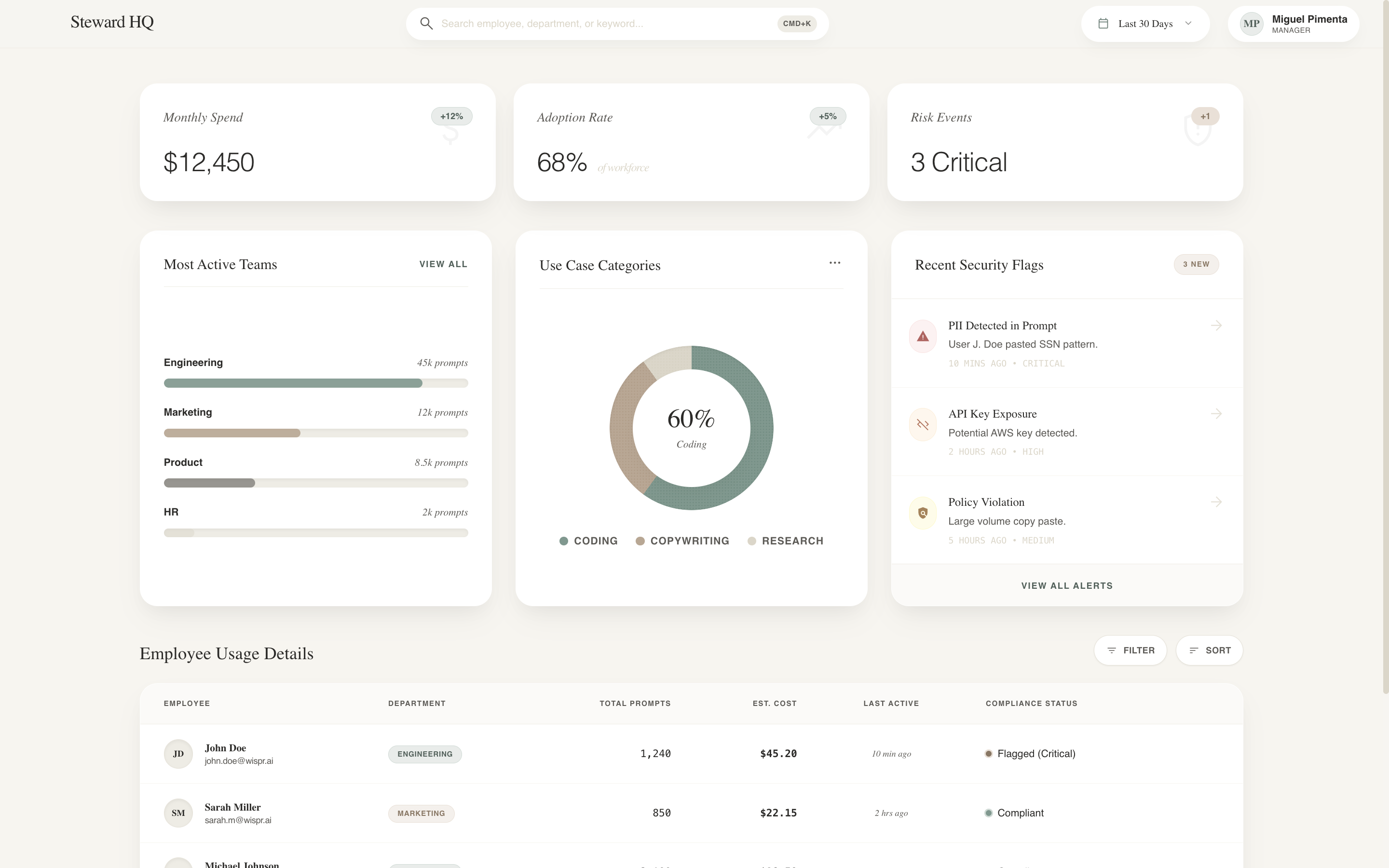
Our project helps companies understand how gen AI is being used across their teams without exposing sensitive content. It surfaces the most valuable use cases each month, highlights which tools employees are not leveraging yet, and identifies power users and adoption gaps by team. With these insights, management can make better decisions about training, policy, incentives, and AI spend
How we built it
We built it by utilizing a desktop application that checks a user's computer for any use of LLM calls. From there, we would pull the information and run a clustering machine learning model to categorize and summarize what employees are doing. This would allow the desktop application to show valuable insights on what their workers are doing and how they could incentivize them or even cut back on AI usage.
Challenges we ran into
One specific challenge we ran into was deciding whether to build our own machine learning model for clustering or use a Hugging Face transformer. For the time being, we choose to use a Hugging Face Transformer, but we will train our own LLM model for even more data security.
Accomplishments that we're proud of
In 24 hours, we turned a real business problem into a working product concept that can meaningfully improve how organizations measure and manage AI adoption. We’re proud that we focused on actionable insights, not just a demo, and built something that could scale into a serious internal tool for companies.
What we learned
We learned how to collaborate under tight time constraints: dividing responsibilities, communicating clearly, making tradeoffs quickly, and staying aligned on a single product goal while building fast.
What's next for NexHacks
Next, we want to deepen the analytics by building and training our own clustering model for stronger control and privacy. We also plan to improve the UI/UX, add more polished dashboards, and expand the insights so teams can track progress over time and measure the impact of training and policy changes.
Built With
- electron
- express.js
- javascript
- node.js
- react
- supabase
- tailwind
- vite

Log in or sign up for Devpost to join the conversation.