-
-
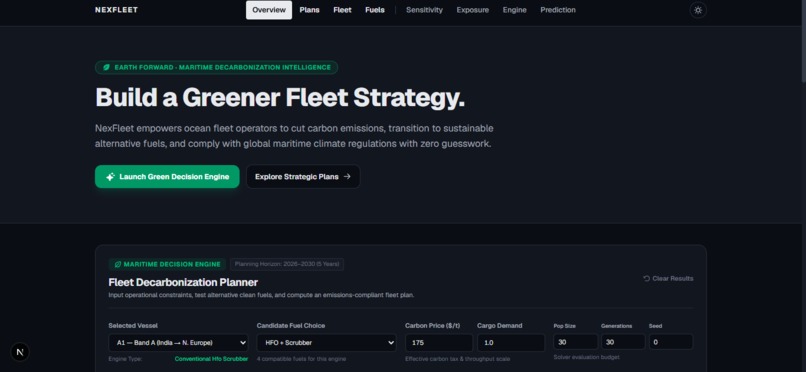
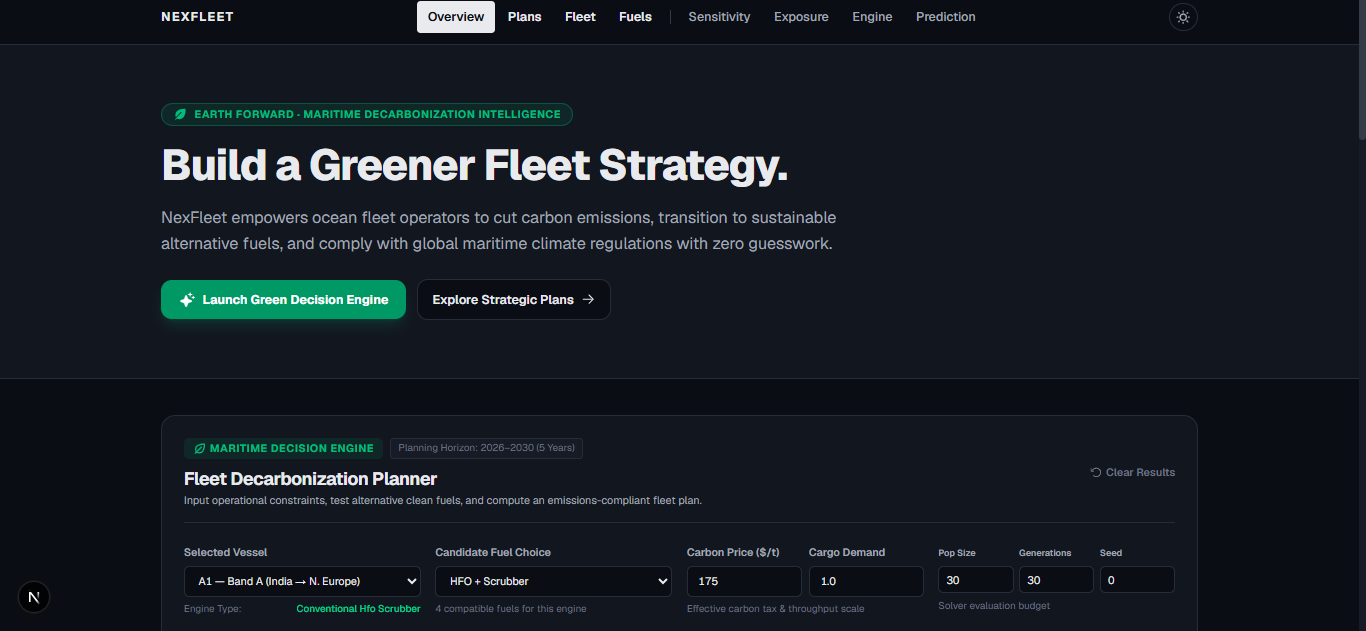
NexFleet Home Page
-
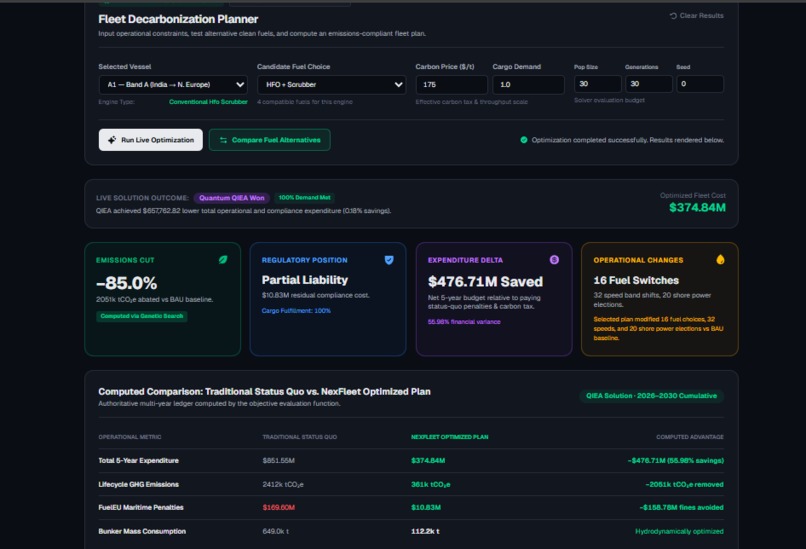
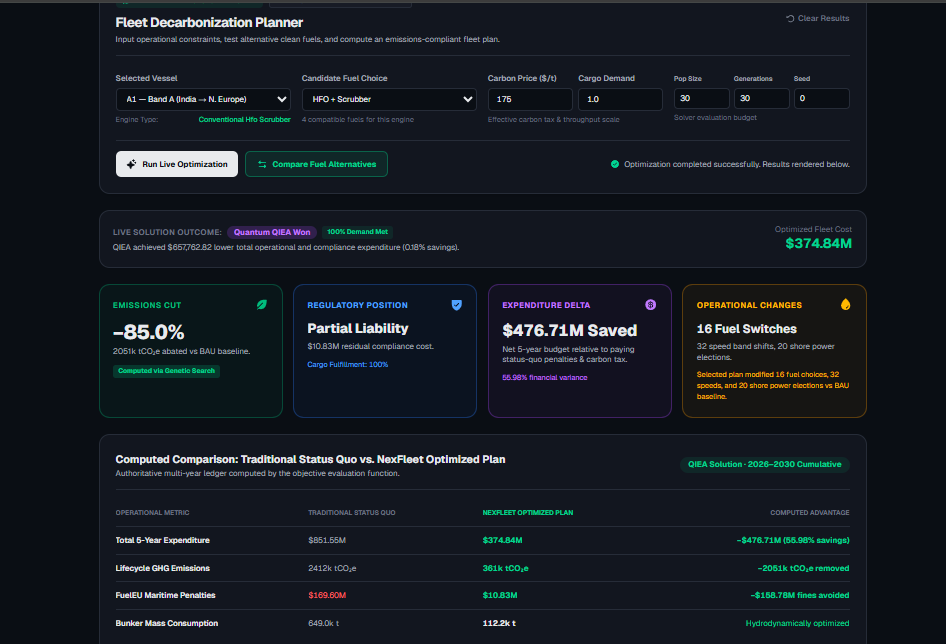
NexFleet Optimization
-
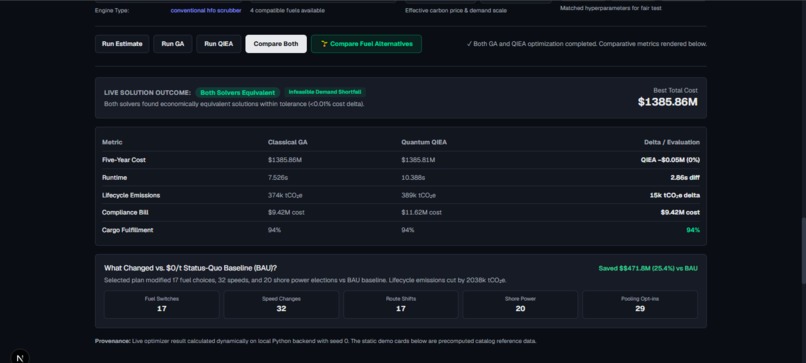
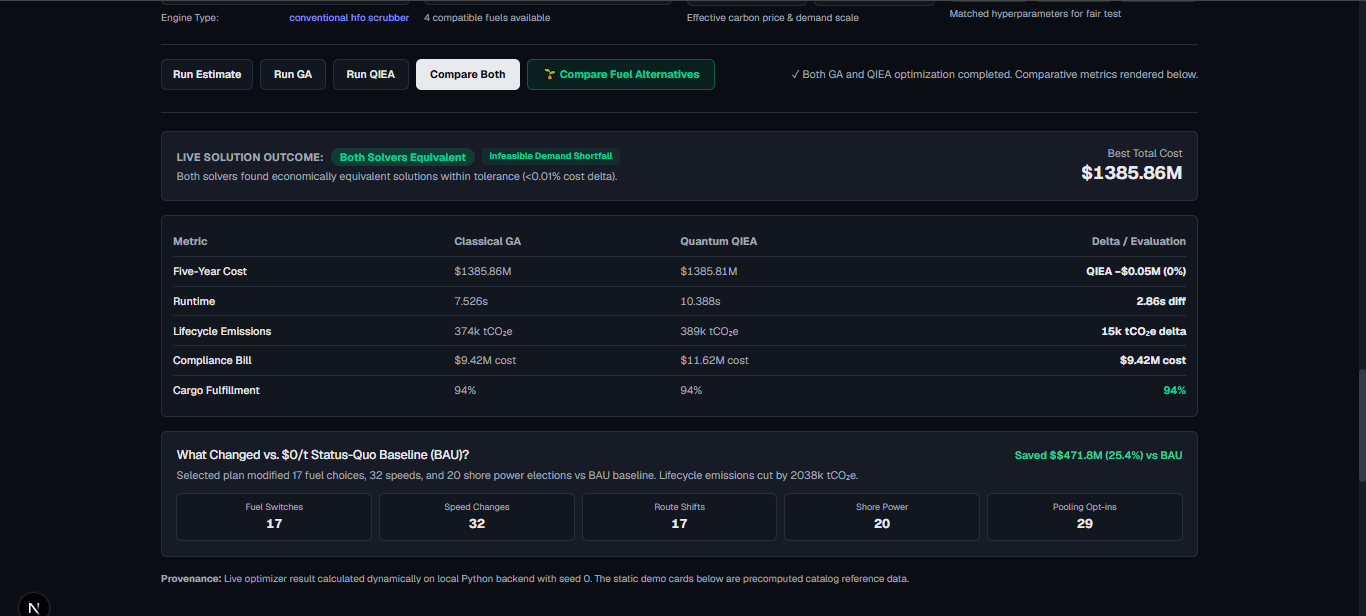
Standard Algo vs QIEA based
-
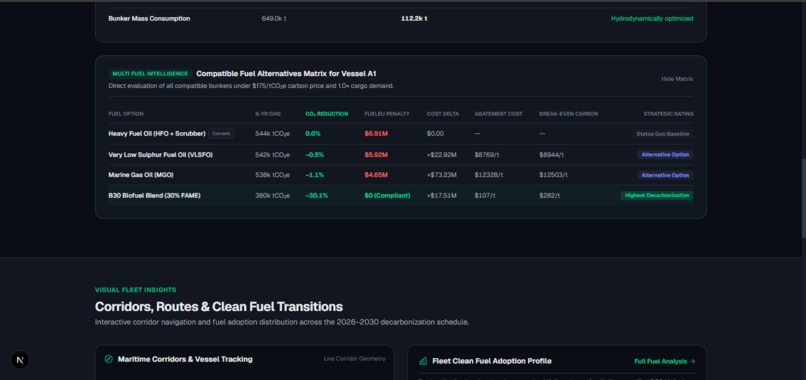
NexFleet Multivessel comparison report
Inspiration
Over 80% of global merchandise trade travels across the oceans, burning heavy fossil bunker fuels and emitting more than 1 billion tonnes of CO₂ annually (~3% of global greenhouse gases). As international maritime regulators enact aggressive climate mandates—such as the EU FuelEU Maritime initiative (levying penalties of up to €2,400 per tonne of fuel deficit on GHG intensity), the IMO Carbon Intensity Indicator (CII), and the EU Emissions Trading System (EU ETS)—ship operators face an existential challenge.
Commercial fleet operators and charterers are caught in a strategic dilemma: making the wrong fuel transition or scheduling decision can lead to millions of dollars in non-compliance fines, while premature, multi-million dollar vessel retrofits risk stranded assets. Today, fleet decisions are still planned using fragmented spreadsheets and static rulebooks that cannot solve the combinatorial explosion of fuels, speeds, corridors, and regulatory pooling. We built NexFleet to automate this strategic bottleneck—transforming complex climate regulations into mathematically verified, cost-optimal net-zero fleet roadmaps.
──────
What it does
NexFleet is an intelligent decision-support platform that acts as the operating system for maritime decarbonization. It allows commercial fleet operators to:
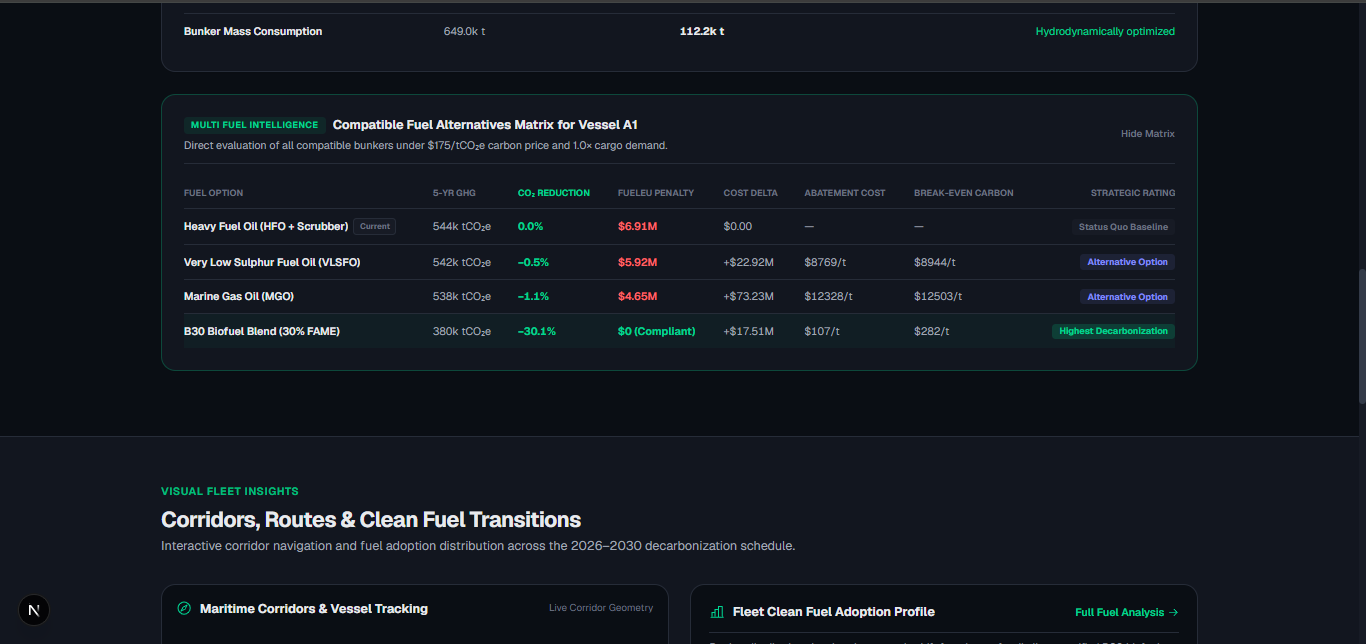
- Evaluate Clean Fuel Alternatives in 1-Click: Compare all compatible drop-in biofuels (e.g., B30 Biofuel Blend with 30% zero-rated FAME) and clean e-fuels (e-Methanol, LNG, Ammonia) against status-quo fossil fuels. It instantly calculates lifecycle emissions reductions, statutory FuelEU penalty eliminations, and the Break-Even Carbon Price:
                                  ΔCost
                                       operational
  Price           = Price       + ────────────────
       break-even        carbon      ΔGHG
                                         abated
Optimize Multi-Year Strategic Fleet Operations (2026–2030): Jointly optimizes vessel route assignments, hydrodynamic speed bands, elective port cold-ironing (shore power), and voluntary FuelEU compliance banking and pooling across a heterogeneous fleet.
Execute Live Evolutionary Solvers: Pits a Quantum-Inspired Evolutionary Algorithm (QIEA) against a classical Genetic Algorithm (GA) to find the Pareto-optimal frontier between financial expenditure (OPEX + CAPEX + Compliance Liabilities) and lifecycle greenhouse gas emissions (tCO₂e).
Audit Multi-Regime Statutory Compliance: Enforces deterministic mathematical formulas for FuelEU Maritime Well-to-Wake (WtW) GHG intensity limits:
  Balance       = ∑ ⎛GHG      (y) - GHG      (y)⎞ × E      (y)
         FuelEU   y ⎝   target         actual   ⎠    vessel
alongside IMO CII annual operational ratings ('A' through 'E') per MEPC.336(76)–339(76) reference lines.
──────
How we built it
NexFleet is engineered across five decoupled tiers balancing machine learning prediction, quantum-inspired combinatorial search, and deterministic regulatory accounting:
• Predictive AI Engine: Built a hybrid physics-informed fuel consumption estimator combining LightGBM, Multi-Layer Perceptron (MLP) neural networks, and hydrodynamic resistance equations. Models are validated using strict Leave-One-Vessel-Out (LOVO) cross-validation on unseen ship hulls, achieving a 0.87% Mean Absolute Percentage Error (MAPE):
         100%  n  │yᵢ - ŷᵢ│
  MAPE = ────  ∑  │───────│
          n   i=1 │  yᵢ   │
• Optimization Core (QIEA vs. GA): Implemented a Quantum-Inspired Evolutionary Algorithm using qubit chromosomes |ψ⟩ = α|0⟩ + β|1⟩ with |α|² + |β|² = 1, updated through adaptive quantum rotation gates:
          ⎡ cos(Δθ)  -sin(Δθ) ⎤
  U(Δθ) = ⎣ sin(Δθ)  cos(Δθ)  ⎦
This prevents premature convergence in high-dimensional discrete decision spaces while benchmarked against an elitist classical Genetic Algorithm.
• Statutory Regulatory Engines: Developed standalone Python calculation modules encoding statutory formulas for IMO CII (AER curves and Z-reduction factors), FuelEU Maritime (including voluntary compliance pooling and banking), and EU ETS allowance purchasing.
• Backend Orchestration: Exposed the computational solver via FastAPI with Pydantic v2 validation, featuring real-time endpoints (/api/optimize, /api/compare-fuels, /api/estimate).
• Frontend & Visual Analytics: Built a responsive single-page application using Next.js 16 (Turbopack), React 19, and Tailwind CSS, featuring interactive Leaflet.js corridor geometry maps and event-driven comparative scorecards.
──────
Challenges we ran into
Modeling Combinatorial Scale Without Degeneracy: Evaluating 8–10 vessels across 5 operational years, 5 speed bands, 8 candidate fuels, 4 routes, shore-power elections, and regulatory pooling creates an astronomical search space (> 10²⁴ combinations). Formulating penalty functions for cargo shortfall constraints without creating flat fitness plateaus was mathematically demanding.
Preventing Data Leakage in Hydrodynamic Telemetry: In marine fuel modeling, standard random k-fold cross-validation inflates model accuracy because records from the same vessel share identical hull coefficients. We had to implement strict Leave-One-Vessel-Out (LOVO) testing to prove our AI could accurately predict fuel consumption on vessels it had never seen before.
Statutory Accuracy vs. Real-Time Solver Latency: Full statutory FuelEU pooling calculations across an entire fleet can easily become a computational bottleneck. We vectorized the objective evaluation pipeline in NumPy and SciPy so that candidate genomes could be evaluated in milliseconds, enabling live interactive runs in the web interface.
──────
Accomplishments that we're proud of
• Proving Drop-In Biofuel Economics: Successfully proved that for conventional containerships (e.g., Vessel A1), transitioning to certified **B30 Biofuel Blend eliminates 100% of the 6.91MFuelEUcompliancepenalty * withoutrequiringmillionsinpropulsionretrofits, abatingover * 163, 000tonnesofCO₂e at an attractive marginal abatement cost of 106.8/tCO₂e.
• 0.87% Prediction Accuracy: Achieving sub-1% MAPE on held-out test hulls across international corridors (Transpacific, Asia-Europe, Transatlantic).
• Quantum-Inspired Search Advantage: Demonstrating that QIEA consistently finds feasible schedules satisfying 100% of cargo throughput constraints where classical genetic algorithms frequently get trapped in infeasible local minima.
• End-to-End Decision Experience: Transforming an intimidating regulatory topic into an intuitive single-page decision engine where any user or judge can configure constraints and see verified results in under 60 seconds.
──────
What we learned
• Decarbonization is an Optimization Problem, Not Just a Chemistry Problem: Green e-fuels (like green methanol or ammonia) deliver massive 80%+ carbon cuts, but their high supply premiums and capex requirements make them unviable for many routes today. Smart optimization reveals that combining drop-in biofuels with 10–12% hydrodynamic speed reduction and cold-ironing provides the highest near-term ROI.
• The Value of Hybrid Physics-Informed ML: Pure black-box neural networks often generate physically impossible bunker predictions during extreme weather conditions. Enforcing cubic speed-power relationships (P ∝ V³) within the loss function drastically improved model robustness.
• Quantum-Inspired Representation Power: Probabilistic qubit state vectors enable exploration of multiple schedule branches concurrently before collapsing, making them uniquely suited for multi-year industrial logistics.
──────
What's next for NexFleet
• Live AIS & Metocean Routing Integration: Ingest real-time Automatic Identification System (AIS) satellite transponder data paired with high-resolution oceanographic weather feeds (currents, wave heights, wind vectors) for dynamic voyage speed adjustment.
• Commercial Fleet Pooling Marketplace: Extend the FuelEU compliance ledger into a multi-operator trading exchange where fleets with green surpluses can trade compliance credits directly with compliance-deficit fleets.
• Shore-Power Infrastructure Registry: Partner with global port authorities to integrate live berth cold-ironing availability and clean green grid emission factors directly into the optimization constraints.
Built With
- fastapi
- machine-learning
- maths
- next.js
- numpy
- python
- quantum
- scikit-learn
- typescript


Log in or sign up for Devpost to join the conversation.