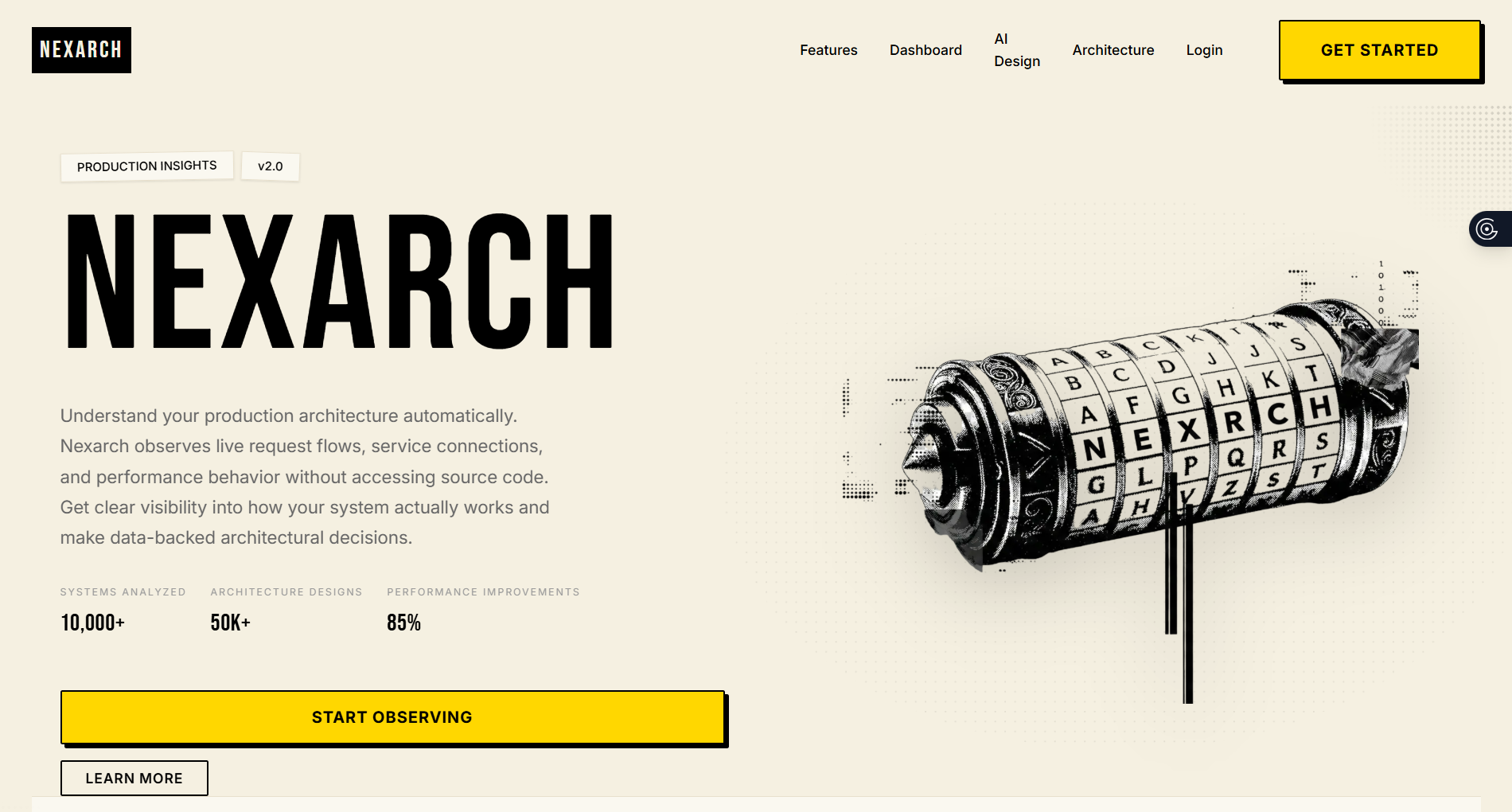
Nexarch: Runtime-Driven Architecture Intelligence Inspiration Modern software systems are growing rapidly with microservices, APIs, databases, and cloud infrastructure. Over time, we noticed that the real production architecture often becomes unclear and disconnected from documentation. Teams struggle to understand how requests actually move through services, where bottlenecks exist, and how architectural changes will impact performance or cost. Existing tools mostly provide logs and metrics, but they fail to explain the system’s actual structure or guide architectural decision-making. This gap inspired us to build Nexarch, a platform that understands systems based on how they truly run in production.
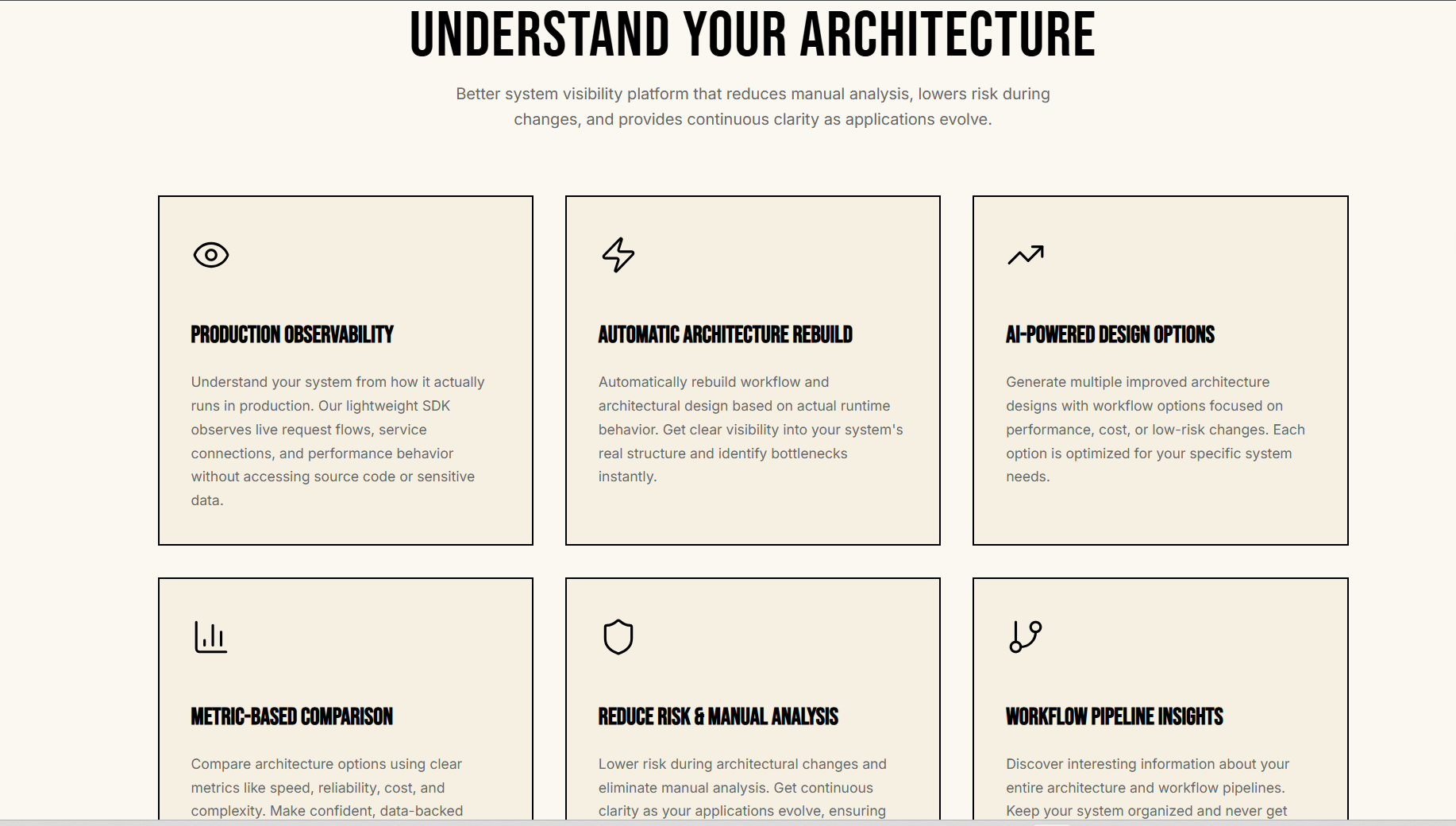
What We Built Nexarch is a B2B Architecture Intelligence Platform that analyzes real production behavior to reconstruct a system’s true architecture. Using a lightweight SDK, Nexarch observes live request flows, service interactions, dependencies, and performance signals without accessing source code or sensitive data. From this runtime information, it automatically rebuilds architectural workflows, highlights problem areas, and generates multiple improved architecture options focused on performance, cost optimization, or low-risk changes. Each option is compared using clear metrics such as speed, reliability, cost, and complexity, enabling fast and data-backed architectural decisions.
How We Built It We designed Nexarch around MCP servers for modular functionality and integrated them with LangGraph to support non-linear, asynchronous workflows. We developed a custom SDK to allow users to easily integrate Nexarch into their systems. AI and LLM reasoning are used to analyze runtime data and generate optimized architectural workflows. The backend is deployed on cloud infrastructure with a custom domain at https://api.modelix.world, while the frontend is hosted at https://run-time.in using Azure Cloud App Service and Virtual Machines.
Challenges & Learnings One of our biggest challenges was managing computational costs while running complex asynchronous workflows on cloud virtual machines. Building and coordinating multiple MCP servers was technically demanding, especially while learning new technologies like tracking systems and key-based cryptography in a very short time. Deployment was also challenging due to SSL configuration and cloud infrastructure setup. Despite these challenges, we successfully built a scalable, production-ready platform and learned how to design efficient AI-driven systems under real-world constraints.


Log in or sign up for Devpost to join the conversation.