-
-
Final solution
-
Cause
-
Head page
# AquaNano-AI
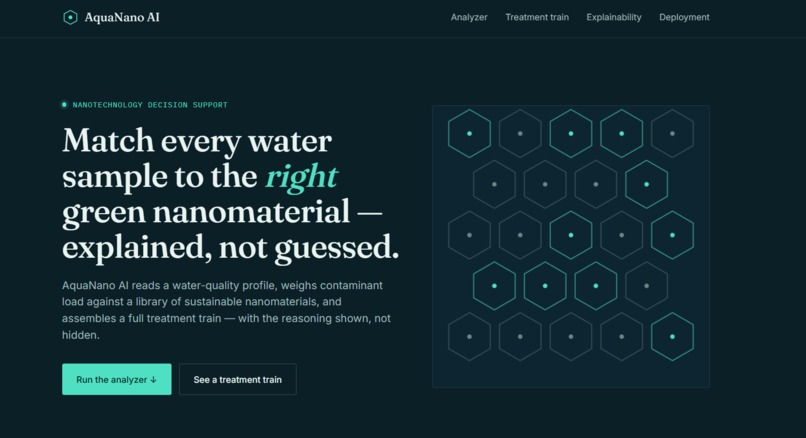
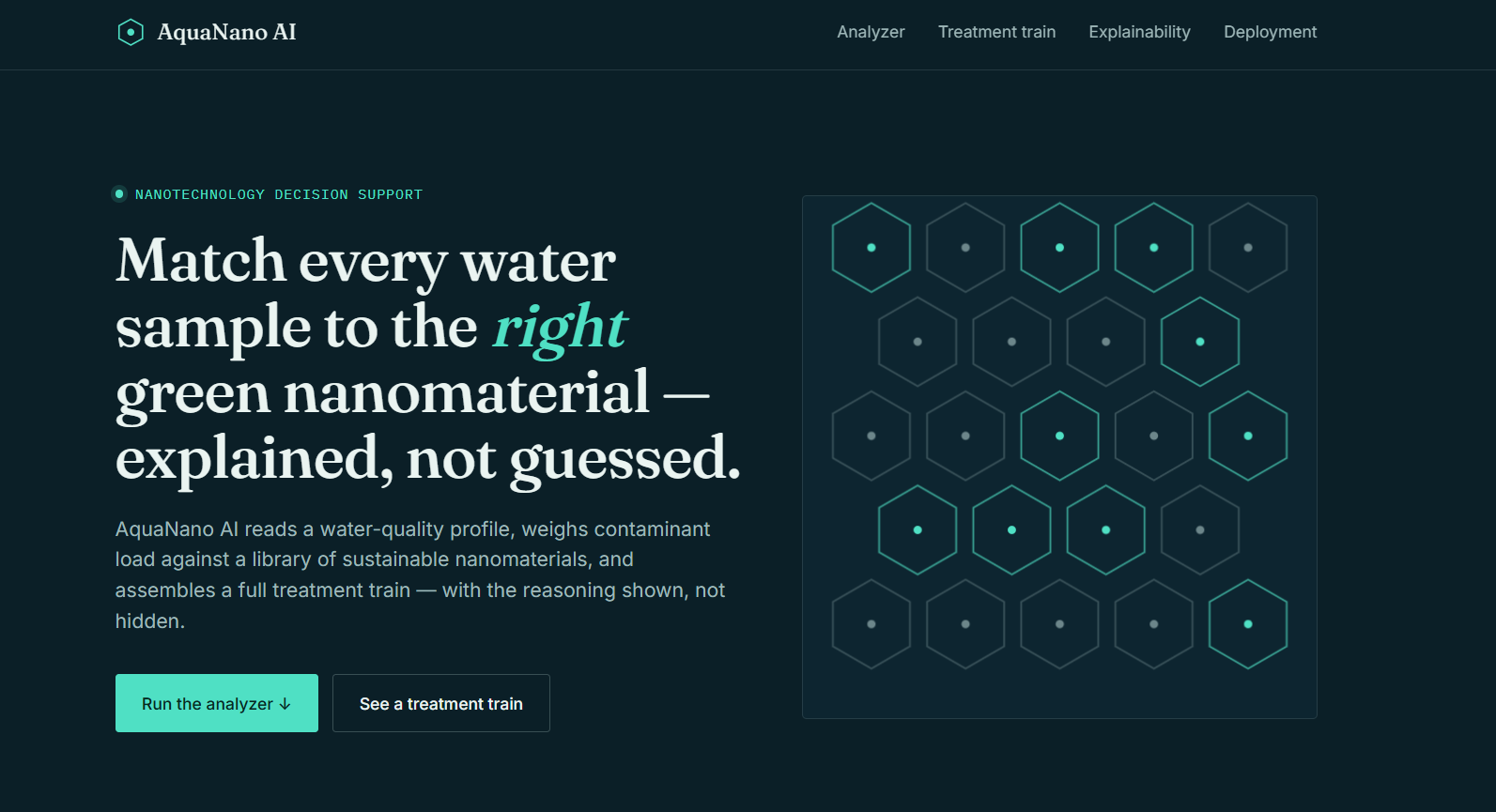
AquaNano-AI is an AI-powered platform that helps analyze water quality and suggest suitable nanotechnology-based purification approaches.
Inspiration
The idea came from our interest in the problem of water pollution and how nanotechnology can be used for cleaner and more sustainable water treatment.
We wanted to see if AI could make the process of choosing a suitable treatment approach easier. Instead of looking at each water condition separately, we wanted to build something where a user could enter the water parameters and get an intelligent recommendation.
That is how we came up with AquaNano-AI.
What the project does
AquaNano-AI takes different water-quality parameters such as:
- pH
- Turbidity
- TDS
- Arsenic
- Lead
- Fluoride
- Microbial contamination
- Organic contamination
The platform analyzes these inputs and recommends a suitable nanomaterial-based treatment approach.
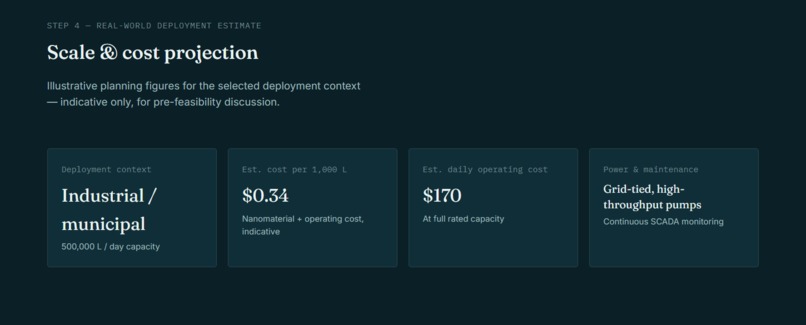
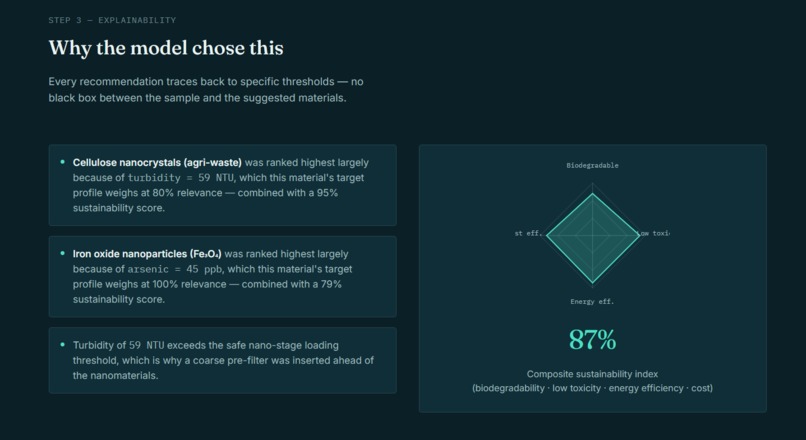
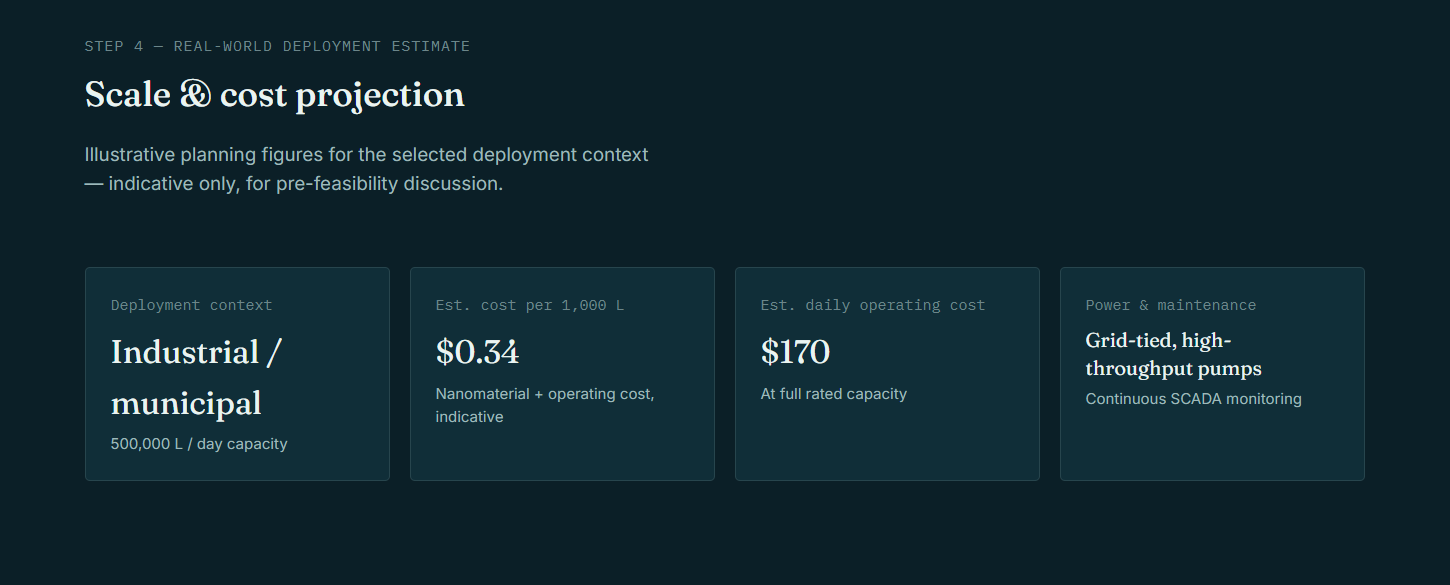
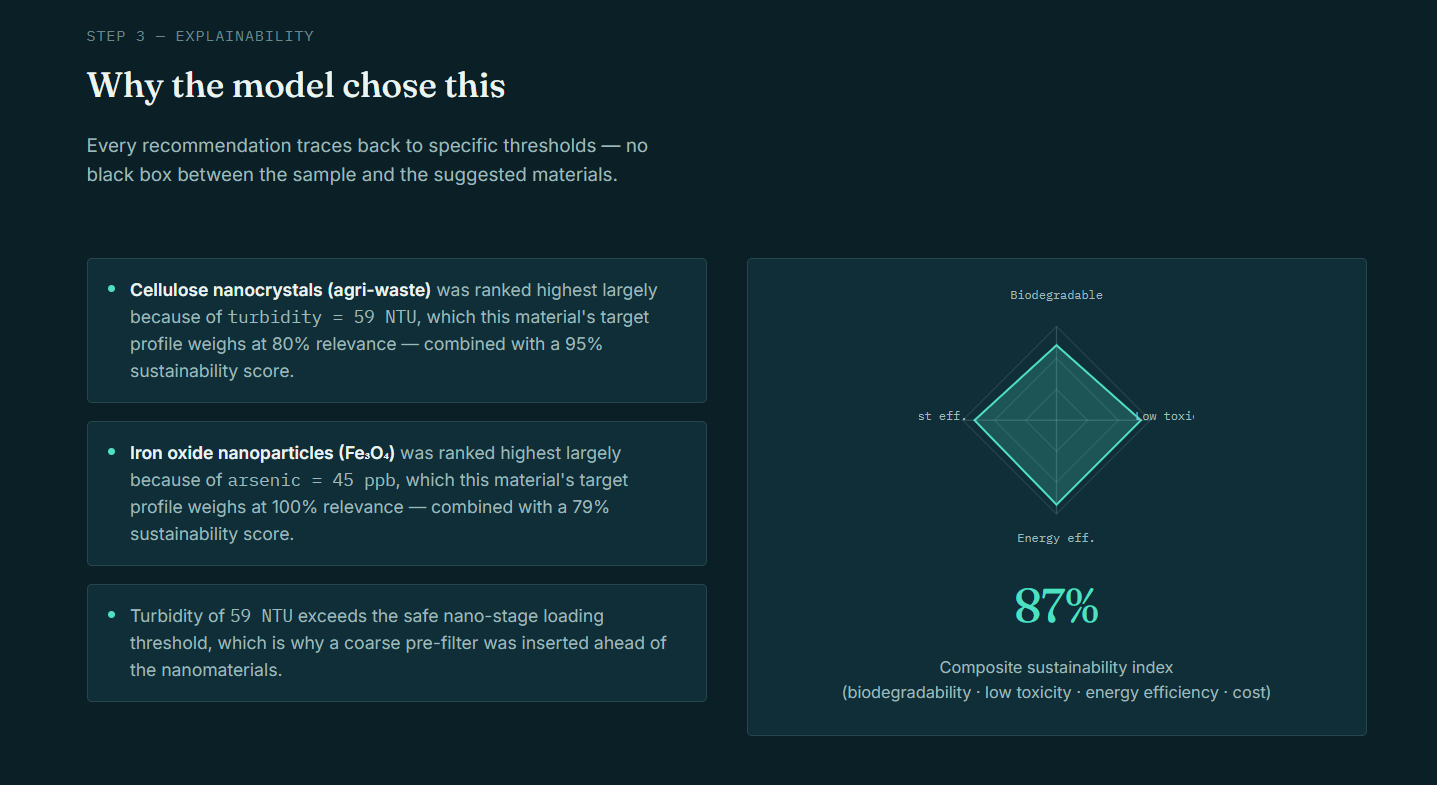
It also shows why the material was recommended, gives a suitability score, suggests a treatment sequence, and provides sustainability-related information.
So the basic flow is:
Water parameters → AI analysis → Nanomaterial recommendation → Treatment strategy
How we built it
We built the project as a web application with a simple interface so that users can enter water-quality values and immediately see the results.
The AI part uses a lightweight neural-network model to analyze the input parameters and rank possible nanomaterial approaches. We also added a knowledge layer containing information about different nanomaterials so that the recommendation is easier to understand.
We focused on making the interface interactive and easy to use instead of making it look like a complicated scientific tool.
The project is deployed online using GitHub Pages.
What we learned
While building this project, we learned that using AI is not just about getting a prediction. The result also needs to be understandable.
We therefore focused on showing the reasoning behind the recommendation instead of only displaying a final material name.
We also learned how to combine a scientific idea with a working web prototype within a limited hackathon timeframe.
Challenges we faced
The biggest challenge was trying to keep the idea technically meaningful while still being able to build a working prototype within the available time.
Water purification and nanotechnology involve many real-world factors, and we obviously could not cover everything in a short hackathon.
Because of that, we built this as a proof-of-concept. The current AI model uses a curated synthetic dataset, so the results are meant to demonstrate the concept and not replace laboratory testing or real-world water-treatment validation.
Another challenge was making the recommendation system explainable. We solved this by combining the AI model with information about the properties of the candidate nanomaterials.
What's next
There is a lot we would like to add if we continue developing AquaNano-AI.
Some of our ideas include using real experimental datasets, predicting treatment efficiency, adding more contaminants and nanomaterials, connecting the platform to IoT water-quality sensors, and adding better cost and environmental-impact analysis.
Our goal is to eventually make AquaNano-AI a more complete decision-support platform for sustainable water treatment.
Final Thought
With AquaNano-AI, we wanted to explore a simple question:
Can AI help us make smarter and more sustainable water-treatment decisions?
This prototype is our first step toward that idea.
Built With
- ai
- css
- github
- html
- javascript
- machine-learning
- tensorflow.js


Log in or sign up for Devpost to join the conversation.