About the Project
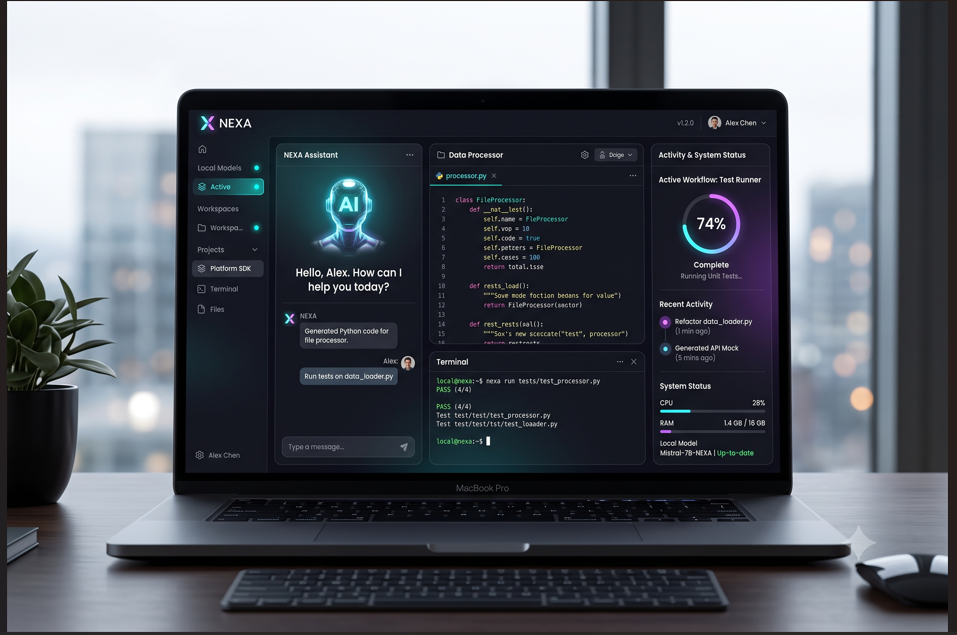
NEXA is a local autonomous computer agent built to help users complete real tasks directly on their machine without relying on cloud-only workflows. The project was inspired by the gap between AI chatbots and systems that can actually act: planning tasks, reading files, opening applications, writing code, and recovering from failures. I wanted to build something closer to a real personal desktop assistant than a simple chat interface.
The idea came from seeing how much of everyday computer work is repetitive and fragmented. Developers and users often switch between files, terminals, apps, and browsers just to do basic tasks. NEXA aims to reduce that friction by acting as a local AI agent that can understand a request, break it into steps, and execute those steps safely.
Inspiration
The biggest inspiration behind NEXA was the dream of a truly useful local AI assistant. I wanted an agent that could run on a personal computer, respect user privacy, and work even without constant internet access. Tools like Ollama made this idea practical by enabling local model usage, which opened the door to building a desktop agent that feels personal and self-contained.
I also wanted to move beyond generic AI chat. Most chatbots only respond, but I wanted a system that could do work. The project was inspired by the idea of an AI teammate that can handle real operations without requiring constant supervision.
What it does
NEXA combines planning, tool use, and local execution to act as an autonomous desktop agent. It can:
- understand user goals in natural language,
- break them into smaller steps,
- plan actions using local reasoning,
- execute tasks such as file creation, project generation, code editing, and terminal commands,
- verify whether the task succeeded,
- and recover when something goes wrong.
It also includes two modes:
- Agent mode for real task execution and system-level actions,
- Learn mode for general question answering and research-style interactions.
This combination makes the system useful for both practical computer automation and learning-oriented conversations.
How we built it
NEXA was built as a modular Python desktop app with a clear agent workflow:
- Planner: converts user requests into structured tasks and steps.
- Executor: performs safe actions like editing files, creating folders, running commands, and opening apps.
- Verifier: checks whether the intended result actually happened.
- Recovery Layer: handles failures and tries alternate paths when a task does not succeed.
- Memory: keeps track of context and recent actions.
- UI: provides a desktop interface for interacting with the agent and switching modes.
The system connects to local Ollama models to keep everything running on-device rather than depending on cloud services. This makes the app more privacy-conscious and more practical for local machine use.
We also designed separate model profiles for different modes:
- a heavier model for agent operations,
- a lighter model for learn mode.
That helped reduce resource usage and kept the experience responsive on lower-power laptops.
Challenges we ran into
One of the main challenges was balancing intelligence with performance. Running an autonomous agent locally can consume a lot of RAM and processing power, especially when heavier models are involved. We had to optimize model selection, reduce unnecessary calls, and make the app feel fast enough to use in real time.
Another challenge was reliability. A real agent must not just “attempt” a task — it must verify whether it succeeded. Without verification, the system can easily generate false confidence. We solved this by adding structured checks and recovery logic so the agent can handle mistakes more gracefully.
We also had to improve output quality. Generating code or scaffolding projects is much harder than generating a normal reply. Generic outputs often look smart but fail in practice. To improve that, we focused on more concrete task planning and better template generation.
Finally, the user experience had to remain smooth. Simple prompts like “hello” should not trigger heavy processing or long waits, or the app feels frustrating. We addressed this by adding quick local responses and separating lighter learning flows from heavier automation flows.
Accomplishments that we're proud of
We are proud that NEXA is not just a chatbot. It is a real local autonomous agent that can perform meaningful work on a user’s computer.
A few major accomplishments include:
- building a working planner–executor–verifier loop,
- supporting both Agent mode and Learn mode,
- integrating local Ollama models for offline-friendly operation,
- adding safe fallback behavior when the model is unavailable,
- improving responsiveness for lightweight tasks,
- and creating a more polished desktop experience.
The project also demonstrates that an AI assistant can be useful without requiring cloud infrastructure or complex remote deployment.
What we learned
This project taught us that building an AI agent is not just about prompting a model. It requires:
- careful system design,
- structured execution,
- error handling,
- resource awareness,
- and a good understanding of user experience.
We also learned that real-world usefulness depends on reliability. A system that is clever but unstable is less valuable than a system that is simpler, predictable, and trustworthy.
Another major lesson was around local AI limitations. Running models on laptops is different from running them in data centers, and constraints like memory, latency, and model choice shape how the system should behave.
What's next for NEXA AI
The next step for NEXA is to make it even more capable, more polished, and more trustworthy as a daily-use local assistant. We want to expand its ability to handle more real-world tasks, improve code generation quality, refine the planning layer, and make the interface feel more premium and responsive.
In the future, NEXA could support deeper file understanding, more advanced project workflows, stronger automation safeguards, and richer multi-step task execution. The long-term goal is to turn it into a practical local AI operating partner that helps users with software work, research, and day-to-day digital tasks in a smooth and reliable way.
Built With
- agent
- agentic
- app
- automation
- controls
- desktop
- developer
- engineering
- language
- learning
- local
- machine
- natural
- ollama
- personal
- planning
- processing
- productivity
- project
- prompt
- python
- safety
- windows
- workflows


Log in or sign up for Devpost to join the conversation.