-
-
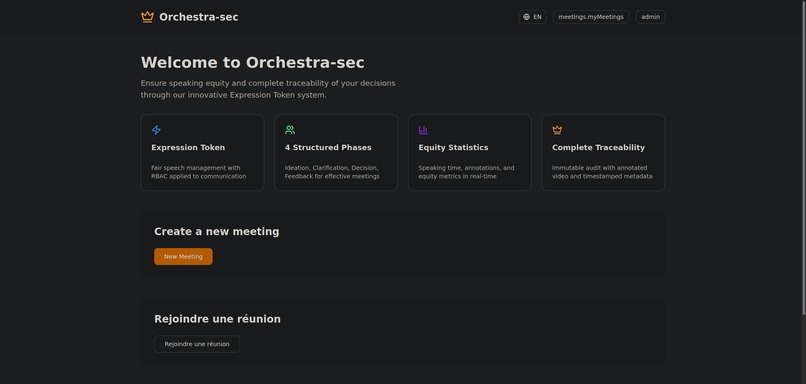
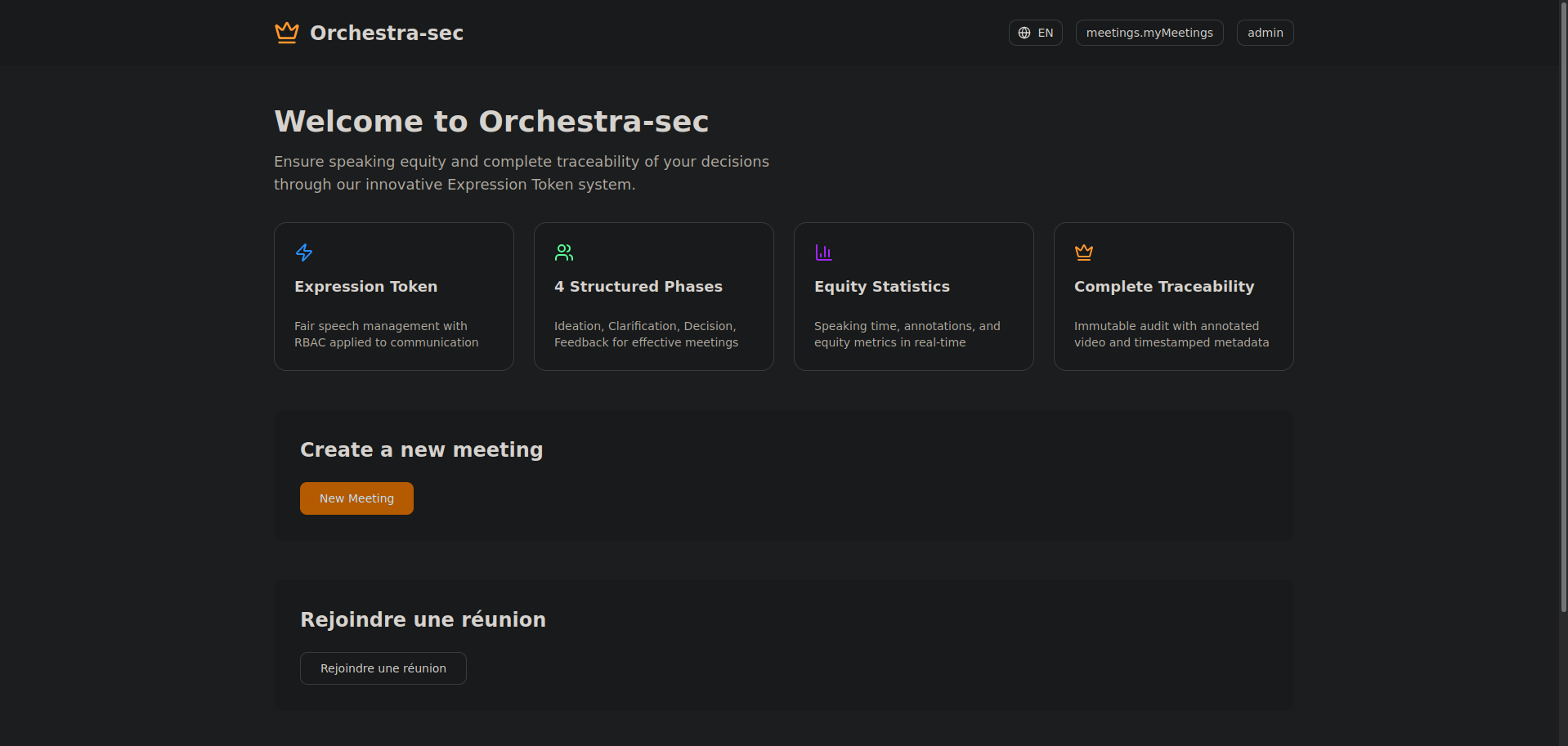
Home Orchestra-sec
Inspiration
Traditional meetings suffer from:
- No governance - Decisions without traceable accountability
- Unequal participation - Dominant voices, silent participants
- No structure - Unorganized, inefficient discussions
- No audit trail - Important decisions lost or disputed
What it does
OrchestraSec transforms meetings into structured, visible, and traceable processes with:
Token-Based Expression
- One speaker at a time - Prevents interruptions
- Visual token system - Clear turn-taking
- Conflict prevention - Server-side locking
- Real-time updates - WebSocket notifications
Structured Meeting Phases
- Ideation - Brainstorming and idea generation
- Clarification - Discussion and refinement
- Decision - Formal decision making
- Feedback - Review and improvement
Role-Based Governance
- Admin - Full control and oversight
- Facilitator - Manages phases and tokens
- Participant - Active contributor
- Observer - Read-only access
Security & Audit
- JWT Authentication - Secure access control
- RBAC - Role-based permissions
- Complete Audit Trail - Every action recorded
- Exportable History - Meeting transcripts
Real-time Collaboration
- Shared Canvas - Visual collaboration
- WebSocket Sync - Instant updates
- Video Integration - WebRTC support
- Annotation Tools - Drawing and text
Key Benefits
Equitable participation - Everyone gets a turn Structured process - Clear meeting phases Full governance - Role-based control Complete traceability - Audit trail Real-time collaboration - WebSocket + WebRTC Secure by design - JWT + RBAC
How we built it
How we built OrchestraSec
Technical Architecture
1. Backend (FastAPI/Python):
- FastAPI framework for its performance and ease of integration
- SQLite database with SQLModel for efficient data management
- JWT authentication system with RBAC (Role-Based Access Control)
- WebSockets for real-time communication between participants
2. Frontend (React/TypeScript):
- React 19 with TypeScript for a robust user interface
- tRPC for type-safe communication between frontend and backend
- Tailwind CSS for modern, responsive design
- Vite as bundler for optimized development times
3. Key Features:
- Token Engine: Token system for fair expression management
- Meeting Phases: 4 structured phases (Ideation → Clarification → Decision → Feedback)
- Collaborative Canvas: Shared whiteboard with annotation history
- Security: AES-256 encryption, 2FA authentication, complete audit trail
Challenges we ran into
Technical Challenges
WebSocket Management:
- Challenge: Real-time synchronization of tokens and canvas between participants
- Solution: Implementation of a centralized WebSocket Manager with connection handling
Token System:
- Challenge: Preventing access conflicts and ensuring fairness
- Solution: Server-side locking mechanism with priority queue
Architecture Challenges
Frontend-Backend Integration:
- Challenge: Type-safe communication between React and FastAPI
- Solution: Adoption of tRPC for typed API with automatic generation
Phase Management:
- Challenge: Smooth transition between 4 meeting phases
- Solution: State machine with server-side validation
Deployment Challenges
Environment Configuration:
- Challenge: Managing complex environment variables
- Solution: Modular configuration system with .env files
Frontend Dependencies:
- Challenge: Compatibility between React 19 and certain libraries
- Solution: Using PNPM for precise version management
User Experience Challenges
User Experience:
- Challenge: Making the token system intuitive
- Solution: Visual interface with clear indicators and real-time feedback
Accessibility:
- Challenge: Multilingual support and accessibility
- Solution: Integration of i18next for FR/EN translation
What we learned
The importance of testing , we do over 31 unit test who helped detect regressions quickly .
What's next for Nex'Champs
Built With
- canvas
- fastapi
- javascript
- jwt
- oauth
- pydantic
- python
- rbac
- react
- sqlite
- tailwind
- typescript
- webrtc
- websockets


Log in or sign up for Devpost to join the conversation.