-
Frontend
- Introduction
In the modern digital environment, individuals are exposed to an unprecedented volume of news content. While access to information has improved significantly, the emotional impact of constant news consumption has become a growing concern. News streams are often dominated by crises, conflict, and negative events, which can contribute to anxiety, stress, and information fatigue.
Traditional news platforms prioritize engagement metrics, such as clicks and time spent, rather than the well-being of the user. As a result, users are frequently exposed to emotionally intense content without any contextual awareness of its psychological impact.
Newsflix is a web-based application designed to address this issue by introducing a mental health–aware layer to news consumption. The system enables users to understand the emotional tone of news articles before engaging with them, allowing for more intentional and balanced information intake.
- Project Objective
The primary objective of Newsflix is to:
Provide users with a structured, transparent, and emotionally-aware view of news content, enabling healthier consumption habits without restricting access to information.
This is achieved by classifying news articles according to: • Sentiment: Positive, Neutral, or Negative • Topic: e.g., Health, Business, Sports, Technology • Language: Detected automatically
Importantly, Newsflix is not designed to filter or censor information, but rather to inform users about the potential emotional impact of the content they are about to consume.
- Conceptual Framework: News as a Mental Input
Newsflix is built on the premise that:
Information consumption affects mental health in a similar way to diet affects physical health.
Just as individuals benefit from understanding nutritional content before eating, users can benefit from understanding the emotional “weight” of information before consuming it.
This framework positions Newsflix as: • A support tool for digital well-being • A non-intrusive awareness system • A public-interest service rather than a commercial product
- System Architecture Overview
The application follows a client-server architecture consisting of:
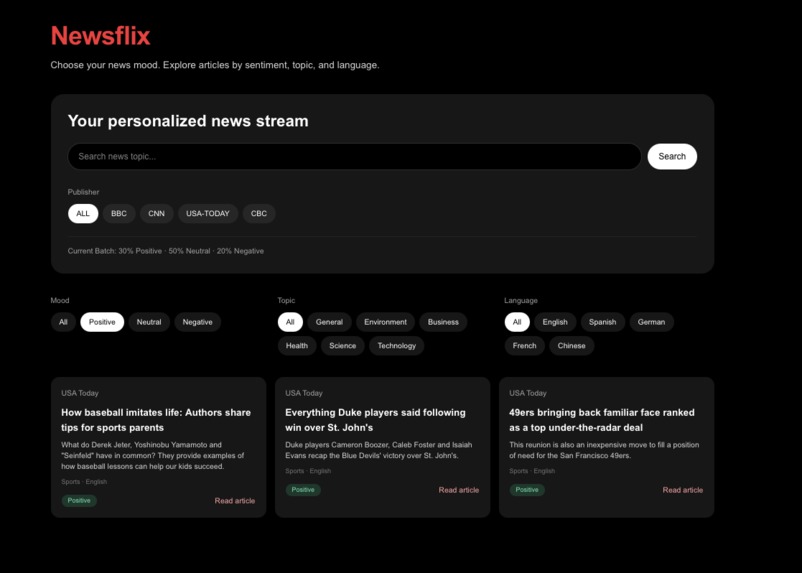
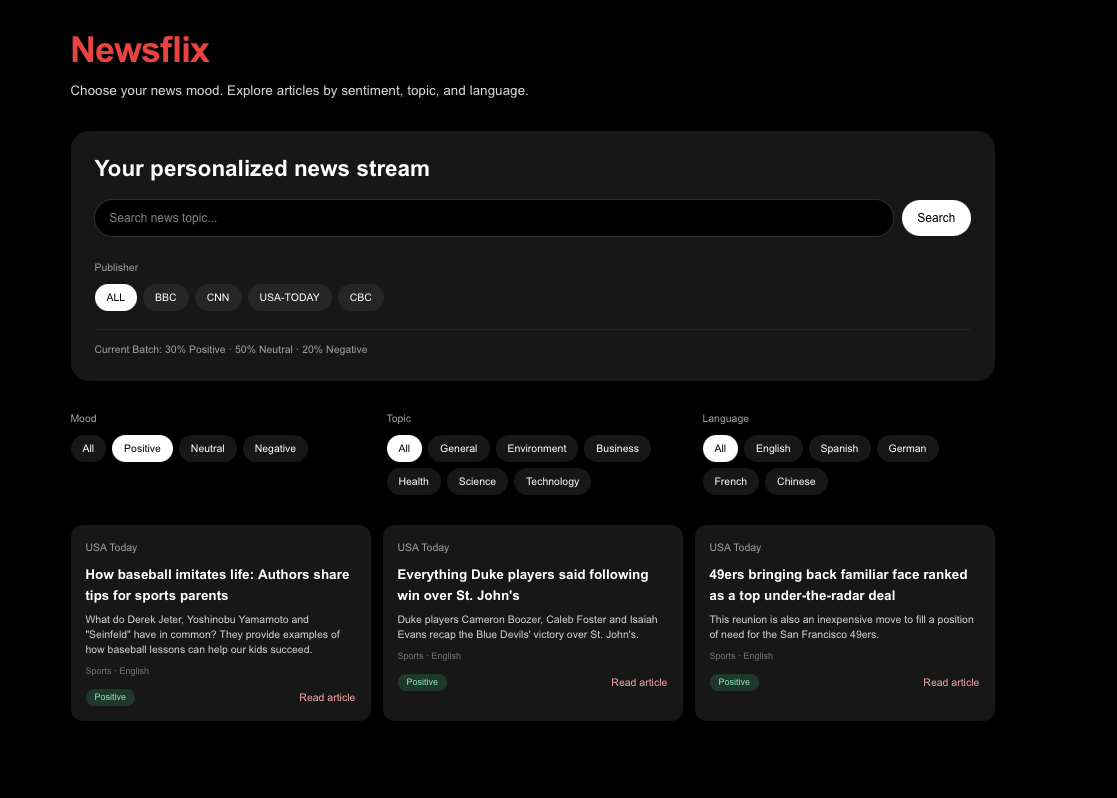
Frontend (Client) • Built using modern React (Next.js) • Responsible for: o Displaying news articles o Providing filtering options (e.g., sentiment) o Rendering article cards with metadata
Backend (API Layer) • Fetches news data from an external provider (NewsAPI) • Processes and enriches articles using AI classification • Returns structured, enriched data to the frontend
AI Classification Layer • Powered by Google Gemini (gemini-2.5-flash) • Performs: o Sentiment classification o Topic categorization o Language detection
- Data Pipeline
The system processes news articles through the following pipeline:
Step 1: Data Retrieval
The backend sends a request to a news aggregation API using parameters such as: • Query keywords (default: world, innovation, recovery, etc.) • Publisher filters (e.g., BBC, CNN, USA Today) • Page size (e.g., 10–30 articles)
Step 2: Preprocessing
Articles are cleaned and standardized: • Titles and descriptions are extracted • Invalid or incomplete entries are removed • Duplicate URLs are filtered
Step 3: Rule-Based Preclassification (Lightweight Layer)
A minimal rule-based system is applied to detect obvious high-impact events, such as: • Wars • Attacks • Natural disasters
This step ensures: • Fast classification for critical cases • Reduced reliance on external AI calls
Step 4: AI-Based Classification (Gemini)
For all remaining articles, the system sends a batch request to Gemini with a carefully engineered prompt.
The prompt instructs the model to: • Evaluate the real-world impact of the event, not just keywords • Avoid naive interpretations (e.g., “recovery” ≠ positive in all contexts) • Distinguish between: o Genuine positive developments o Routine or neutral reporting o Negative events or setbacks
The model returns structured JSON with: • sentiment • topic • language • confidence score
Step 5: Post-Processing Rules
Additional logic is applied to improve consistency: • Example: Sports articles are normalized to Neutral sentiment, as they typically do not carry significant real-world emotional impact beyond entertainment.
Step 6: Response Construction
The backend returns a structured list of enriched articles: { "title": "...", "source": "...", "sentiment": "Neutral", "topic": "Sports", "language": "English" }
- Frontend Experience
The frontend presents the data through a clean and minimal interface.
Key Features • Feed Refresh Button Users can request a new batch of articles at any time. • Publisher Selection Users can choose trusted sources. • Mood Filter (Core Feature) Users can filter articles by: o Positive o Neutral o Negative • Article Cards Each article displays: o Title o Source o Summary o Sentiment label (colored badge) o Topic label o Link to full article
Design Philosophy • Simple • Transparent • Non-manipulative
The interface avoids: • addictive design patterns • excessive notifications • engagement-driven ranking
Key Technical Challenges
Sentiment Misclassification
Naive keyword-based systems often fail: • Example: “injury delays return” may be incorrectly classified as positive due to the word “return”
Solution: • Shift toward AI-based contextual understanding • Improve prompt engineering
- Topic Misclassification
Early implementations misclassified sports as technology due to keywords.
Solution: • Expand keyword detection • Reinforce topic instructions in AI prompt • Add post-processing rules
- API Rate Limits
The Gemini API imposes request limits (e.g., 20 requests/day in free tier).
Solution strategies: • Batch classification • Reduce article count per request • Cache results (future improvement) • Use fallback rule-based classification when limits are exceeded
- Ethical and Design Principles
Newsflix is built with the following principles:
Transparency • Users see how content is classified • No hidden ranking algorithms
User Autonomy • No content is removed or hidden • Users decide what to consume
Privacy • No personal data collection • No behavioral tracking
Non-Commercial Intent • No ads • No subscriptions • No monetization
- Impact and Applications
Newsflix has potential applications in: • Digital well-being tools • Educational environments • Media literacy initiatives • Research on emotional impact of news
It can also serve as a prototype for: • browser extensions • personalized news dashboards • mental health–aware content platforms
- Conclusion
Newsflix redefines how users interact with news by introducing emotional awareness as a first-class component of information consumption.
Rather than optimizing for engagement, it promotes: • awareness • balance • intentional reading
By combining AI-driven classification with a user-centered design, Newsflix demonstrates how technology can be used not only to inform, but also to protect and empower users in their interaction with information.


Log in or sign up for Devpost to join the conversation.