-
-
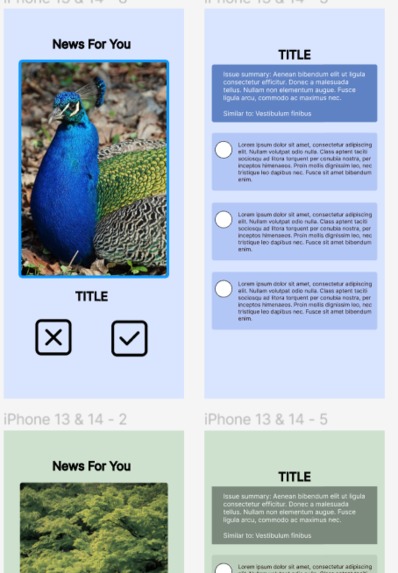
Sample element in NewsFeed swipe of a single news.
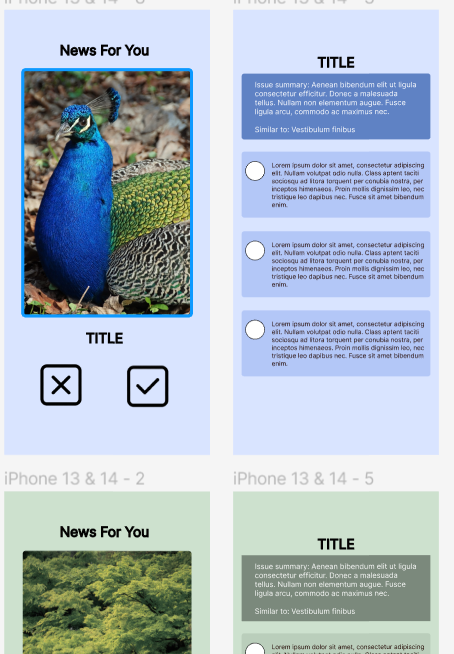
Inspiration
The overwhelming influx of news from countless sources can be daunting, leading to information overload and fatigue. This has led to an increased need for streamlined news consumption. In a world where optimization is vital, our team wanted to ensure that news readers had the most valuable and interesting information at their fingertips by suggesting this addition to Shades: a dating app style “For You” news feed.
What it does
NewsFeed Swipe implements a dating app style “For You” news feed by using an algorithm to calculate what the user would most likely want to view. In this feed, the algorithm uses data entered by the user (such as location and certain points of interest) and data collected from their views (such as content most frequently viewed/liked) to formulate their feed. Only one news recommendation at once relieves the choices on users and eases their experience in general. This way, users can seamlessly view some of the newest and hottest content while still being enriched with different viewpoints on the same subject.
By harnessing the power of personalization, we strove to create a news consumption experience that is not only efficient but also engaging for every user. With options of “swiping right” on the profiles they would like to see more in-depth news about and “swiping left” on the profiles they would like to see less of, users can determine what kinds of information they would like to consume (ethically, of course). Their preferences will be stored in their database to curate selections of articles, stories, and updates that align with that user’s interests.
How we built it
Our journey to create NewsFeed Swipes began in Figma, where we utilized the platform to design the general structure of the feature. Then, we researched how weighted score feed optimization algorithms work for popular social media platforms today and decided to implement a basic version of this for our project. Then, we recognized what properties of the activities on the app like likes, shares, pollVotes play a role in determining a user's engagement and decided to use that for our weighted scores. We then translated our algorithm into the object-oriented outline and finally into Java to create the final product.
Challenges we ran into
When implementing the object-oriented outline, we realized that a single user object could only have one scoreboard property, which can only be used for one news. This is why we allowed our program to create multiple user objects with the same user name, but not under the same piece of content. This allowed us to create a unique pairing of each user with each piece of content while ensuring there were not duplicate users under the same content. We were glad that our deep insight of the object-oriented outline helped us in overcoming this challenge.
Accomplishments that we're proud of
Despite our initial hurdles, we are delighted with the progress we have made on this project. While we did not fully create the front end of the project, we successfully implemented the back end with the algorithm we developed. Moreover, we're also proud of how closely our project aligns with Shades's mission to appeal the GenZ. By following a model that closely resembles today's popular dating apps, we hope to bring more engagement to Shades with NewsFeed Swipe feature.
What we learned
Our experience with Git was a valuable lesson in collaboration and version control. We tackled problems related to merging files, repository sharing, and Git installation. This project taught us effective problem-solving and file-sharing practices. Along with this, this project also taught us to carefully analyze client's needs and work on translating them into technical terms that can further be translated into code. This overall process was significantly valuable to us.
What's next for NewsFeed Swipes
We hope to make the backend fully functional by connecting it to live user inputs, and we hope to design the app further to make the UI more appealing in the upcoming versions. Also, as we move forward, we hope to replace the current algorithm with a more powerful optimization algorithm that can operate on a deeper level implementing Natural Language Processing and Reinforcement Learning.

Log in or sign up for Devpost to join the conversation.