Inspiration
While scrolling through social media, I noticed how easily false information gains traction. Whether it's manipulated images, misquoted statements, or completely fabricated news, misinformation influences public perception. I wanted to build a simple yet powerful tool that could analyze text from images and verify its authenticity using AI-driven techniques.
What it does
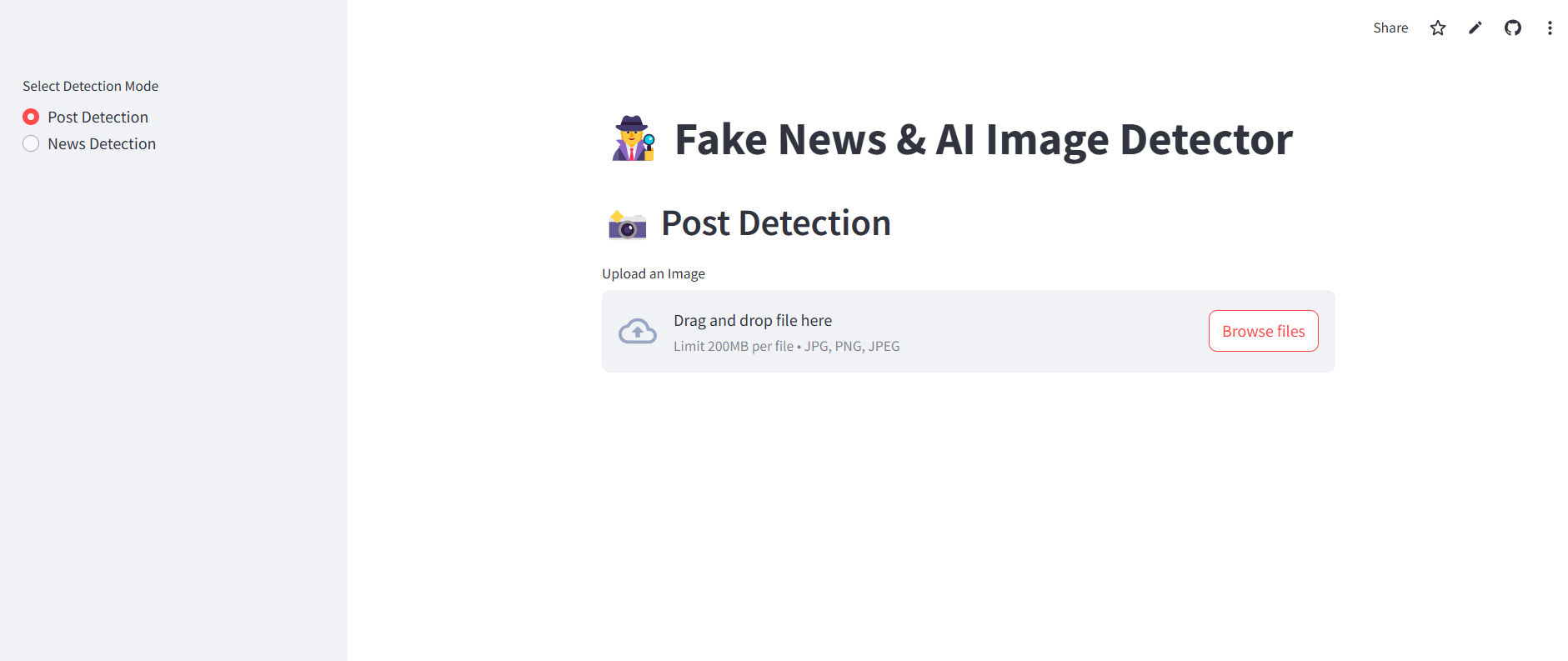
The News & Post Detector is an AI-powered tool designed to analyze and verify the authenticity of text extracted from images, such as social media posts, news screenshots, or memes.
✨ Key Features
Extracts Text from Images
- Uses Optical Character Recognition (OCR) with EasyOCR to extract text from uploaded images.
- Uses Optical Character Recognition (OCR) with EasyOCR to extract text from uploaded images.
Fact-Checks Content
- Cross-references extracted text with online sources using DuckDuckGo search to identify misleading or fake news.
- Cross-references extracted text with online sources using DuckDuckGo search to identify misleading or fake news.
Provides Credibility Score
- Analyzes search results and returns a confidence level on whether the text is factually accurate.
- Analyzes search results and returns a confidence level on whether the text is factually accurate.
User-Friendly Interface 🎨
- Built with Streamlit, offering a simple and interactive way to upload images and get results instantly.
- Built with Streamlit, offering a simple and interactive way to upload images and get results instantly.
This project helps users detect misinformation, analyze viral content, and verify authenticity with minimal effort. 🚀
How we built it
The News & Post Detector was developed using a combination of AI-driven text extraction and fact-checking techniques. Our goal was to create a seamless and efficient way to verify information from images.
Tech Stack
- Python – The core programming language for scripting and processing.
- Streamlit – Used to build an interactive and user-friendly web interface.
- EasyOCR – Optical Character Recognition (OCR) libraries to extract text from images.
- DuckDuckGo Search API – For cross-referencing extracted text to verify its authenticity.
- Git & GitHub – Version control and collaboration.
- Streamlit Cloud – Deployment platform for easy access.
Challenges we ran into
Building the News & Post Detector was an exciting journey, but it came with its fair share of challenges. Here are some of the key hurdles we faced and how we tackled them:
1️⃣ OCR Accuracy Issues
- Extracting text from images was inconsistent, especially for low-quality or distorted images.
- Solution: We experimented with EasyOCR as an alternative to Pytesseract, adjusted image preprocessing techniques (grayscale conversion, thresholding), and fine-tuned OCR parameters for better results.
2️⃣ Tesseract Not Found Error
- During deployment, the app failed because Tesseract-OCR was missing or not configured in the server environment.
- Solution: We switched to EasyOCR, which doesn't require a separate installation, making deployment smoother on Streamlit Cloud.
3️⃣ Fact-Checking Reliability 🌐
- Searching for extracted text on DuckDuckGo sometimes returned irrelevant or biased results.
- Solution: We refined the search queries, filtered out unnecessary results, and considered additional fact-checking sources to improve accuracy.
4️⃣ GitHub Push Rejection 🚀
- Faced a "rejected push" error when trying to upload code due to conflicts with the remote repository.
- Solution: We ran
git pull --rebaseto merge remote changes before pushing, resolving version control issues.
What we learned
Despite these challenges, we gained valuable insights into:
✅ Optimizing OCR models for real-world text extraction.
✅ Enhancing search query efficiency for better fact-checking.
✅ Deploying AI-powered apps on Streamlit Cloud without dependency issues.
✅ Managing Git & GitHub effectively for seamless collaboration.
Built With
- duckduckgo
- easyocr
- github
- groq
- langchain
- opencv
- python
- streamlit

Log in or sign up for Devpost to join the conversation.