-
-
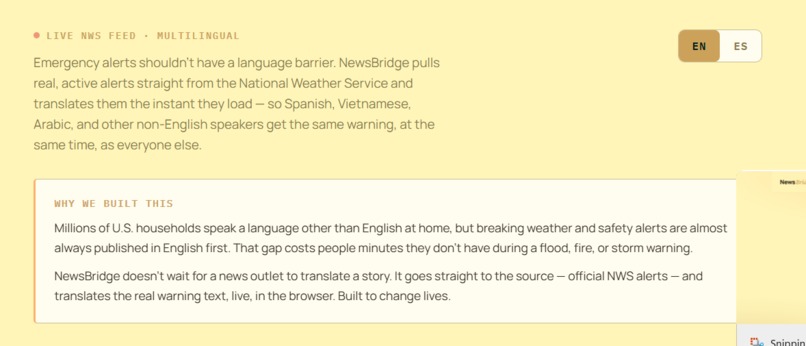
What my website is all about and our plan
-
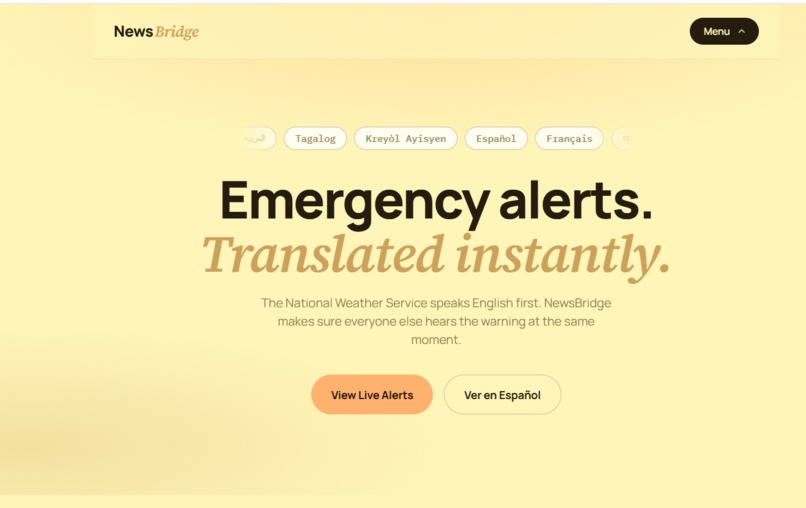
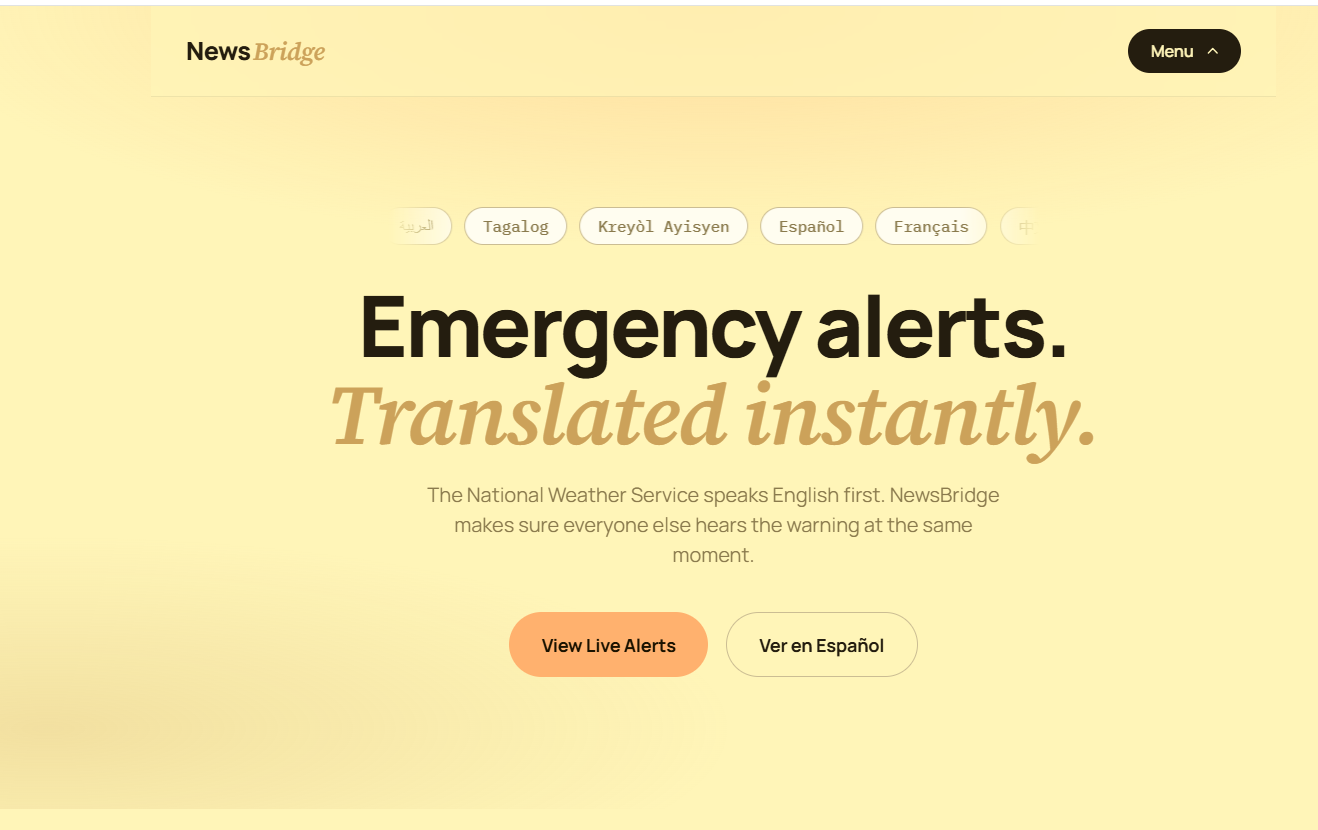
Home page
-
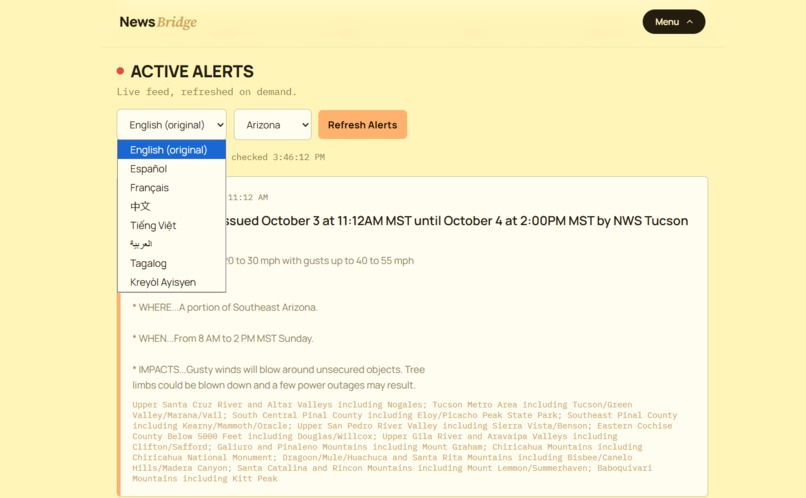
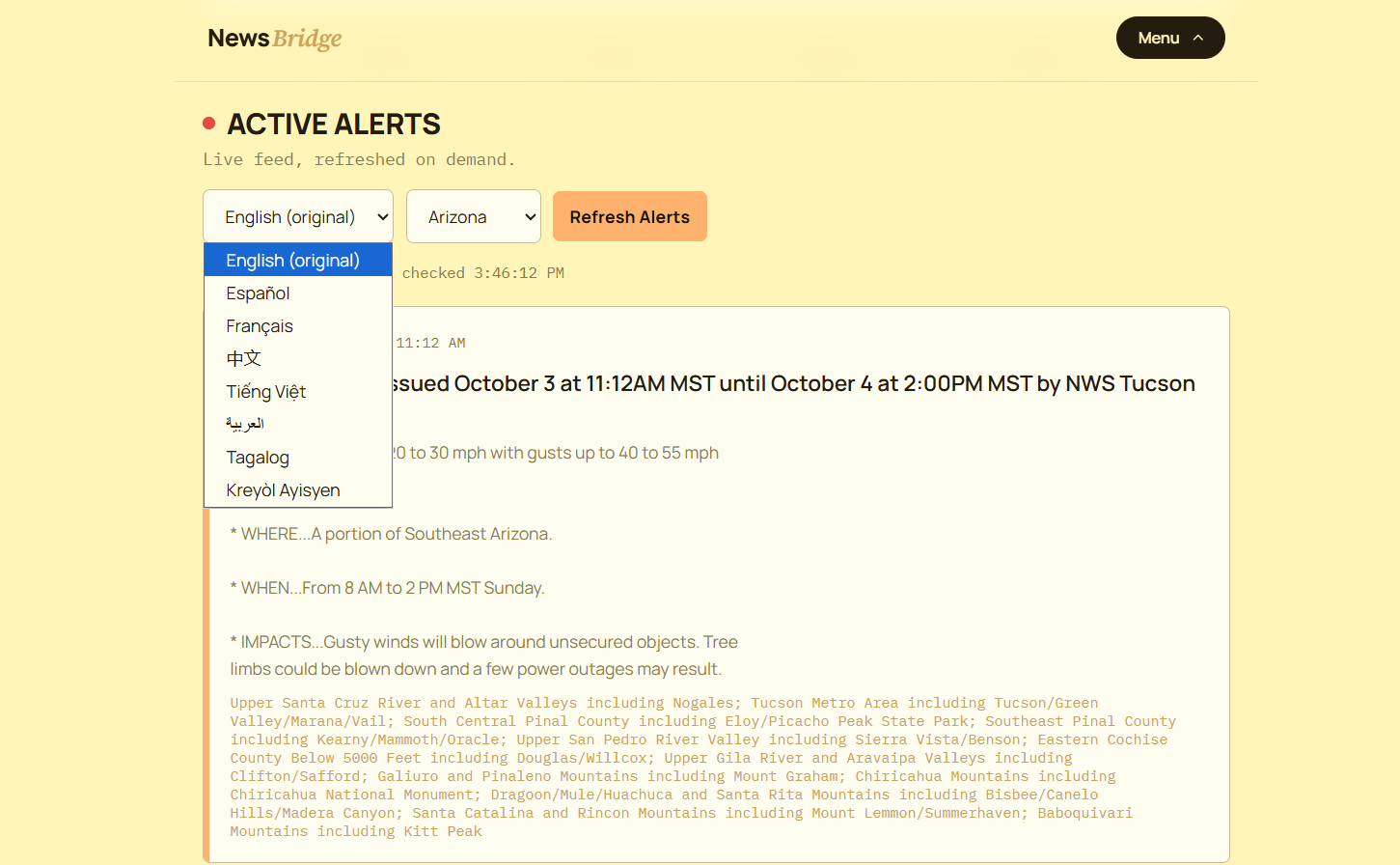
real active alerts from our feed
Inspiration
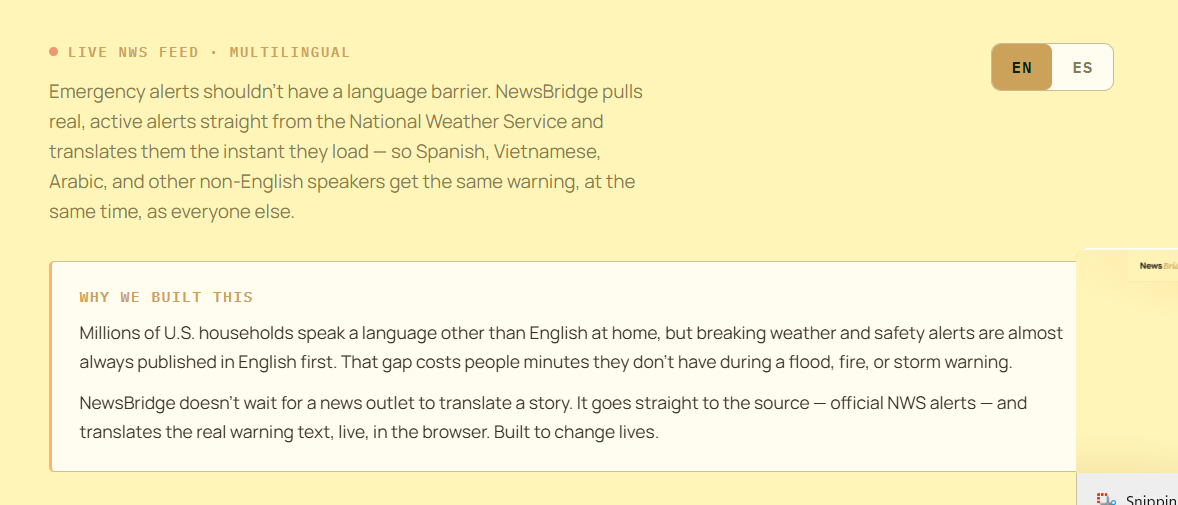
During emergencies like floods, wildfires, extreme heat, and severe storms, NOAA and other agencies issue critical alerts in English within seconds. But millions of Americans have limited English proficiency, and in a real emergency, a delay of even a few minutes to find or understand a translated warning can be the difference between safety and harm. We wanted to close that gap by making sure life saving information reaches people the moment it's issued, not hours later through word of mouth or a translation that arrives too late to matter.
What it does
NewsBridge pulls live NOAA and emergency alert data directly from api.weather.gov and translates it in real time into the user's preferred language, so non English speakers get the same warning, with the same urgency, at the same moment as everyone else. Users can monitor alerts for their area, see the original English text alongside the translated version, and quickly understand what kind of emergency is happening and what action to take.
How we built it
We built NewsBridge using the api.weather.gov feed for live, authoritative alert data, paired with the Google Translate and MyMemory APIs for translation. The interface went through two full design passes. The first version was a dark, dense "monitoring station" style UI built for the Suvidha Hacks submission, aimed at making the app feel like a real emergency operations tool. Later, we redesigned the entire interface into a cleaner cream and amber palette using Playfair Display for headers and IBM Plex Mono for data and alert text, which made the app feel calmer and more legible under stress rather than alarming. That rebuilt version was submitted to the Proof of Possible hackathon.
Challenges we ran into
Getting reliable, real time data out of api.weather.gov took some trial and error, since alert volume and formatting can vary a lot depending on the region and type of event, and we had to build parsing logic that could handle everything from short heat advisories to long, detailed flood warnings without breaking the layout. Translation accuracy was another major challenge. General purpose translation APIs are built for everyday language, not urgent safety terminology, so we had to be careful that phrases like "seek shelter immediately" or "evacuate now" were translated with the same urgency and clarity in every supported language, not softened or made ambiguous by a literal translation. We also had to balance visual design with function. Early on, our dark monitoring UI looked impressive but was actually harder to scan quickly during a real alert, which pushed us to prioritize legibility and speed of comprehension over aesthetics in the redesign. Keeping the interface responsive while polling for new alerts and running translation requests without noticeable lag was an ongoing technical challenge as well.
Accomplishments that we're proud of
We're proud that NewsBridge works with real, live government alert data rather than mocked or simulated examples, so the demo is a true end to end pipeline. An alert issued by NOAA reaches a non English speaker, translated, within moments, using the same infrastructure that would power the app in a real emergency. We're also proud of how much the design improved between our two builds. Moving from the dark monitoring UI to the cream and amber redesign taught us a lot about designing for clarity under pressure rather than just visual impact, and we think the final version is genuinely easier and faster to use in a real crisis.
What we learned
We learned that translation for safety critical text is a fundamentally different problem than everyday translation. Small ambiguities that would be harmless in casual conversation can be dangerous in an emergency alert, so we had to think carefully about which phrases needed extra verification or simplification rather than trusting a direct machine translation. We also learned a lot about accessible design for high stress situations. Choices that seem like small details, like font weight, color contrast, and how information is ordered on the screen, actually have a big impact on how quickly someone can understand and act on a warning when they are scared or in a hurry. Finally, working with a live government data feed taught us to design for unpredictability, since real alerts do not always arrive in a clean, consistent format.
What's next for NewsBridge
Next, we want to expand language coverage beyond our current set to better serve the communities most at risk during emergencies. We also want to add an offline or SMS based fallback mode so people in low connectivity areas, which are often the same areas hit hardest by disasters, can still receive translated alerts. Another priority is smarter prioritization, so that alerts are ranked by severity and matched to a user's exact location, ensuring the most critical warnings for their situation always surface first instead of getting buried among lower priority notices. Longer term, we would like to explore partnerships with local emergency management agencies and community organizations to get NewsBridge in front of the non English speaking households who need it most.
Built With
- api.weather.gov
- css
- google-translate-api
- html
- ibm-plex-mono
- javascript
- mymemory-api
- noaa-weather-api
- playfair-display

Log in or sign up for Devpost to join the conversation.