-
-
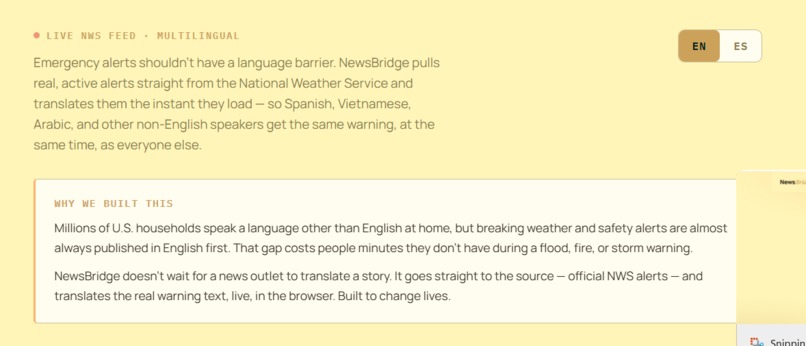
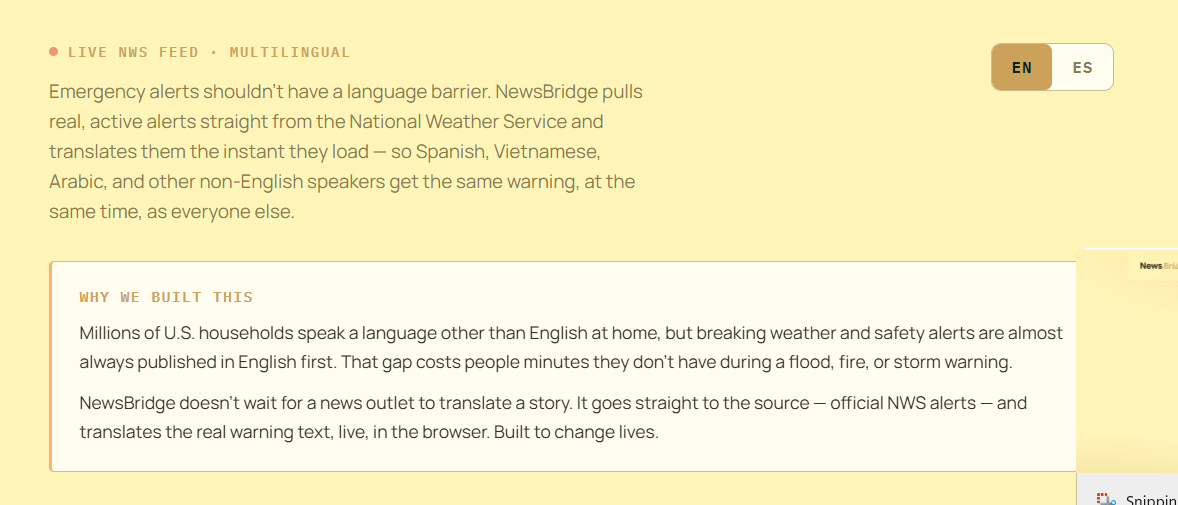
about the website
-
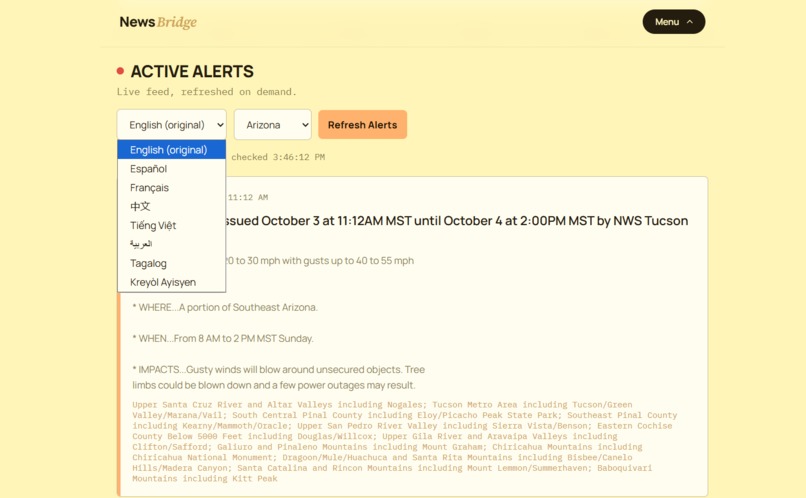
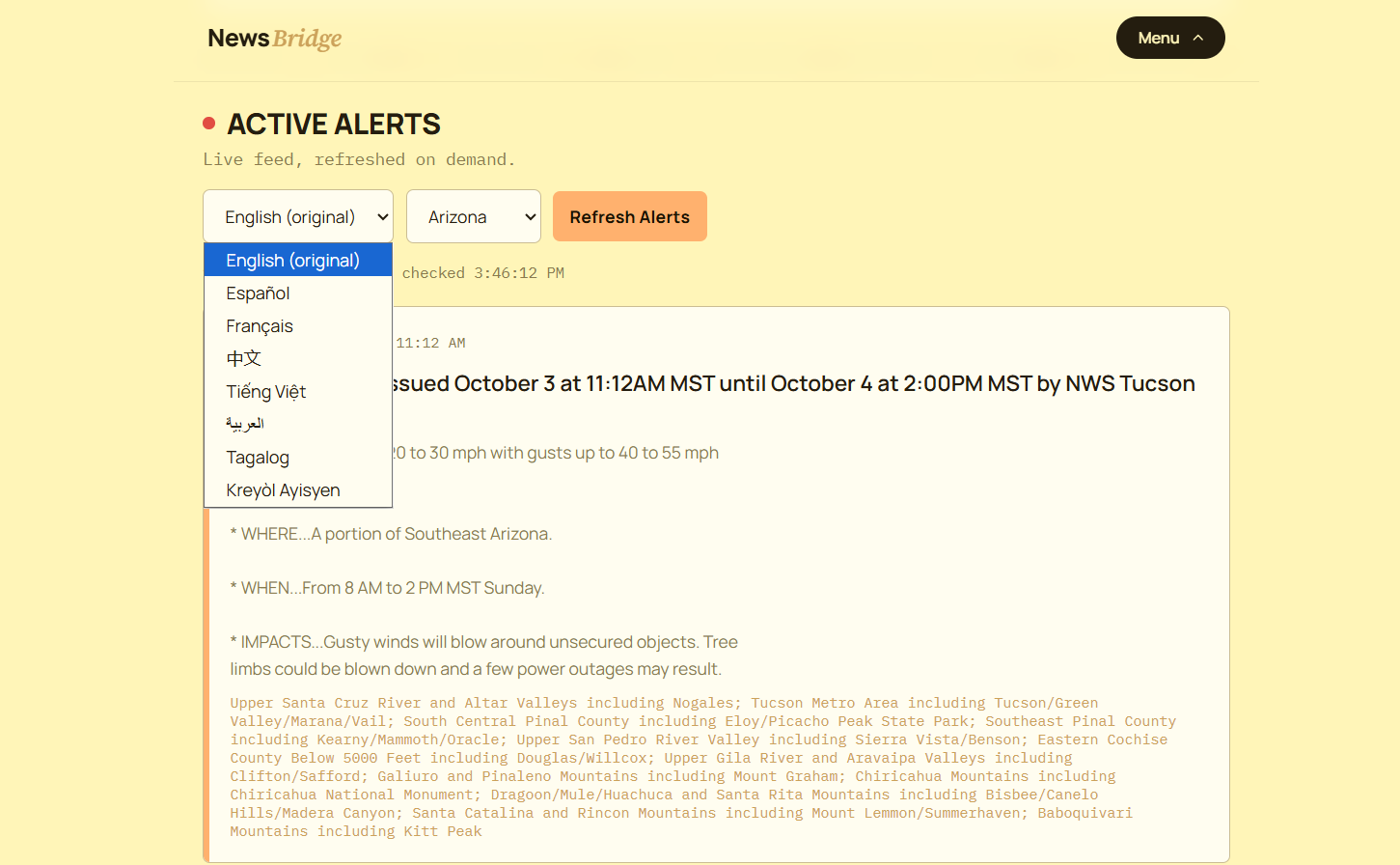
real active feed pulled from NewsBridge
-
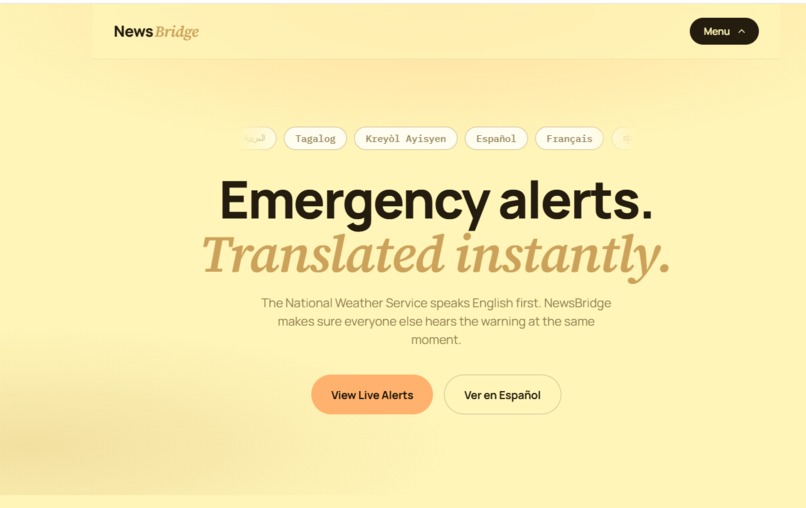
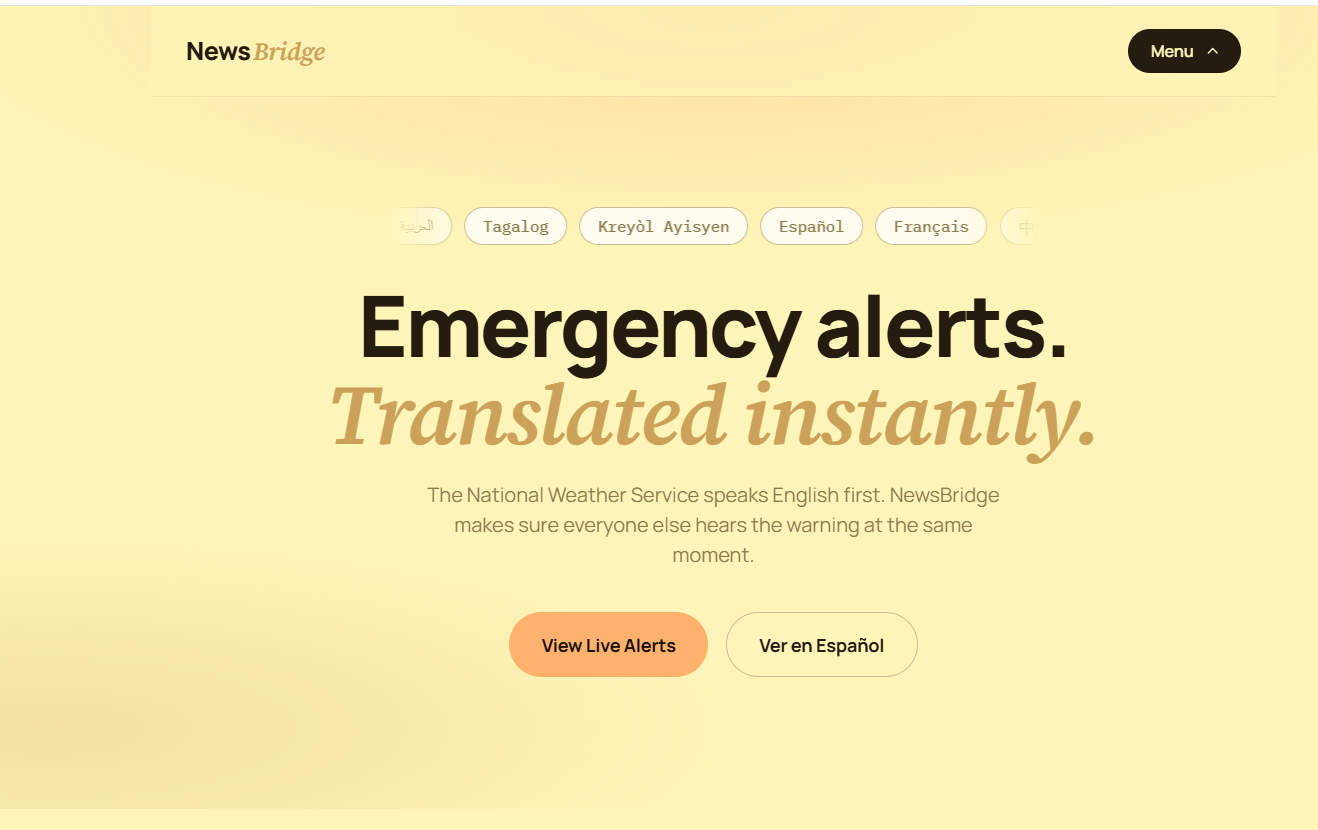
home pag
Inspiration
During emergencies like floods, wildfires, extreme heat, and severe storms, NOAA and other agencies issue critical alerts in English within seconds. But roughly 25 million Americans have limited English proficiency, and in a real emergency, a delay of even a few minutes to find or understand a translated warning can be the difference between safety and harm. Cities, counties, school districts, and hospitals all know this gap exists, and most handle it today with slow manual translation or nothing at all. We wanted to close that gap by making sure life saving information reaches people the moment it is issued, and by building it as a product that the agencies responsible for warning people can actually buy and rely on.
What it does
NewsBridge pulls live NOAA and emergency alert data directly from api.weather.gov and translates it in real time into each person's preferred language, so non English speakers get the same warning, with the same urgency, at the same moment as everyone else. Users can monitor alerts for their area, see the original English text alongside the translated version, and quickly understand what kind of emergency is happening and what action to take.
The public app is free for individuals. The business is selling the same product to governments and whoever controls alert distribution for a community: city and county emergency management offices, state agencies, school districts, public transit, utilities, and hospital systems. They pay us a fixed amount every month based on how many people they serve, so they get a predictable budget line with no per-alert surprises. Then they take that information and send it to all of their residents, students, patients, and workers by SMS, email, and push notification, each in their own language. Residents never pay anything. These are launch targets we plan to test with pilots, not current revenue.
Target pricing:
Community (individuals using the public app): Free Local (small towns and school districts under 25,000 people): about $500/month County (cities and counties with 25,000 to 250,000 people): about $1,500/month Regional (large counties, state agencies, and utilities with 250,000+ people): about $5,000/month
Every tier includes unlimited translated alerts, the agency's service area and languages, a dashboard showing who was reached, an audit log of what was sent and when, a Verified Safety Phrases library for the most critical warnings, and a text message allowance. A county of 100,000 people paying $1,500 a month works out to about 1.5 cents per resident per month to reach every language group instantly, which is far cheaper than interpreters or printed translations for every emergency.
How we built it
We built NewsBridge using the api.weather.gov feed for live, authoritative alert data, paired with the Google Translate and MyMemory APIs for translation. The interface went through two full design passes. The first version was a dark, dense "monitoring station" style UI built for the Suvidha Hacks submission, aimed at making the app feel like a real emergency operations tool. Later, we redesigned the entire interface into a cleaner cream and amber palette using Playfair Display for headers and IBM Plex Mono for data and alert text, which made the app feel calmer and more legible under stress rather than alarming. That rebuilt version was submitted to the Proof of Possible hackathon. Because we built it once on free public alert data, the same product can be set up for any town, county, or state without rebuilding anything, which is what lets us mass produce it.
Challenges we ran into
Getting reliable, real time data out of api.weather.gov took some trial and error, since alert volume and formatting can vary a lot depending on the region and type of event, and we had to build parsing logic that could handle everything from short heat advisories to long, detailed flood warnings without breaking the layout. Translation accuracy was another major challenge. General purpose translation APIs are built for everyday language, not urgent safety terminology, so we had to be careful that phrases like "seek shelter immediately" or "evacuate now" were translated with the same urgency and clarity in every supported language, not softened or made ambiguous by a literal translation. That problem is also what led to our Verified Safety Phrases library, which is both our quality fix and a reason an agency would pay. We also had to balance visual design with function. Early on, our dark monitoring UI looked impressive but was actually harder to scan quickly during a real alert, which pushed us to prioritize legibility and speed of comprehension over aesthetics in the redesign. Keeping the interface responsive while polling for new alerts and running translation requests without noticeable lag was an ongoing technical challenge as well.
Accomplishments that we're proud of
We are proud that NewsBridge works with real, live government alert data rather than mocked or simulated examples, so the demo is a true end to end pipeline. An alert issued by NOAA reaches a non English speaker, translated, within moments, using the same infrastructure that would power the app in a real emergency. We are also proud of how much the design improved between our two builds. Moving from the dark monitoring UI to the cream and amber redesign taught us a lot about designing for clarity under pressure rather than just visual impact, and we think the final version is genuinely easier and faster to use in a real crisis. Finally, we are proud that we turned a technical problem, unreliable machine translation of safety text, into a clear product advantage and a business model.
What we learned
We learned that translation for safety critical text is a fundamentally different problem than everyday translation. Small ambiguities that would be harmless in casual conversation can be dangerous in an emergency alert, so we had to think carefully about which phrases needed extra verification or simplification rather than trusting a direct machine translation. We also learned a lot about accessible design for high stress situations. Choices that seem like small details, like font weight, color contrast, and how information is ordered on the screen, actually have a big impact on how quickly someone can understand and act on a warning when they are scared or in a hurry. Working with a live government data feed taught us to design for unpredictability, since real alerts do not always arrive in a clean, consistent format. Finally, we learned that a good idea needs a payer. The people who benefit most from the free app are not the ones who will fund it, so the business has to serve the agencies responsible for reaching them.
What's next for NewsBridge
Run free pilots with a few local agencies and school districts in Arizona to get real results and testimonials, then convert them to paid monthly contracts, starting with small towns and districts that can buy quickly. Add an offline or SMS based fallback mode so people in low connectivity areas, which are often the same areas hit hardest by disasters, can still receive translated alerts. Add smarter prioritization so alerts are ranked by severity and matched to a user's exact location, ensuring the most critical warnings always surface first instead of getting buried among lower priority notices. Expand language coverage and grow the Verified Safety Phrases library to better serve the communities most at risk during emergencies. Expand county by county and to state agencies, using grant funding for emergency preparedness and language access where it helps. Illustrative goal: 50 agencies at an average of $1,000 a month would be about $600,000 a year in recurring revenue.
Built With
- api.weather.gov
- css3
- google-translate-api
- html5
- ibm-plex-mono
- javascript
- mymemory-api
- playfair-display

Log in or sign up for Devpost to join the conversation.