-
-
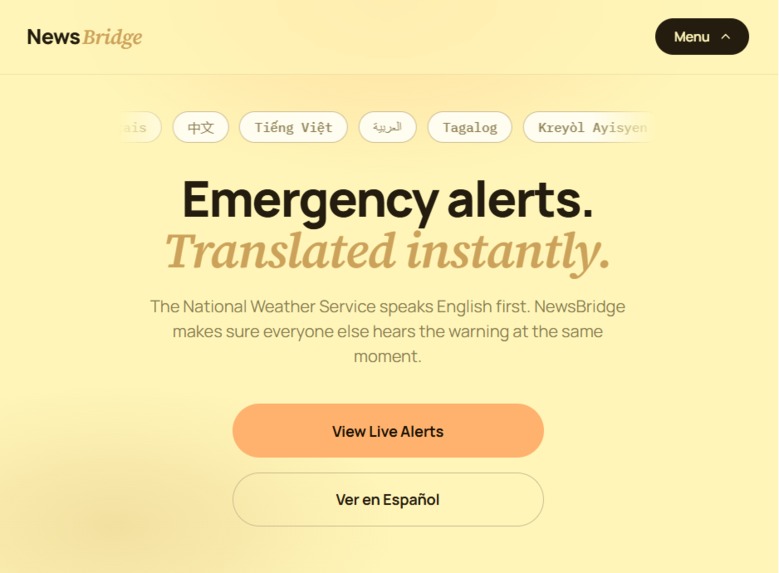
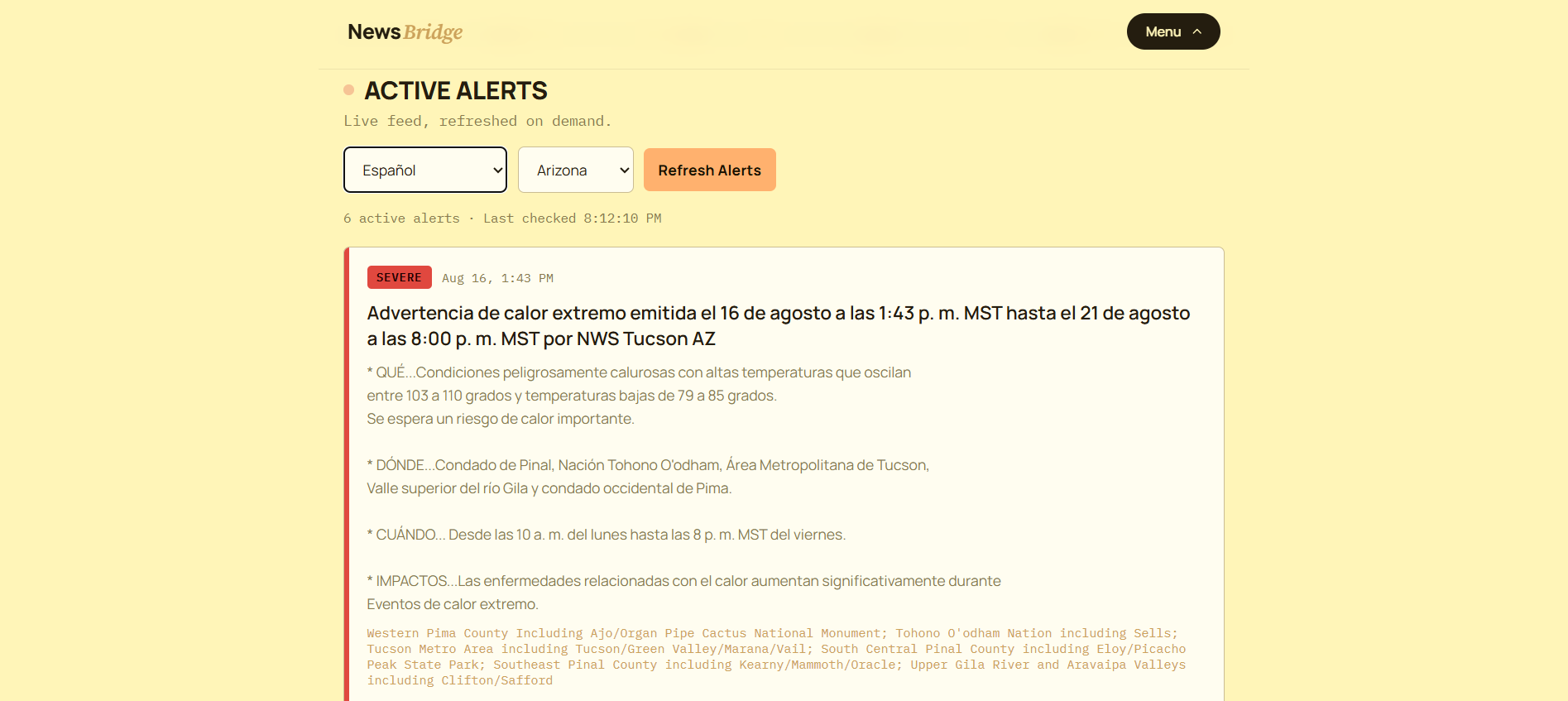
NewsBridge translates emergency alerts the instant they're issued, no delay.
-
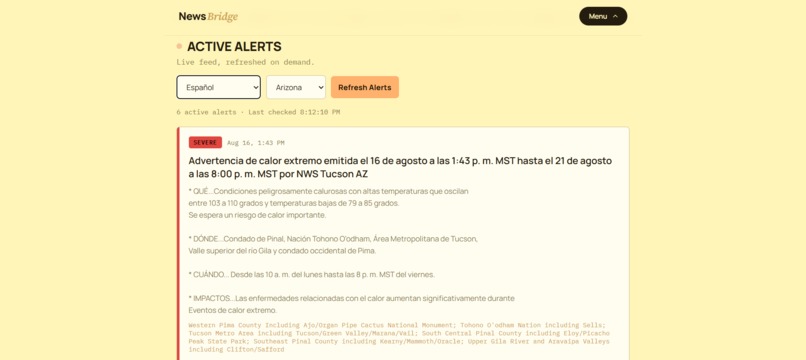
A real, active National Weather Service alert translated live into Spanish. Same warning, same moment, no language barrier.
-
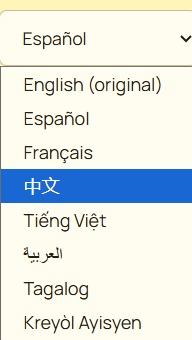
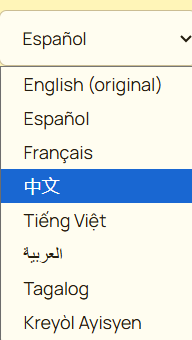
Seven different languages
Inspiration
What it does
In September 2023, hazardous wildfire smoke spread across the Bay Area, and emergency alerts went out to residents' phones. But for three straight days, those alerts were only in English. San Francisco County offers alerts in seven languages, but Alameda and Solano Counties, where more than one in ten residents speak a language other than English at home, did not, according to reporting by Oaklandside and El Timpano. It took until day four for an alert to go out in Spanish, Chinese, and Tagalog. Vietnamese and Russian speakers were left out entirely.
That is not a rare failure. Nationally, nearly 68 million Americans speak a language other than English at home, and wireless emergency alerts in the U.S. are currently issued in only English and Spanish. The FCC voted years ago to expand that to 13 languages plus American Sign Language, but as of this year, that expansion has still not taken effect. During the LA wildfires, false evacuation alerts reached millions of people, and anyone outside English or Spanish had no way to know what the message even said.
We kept coming back to one question. If the information already exists, correct, official, and issued in time, why should the language someone speaks decide how fast they get it. That question is the real reason I built NewsBridge, to save lives. Not to win a hackathon, not to check a box on multilingual accessibility, but because that gap is not a hypothetical. It is happening in real counties, during real emergencies, right now, and somewhere, someone is finding out too late.
How we built it
The frontend is a single page built with HTML, CSS, and vanilla JavaScript. Live alert data comes from api.weather.gov, the NWS's public GeoJSON feed. Translation happens client side through the MyMemory translation API, with results cached so repeat requests don't hit the API again. We built in a fallback data set so the app degrades gracefully and stays demonstrable even if the live feed or translation service is temporarily unreachable, and we made sure that fallback state is clearly labeled so it's never mistaken for a real alert.
Challenges we ran into
Getting translations to feel trustworthy was harder than getting them to work. A mistranslated emergency warning is worse than no warning at all, so we spent real time on how translated content is labeled and displayed, not just whether the API call succeeded. We also had to handle the NWS API's inconsistent alert formatting and MyMemory's character limits per request, which meant chunking longer alert descriptions without breaking sentences mid-translation.
Accomplishments that we're proud of
We built a tool that works with real, live emergency data instead of a mocked demo, and we prioritized honesty in the UI, meaning nothing ever looks like a live alert unless it actually is one. We also kept the whole thing to a single, lightweight page with no build step, so it is fast to load in exactly the kind of moment where speed matters most.
What we learned
We learned how much of building for emergencies is really about trust and clarity, not just getting the technical pipeline working. A translated warning has to read as authoritative, not machine generated, or people will hesitate at the exact moment they can't afford to. We also learned a lot about the structure and quirks of public government data APIs.
What's next for NewsBridge
Next, we want to add push notifications so people are alerted the moment a new warning is issued for their area, not just when they open the app. We would also like to explore text to speech for translated alerts, since not everyone can read fluently in their spoken language, and expand beyond the NWS to cover other public safety sources. But this is bigger than a hackathon project to me. I want to start here, prove it works, and then take NewsBridge global, because a language barrier during an emergency is not just an American problem, it is happening everywhere, and everyone deserves to hear the warning at the SAME time.
Built With
- css
- googlefonts
- html
- javascript
- mymemoryapi
- nationalweatherserviceapi
- vercel

Log in or sign up for Devpost to join the conversation.