-
-
title-card
-
end-card
-
paraphase
-
withholding-ledger
-
prior-axis
NiuLai — a conversational shopping agent that argues with its own results
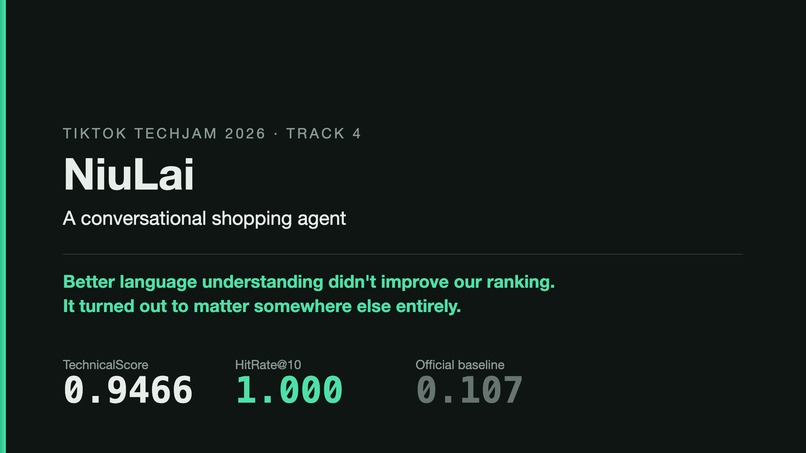
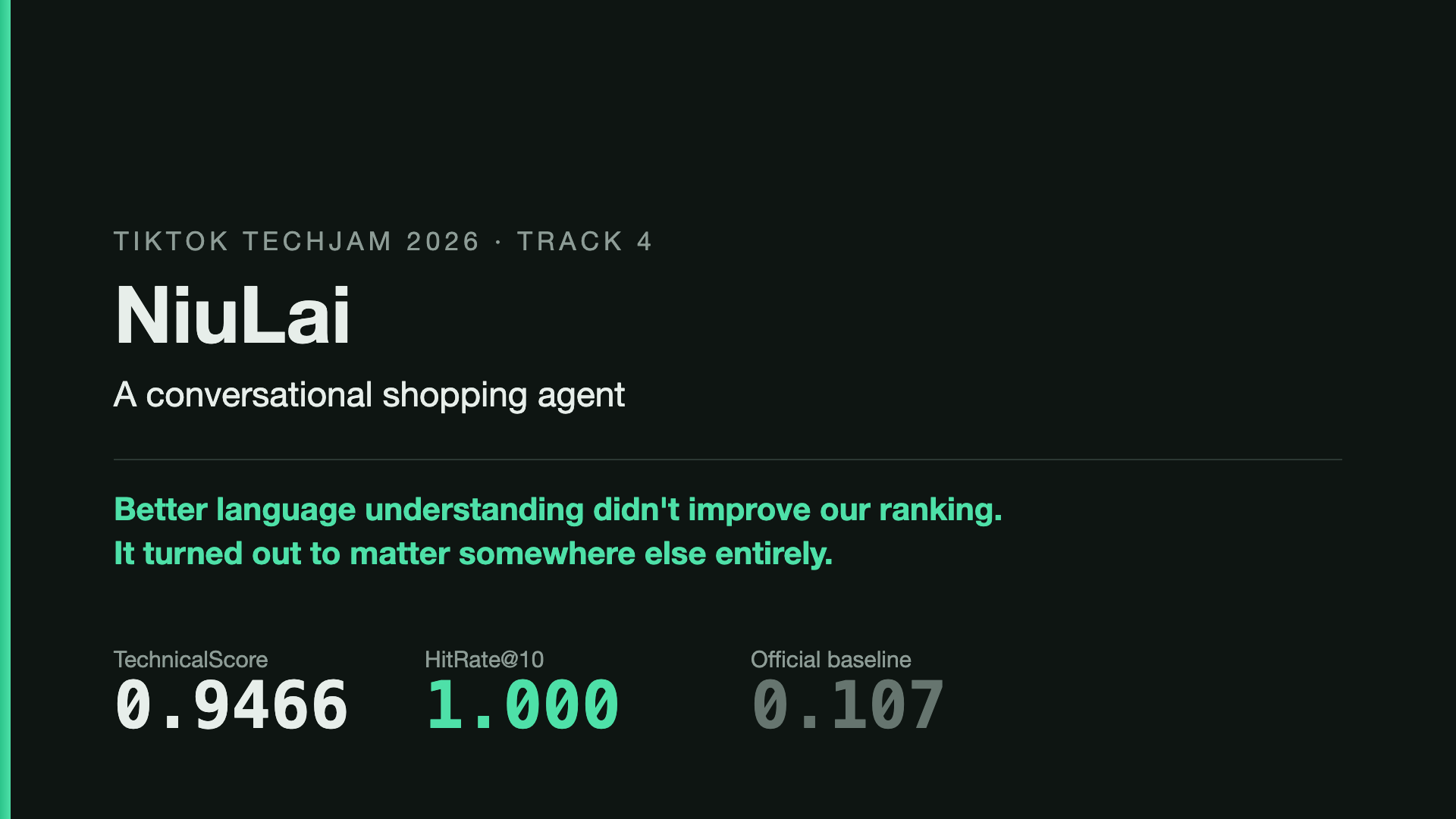
A shopper says "I'm looking for tunics, but I'm still exploring." Ten turns later the agent has to have put the one product they actually bought — out of 50,000 — at the top of a list. Our submitted system does that for 200 of 200 public sessions, at TechnicalScore 0.9466 against the official baseline of 0.107, using the Python standard library only, offline, in 9.7 seconds.
The score is the least interesting thing about it. What we would rather be judged on is the set of things we measured, disproved, and removed.
Inspiration
We nearly started by writing prompts. Instead we spent the first forty minutes reading the evaluator's source, and three facts there overrode the plan we walked in with.
The simulated customer never reads our prose. It consumes a single ask_attribute value from a
ten-item enum; the message string is only type-checked. Our entire channel to the customer is
roughly log2(10) ~ 3.3 bits per turn. No amount of prompt craft can change what the
customer says next — so we optimised our copy for human readers and said so, rather than presenting
it as a modelling achievement.
The customer quotes the product. The constraints they utter are verbatim fragments of the target item's own catalogue text, which makes verbatim substring matching close to a fingerprint. That one property drove almost every later decision.
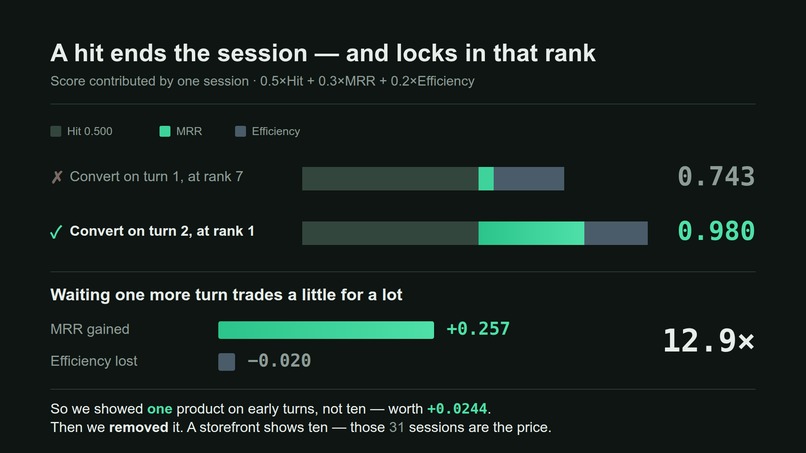
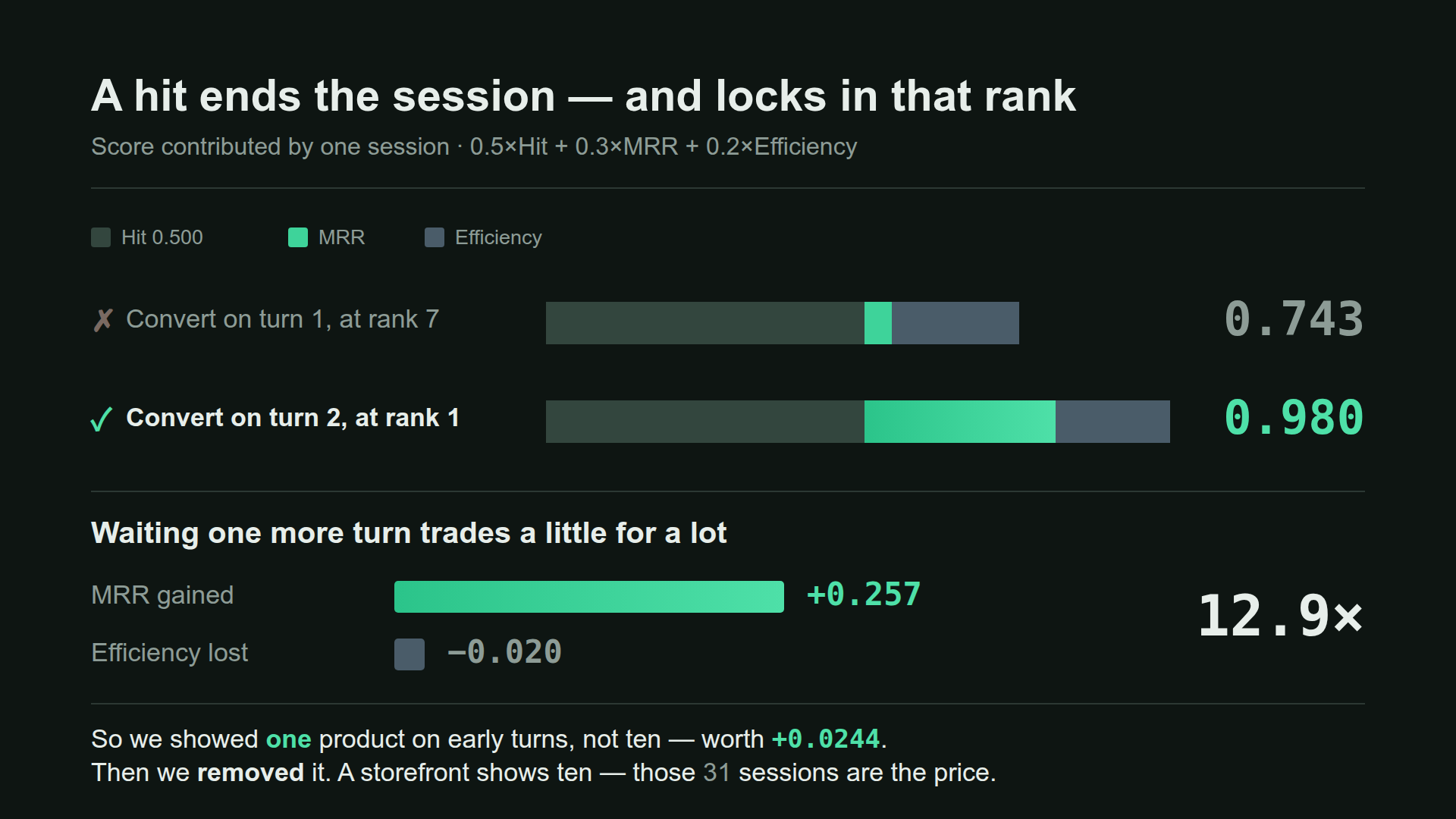
A hit ends the session and locks in that turn's rank. The official composite is
TechnicalScore = 0.50 x HitRate@10 + 0.30 x MRR + 0.20 x Efficiency
Efficiency     = clip((11 - MTTC) / 10, 0, 1)
so converting early at a mediocre rank is a trade the metric punishes:
convert on turn 1 at rank 7:   0.50 + 0.30 x (1/7) + 0.20 x (10/10)  =  0.743
convert on turn 2 at rank 1:   0.50 + 0.30 x  1    + 0.20 x ( 9/10)  =  0.980
We found 31 sessions sitting in exactly that losing trade. None of these three facts is inferable from the problem statement; all three are visible in the source.
How we built it
A single constraint-driven pipeline, deliberately not branched by intent: parse the customer's turn into slots → retrieve candidates → score them → ask the one question with the highest expected yield, while always returning a full slate.
- Parsing has three layers. Strict templates first; then a rule-based salvage layer that pulls constraint fragments out of unfamiliar phrasing; then, only when both fail, an LLM that extracts verbatim spans. A candidate extraction is accepted only if the catalogue actually contains it — we validate against the data, not against a grammar.
- Retrieval is BM25 over SQLite FTS5 with per-constraint phrase recall. We built a dense embedding route too, measured it honestly, and ship it disabled.
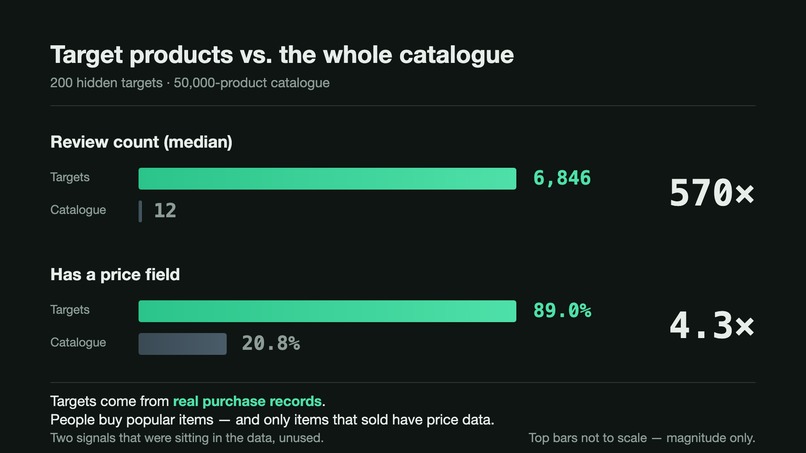
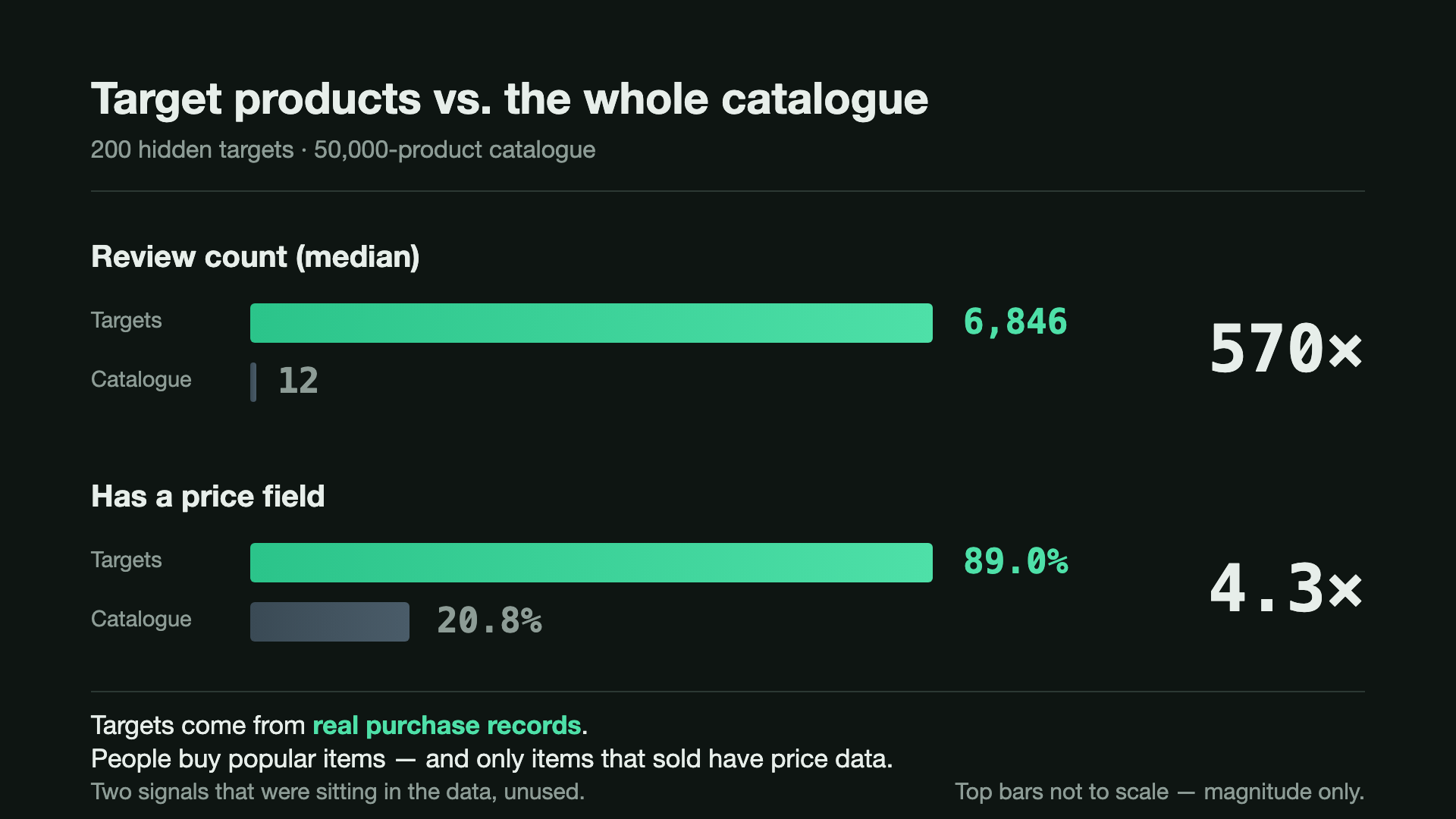
- Ranking scores two independent axes. The relevance axis asks which product matches the sentence. The prior axis asks which product a real person would actually have bought — targets come from genuine purchase records, so they carry 570x the median review count and are 4.3x more likely to have a price field. Nobody had used those two columns. Adding them was the single largest gain in the project.
Everything ships behind flags, the default path makes zero network calls, and the headline number is bit-identical with the network removed.
Challenges
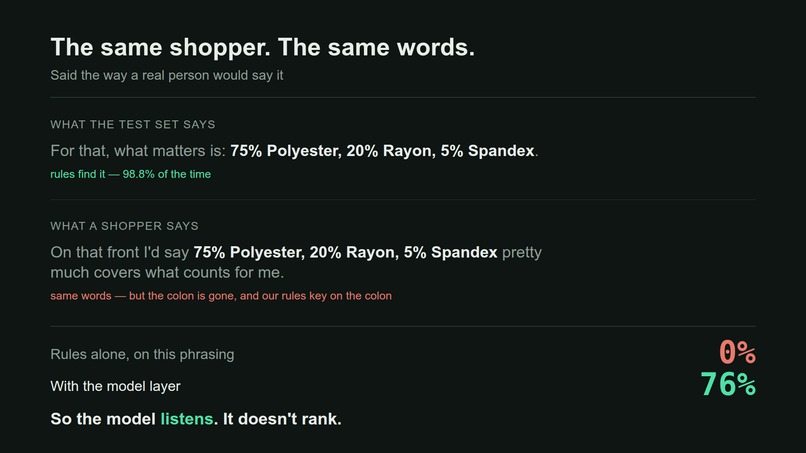
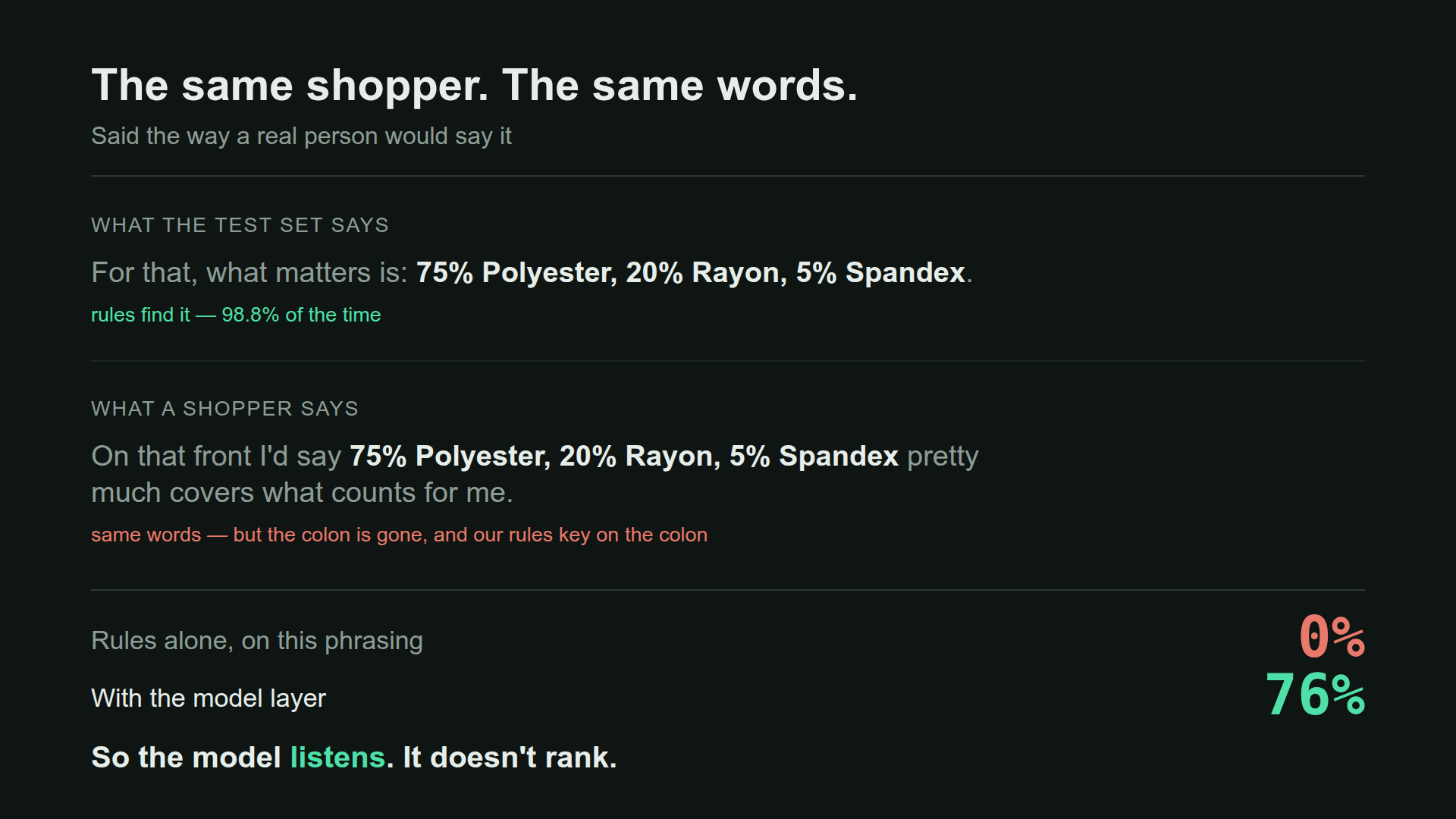
The public set cannot show you what breaks on the private one. The organisers reserve the right to paraphrase the simulated customer, and our whole pipeline rested on verbatim matching. So we built a five-level paraphrase stress harness and found the damage was not where we assumed: it was sentence-pattern matching that shattered, not verbatim matching. The three-layer parser is the answer to that, and it recovers most of the loss.
Our own metrics hid a defect. An end-to-end score absorbs upstream failures silently. Only after scoring the parser in isolation did two real bugs surface — within an hour of that metric existing.
The most interesting failure was a personalisation feature that looked like it worked. The brief names "safe personalization using the aggregate profile" as an innovation direction, so we built it. Profile keywords hit the target listing 1.745x more often than a random listing — apparently real signal. It was an artefact: targets are popular products, popular products have longer listings, and any word hits them more often. Holding the items fixed and shuffling only which profile pairs with which session, the ratio collapses to
true pairing vs shuffled pairing: 1.021x z = +0.93 p ~ 0.18 (200 permutations)
The profile is statistically independent of what the customer bought. We shipped the module running and measured, but disconnected from scoring, and wrote down why.
What we learned
When the second implementation of an idea fails the same way, stop testing implementations and test the premise. Two wirings of the personalisation feature each falsified one design and left "try a different weight" open. One permutation test closed the entire class. That single measurement saved more hours than the feature could plausibly have scored.
A rising score is not automatically a win. One weight kept improving the score as we pushed it higher — which is what over-fitting looks like, not what success looks like. We adopted a stopping rule (keep a change only if all three difficulty buckets improve together), a noise threshold (0.002, about one session flipping), and a habit of simulating failure rather than trusting parity on the public set. We rejected several "improvements" under those rules and left measurable points on the table.
We removed our largest benchmark-shaped mechanism on purpose. Withholding recommendations in early turns was worth 0.0244, and it is not how a shopping assistant should behave. We shipped without it. What remains that is benchmark-specific detaches for -0.0031, with hit rate and turn count unchanged.
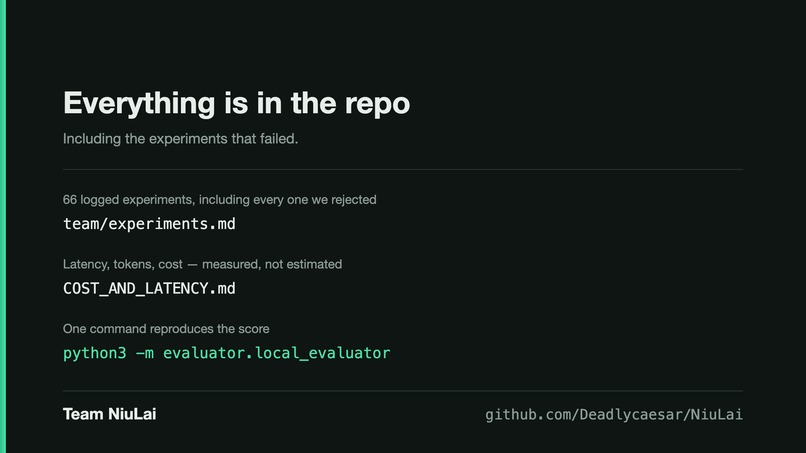
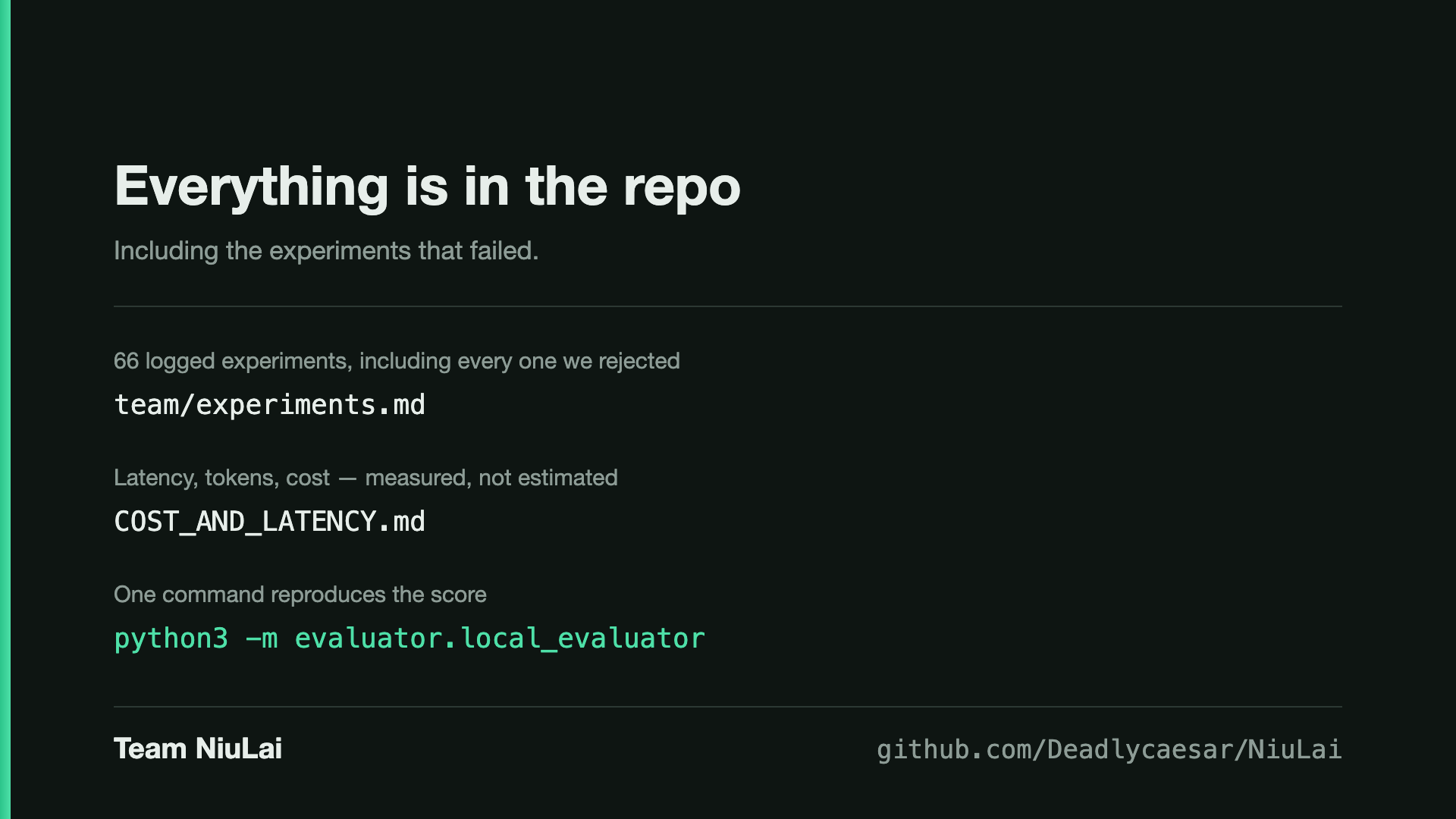
Every experiment we ran is logged in the repository, including the ones that failed.


Log in or sign up for Devpost to join the conversation.