-
-
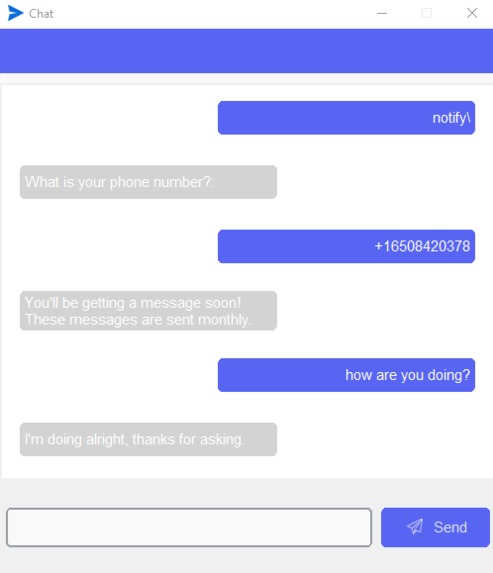
The default GUI system.
Inspiration
A lot of my friends and I frequently wonder what it would be like to talk with yourself from the past: now, with this project, it's entirely possible. I also sometimes have trouble completing my New Years Resolutions, and the new texting feature to the chatbot will certainly help to remedy that.
What it does
New-Year-New-Chat is an AI-based chatbot that automatically mimics your speech by training itself on the messages you send it in real time. The AI model is based off of the popular Generative Pretrained Transformer, the same family of AI models used by OpenAI in ChatGPT. It's used for you to reflect on yourself in the past year and see what changed, what New Years resolutions you completed, and how your typing mannerisms change over time.
How we built it
The model is a subset of the widely popular GPT-2 model, originally designed by the researchers at OpenAI. The model was loaded in HuggingFace. For real-time training of the model, both HuggingFace and PyTorch were used. Tkinter was used to make the GUI and Twilio was used for the handy texting feature in the project.
Challenges we ran into
Real-time training is an extremely difficult task to accomplish, especially for large NLP (Natural Language Processing) models such as the one that was used in this project, which boasted well over 275 million parameters. Real-time training is also completely undocumented for Transformers, the type of the model, so I was going into the project completely blindfolded. This led into a lot of errors and sometimes outright scrapping ideas and workflows for how to get real-time training to work.
Accomplishments that we're proud of
At the end, real-time training was accomplished. This is one of the biggest accomplishments in the project, because its an entirely novel concept for a Transformer model to be trained in real time. Some other minor accomplishments were successfully using the Twilio texting API, and making a clean looking GUI with Tkinter (which was a lot harder than anticipated).
What we learned
I learned a lot about how to optimize models to return output in the fastest way possible (this was one of the biggest goals of real-time training so the chat window doesn't just freeze) and about new technologies such as Twilio. I also familiarized myself with GUI tools and am overall really happy with what I gained from the project.
What's next for New-Year-New-Chat
I hope to port New-Year-New-Chat on the iOS app store for it to be more accessible to others. I also hope to get larger computational power by upgrading the base model (GPT-2 - 275M parameters) to GPT-J (6B parameters), greatly increasing the quality of the model's output.


Log in or sign up for Devpost to join the conversation.