Inspiration
I wanted to help founders understand how their venture aligns with investor criteria and why that assessment changes when their answers change. As a learner building with AI, I also wanted to understand the process behind the software: how inputs produce results and how saved assessments preserve earlier decisions.
What it does
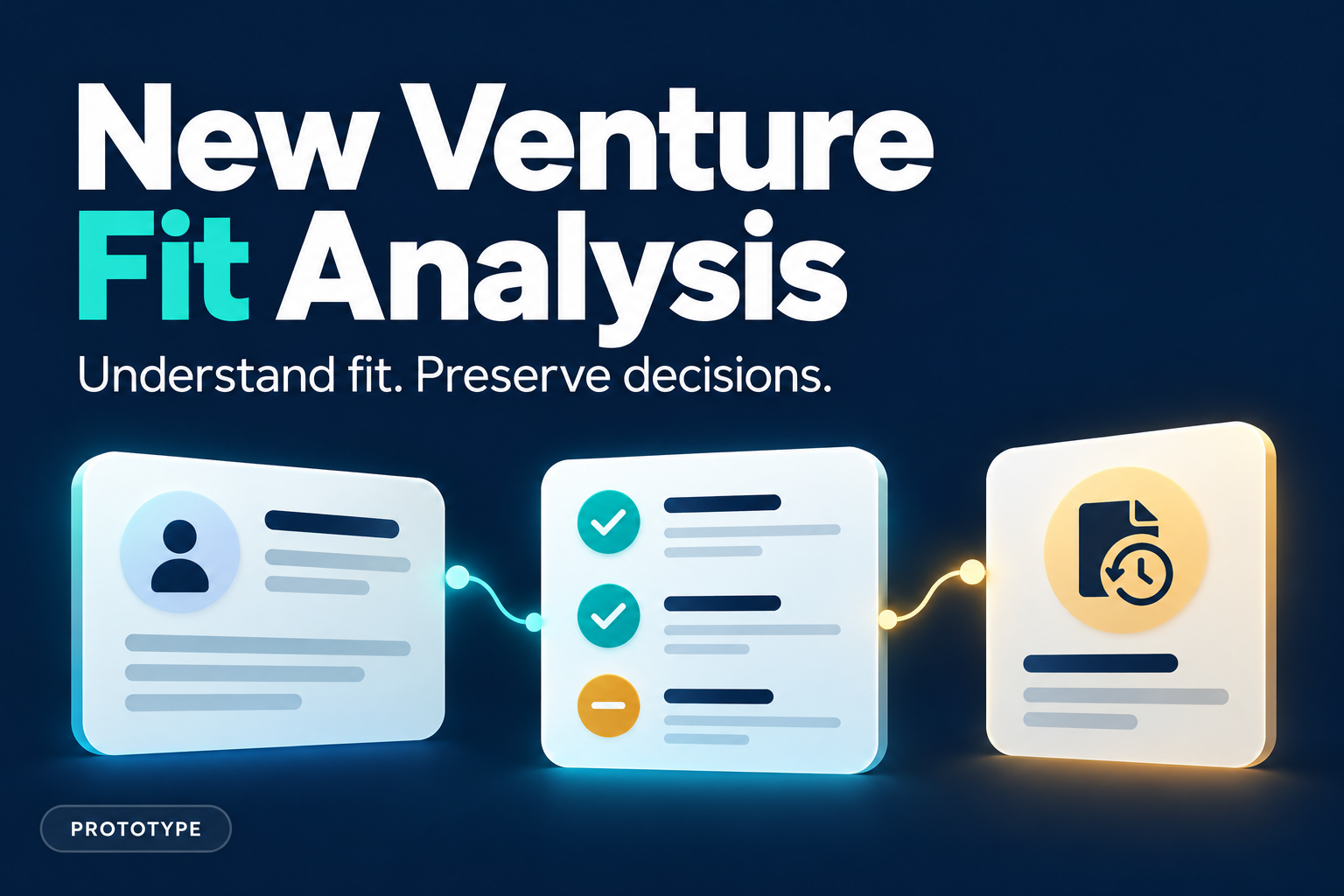
New Venture Fit Analysis is a working prototype for founders exploring funding fit. A user enters a venture profile, reviews and confirms the answers, and receives an assessment explaining matches, mismatches, conditions, and unknowns.
The demonstration uses three fictional investors with synthetic criteria. Changing an answer—such as whether all founders work full-time—shows how a requirement affects the result.
Users can save assessments and reopen an earlier version with its original answers and results. Supporting features include editable introduction drafts, manual outreach and response tracking, and downloadable PDF briefs and CSV shortlists.
The app does not send emails or predict funding success. Its results describe criteria alignment.
How I built it
I built the application with Codex as my AI coding assistant and used the Devpost Learn Skill Pack to guide scope review, planning, verification, and submission preparation.
The app uses Python and Streamlit for the interface, SQLite for saved assessments, JSON Schema for research import validation, and ReportLab for PDF generation. The public repository includes scope.md, prd.md, and spec.md.
Challenges
A key challenge was keeping historical assessments intact while allowing users to change their current answers. Reopening an assessment needed to restore the original results without recalculating them.
Another challenge was keeping manually recorded outreach and responses separate from funding fit. Tracking a response should not change an assessment's criteria-based result.
Accomplishments
The prototype completes the full journey from venture profile to explained funding fit and saved assessment. Verification included 76 passing automated checks and a recorded demonstration showing a changed answer producing a different result, followed by reopening the original assessment.
What I learned
I learned how a founder's answers connect to evaluation rules and how saving a complete assessment preserves the context behind a result. Reviewing both processes helped me understand the business logic and the software workflow.
Working with an AI coding assistant also showed me the value of clear scope, documented decisions, and checking actual behavior.
What's next
The next step is to explore carefully reviewed real investor research and gather founder feedback. The current submission stays focused on demonstrating the core workflow with clearly labeled fictional data.

Log in or sign up for Devpost to join the conversation.