-
-
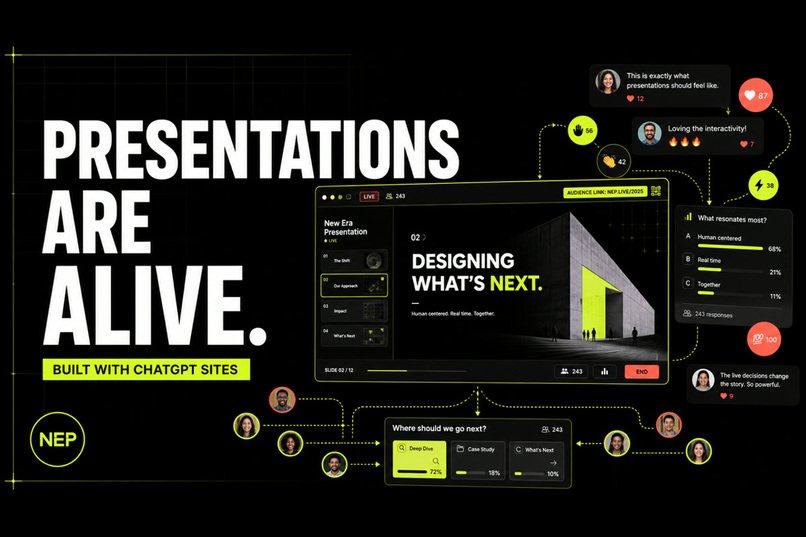
New Era Presentation — a live participatory presentation medium built with ChatGPT Sites.
Inspiration
AI has made slide production dramatically faster—but it has also made presentations dramatically easier to ignore. Too many PowerPoint and Google Slides decks now feel like one-click output: generated in seconds, presented without editing, and delivered to an audience that has already seen the same structure, tone, and visual rhythm many times before.
New Era Presentation is an antidote to AI presentation fatigue. It is not a file that a speaker talks through. It is a live space that the speaker and audience create together.
What it does
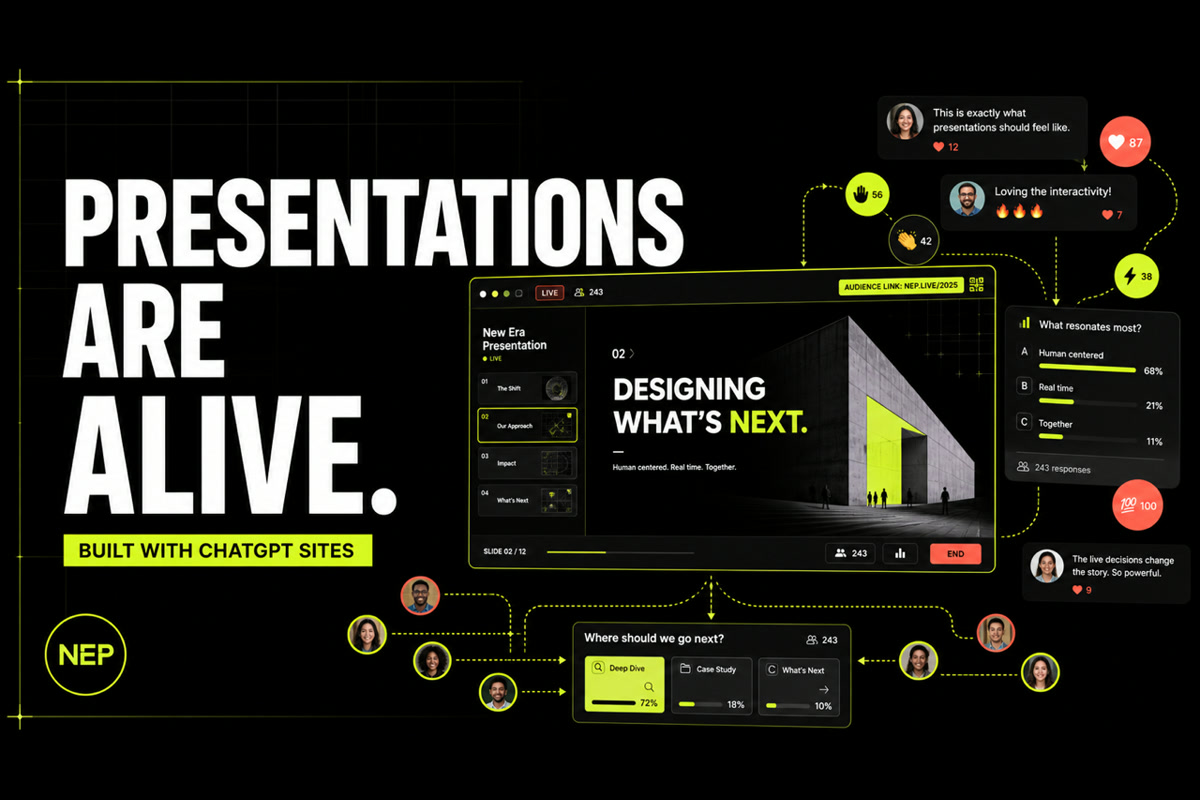
Participants join instantly from a QR code. During the session they can react with stamps, post comments, ask questions, and vote on four-way branches in real time. Every interaction stays connected to the slide that triggered it, so when the presenter moves to another slide, the conversation follows the story instead of showing an unrelated last comment forever.
PRESENT mode gives the speaker a full-width stage while the audience participates through /join. On a branch slide, the audience votes and the presenter’s next action follows the winning path; a zero-vote branch cannot advance. WEB mode is self-paced, keeps the interaction rail, and requires the reader to choose a branch directly. All paths later rejoin the common story.
Guests can participate with almost no friction. Email, Google, and ChatGPT authentication add a verified identity mark for people who want a persistent profile. Verified participants receive a personal post-presentation timeline showing where they reacted and what they wrote.
From a presentation to a relationship
Traditional slide tools stop when the talk ends. New Era Presentation continues the relationship. With consent, interaction history becomes an interest signal. Presenters can manage participants and comments, segment audiences by the slides and themes they engaged with, and send relevant follow-up communication after the event. Public, password-protected, and private presentation states are managed from one control room.
How we built it
We built the full experience with Codex, GPT-5.6, and ChatGPT Sites as one continuous product workflow. Sites turned product intent into a working multi-route application with real UI, server routes, persistent Cloudflare D1 data, authentication-aware experiences, and production deployment—not a static mockup.
Codex and GPT-5.6 helped us reason across the entire system: narrative, interaction model, responsive UI, branching logic, database schema, access control, testing, and deployment. Fast iteration did not only reduce coding time; it let us repeatedly edit the product idea itself while seeing it run.
Codex’s seamless access to GPT Image 2 was a major creative advantage. Visual direction, motion, participation design, generated imagery, and service implementation could be shaped as one coherent experience. For capabilities beyond Sites—especially email verification and consent-based marketing delivery from [email protected]—we used Codex’s cloudflare-deploy skill to build and deploy a Cloudflare Email Service layer.
Challenges we ran into
The hardest problem was preserving one shared story across two fundamentally different modes. A presenter-led room needs synchronized state and audience voting, while a self-paced reader needs direct control without accidental keyboard navigation through a branch. We also had to make slide-bound comments follow transitions correctly, keep mobile controls usable, protect the admin surface, and extend Sites with email without leaking secrets into the public repository.
Accomplishments that we're proud of
One deployed Sites project now powers the presentation stage, self-paced web deck, QR participant experience, verified participant memory, and restricted admin control room. The experience supports real-time stamps, comments, questions, live branching, mobile swipe navigation, identity marks, visibility controls, moderation, segmentation, and follow-up campaigns.
Most importantly, the technology proves the product thesis while it is being presented: the audience does not merely hear that presentations can become participatory software—they use that software during the talk.
What we learned
The faster AI makes content creation, the more human attention, editorial judgment, and live interaction matter. AI is most powerful here not as a slide factory, but as a medium for integrating narrative, design, software behavior, and deployment quickly enough that each part can improve the others.
What's next for New Era Presentation
Next we will deepen audience analytics, reusable presentation templates, consent-aware segmentation, richer post-event journeys, and presenter controls for choosing how closely live votes steer the room. We want to make presentations worth joining, worth remembering, and capable of becoming long-term relationships.
Built With
- chatgpt
- cloudflare
- codex
- gpt
- image
- openai-api

Log in or sign up for Devpost to join the conversation.