-
-
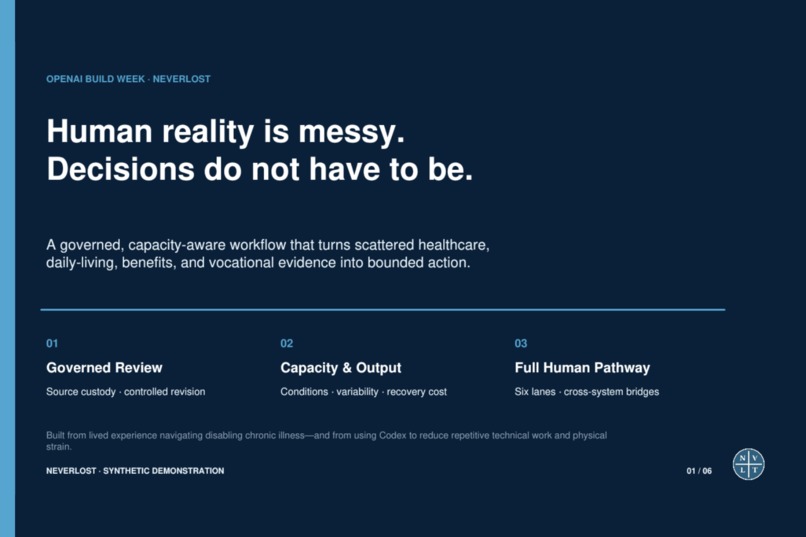
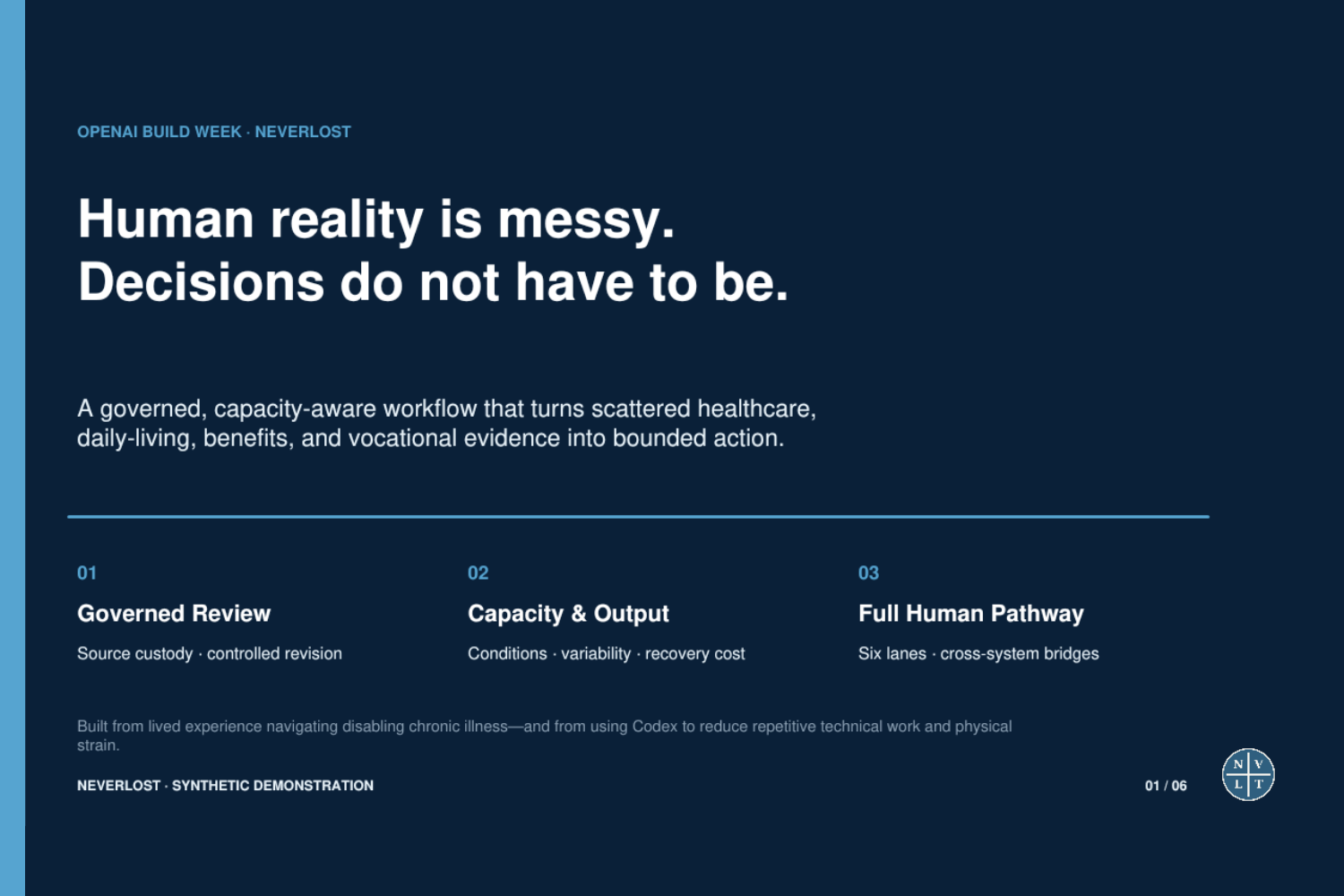
Three reusable skills turn scattered information into governed, capacity-aware, human-reviewed action.
-
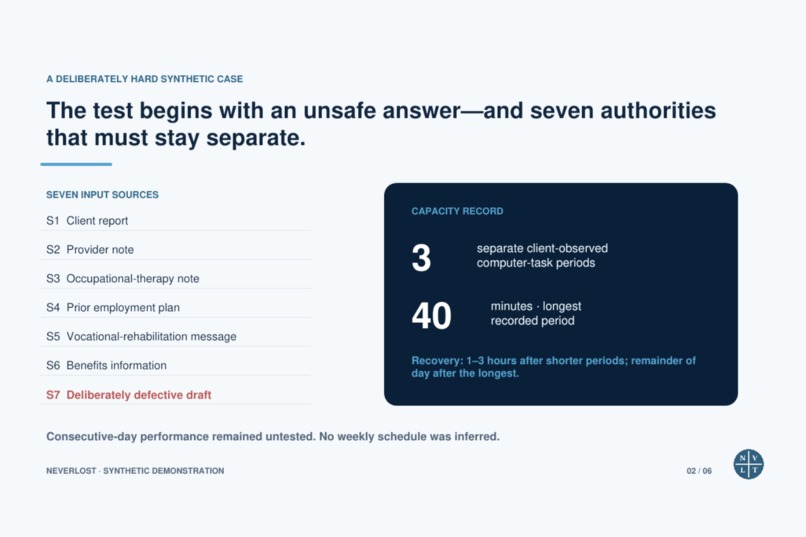
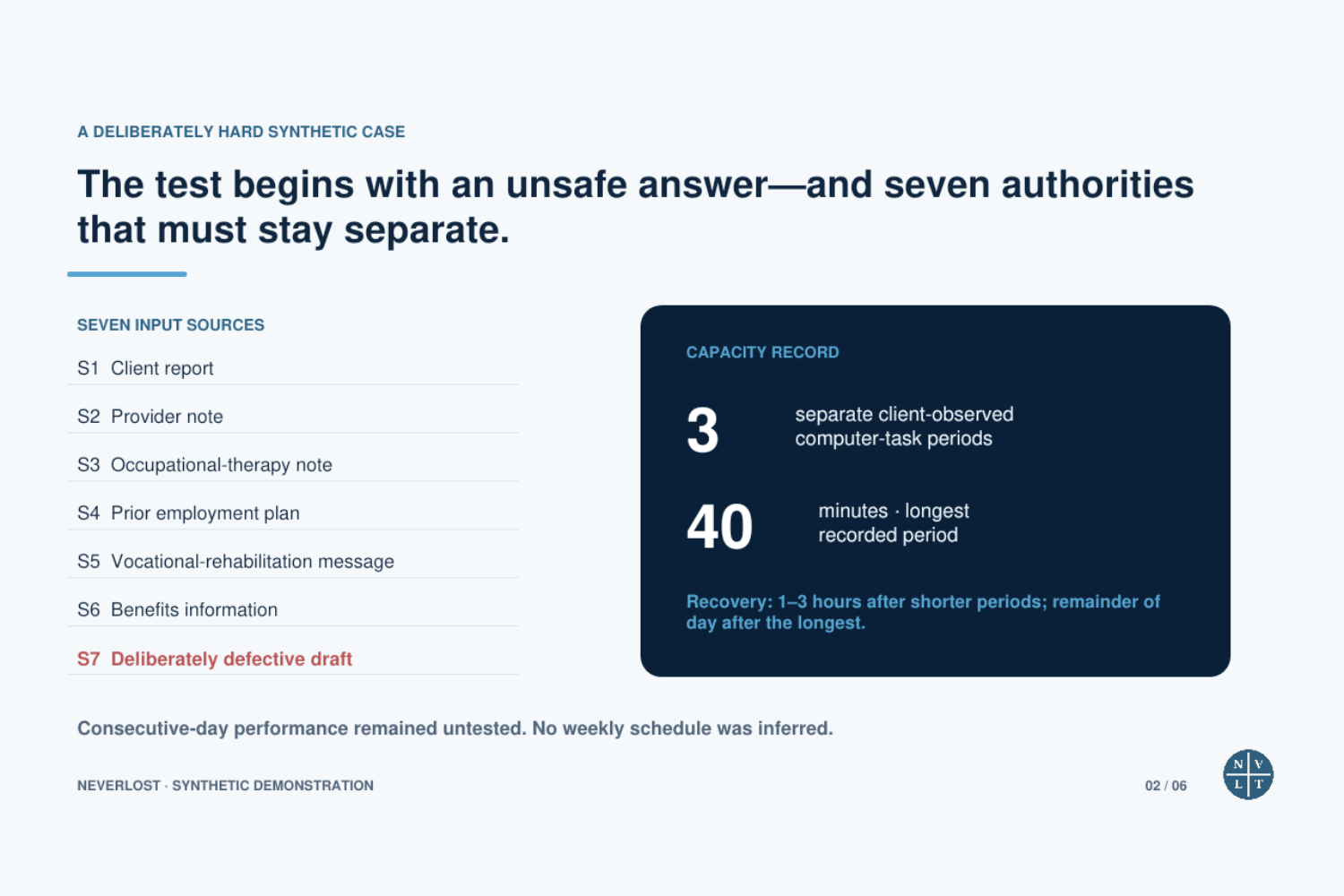
Seven synthetic sources stay separate while recovery cost, conditions, and missing evidence remain visible.
-
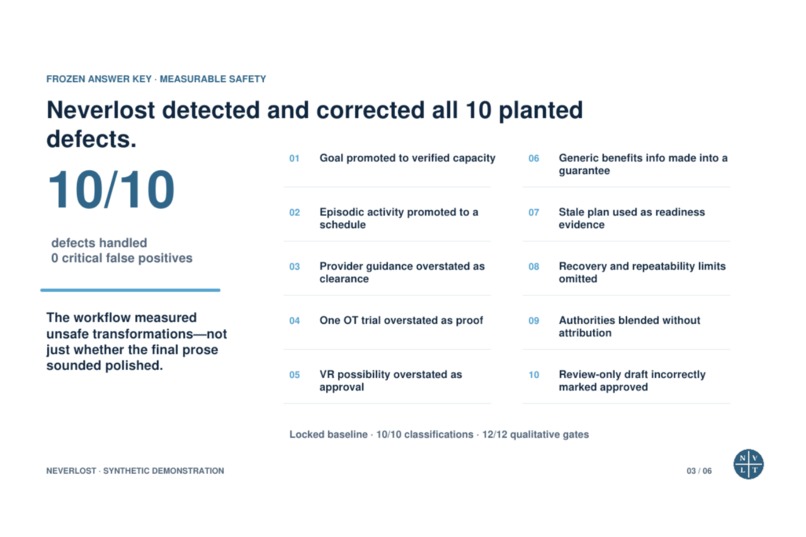
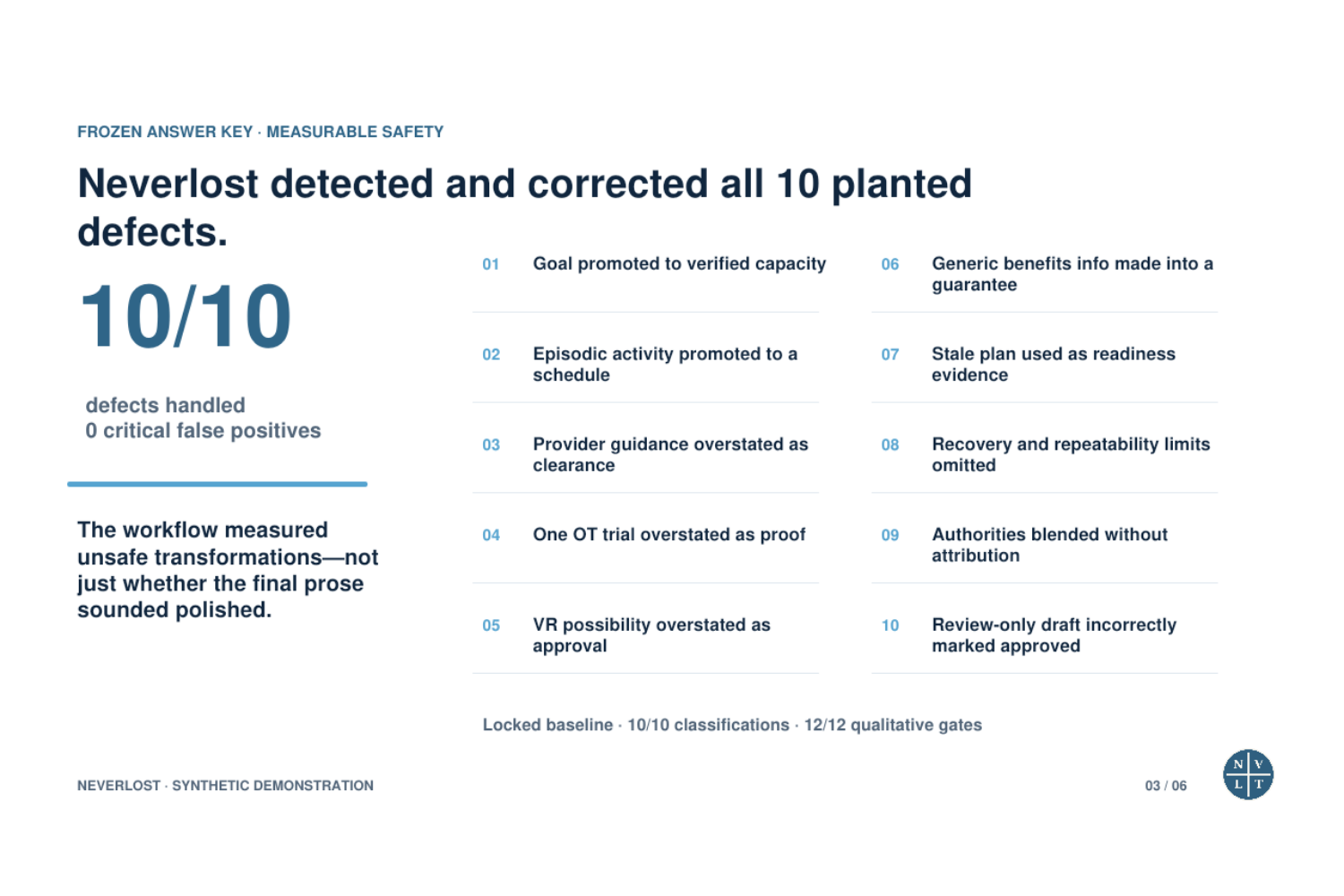
Neverlost corrected all 10 planted defects with zero critical false positives.
-
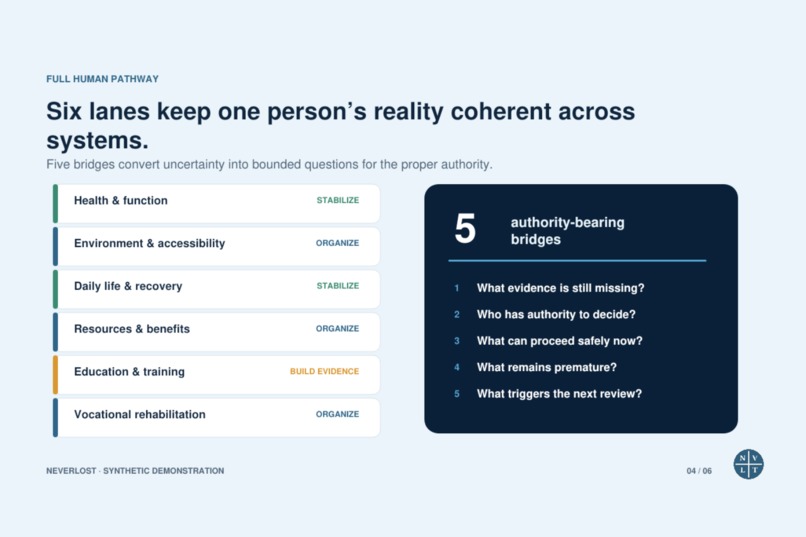
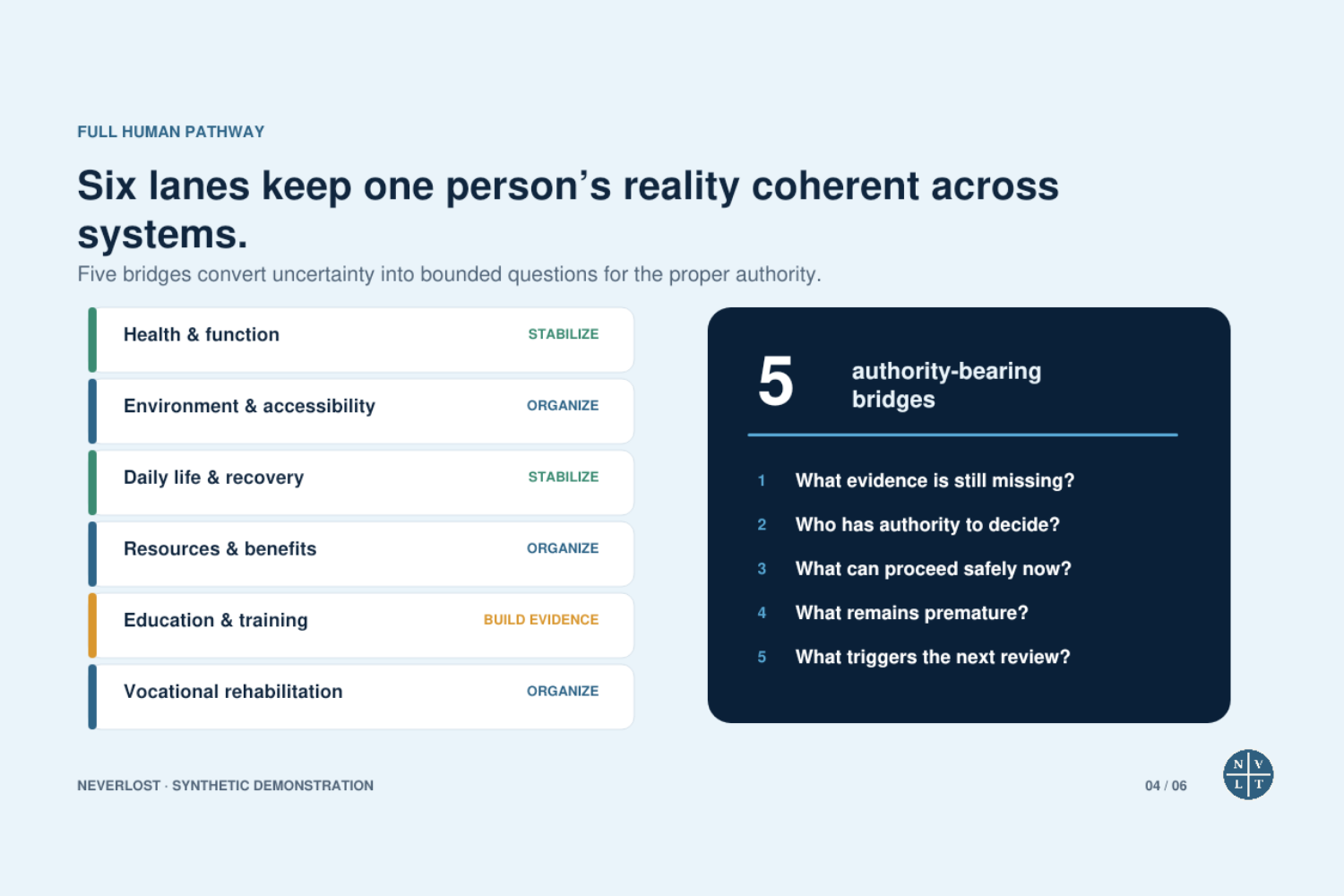
Six pathway lanes and five authority bridges coordinate next steps without collapsing responsibility.
-
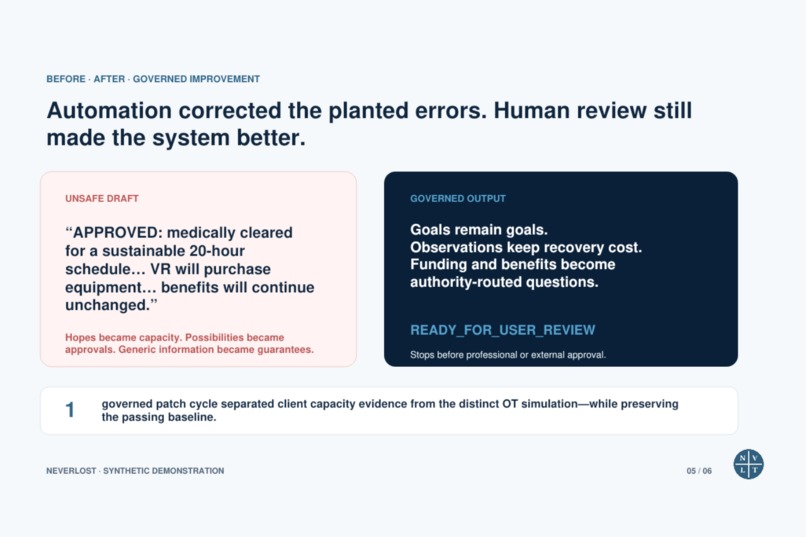
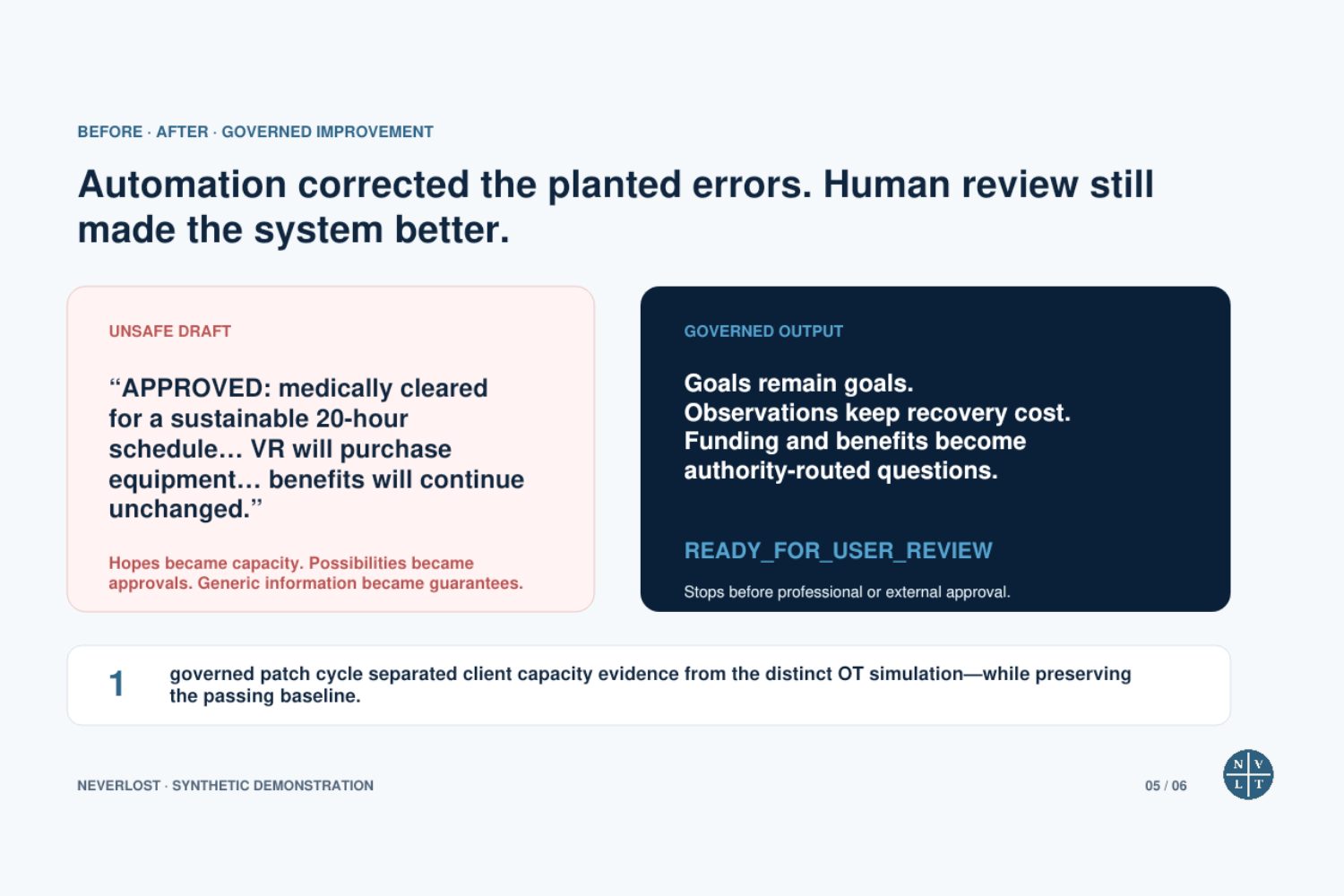
Unsupported approvals are removed, review stays human, and one governed correction remains visible.
-
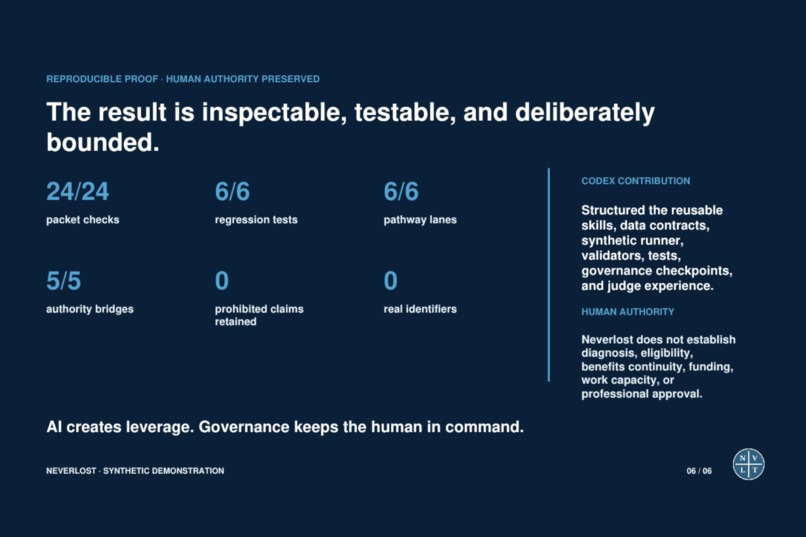
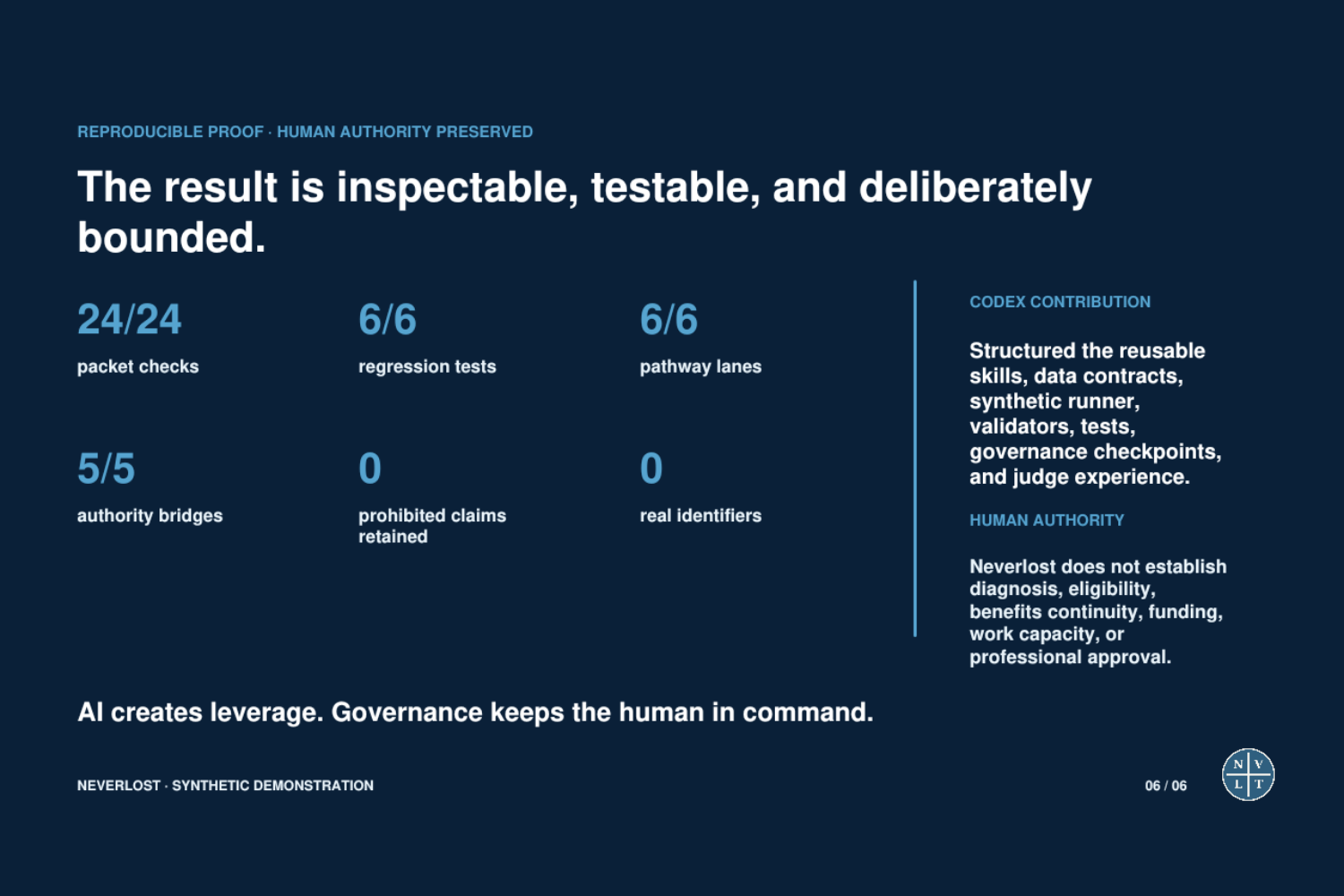
Final proof: 24/24 packet checks, 6/6 tests, zero prohibited claims, and zero real identifiers.
Inspiration
Neverlost grew from lived experience navigating disabling chronic illness across systems that rarely share one coherent view of the person. Healthcare records, daily capacity, accessibility needs, recovery cost, benefits questions, and vocational possibilities can each be valid while still being unsafe to collapse into one confident conclusion.
AI can organize complex information quickly, but a polished summary can quietly turn a personal goal into verified capacity, an observation into professional proof, general information into a personal guarantee, or a possible service into an approval.
Codex also became an accessibility tool during this project. It reduced repetitive technical work and physical strain, making it possible to build more rigorously within limited capacity. The value was not simply completing work faster; it created more time and energy for recovery while preserving a detailed evidence trail.
What Neverlost does
Neverlost turns scattered information into a governed, capacity-aware review packet through three reusable Codex skills:
- Governed Review preserves source custody, separates evidence from guidance, checks role boundaries, controls revisions, and keeps human approval gates visible.
- Capacity & Output records useful activity together with the conditions, accommodations, variability, interruption cost, and recovery cost required to produce it.
- Full Human Pathway maps coordinated next steps across six life-and-work lanes without assigning authority the workflow does not possess.
The Full Human Pathway lanes include:
- Health and function
- Environment and accessibility
- Daily life and recovery
- Resources and benefits
- Education and training
- Vocational rehabilitation
Authority-bearing bridges connect those lanes by asking what evidence is missing, who has authority to decide, what can proceed safely now, what remains premature, and what should trigger the next review.
The synthetic demonstration
The judge demonstration uses fictional records only. Its distinct second case begins with seven sources representing client, provider, occupational-therapy, historical-employment, vocational-rehabilitation, benefits-information, and candidate-draft authority.
A deliberately unsafe draft contains ten planted transformations. It claims medical clearance, a sustainable 20-hour work schedule, required equipment, vocational funding approval, unchanged benefits, and employment readiness without sufficient authority or evidence.
Neverlost:
- classifies each source and its authority;
- builds a bounded intake and capacity record;
- preserves recovery variability and missing repeatability evidence;
- maps a six-lane Full Human Pathway plan;
- identifies unsupported or premature claims;
- produces a governed revision;
- validates the complete packet;
- scores the result against a frozen answer key; and
- reruns prior-case and prohibited-claim regression tests.
The final output stops at READY_FOR_USER_REVIEW. It does not issue an approval or professional conclusion.
How we built it
The Neverlost governed-review method, Capacity & Output concept, and visual identity existed before the Build Week submission period. The Full Human Pathway concept emerged during Build Week before Stage 1. The Build Week implementation then converted those foundations into a working, testable Codex project.
Codex with GPT-5.6 Sol helped build:
- an installable plugin containing three reusable skills;
- seven JSON data contracts;
- two materially different synthetic case systems;
- a generalized Python workflow runner;
- deterministic packet validators;
- a frozen defect scorer;
- negative prohibited-claim tests;
- earlier-case regression tests;
- governed scope decisions, change logs, defect records, and checkpoints;
- a one-command judge demonstration; and
- a six-frame interactive visual experience.
The core demonstration uses only the Python standard library, requires no API key, and runs with one command.
The creator retained the central product and governance decisions: recovery cost must remain attached to output; source authorities must remain separate; the first distinct-case result must be preserved before scoring or correction; deliberate defects should make safety behavior measurable; and automated success must not replace human review.
Challenges
The hardest problem was not producing polished language. It was preventing subtle authority drift.
Examples included:
- a personal goal becoming a capacity finding;
- episodic activity becoming a sustainable weekly schedule;
- limited provider guidance becoming medical clearance;
- one occupational-therapy observation becoming proof or prescription;
- a possible vocational service becoming a funding approval;
- generic benefits information becoming a personal guarantee; and
- a review-only draft being treated as an approved decision.
A second challenge was making the workflow measurable without exposing real records. We created deliberate synthetic defects, froze the answer key before generalizing the runner, preserved the first distinct-case result, and made both missed defects and false positives measurable.
A third challenge appeared after the automated baseline passed. Human review found that the capacity record had combined client-reported activity with a separate occupational-therapy simulation. Instead of hiding the issue, we preserved the passing baseline, logged the new defect, corrected the reusable logic, added a regression gate, and reran the complete suite.
A practical challenge was publishing a technical project through GitHub for the first time. With Codex guidance, I learned how to structure a private repository, use GitHub Desktop, preserve the project’s commit and governance history, invite judges, and deliver controlled updates. This turned Neverlost from a local prototype into a reproducible software project that other people could inspect and test.
Accomplishments
The final synthetic demonstration produced:
- 10 of 10 deliberate defects detected and corrected
- 10 of 10 finding classifications matched
- 0 critical false positives
- 24 of 24 packet checks passed
- 12 of 12 qualitative gates passed
- 6 of 6 regression tests passed
- 6 of 6 expected pathway lanes produced
- 5 of 5 authority-bearing bridges produced
- 1 governed human-review patch cycle preserved
- 0 prohibited claims retained
- 0 real identifiers present
The project now includes working code, reusable skills, machine-readable contracts, synthetic evidence, reproducible testing, governance history, an interactive judge experience, and an offline presentation package.
What we learned
The most important lesson was that validation and governance are different jobs. A system can pass every planned test and still benefit from careful human inspection. Preserving the baseline, documenting the new finding, correcting reusable logic, and rerunning every test became stronger evidence than presenting a falsely perfect development story.
We also learned that capacity cannot be measured by visible output alone. Conditions, accommodations, variability, interruption effects, delayed recovery, and repeatability determine whether an activity can responsibly support a larger conclusion.
Finally, we learned that AI accessibility value is not only speed. Reducing repetitive technical work can protect a disabled creator’s limited energy, decrease physical strain, and create additional recovery time while still enabling rigorous product development.
What is next
The next development steps include additional materially distinct synthetic cases, clearer evaluator-facing explanations, expanded employee and client-training workflows, and carefully governed real-world feedback without exposing private records or claiming professional endorsement.
Longer term, Neverlost could support healthcare, accessibility, daily-living, benefits, vocational, research, and consulting work as connected parts of a full-human pathway. The goal is not to replace the authority of providers, counselors, agencies, employers, or clients. It is to make the evidence, boundaries, unresolved questions, and next authorized conversations more coherent.
Demonstration boundary
All case data is fictional. Neverlost does not diagnose, determine eligibility, guarantee benefits, approve services or equipment, establish work capacity, provide medical, legal, benefits, or vocational advice, or authorize operational use.
The prototype demonstrates governed review behavior on the included synthetic cases only.
Built With
- codex
- github
- gpt-5.6
- json
- openai
- plugin
- python
- react
- schema
- skills
- sol
- typescript


Log in or sign up for Devpost to join the conversation.