Inspiration
I built this project after producing Neverlost’s first videos during OpenAI Build Week. Creating the ideas was only part of the work. Every approved piece still had to move through scripts, narration, slides, captions, video rendering, thumbnails, descriptions, quality checks, and platform uploads.
As a disabled creator working with limited physical capacity, that repeated technical handling can become the barrier to publishing. The question behind this project became:
Can AI reduce the mechanical burden of publishing while preserving the creator’s meaning, capacity, and final authority?
What it does
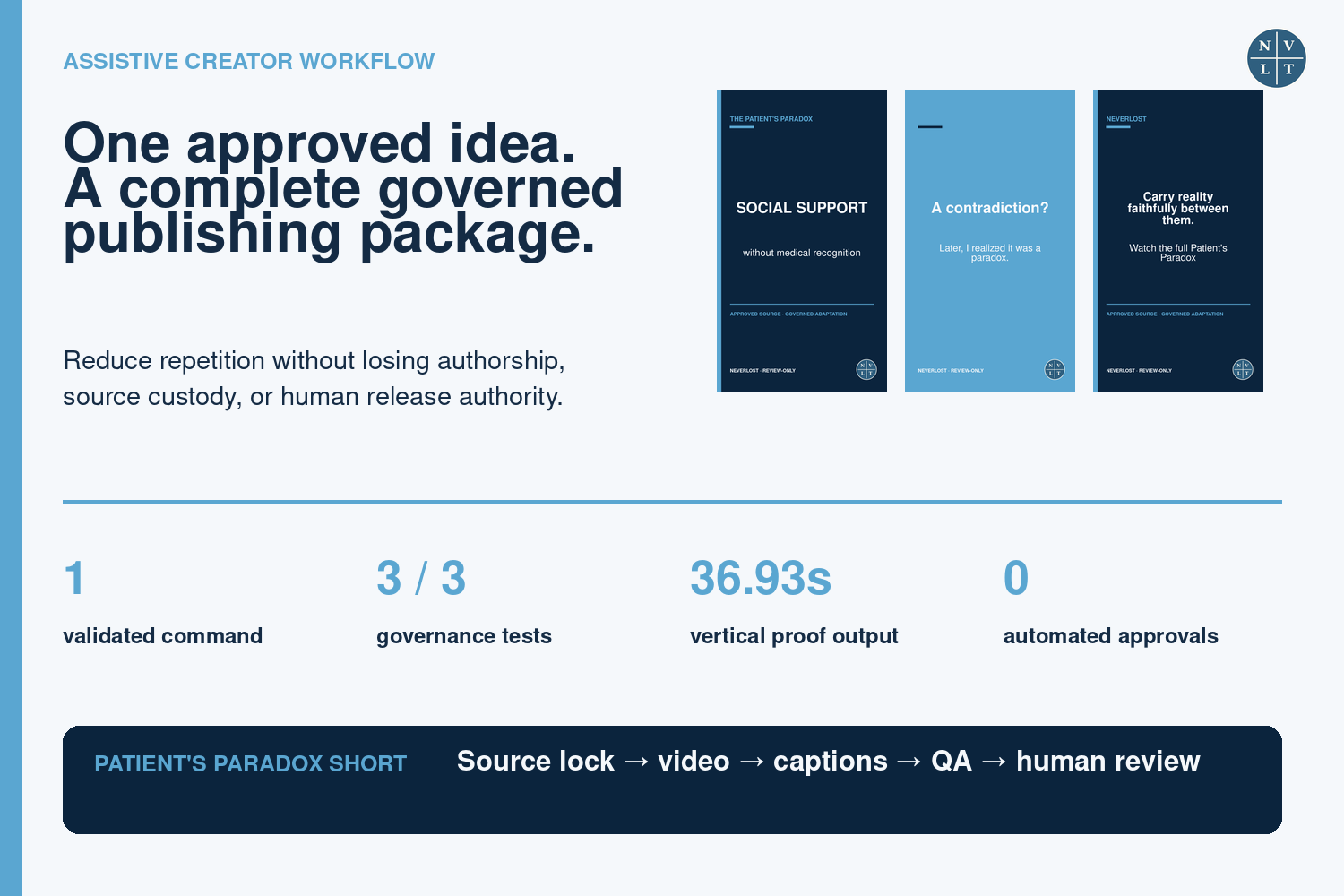
Neverlost Capacity-Aware Publishing Workflow turns approved source material into a governed, accessible media package.
A controlled JSON manifest records:
- the approved source and its SHA-256 hash;
- the exact narration authorized for use;
- narration audio and asset custody;
- scene and caption timing;
- branding instructions;
- the output’s review status.
One command validates those inputs, creates vertical visuals, assembles narration, produces captions, renders the video, probes the finished media, generates a QA contact sheet, and writes a hashed build report.
The workflow deliberately stops at REVIEW_ONLY. It cannot approve or publish its own output. The creator remains responsible for meaning, rights, final review, and release.
Recovery-Aware Mode
Recovery-Aware Mode lets the creator choose an active-minute budget for the session.
The workflow identifies which review tasks fit within that budget, automates the mechanical production work, and preserves anything deferred in a resume checkpoint with an exact next step.
This is not a medical or work-capacity assessment. It is a creator-controlled planning tool designed to reduce prolonged computer use, repeated copying, context switching, and the burden of reconstructing an interrupted session.
How I built it
I built the prototype with Python, Pillow, JSON manifests, FFmpeg, FFprobe, Kokoro narration, and standard-library tests.
Codex with GPT-5.6 Sol helped me:
- generalize the publishing runner;
- implement source, narration, audio, and branding custody;
- create Recovery-Aware planning and resume checkpoints;
- strengthen caption and timing validation;
- build a second logo-free synthetic test case;
- create deliberate failure tests;
- generate judge-facing demonstrations and documentation.
I retained control over the source material, excerpts, manuscript, editorial direction, visual language, voice profile, and publication decisions.
Challenges
The hardest problem was not rendering a video. It was maintaining custody across every transformation.
A polished result can still be unsafe if it silently changes the approved source, treats generated language as authorized, loses track of an asset, or promotes a draft into a published result without human approval.
Caption accessibility also required repeated visual review across light and dark scenes. I had to balance readability, timing, visual hierarchy, and the amount of information presented at once.
The project also had to work with more than one carefully prepared example. I added a distinct synthetic source, separate audio, a logo-free visual profile, independent outputs, and a separate recovery checkpoint to demonstrate that the runner was reusable.
What I learned
I learned that governance can be executable.
Source custody, timing, review status, and human authority do not have to remain informal promises. They can become testable build conditions that stop the workflow when something changes unexpectedly.
I also learned that the final production steps are an accessibility problem of their own. Creative tools often focus on what someone can generate, but not on how much physical and cognitive effort it takes to review, organize, recover, and publish that work.
The finished prototype includes two governed cases, sixteen source-bound caption cues, two capacity plans, two resume checkpoints, fifteen passing tests, and zero automated release decisions.
How this differs from the first Neverlost project
The first Neverlost submission carries complex human evidence across healthcare, daily life, accessibility, benefits, education, and vocational systems.
This project addresses a different task: helping disabled and energy-limited creators carry approved source material into accessible media without losing authorship or publication control.
The projects share Neverlost’s human-authority principle, but they serve different users, processes, and outputs.
What’s next
The next stage is to measure the workflow with real publishing sessions, compare estimated and actual active time, support additional media formats, and refine the recovery planner using creator feedback.
The larger goal is a publishing system where automation creates leverage while the human remains in command.


Log in or sign up for Devpost to join the conversation.