-
-
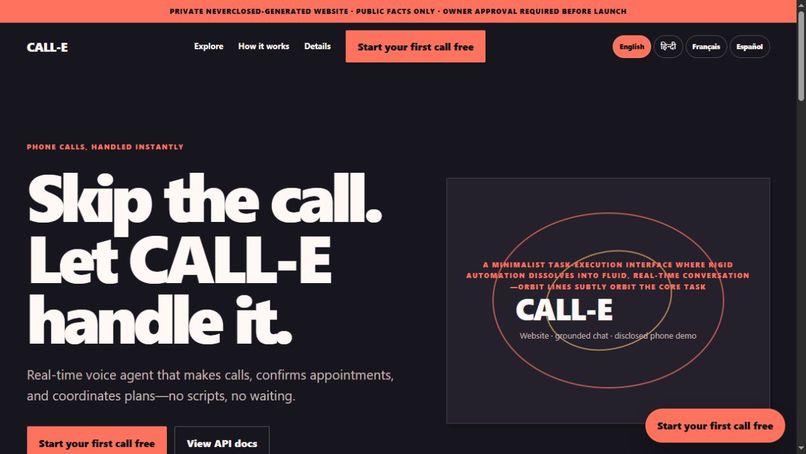
The generated CALL-E website is original, private, and grounded in the same saved business profile.
-
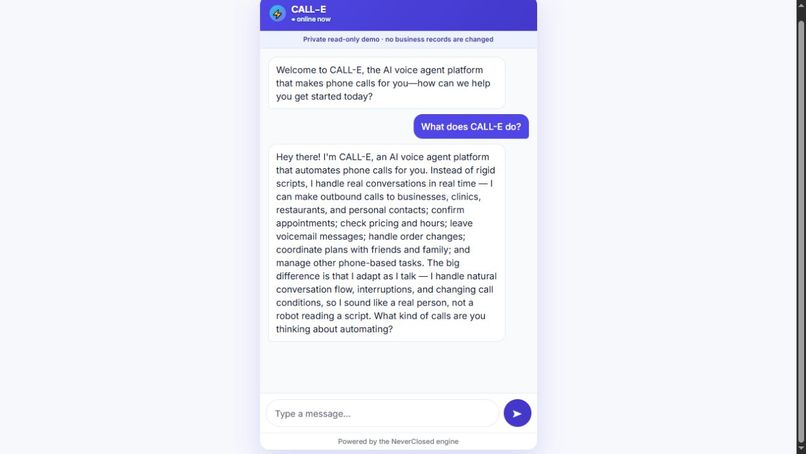
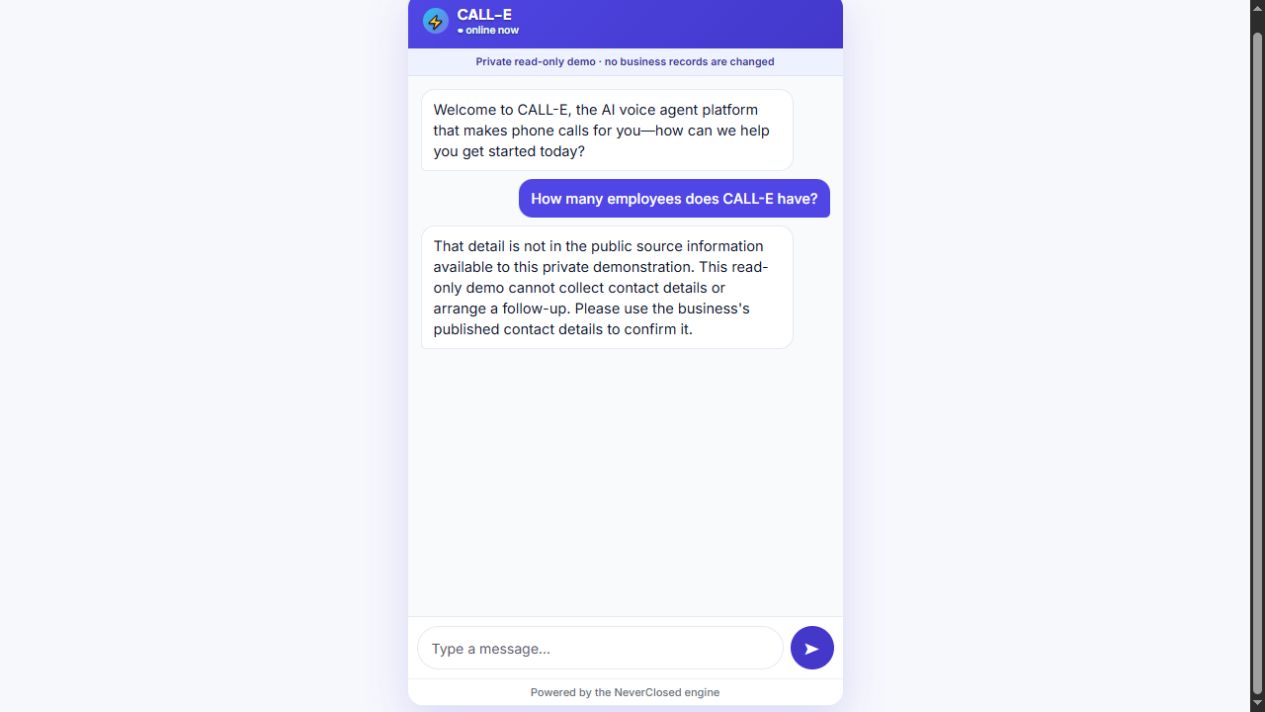
The live chat answers from retrieved CALL-E source evidence rather than a fixed script.
-
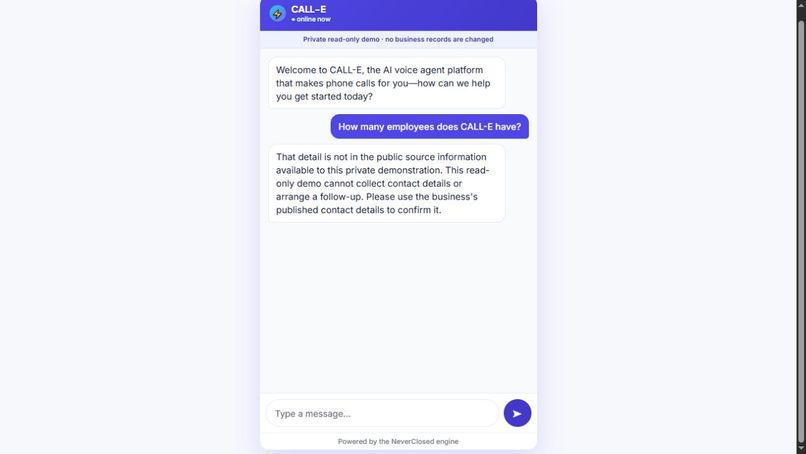
Ask for an unpublished fact and the assistant keeps it unknown instead of inventing an answer.
-
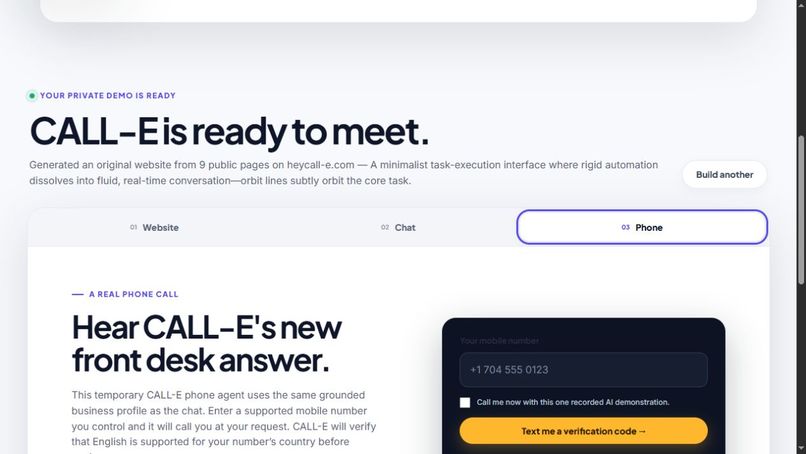
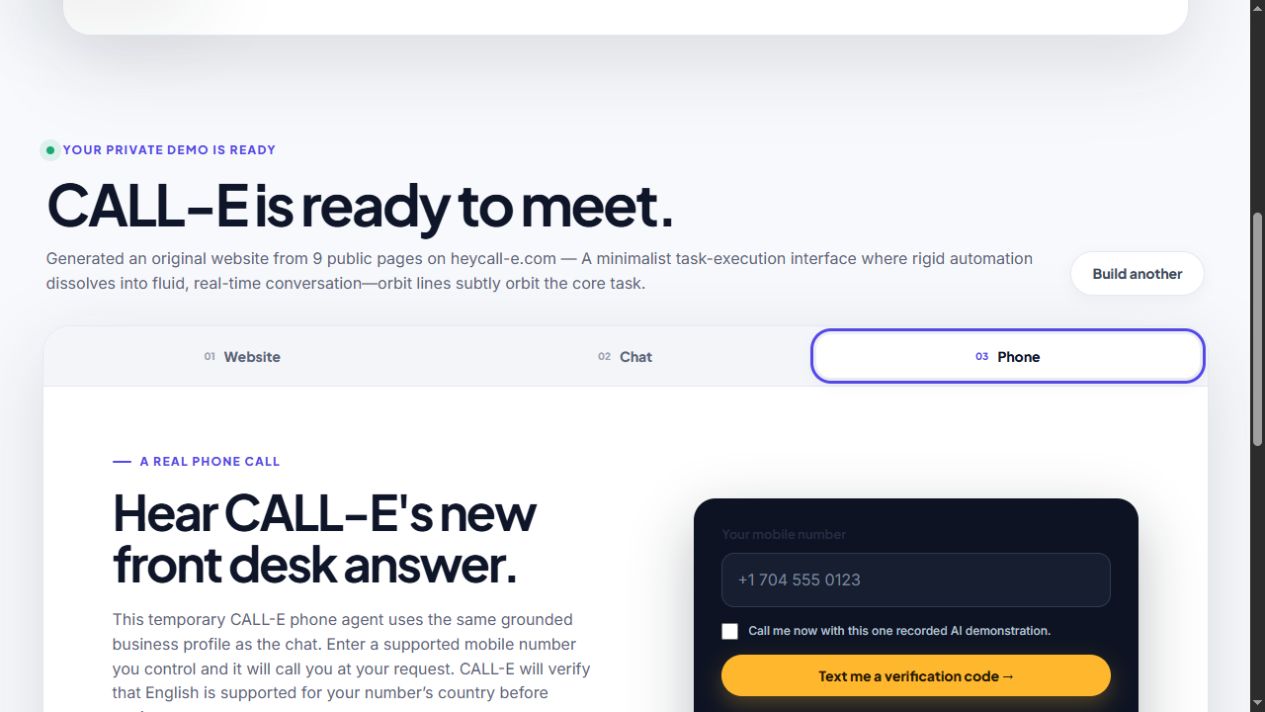
The real CALL-E path requires consent and SMS ownership verification before any call begins.
-
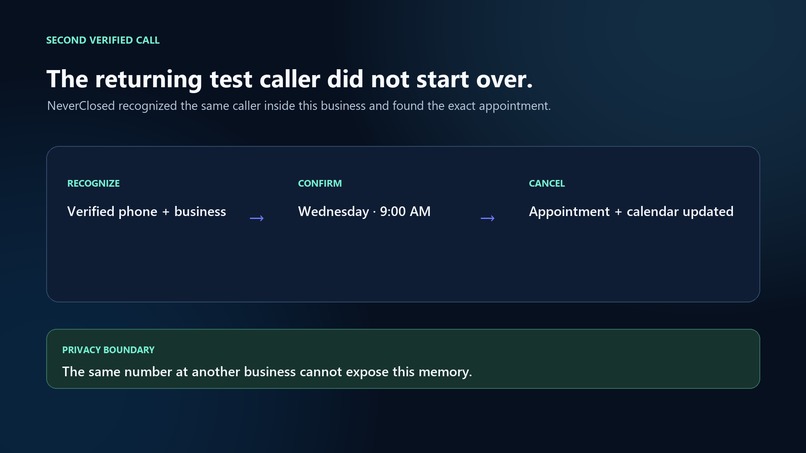
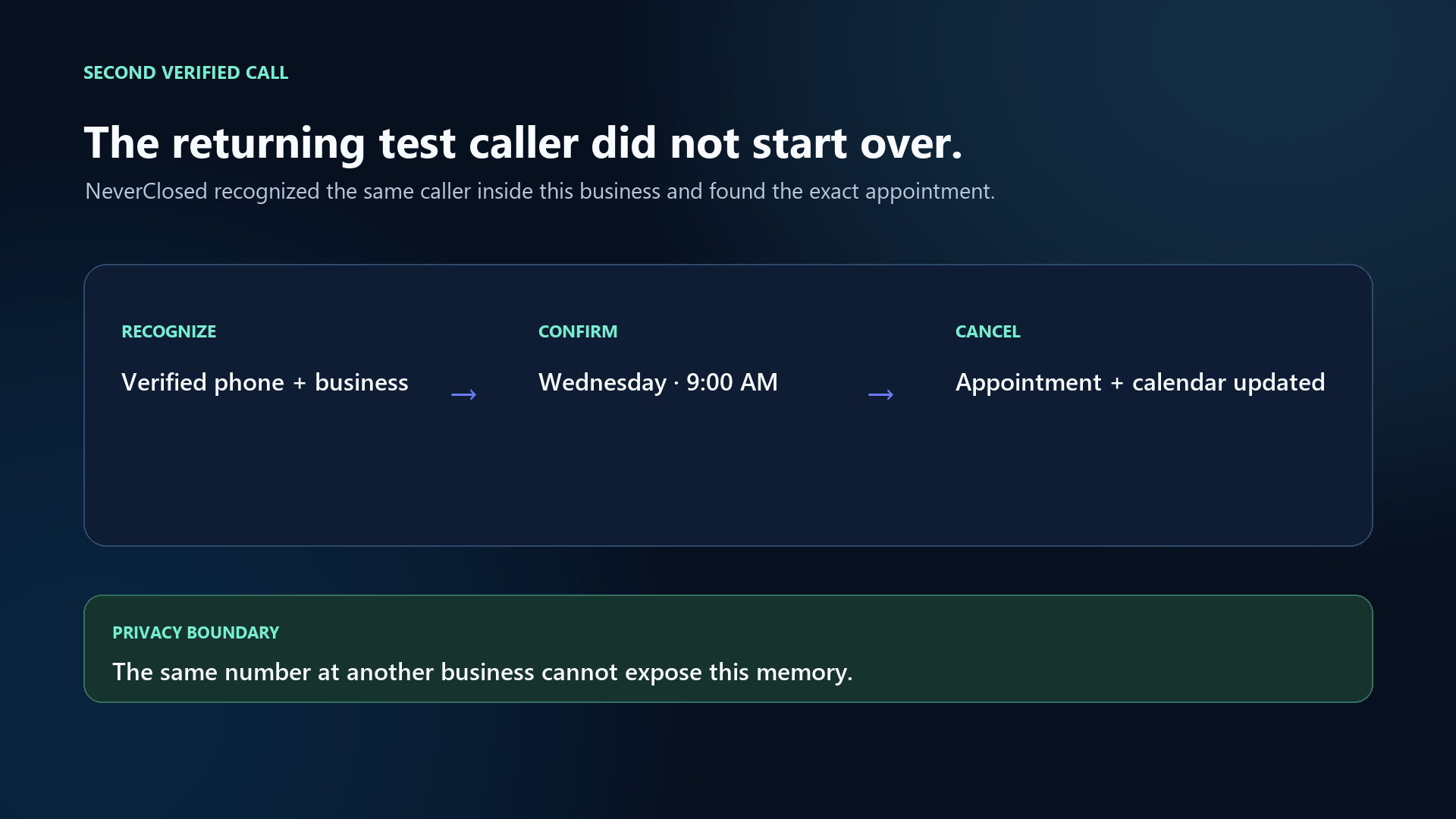
A second verified call recalled the exact appointment within this business and cancelled it after confirmation.
-
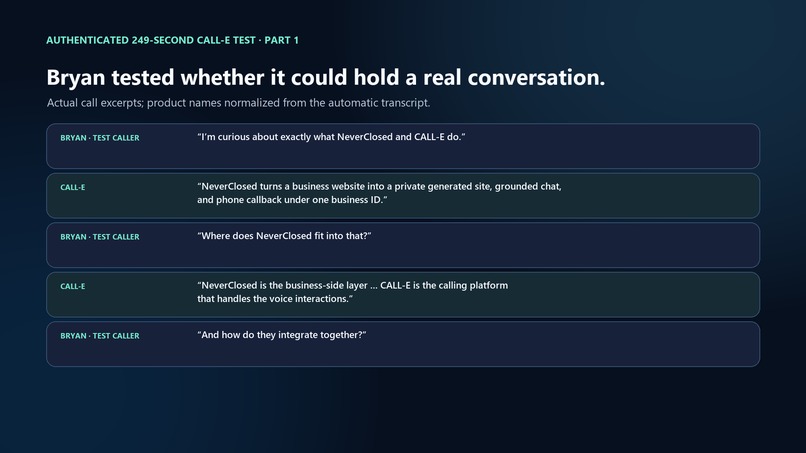
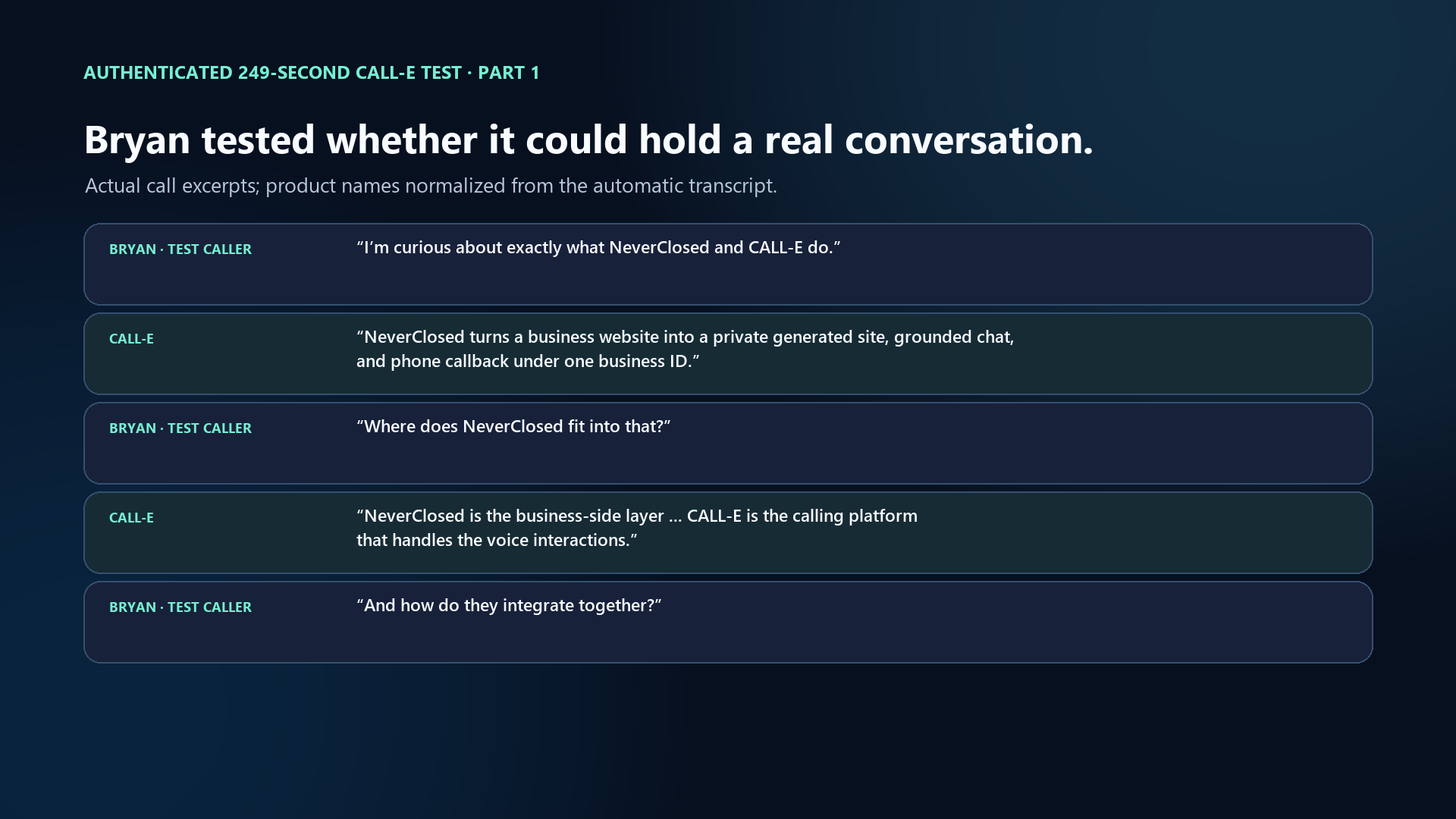
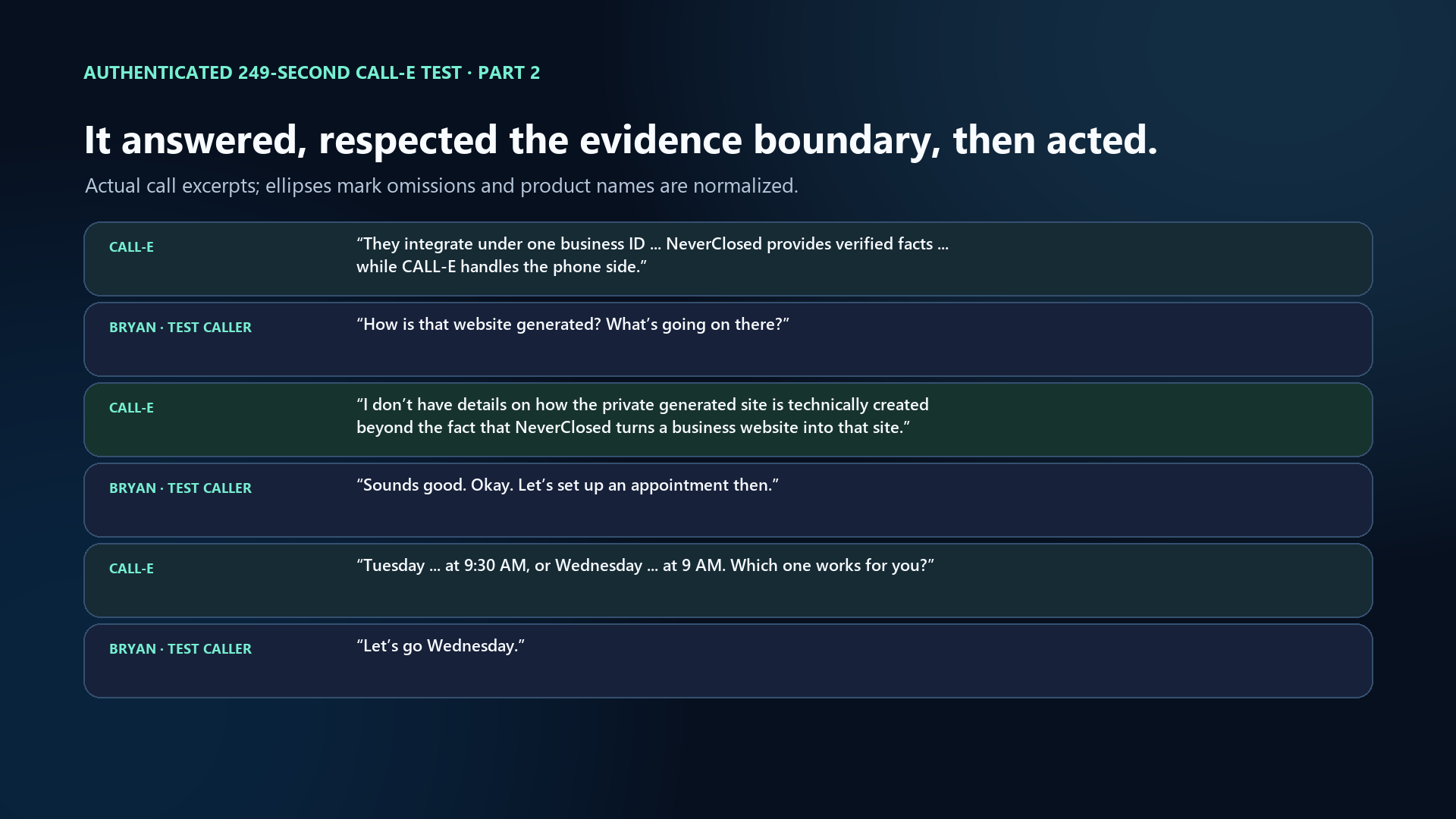
The real caller tested how NeverClosed and CALL-E work together; the agent answered adaptively.
-
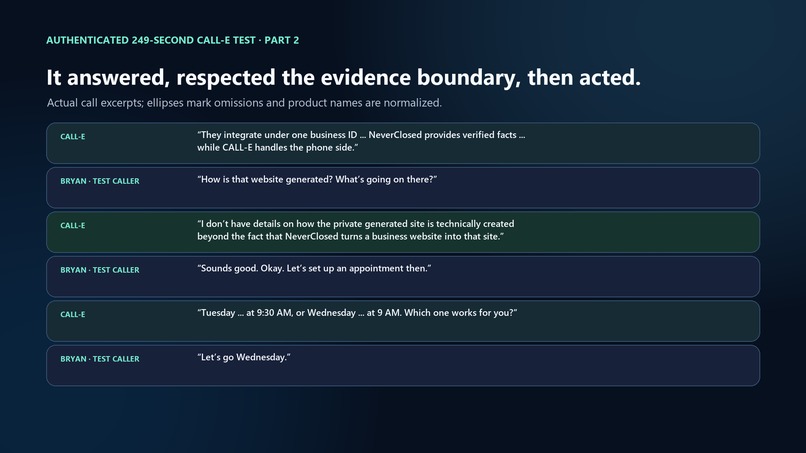
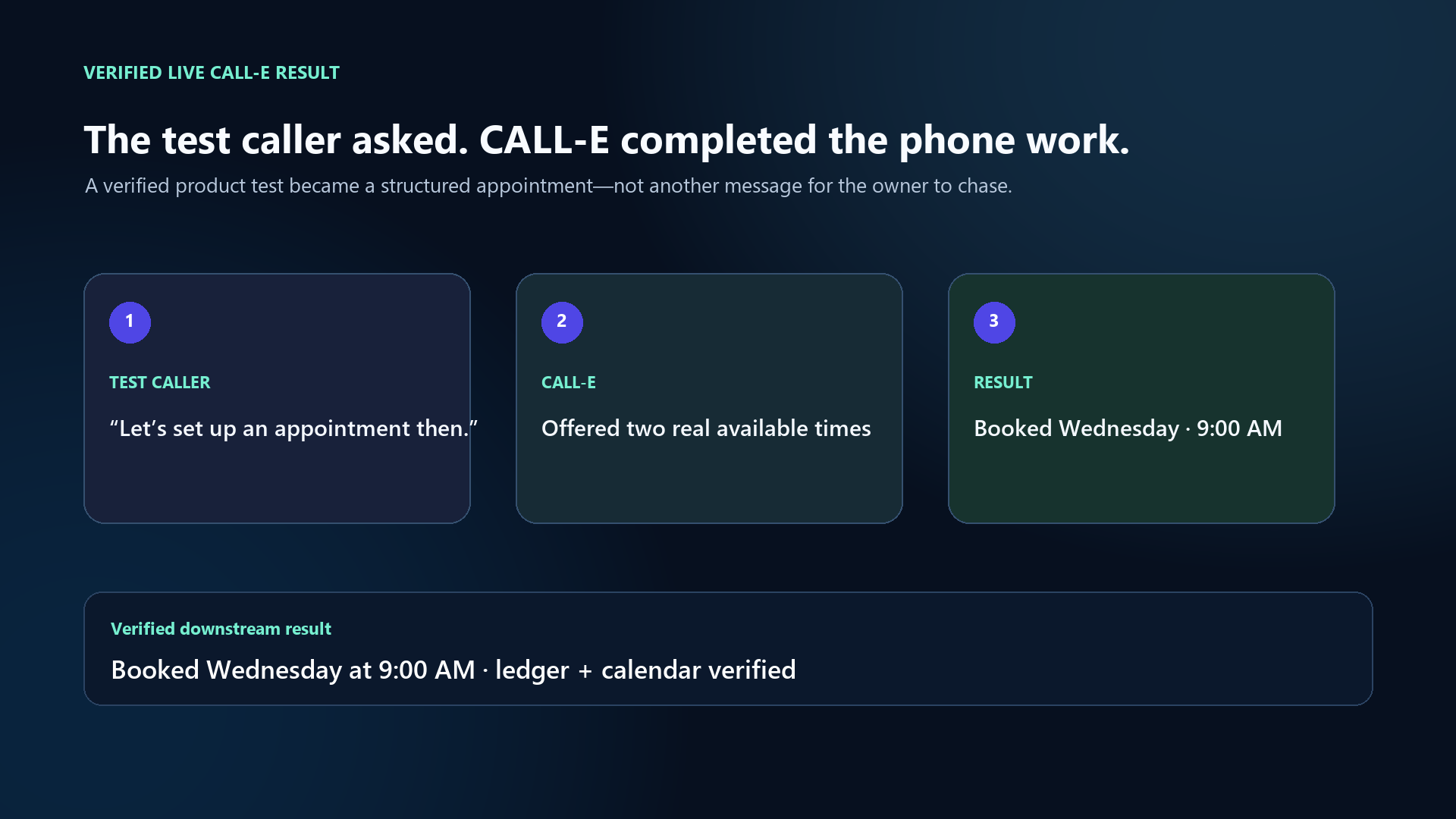
CALL-E held the evidence boundary, offered two real times, and captured the caller's selection.
-
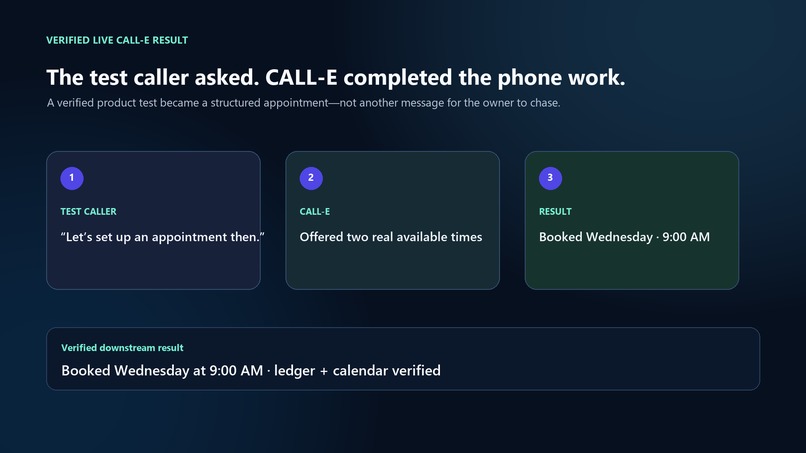
NeverClosed accepted the exact structured result and verified the booking in its ledger and calendar.
-
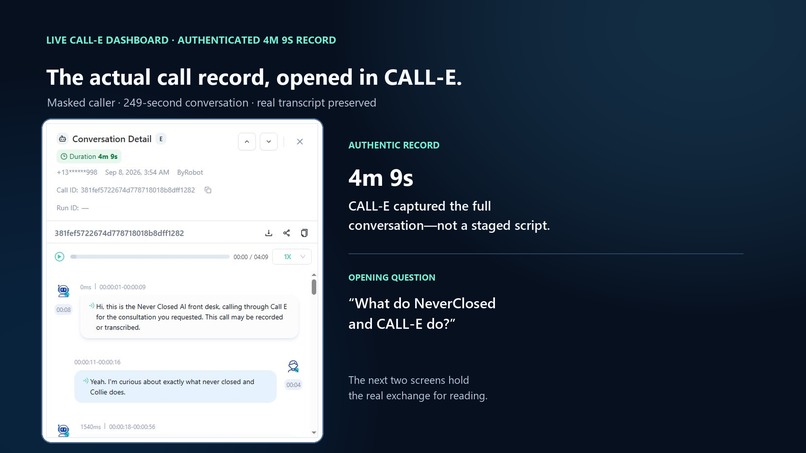
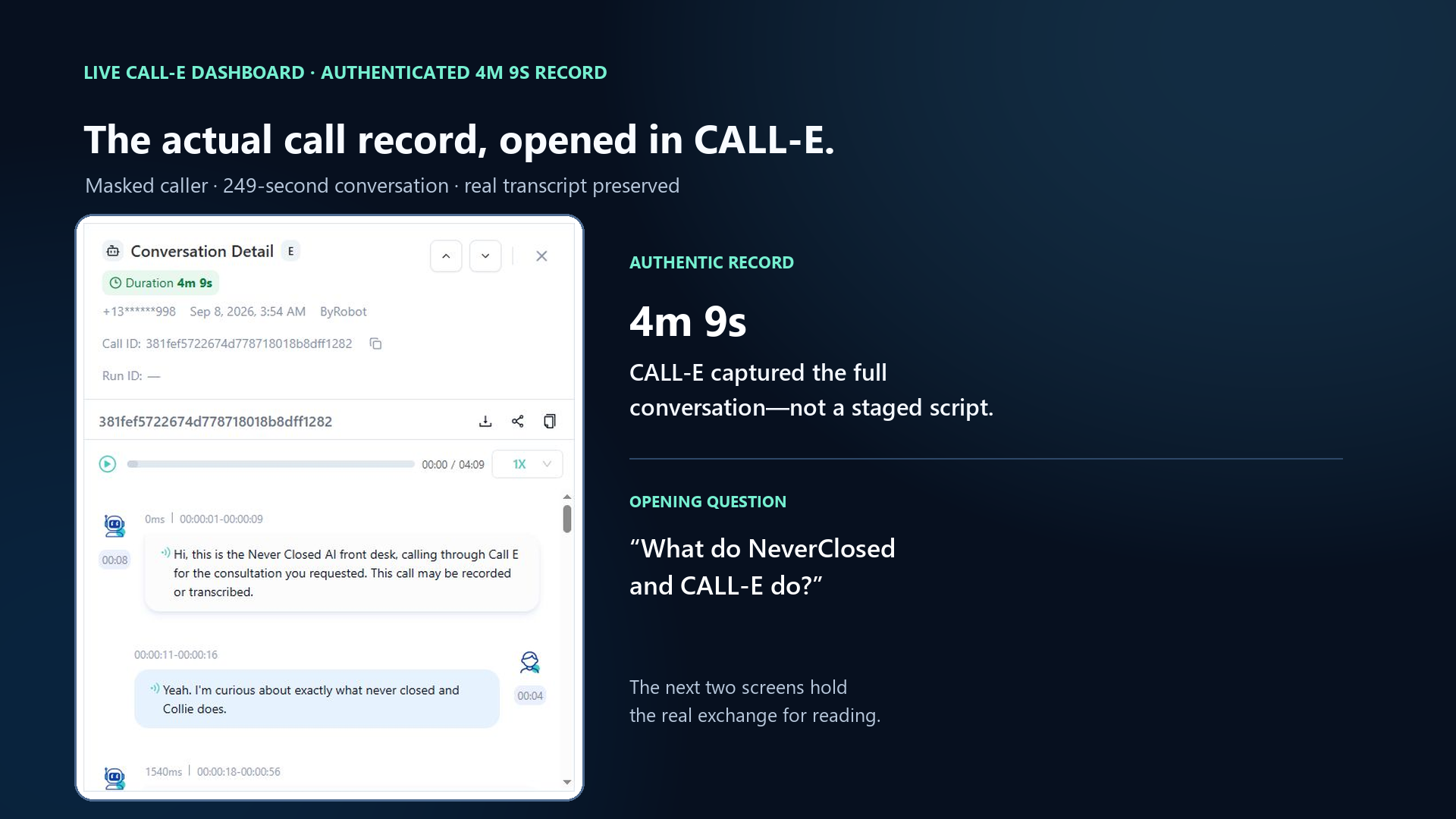
Authentic CALL-E dashboard record: masked caller, 249-second conversation, and preserved transcript.
-
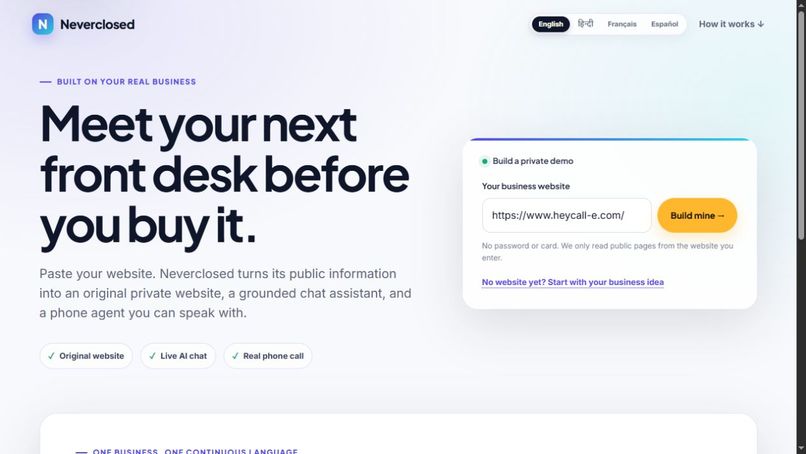
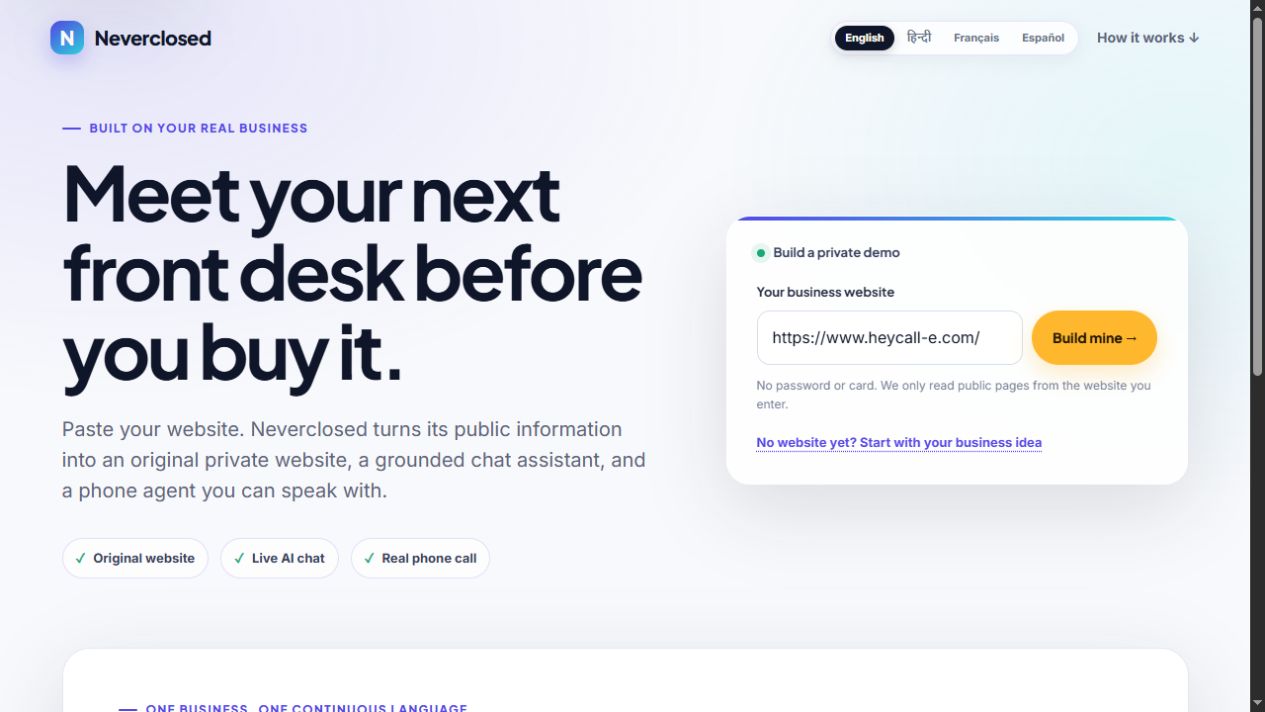
Start here: paste a real business URL and NeverClosed builds its private AI front desk.
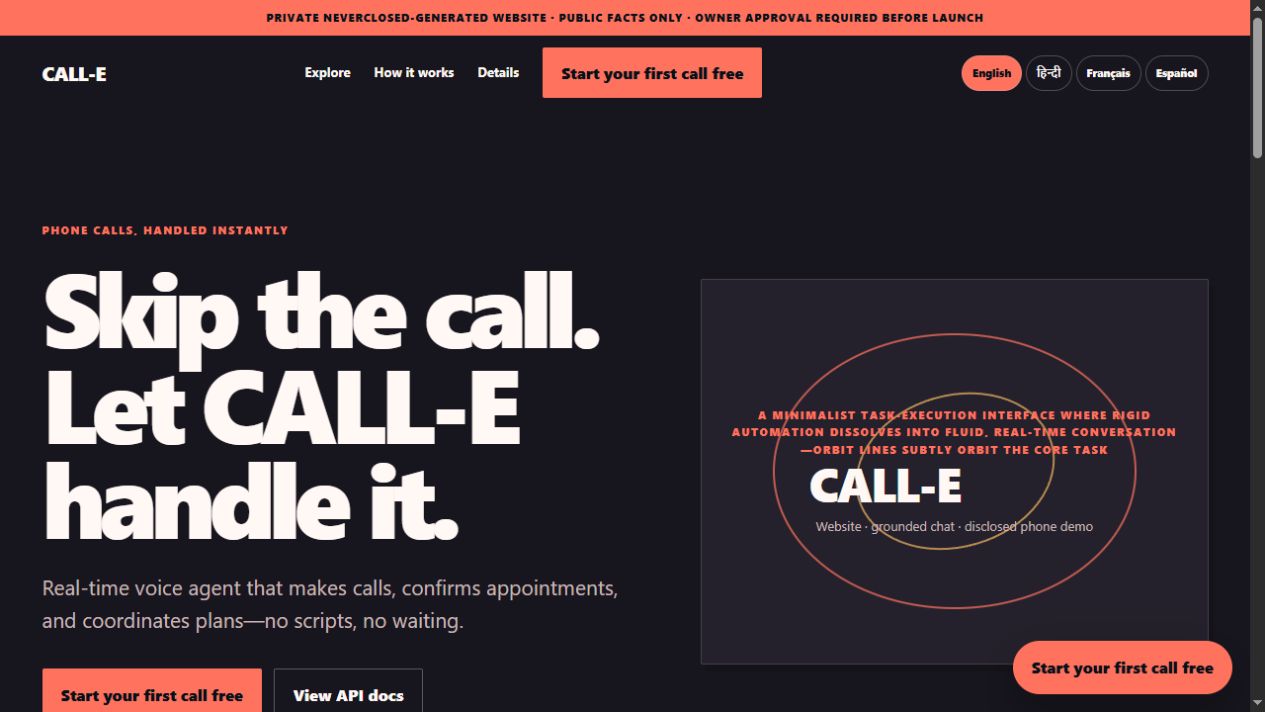
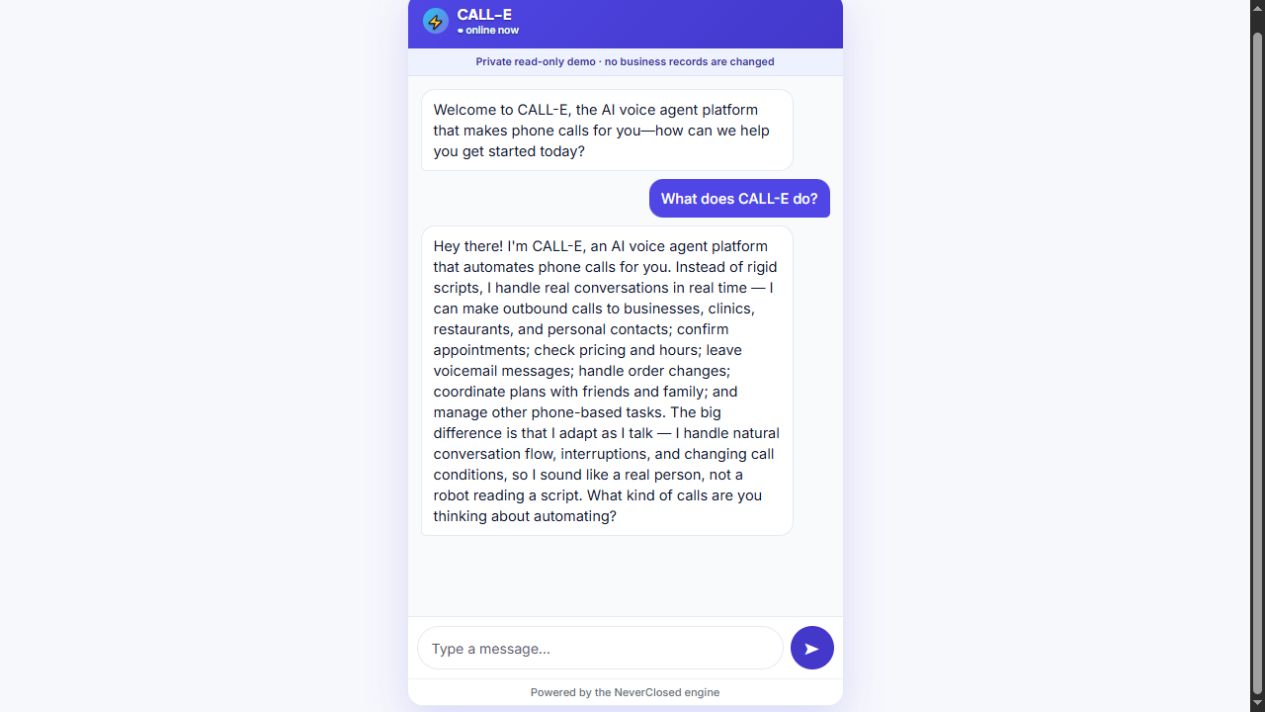
One website in. One CALL-E front desk out.
Try the live judge build — no login, password, card, or repository checkout required.
- Open Website to see the original private site generated from CALL-E's public pages.
- Open Chat and ask a published-fact question, then challenge it with something CALL-E never published. The first answer should be specific; the second should stay unknown. The preserved owner-connected profile also exposes the live human-handoff channel.
- Open Phone to inspect the consent and SMS ownership boundary. If you place a call, use a number you control. CALL-E will offer only server-supplied appointment times, and NeverClosed will write to its appointment ledger and connected Google Calendar only after an explicit confirmation.
The reusable public contribution is the merged evidence-grounded callback app in CALL-E PR #166.
The problem
Small businesses lose real work when nobody answers the phone. Their website may already explain their services, hours, prices, and policies, but that knowledge is usually disconnected from chat, phone, scheduling, and the person who must take over when automation reaches its limit.
The obvious solution is to add another generic voice bot. We built the opposite: one evidence chain from the business's own public website to a grounded assistant, a real CALL-E conversation, and a downstream appointment receipt.
What NeverClosed does
A user pastes a business URL. NeverClosed reads the useful public pages, separates published facts from unsupported claims, and generates an original private website for that business. The same frozen business profile and identifier power a grounded chat assistant and a consented CALL-E phone experience.
The website is not a screenshot or a swapped template. Each fresh build receives a validated AI design blueprint that changes composition, navigation, typography, palette, density, signature graphic, service layout, and section order. The blueprint is compiled through our own component system, so model-authored scripts or copied site assets never execute. A saved build remains stable and reviewable.
The chat retrieves relevant source excerpts for each question and verifies the answer against that evidence. The preserved judge build is the owner-connected experience rather than an anonymous read-only demo: it can explain published facts, keep missing facts unknown, preserve conversation history, alert the owner, and hand the exact room to a person. The generated website remains a private preview and never modifies CALL-E's source site.
When the customer needs action, CALL-E becomes the center of the system.
Why CALL-E is essential
NeverClosed does not hand CALL-E a loose paragraph and hope for the best. Before any call, it compiles a deterministic phone plan containing:
- the exact workflow stage;
- genuinely available appointment choices;
- business-scoped caller memory;
- the one permitted action;
- the explicit-confirmation rule; and
- the structured result contract.
The official call-e/calle TypeScript SDK then powers the live telephone conversation. CALL-E adapts to the caller, explains the task, presents the verified choices, reads back the selection, and returns a structured outcome. NeverClosed validates that outcome against the original plan before it can book, cancel, or display success.
That division of labor is the product: NeverClosed supplies grounded business intelligence, availability, memory, authorization, and downstream verification; CALL-E supplies the adaptive human conversation that turns those constraints into completed phone work.
Live proof, not a simulated progress screen
We tested the deployed path with an SMS-verified number through the public NeverClosed gateway.
In the first CALL-E conversation, the caller asked what CALL-E does, why a business would choose it, where NeverClosed fits, and how the products integrate. CALL-E answered from the business evidence, admitted what it did not know, offered two real appointment times, obtained an explicit readback, and returned the exact selected option. NeverClosed independently booked that option, verified it in the appointment ledger and the same profile's connected Google Calendar, and stored the authentic CALL-E record and transcript in the private owner inbox.
In the paired follow-up, NeverClosed supplied the same business-scoped verified caller and active appointment to CALL-E. After another explicit confirmation, CALL-E returned the cancellation outcome. NeverClosed cancelled that exact appointment, verified the ledger state, and confirmed the calendar event was absent.
The browser's evidence panel appears only after terminal provider status and downstream verification. A provider utterance, animation, ambiguous retry, or partially completed call is never presented as a successful booking.
Technical implementation
- Cloudflare Workers + KV for generation, saved business profiles, retrieval, rate limits, appointment state, and receipt-bound polling.
- Cloudflare Browser Rendering for JavaScript-heavy source sites, with a static-fetch fallback.
- Anthropic Claude for bounded business extraction and per-build design blueprints.
- The official CALL-E TypeScript SDK for the real phone conversation and structured outcome.
- A deterministic call-plan compiler that rejects invalid stages, duplicate or missing options, mismatched actions, missing confirmation policy, and unbound cancellation references before CALL-E is contacted.
- A consented public gateway with SMS number control, regional language validation, idempotency, retry recovery, and daily budgets.
- Google Calendar + a shared appointment service for real availability, conflict checks, booking, cancellation, and cleanup receipts.
- A private owner inbox + WebSockets for website and CALL-E transcripts, exact-room human takeover, AI pause, and reconnect-safe history.
- Playwright and contract suites covering the generated site, grounded/unknown chat behavior, phone lifecycle, failure paths, accessibility, and live deployed bytes.
What changed during the hackathon
NeverClosed existed before July 23 as a business-assistant product. During the submission period it gained the complete CALL-E integration shown here: URL-to-website generation; per-build design blueprints; one frozen identity across website, chat, and phone; the official CALL-E SDK gateway; structured provider-result verification; consent and SMS ownership checks; receipt-bound idempotency and recovery; a two-call book/remember/cancel lifecycle; business-scoped customer memory; shared appointment state; Google Calendar verification; and a private owner inbox with durable human takeover.
Reusable community contribution
The evidence-grounded callback app was reviewed and merged into CALL-E's official awesome-phone-call-agents repository as PR #166. It includes setup, masked preview, tests, a no-call default, explicit side-effect boundaries, cancellation guidance, and a separately gated live dispatch path. NeverClosed's commercial engine and private business data are not distributed through that MIT-licensed example.
What we learned
Voice-agent quality is an end-to-end evidence problem. A natural conversation is not enough. The application must control provenance, authorization, retries, provider receipts, downstream state, and what the interface is allowed to claim.
What's next
Next we are packaging the proven owner activation into guided setup: private business facts, calendar authorization, escalation rules, and approved phone behavior. The boundary stays the same—public previews are safe to explore, production actions require owner-approved connections, and every consequential claim must be backed by a downstream receipt.
Built With
- anthropic-claude
- call-e
- cloudflare-browser-rendering
- cloudflare-kv
- cloudflare-workers
- google-calendar-api
- playwright
- typescript
- websockets

Log in or sign up for Devpost to join the conversation.