-
-
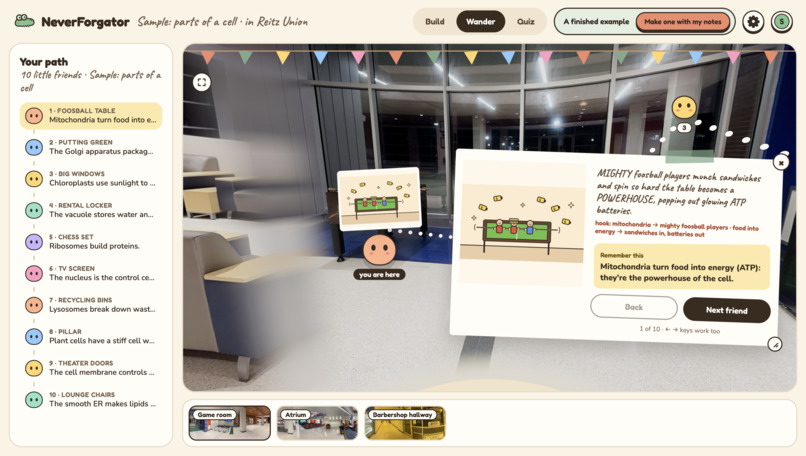
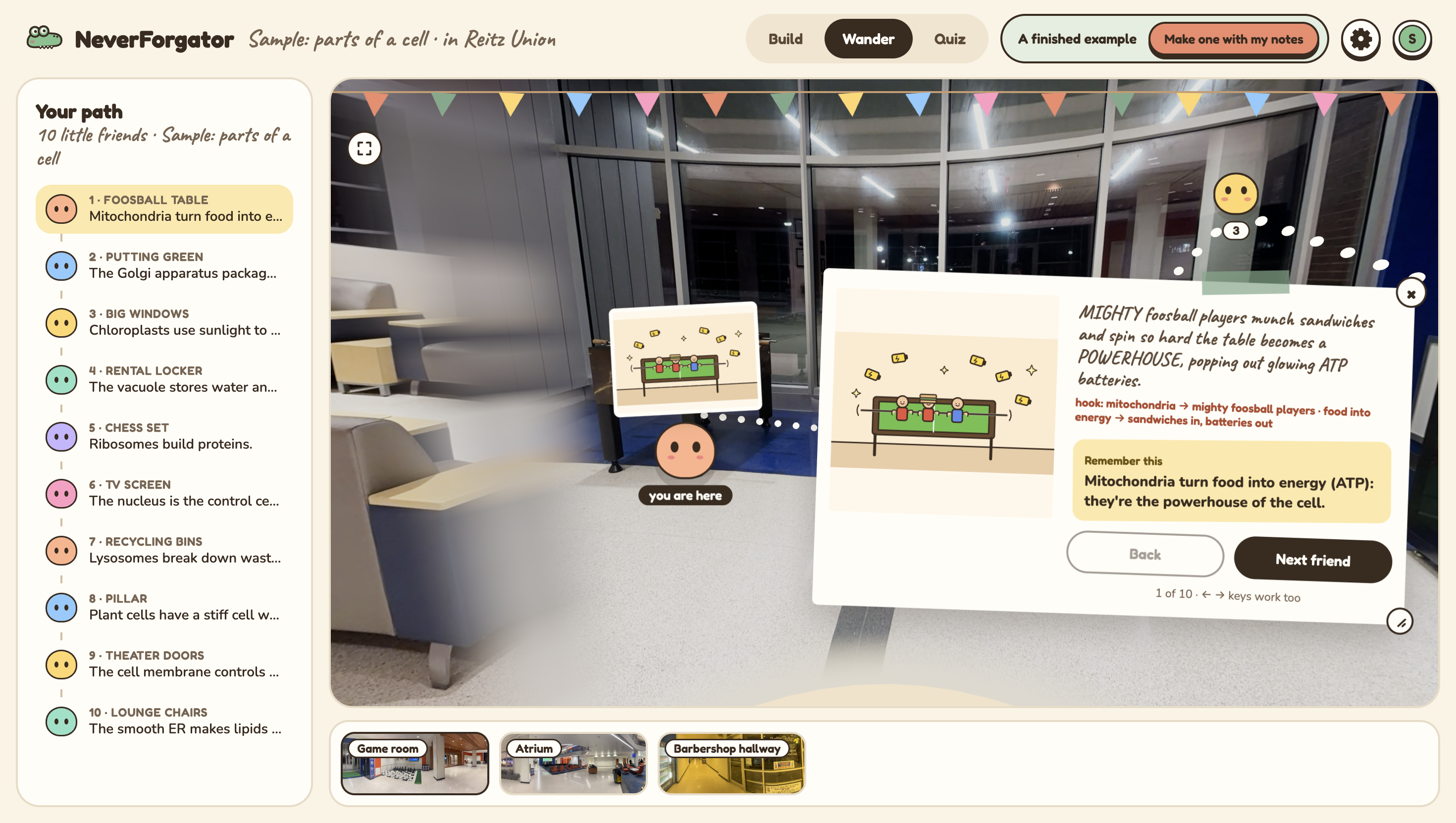
NeverForgator wander mode of example palace; depicting mitochondria representation in terms of spatial components
-
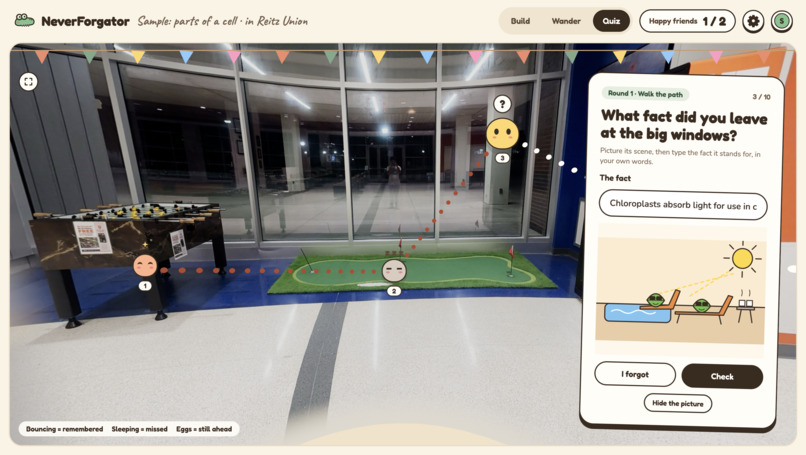
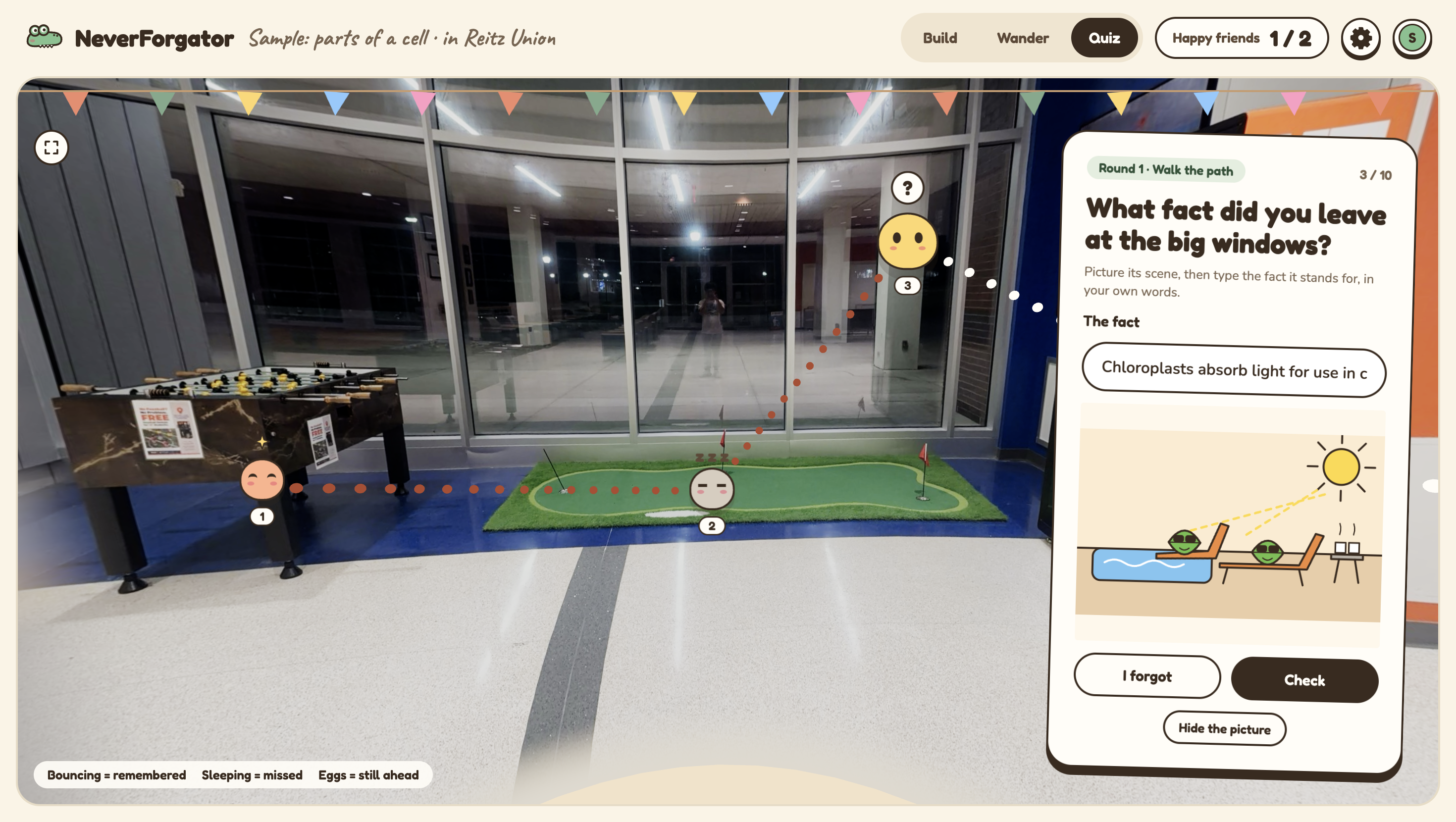
Quiz mode depicting (left to right) correct, incorrect, and in-progress (with image shown option)
-
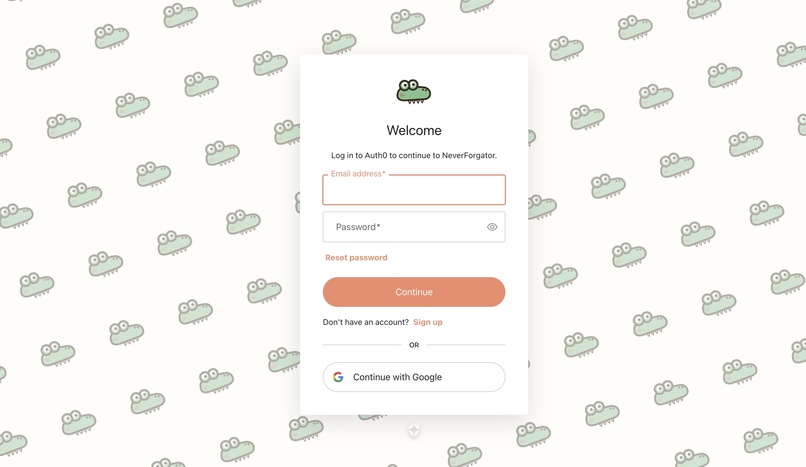
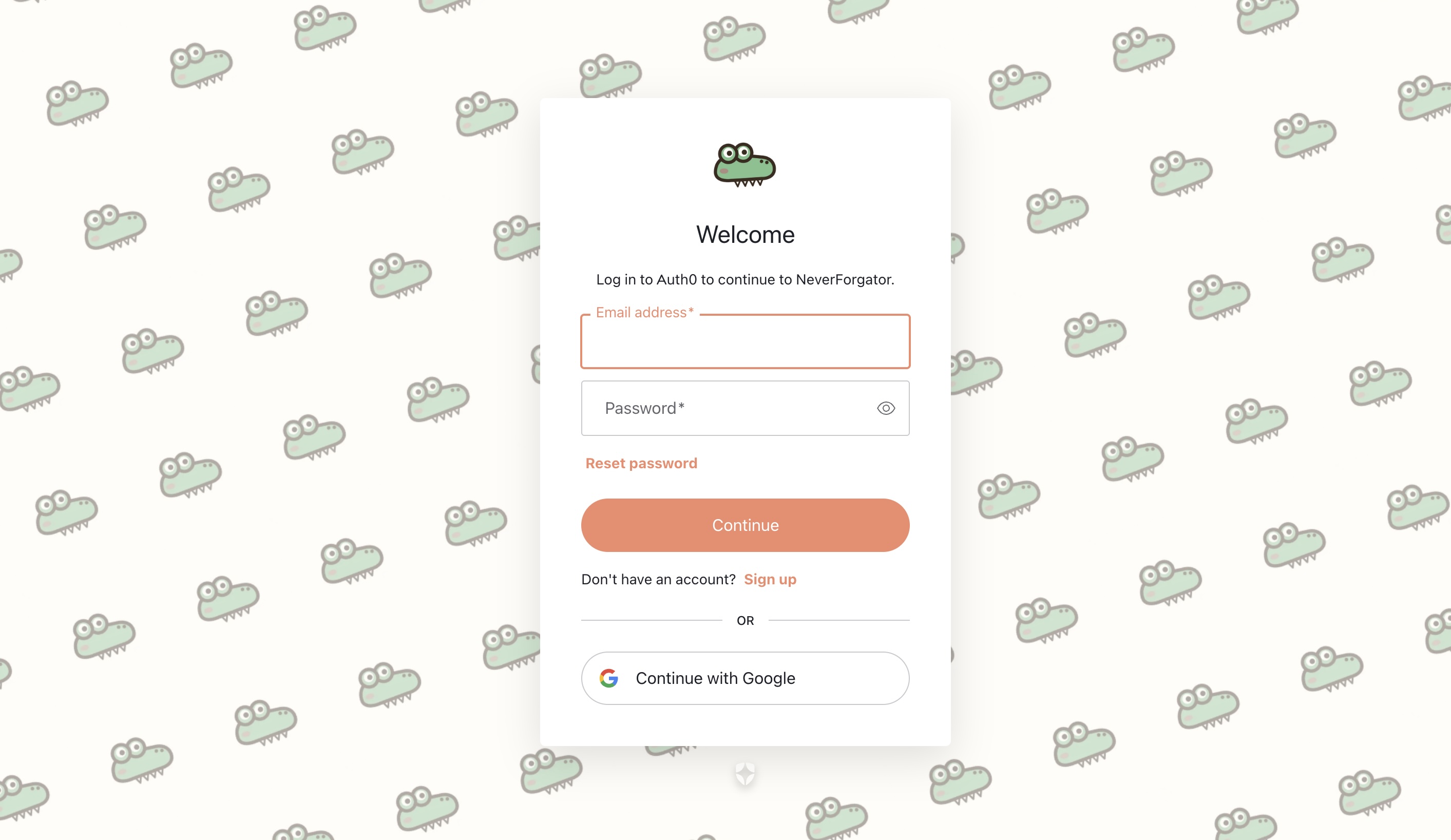
Auth0 user login / sign-up; patterned background of NeverForgator logo
-
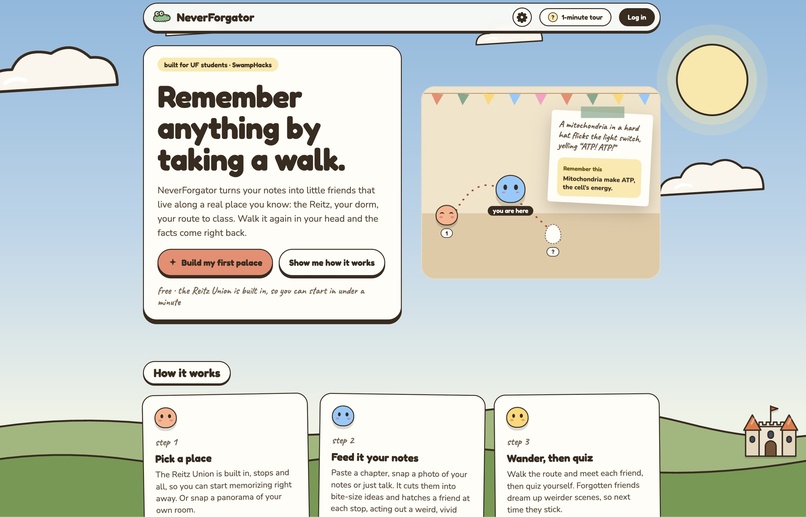
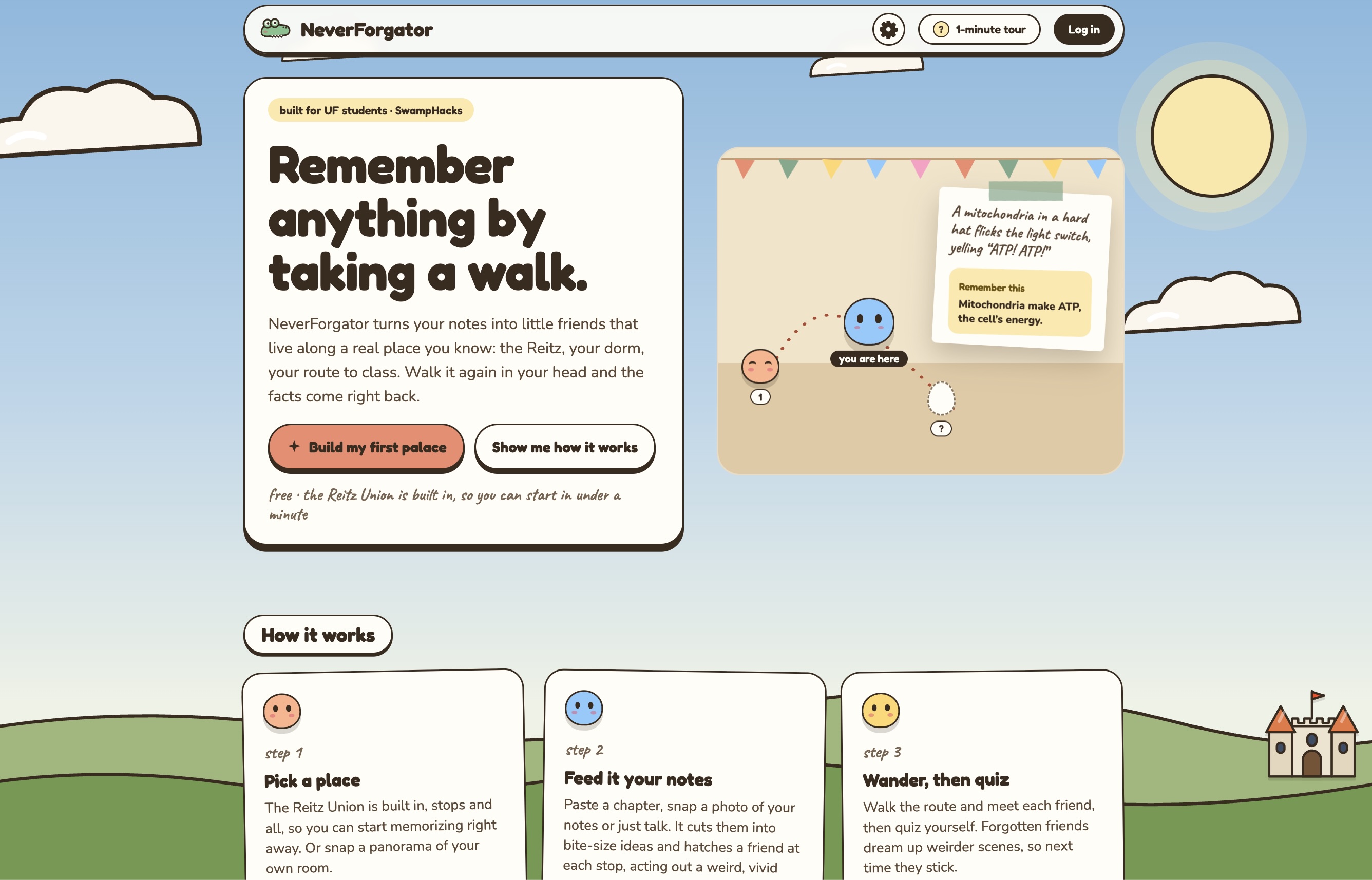
New user / not-logged-in NeverForgator home page
-
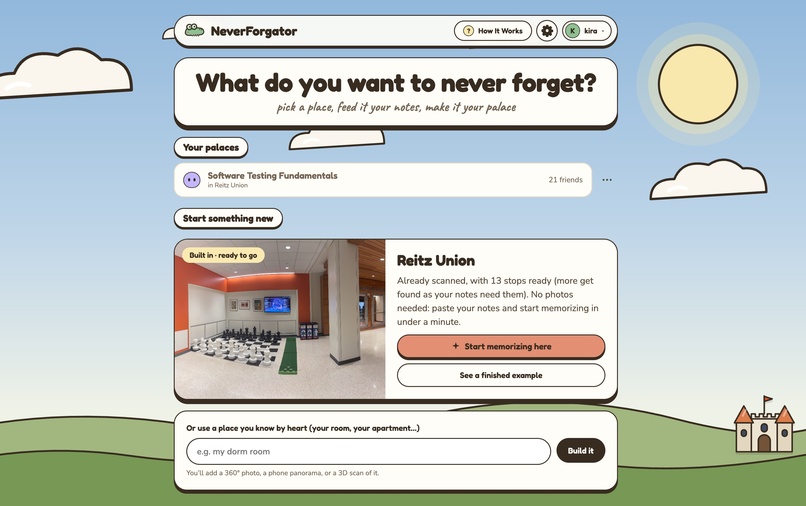
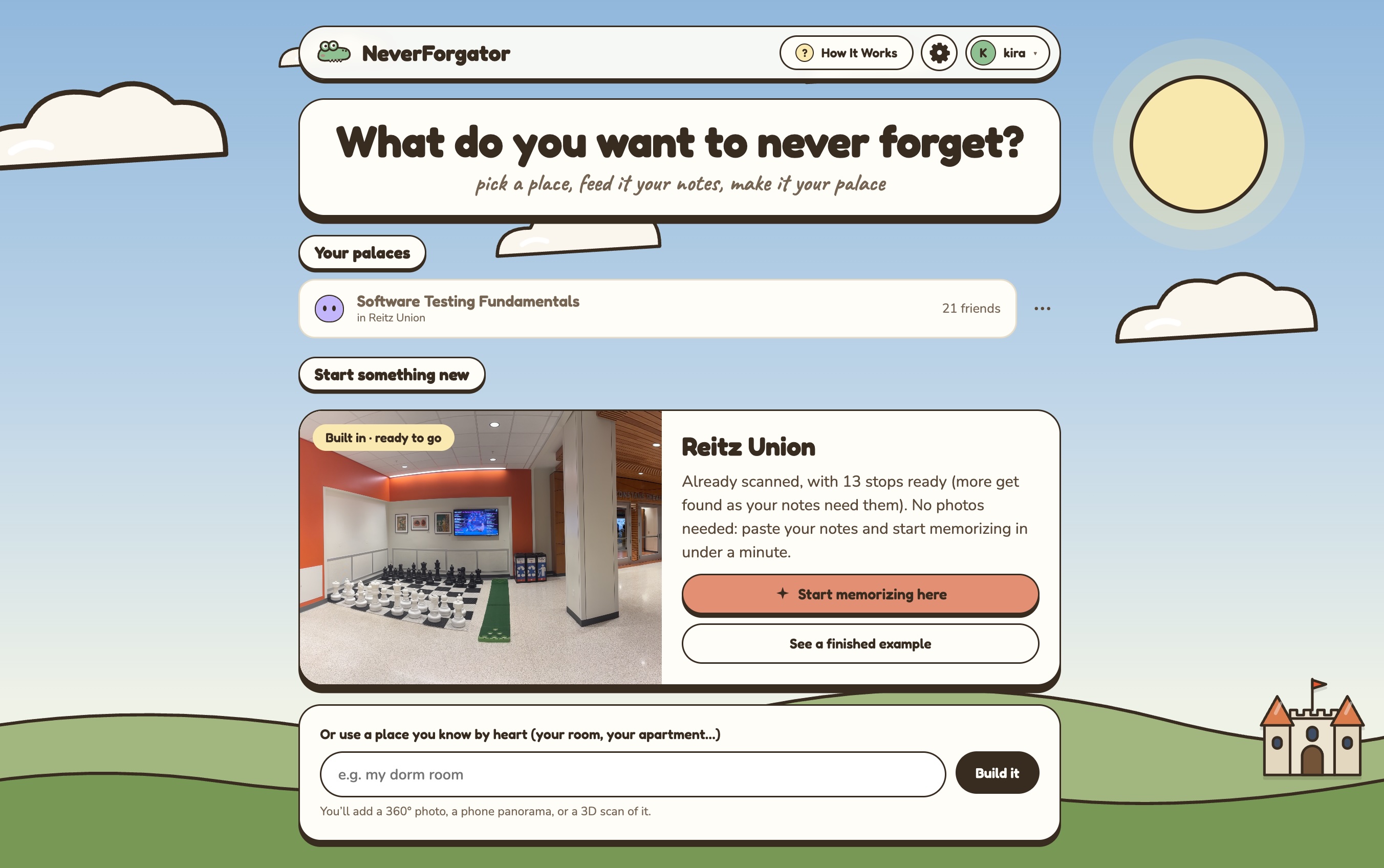
User dashboard
-
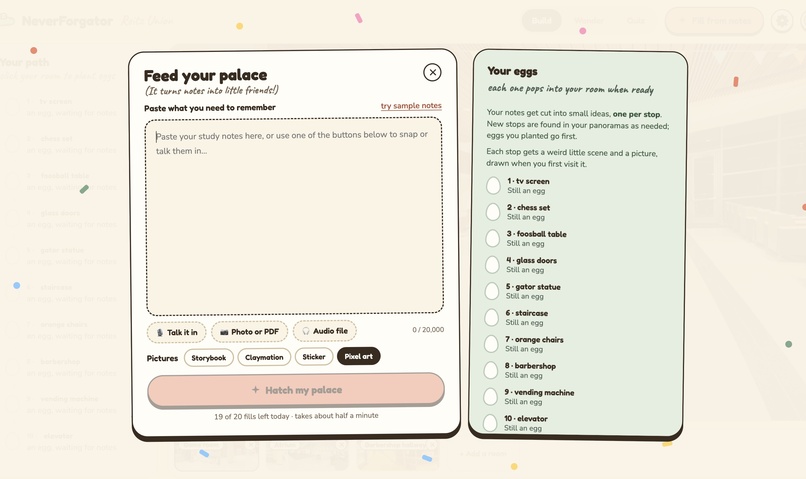
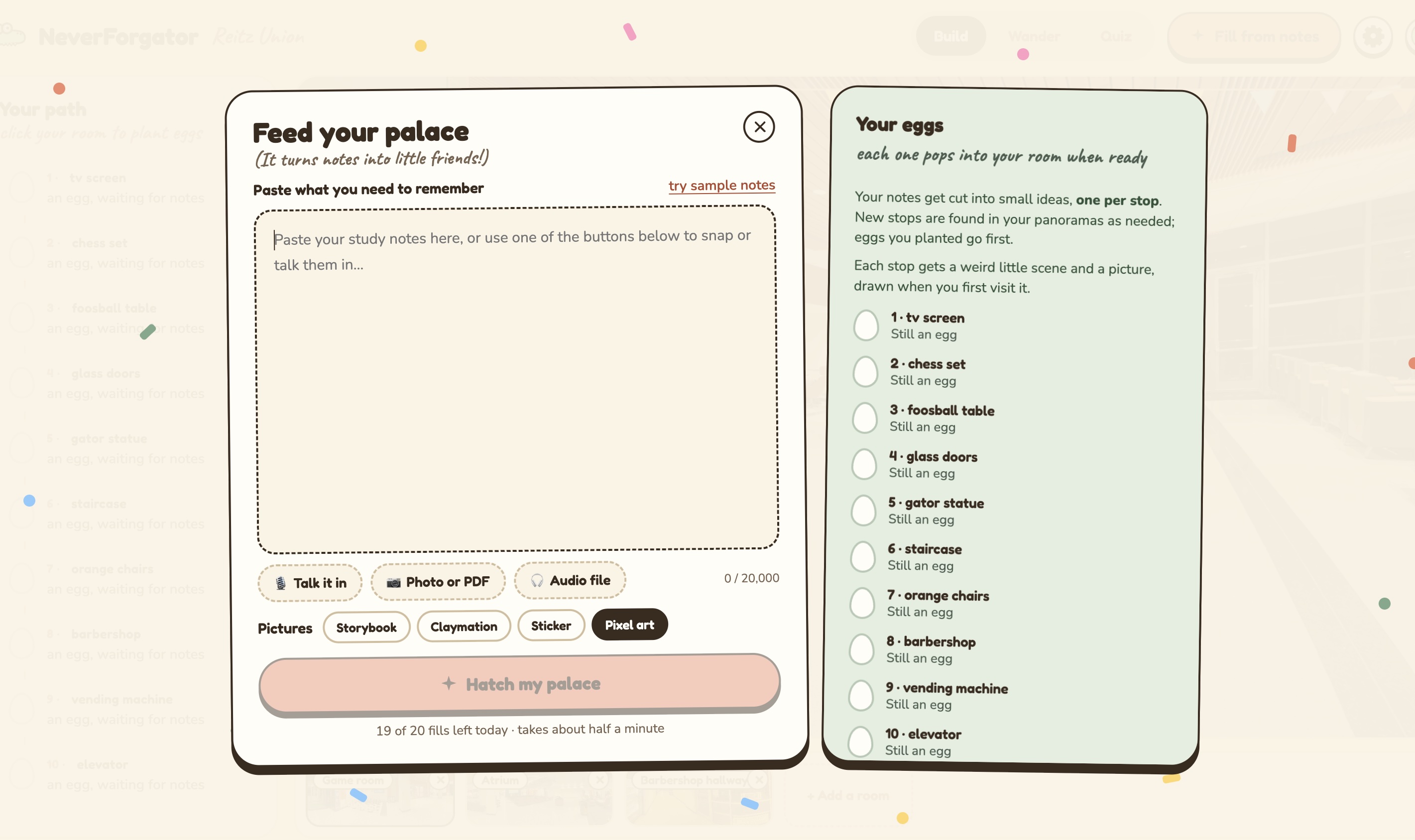
Section for users to upload notes and data via PDF, image, text, or voice
-
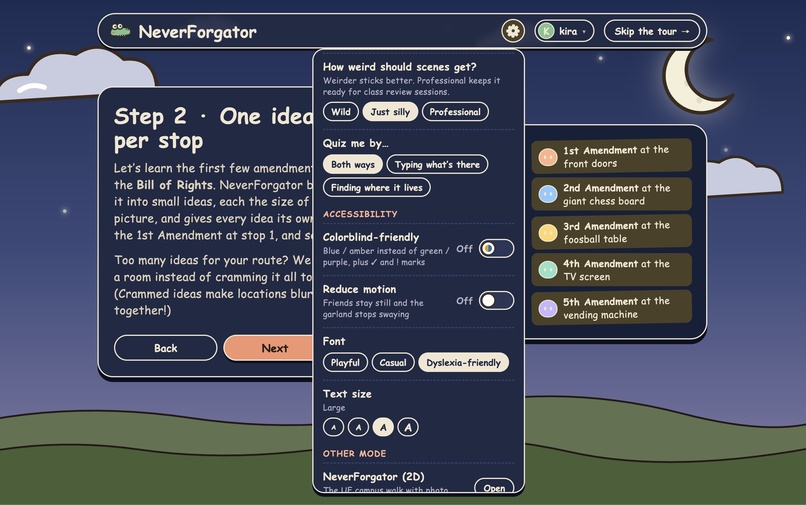
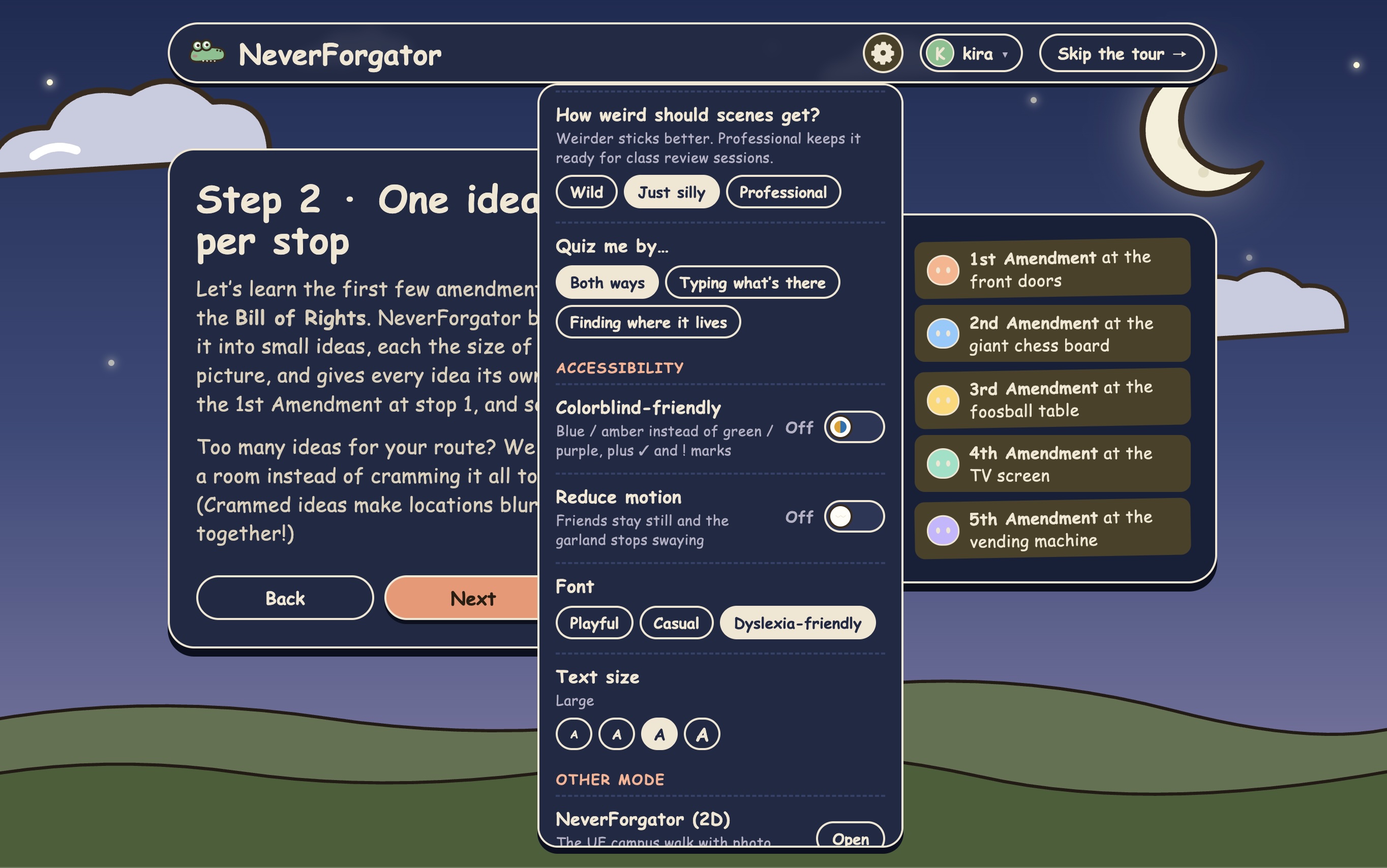
Accessibility features enabling dark mode, font size, and font type changes
NeverForgator—Method of Loci Tool
Make memorization easier with an AI-assisted memory palace maker centered around UF campus. Paste your notes (or snap a photo/PDF of them, or just talk), and AI (using Gemini API) will pull out the key concepts. Each concept is placed at a real location on an interactive view. Users are able to upload their own panoramas/images to create custom palaces for even better association (due to the familiarity effect). A guided walkthrough teaches users the route-topic associations, and quizzes help the material stick. Palaces are then saved and accessed from a user-friendly dashboard.
Inspiration
The method of loci (also known as the memory palace) is an ancient mnemonic strategy which uses spatial memory and imagination to memorize and recall information. However, getting started in this technique can be difficult, so students instead try to memorize vast amounts of information and complex concepts with sheer willpower! Instead, we thought, what if there was an easy-to-use study tool geared for UF students looking to put the loci method into practice? Not only could we associate UF campus locations with a custom mind palace, but we could also allow a user to upload their own panoramas and 3D scans for associating concepts to already familiar places. From this idea, NeverForgator was born.
Roles
- Kira Luna Nichtawitz: User authentication, UX
- Eric Tran: Gemini API integration & middleware
- Natasha Antoniuk: React frontend & UI design
- Thomas McLaughlin: Backend & database
How We Built It—Integrations & Tech Stack
| Area | Tools | Purpose |
|---|---|---|
| Frontend | React + Vite | App UI, map, walkthrough, quiz, dashboard |
| Backend | Python + FastAPI | API, Gemini calls, auth checks, database access |
| Authentication | Auth0 | Sign up, log in, access tokens for the API |
| AI | Google Gemini API (Google Cloud) | Concept extraction, memory scene associations, doodle pictures, and weirder scenes for quiz misses |
| Map | three.js + React Three Fiber | 360° panoramas wrapped into a 3D space to create the interactive world (with optional Gaussian splat 3D scans) |
| Database | SQLite (PostgreSQL supported) | Users, campus route, palaces, stops, quiz scores |
| Database access | SQLAlchemy + Alembic | Tables as Python classes; migrations that build and change the tables |
| Tests | pytest | Backend tests (with a throwaway database) |
| Domain | neverforgator.study | https://neverforgator.study |
| Hosting | DigitalOcean Droplets + Caddy | Host backend + frontend with HTTPS |
Challenges + How We Grew
As a predominantly first-time team, we ran into hiccups during nearly every step of the process, from coming up with ideas, collaborating across devices, designing the backend, comparing UI choices, and parsing bugs with pages of error codes. But as a team, we worked together to communicate, resolve issues, do research, and persist. From our challenges, we learned soft skills like how to work together under pressure, as well as hard skills like using JavaScript and tools like React and FastAPI. Over the course of the hackathon, every problem that set us back ultimately taught us a valuable lesson, and we were able to accomplish more than we ever thought.
Accomplishments + What We Learned
Despite having limited coding experience, we were determined to learn and integrate as many tools as we could to make our project as great as possible. With this goal in mind, we implemented secure authentication with Auth0, Gemini AI integration with Google Cloud, hosting on our own domain (neverforgator.study) with DigitalOcean, and a complete backend and frontend tech stack to tie it all together. Not to mention, we carefully designed a cute and user-friendly UI with theming and customization settings to give users the best experience. We all grew socially, interpersonally, technically, and professionally through this project, and will certainly carry these skills with us into the future.
What's next for NeverForgator?
Next up, we're going to keep improving and iterating off of NeverForgator. We have a solid Minimum Viable Product, but we truly want to keep growing and working on this project. We plan to expand the platform for a larger user base, better token efficiency, cross-platform app compatibility, and more. Some features we plan on implementing:
Public Forum: A collaboration feature where approved memory palaces can be shared with other users. Users may search for palaces associated with a specific location or a relevant topic they're looking to study, ranked by visits and upvotes across the platform.
Palace Connections: A consolidation tool for combining various memory palaces a user has created in the past, allowing them to study across sets for exam season (midterms & finals).
Walkable Environments: Palaces can already span multiple rooms, but next we want fully walkable environments that connect whole buildings, letting users move freely between spaces and better associate paths to expand their mental associations.
Expanded User Base: Altered theming appealing to a wider non-UF audience. More theme customization under Advanced settings allows user-preferred styles (e.g. pastel hues, futuristic, custom university colors) in order to enable more user personalization.
Built With
- alembic
- auth0
- digitalocean
- fastapi
- gemini
- godaddy
- javascript
- particle
- pm2
- postgresql
- pytest
- python
- react
- sqlalchemy
- three.js
- vite


Log in or sign up for Devpost to join the conversation.