NeuroViu Vision Agent
Agentic vision that sees, reasons, and adapts to human behavior in real time.
Inspiration
Computer vision systems are often designed to detect, classify, or track something and stop there. I wanted to explore a different question:
What happens when visual evidence actually changes what an AI system does next?
As the founder of NeuroViu and a biomedical engineer working at the intersection of human behavior, neurotechnology, and AI, I am interested in adaptive systems that can respond to changing human conditions rather than simply collect data.
That became the foundation for NeuroViu Vision Agent: an OpenCV 5-powered prototype that turns visual observations into decisions and adaptive actions, then observes again to determine whether the action worked.
Instead of a one-way computer vision pipeline, I built a closed loop:
Observe → Decide → Act → Re-observe → Adapt
What it does
NeuroViu Vision Agent uses OpenCV 5 to analyze visual input and convert it into structured observations that influence an agent's next action.
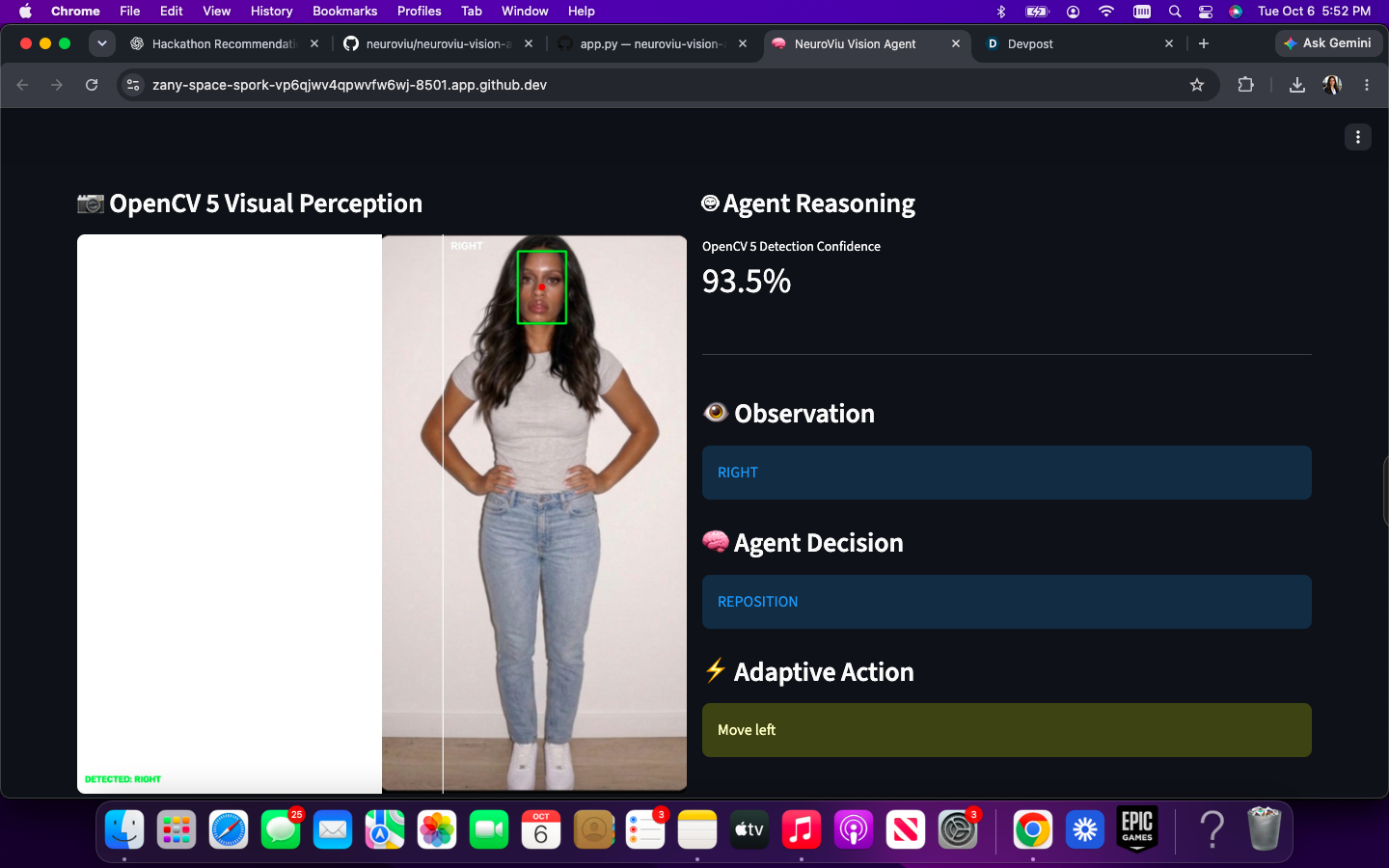
In the current prototype, the system evaluates whether a participant is positioned to the left, center, or right of the desired visual region.
For example:
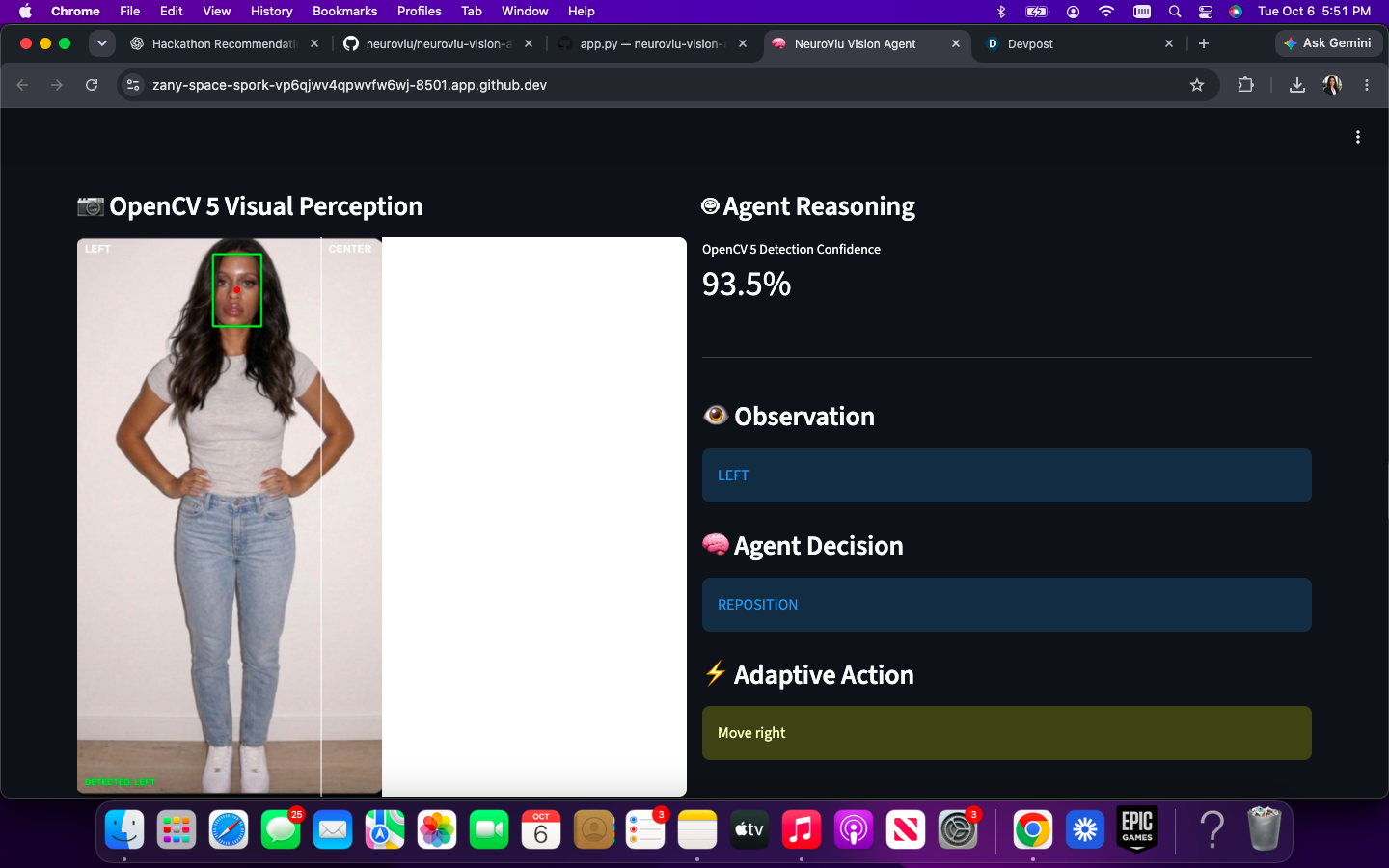
- OpenCV 5 detects the participant on the left.
- The agent receives the structured observation
LEFT. - It decides
REPOSITION. - It generates the action
Move right. - The system requests another visual observation.
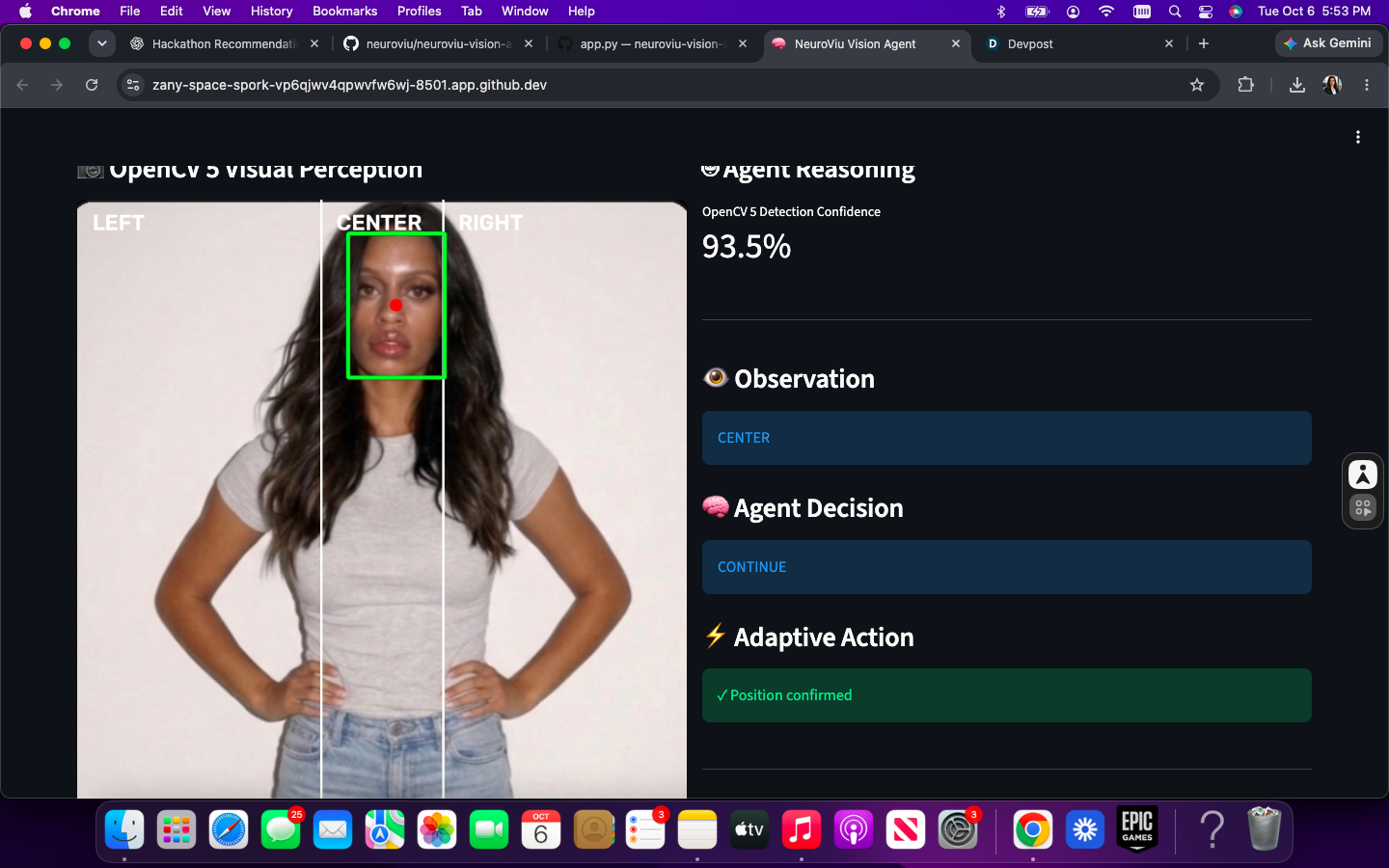
- OpenCV analyzes the new image.
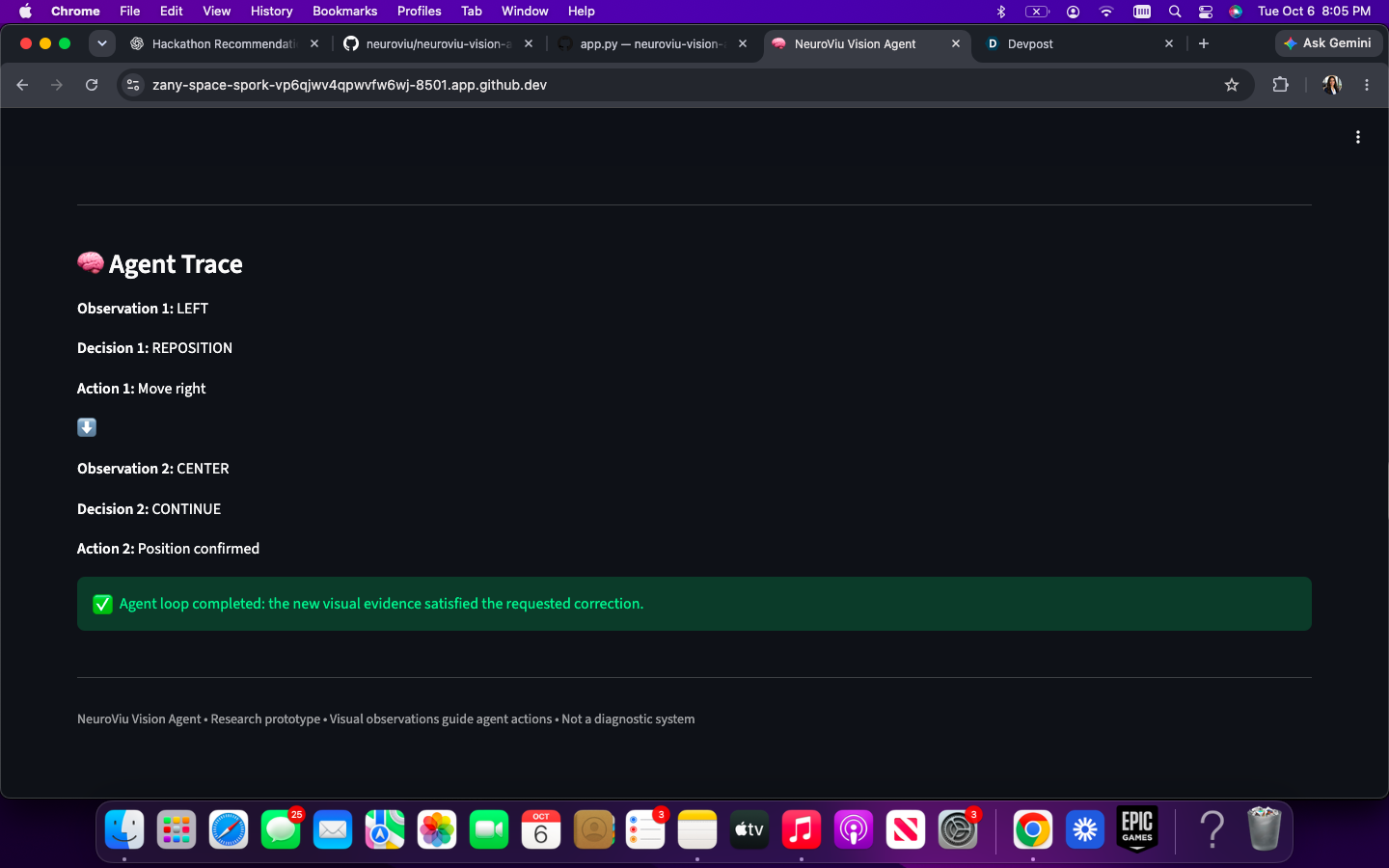
- If the participant is now centered, the observation becomes
CENTER. - The agent changes its decision to
CONTINUE. - The resulting action becomes
Position confirmed.
This means the second decision depends on new visual evidence produced after the first action.
The system also handles a no-detection condition. If OpenCV cannot detect the participant, the agent does not continue blindly. It requests that the participant move into the camera view and obtain another observation.
How I built it
The computer vision pipeline is built in Python using OpenCV 5.
I use OpenCV's YuNet face detector to identify the participant and calculate the horizontal center of the detected face relative to the image dimensions.
The frame is divided into three behavioral regions:
- LEFT
- CENTER
- RIGHT
Those visual observations are passed into an agent decision layer that determines whether the workflow should continue or request corrective action.
I built a Streamlit interface to make the entire reasoning loop observable. The interface displays the OpenCV detection, detection confidence, visual observation, agent decision, adaptive action, re-observation, and final agent trace.
For cloud integration, I connected the system to AWS DynamoDB. Completed agent loops generate a structured trace containing observations, decisions, actions, confidence values, timestamps, and the loop outcome.
Uploaded participant images are not stored in DynamoDB.
The application is deployed through Streamlit Community Cloud, with credentials handled through encrypted secrets rather than stored in the source repository.
Agentic Vision architecture
The core architecture is:
Visual Input → OpenCV 5 → Structured Observation → Agent Decision → Adaptive Action → Re-observation → Updated Decision → AWS Trace
The key design choice is that computer vision is not merely an output.
Visual evidence becomes an input to subsequent agent behavior.
That allows the system to respond differently as the observed environment changes.
Evaluation
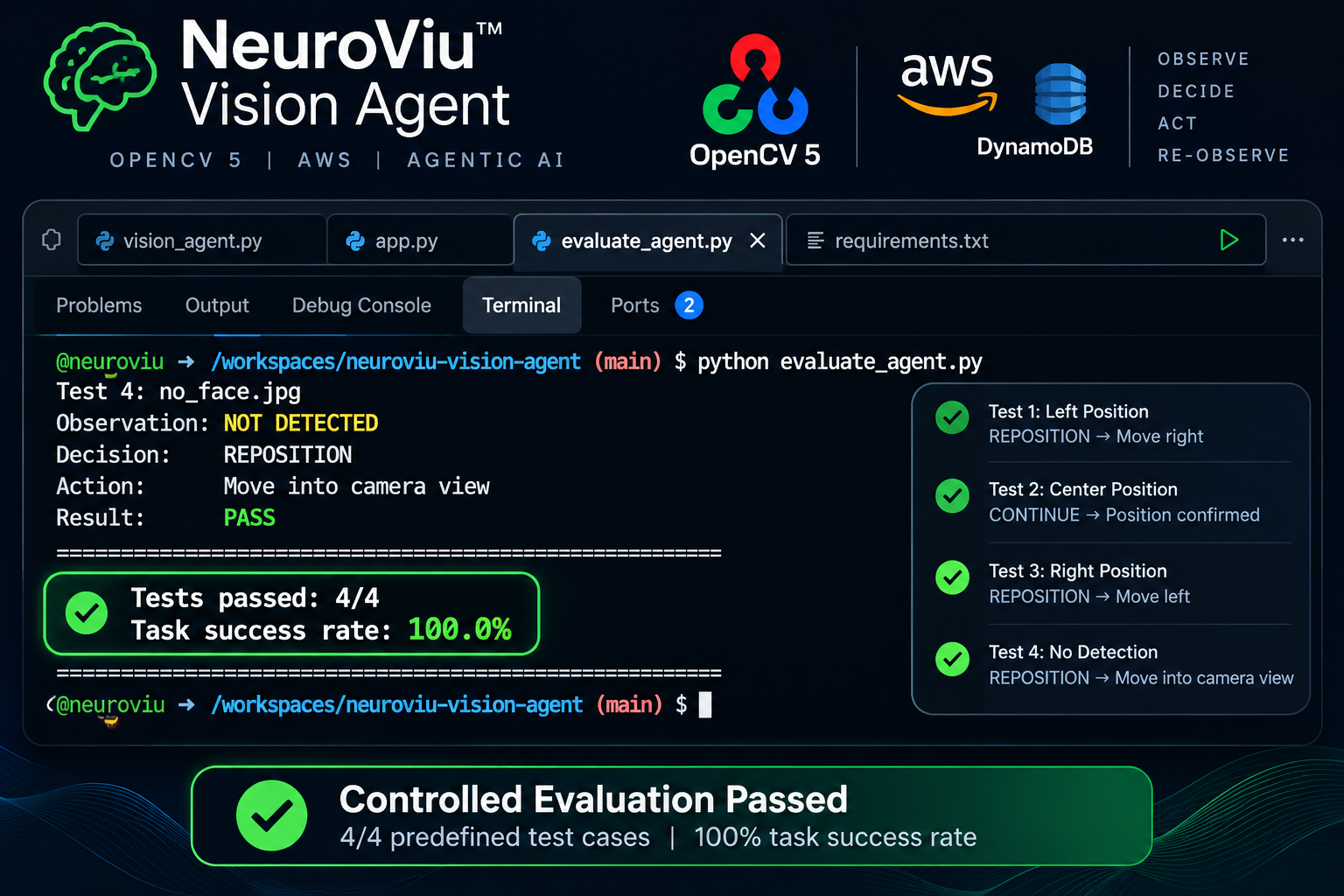
I created a small controlled evaluation covering four predefined conditions:
| Test condition | Expected agent behavior |
|---|---|
| Participant left | REPOSITION → Move right |
| Participant centered | CONTINUE → Position confirmed |
| Participant right | REPOSITION → Move left |
| Participant not detected | REPOSITION → Move into camera view |
The prototype passed 4/4 predefined test cases, resulting in a 100% task success rate within this small controlled evaluation.
This result is not intended as a claim of general computer-vision accuracy. Instead, it verifies that the prototype correctly connects predefined visual conditions to the intended decisions and actions, including the no-detection failure-handling case.
Challenges I faced
One of the biggest challenges was turning the project from a computer vision demonstration into a genuinely agentic loop.
Detecting a face or determining its position was relatively straightforward. The more important challenge was making that observation consequential: the first visual result needed to change what happened next, and the system then needed to examine new evidence before deciding whether to continue.
Cloud deployment introduced another set of challenges.
The local development environment and Streamlit Cloud required different OpenCV configurations. The standard OpenCV package depended on a Linux graphical library that was unavailable in the cloud environment, so I migrated the deployment to OpenCV 5 headless while preserving the vision functionality required by the application.
I also integrated AWS using a least-privilege IAM configuration and Streamlit secrets so credentials would not be embedded in the application or committed to GitHub.
These challenges ultimately improved the project because they forced me to think beyond the model itself and build a complete, deployable system.
What I learned
This project reinforced that agentic computer vision is less about adding more detections and more about designing the relationship between perception and action.
A visual model can tell a system what it sees. An agentic system must determine:
What should I do because I saw that?
And then:
Did my action change the situation?
Building the re-observation step made that distinction much clearer.
I also gained hands-on experience deploying OpenCV 5 in a cloud environment, implementing AWS DynamoDB trace logging, designing failure-handling behavior, securing cloud credentials, and building observable agent traces.
What's next
The current positional task is intentionally simple because it provides a clear and testable demonstration of the closed-loop architecture.
Future versions could expand visual observations to include movement, posture changes, task interaction, tracking quality, response timing, and other behaviorally relevant signals.
The same architecture could eventually support adaptive research environments where visual observations influence task progression, request additional observation windows, flag low-confidence segments, or route uncertain situations to human review.
For NeuroViu, I am particularly interested in exploring how agentic vision can complement other research signals in human-centered and neurotechnology applications.
NeuroViu Vision Agent is a research prototype and is not a diagnostic system.
Built for
OpenCV AI Competition 2026 powered by AWS
Built by NeuroViu Labs
Built With
- 5
- agentic
- agents
- amazon
- amazon-web-services
- computer
- dynamodb
- human-centered
- learning
- machine
- machine-learning
- opencv
- python
- streamlit
- vision
- yunet


Log in or sign up for Devpost to join the conversation.