-
-
-
-
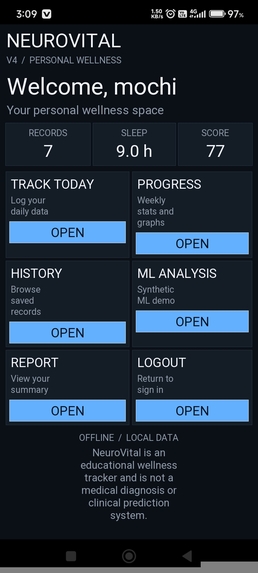
Neurovital main page


My Journey Behind NeuroVital NeuroVital was not built in one day. It was the result of a long process of learning, experimenting, making mistakes, and improving. My interest in healthcare initially made me think about how technology could help people with basic health monitoring and guidance. When I started learning programming, I wanted to turn that idea into something practical. My first version of the project was called Smart Healthcare Assistant, and I developed it using C++. At that stage, I was still learning programming fundamentals, so syntax errors and debugging were a major part of my experience. Many times, the program did not work the way I expected, and I had to understand my mistakes and try again. Later, as I learned more about Python and Artificial Intelligence, I decided to rebuild and improve the project. I converted the project from C++ to Python because Python was comparatively easier for me to develop with, and it allowed me to explore AI and Machine Learning concepts more comfortably. The project gradually evolved into NeuroVital. I worked on features such as water tracking, sleep tracking, mood tracking, symptom recording, medicine reminders, health history, a dashboard, chatbot functionality, heart-rate recording, BMI calculation, and rule-based health-risk analysis. With every new feature, I had to understand not only how to write the code, but also how the different parts of the program should work together. The biggest challenge came when I wanted to introduce Machine Learning. I had learned about AI concepts through resources such as Elements of AI, but understanding how a real ML workflow worked was very different from simply knowing the definition of AI. I had to learn about datasets, features, labels, training and testing, classification, Decision Trees, predictions, and model evaluation. I experimented with a synthetic dataset and built a Decision Tree classification component for NeuroVital V3. There were also moments when the code became too large and difficult to manage. I faced errors, debugging problems, and situations where I had to go back, understand what had gone wrong, and rebuild parts of the project. Instead of treating those mistakes as failures, I treated them as part of learning. I also worked on the project with a friend, while personally developing and understanding many of the core components. I do not consider NeuroVital finished. It is a student prototype and a representation of my current knowledge, with many areas that I hope to improve through further study. The most valuable thing NeuroVital has given me is not just a project to submit. It has taught me how to take an idea, break a problem into smaller parts, learn unfamiliar technologies, face errors, improve my work, and keep going even when the solution does not work the first time. NeuroVital is therefore not just a healthcare prototype—it represents my journey from learning basic programming to exploring Artificial Intelligence and Machine Learning, one step at a time.
Built With
- ml
- python
