-
-
-
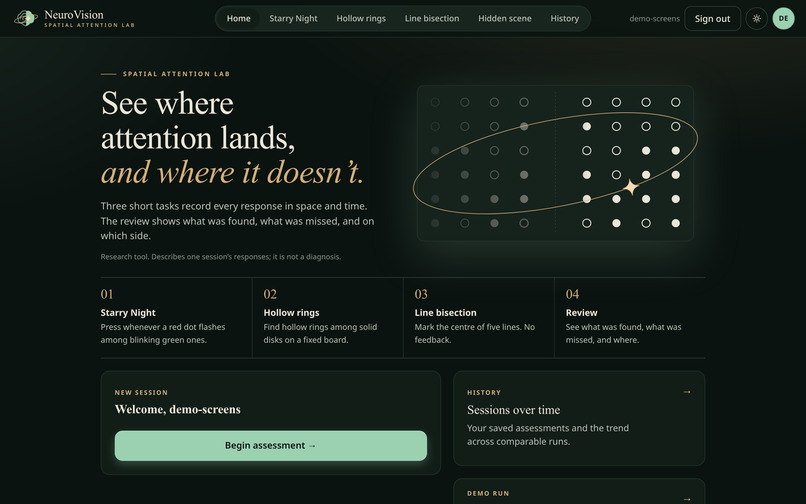
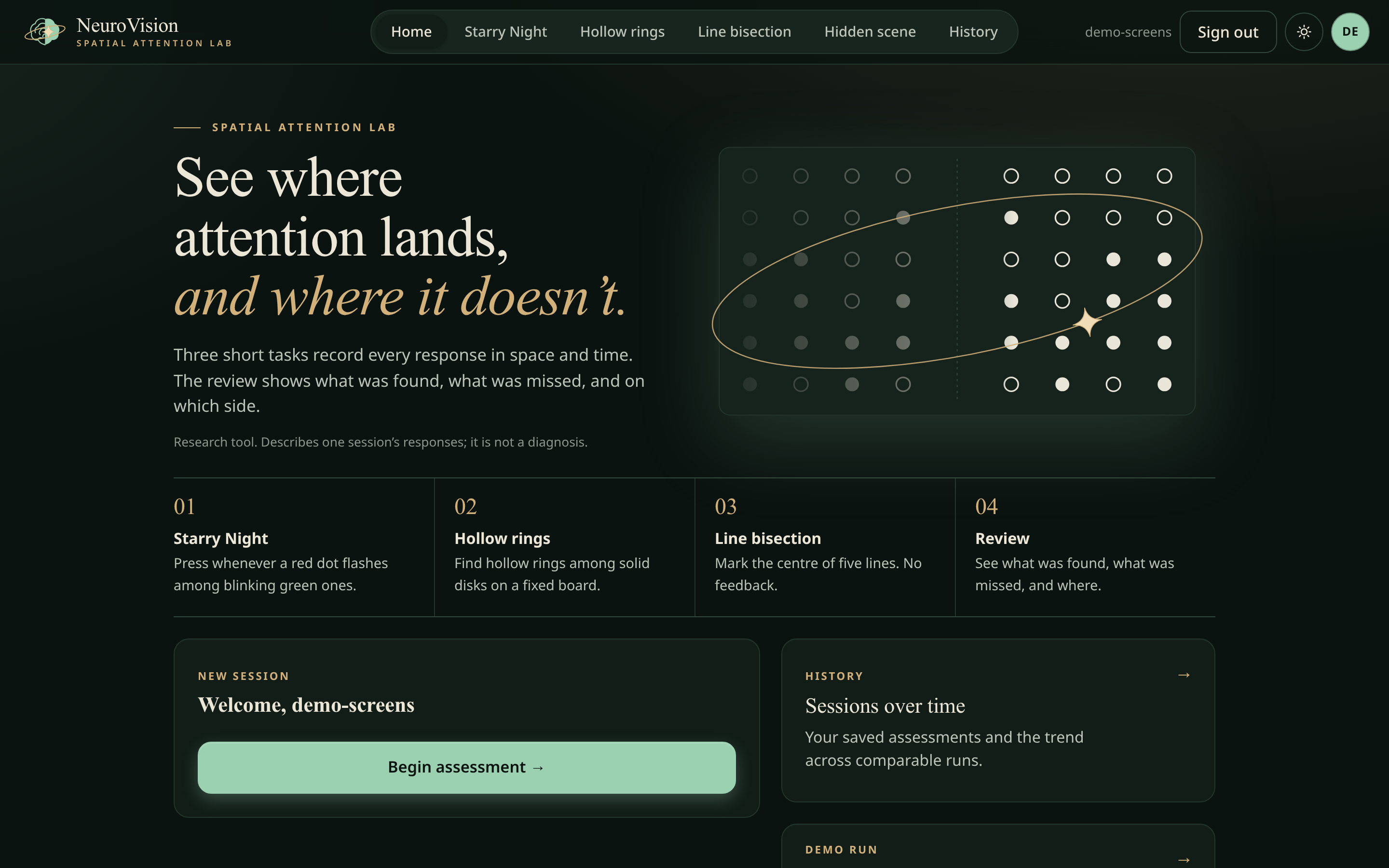
Home page
-
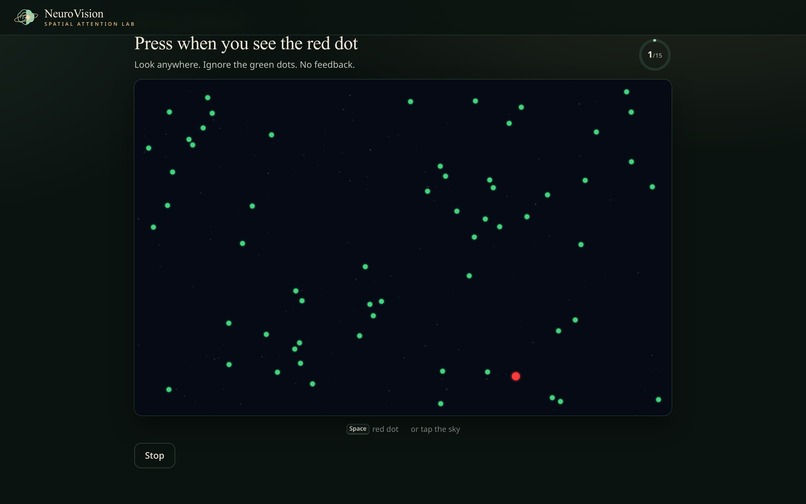
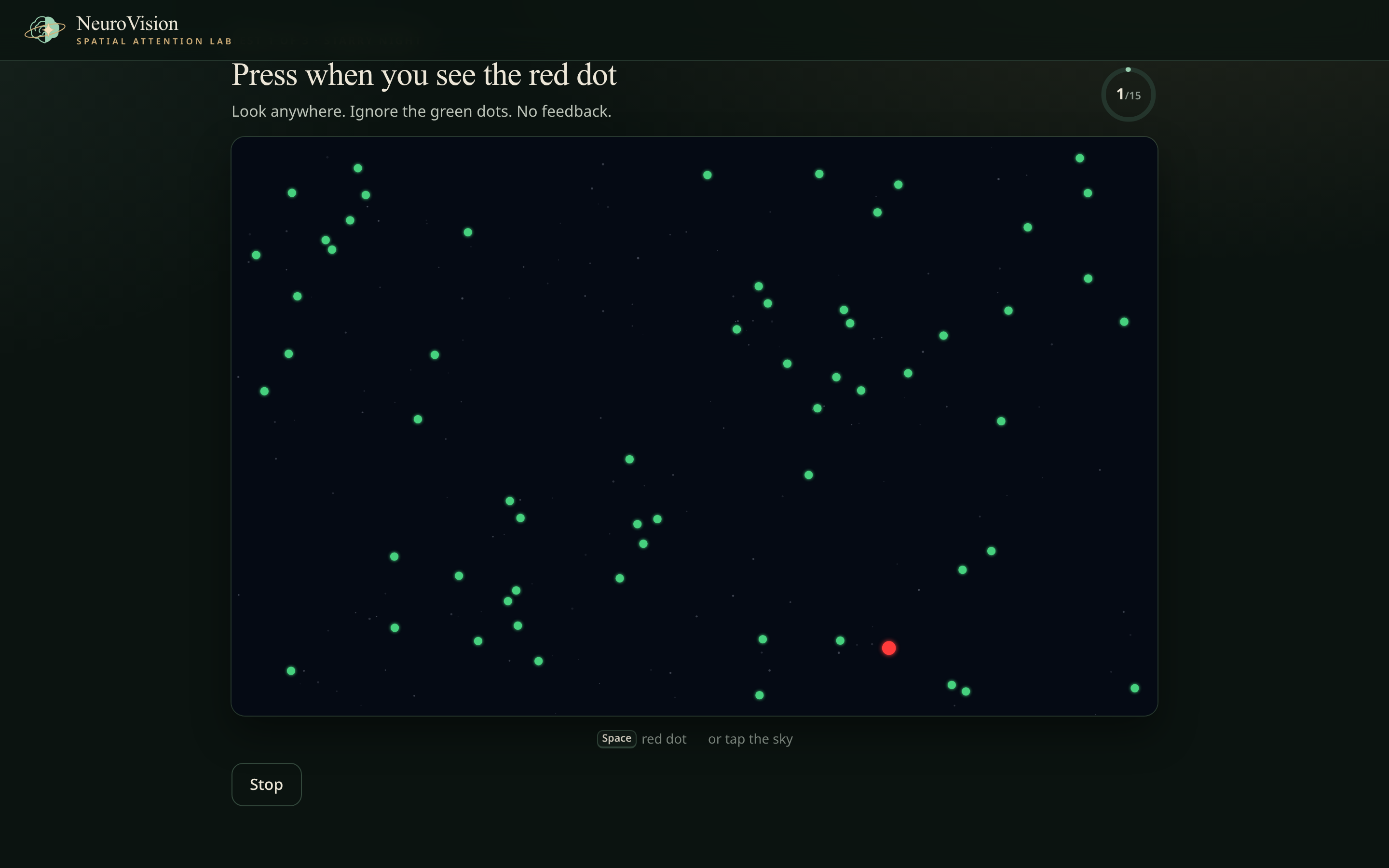
Test 1: Starry Night
-
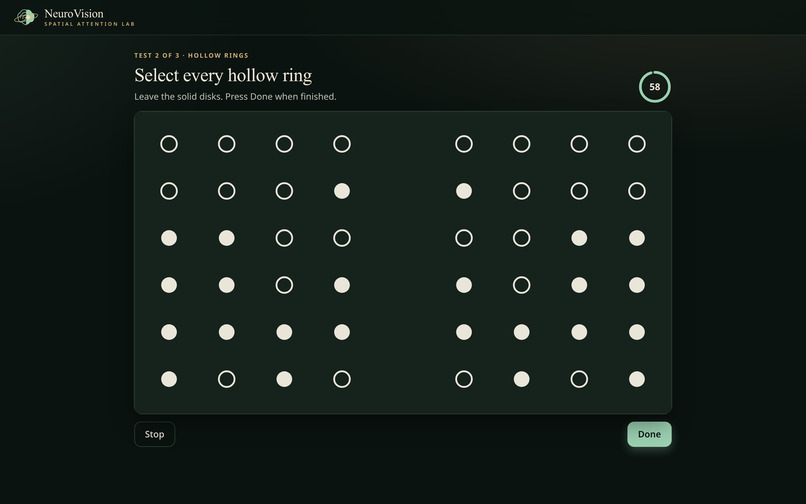
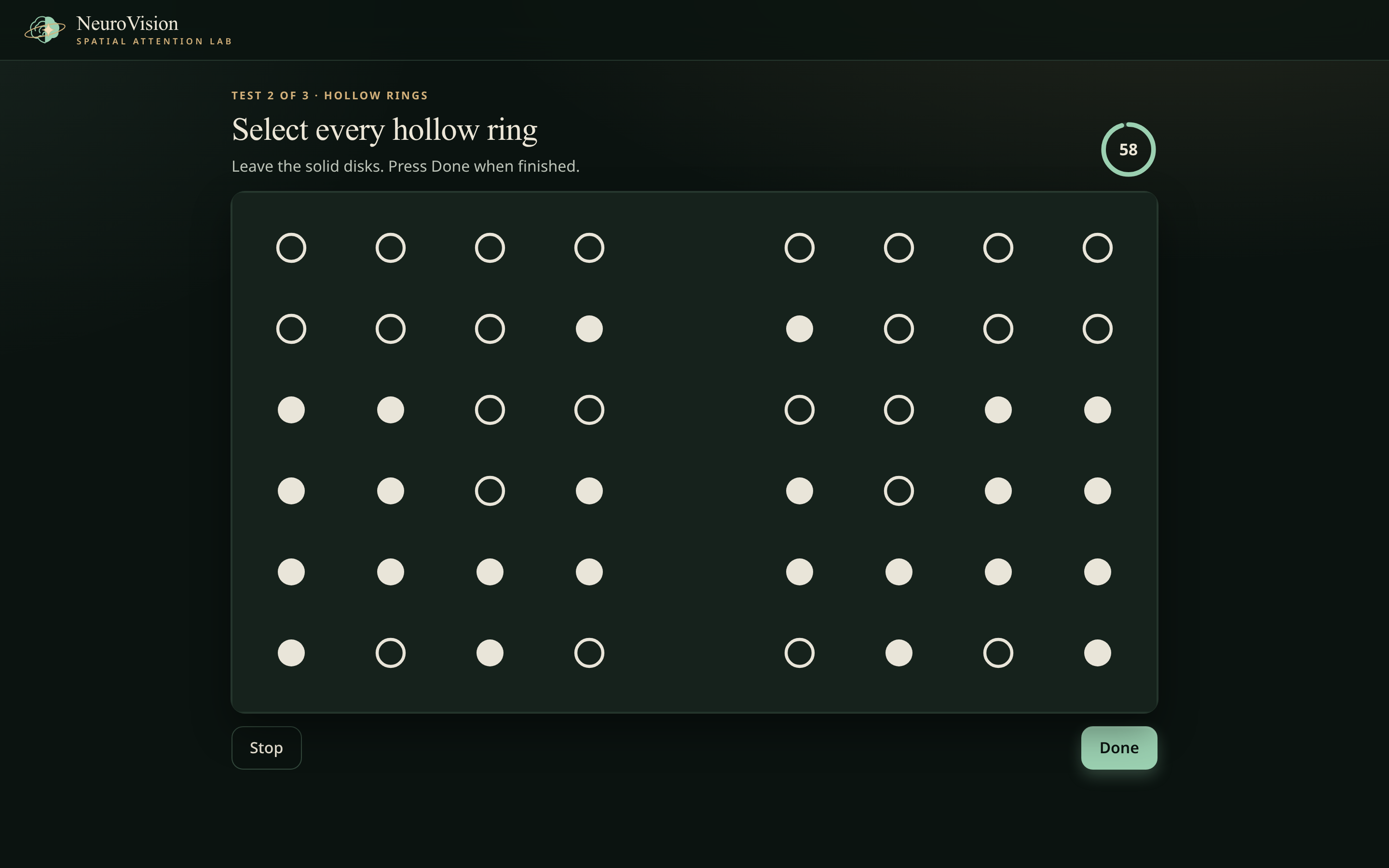
Test 2: Hollow Rings
-
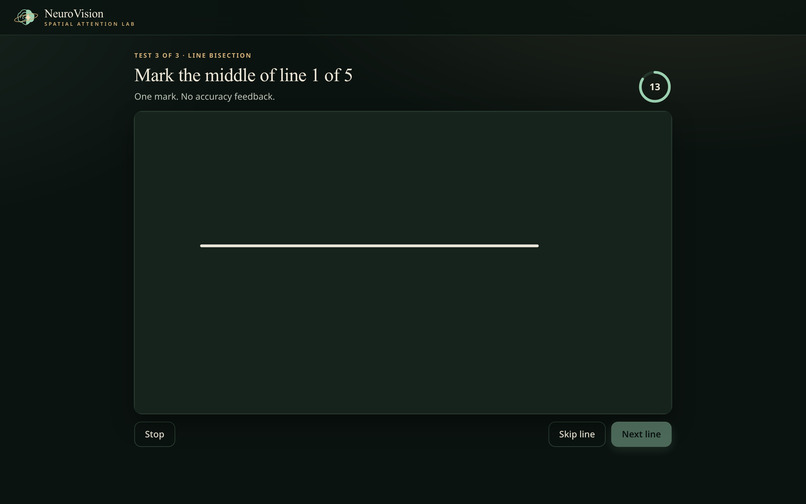
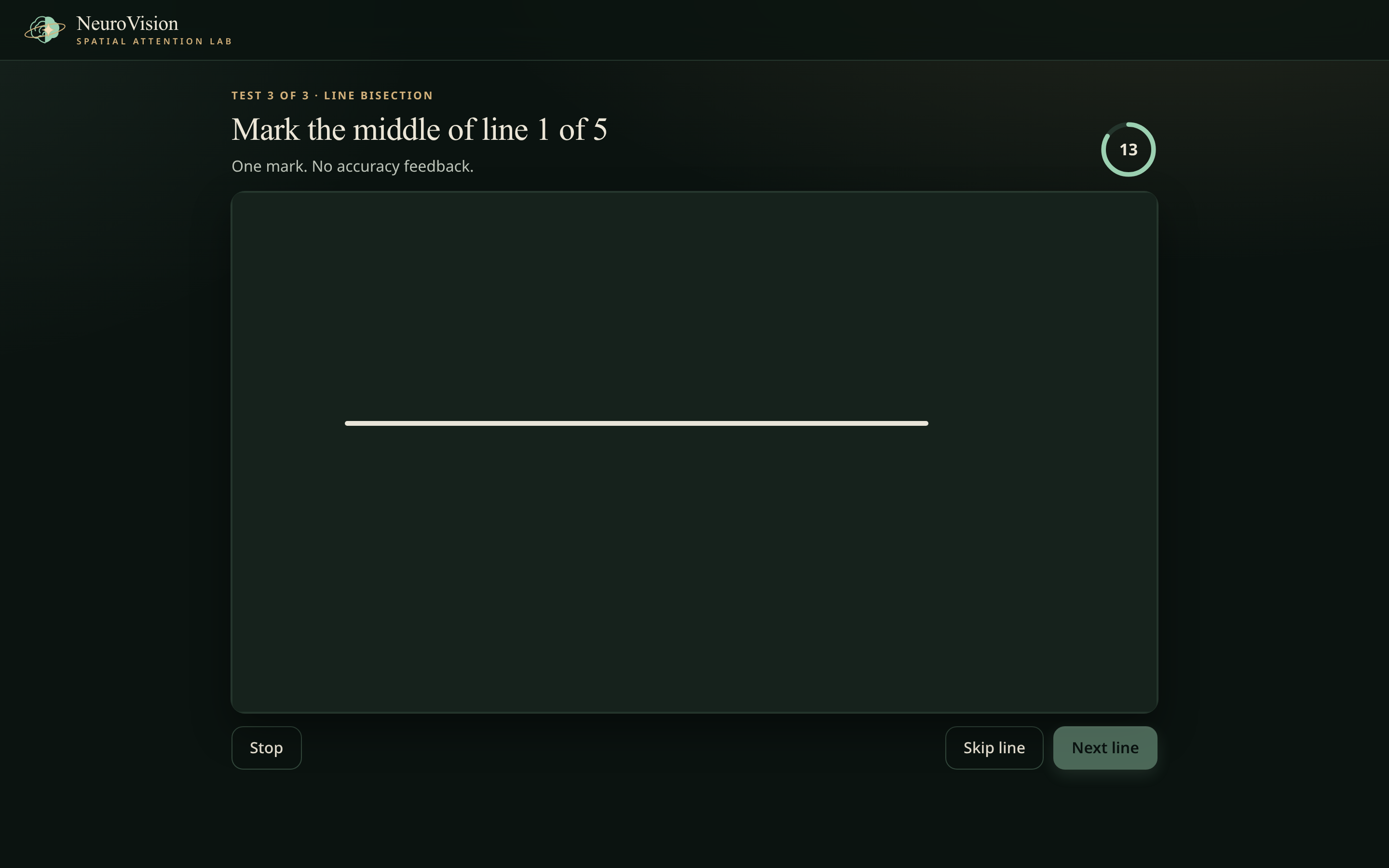
Test 3: Line Bisection
-
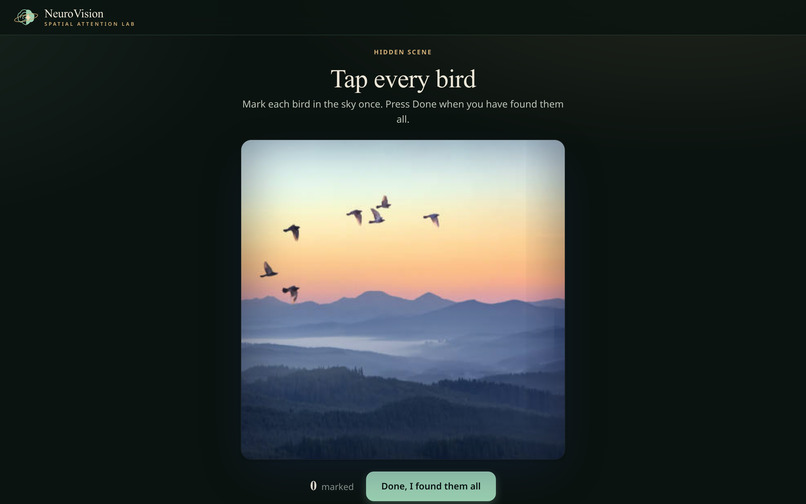
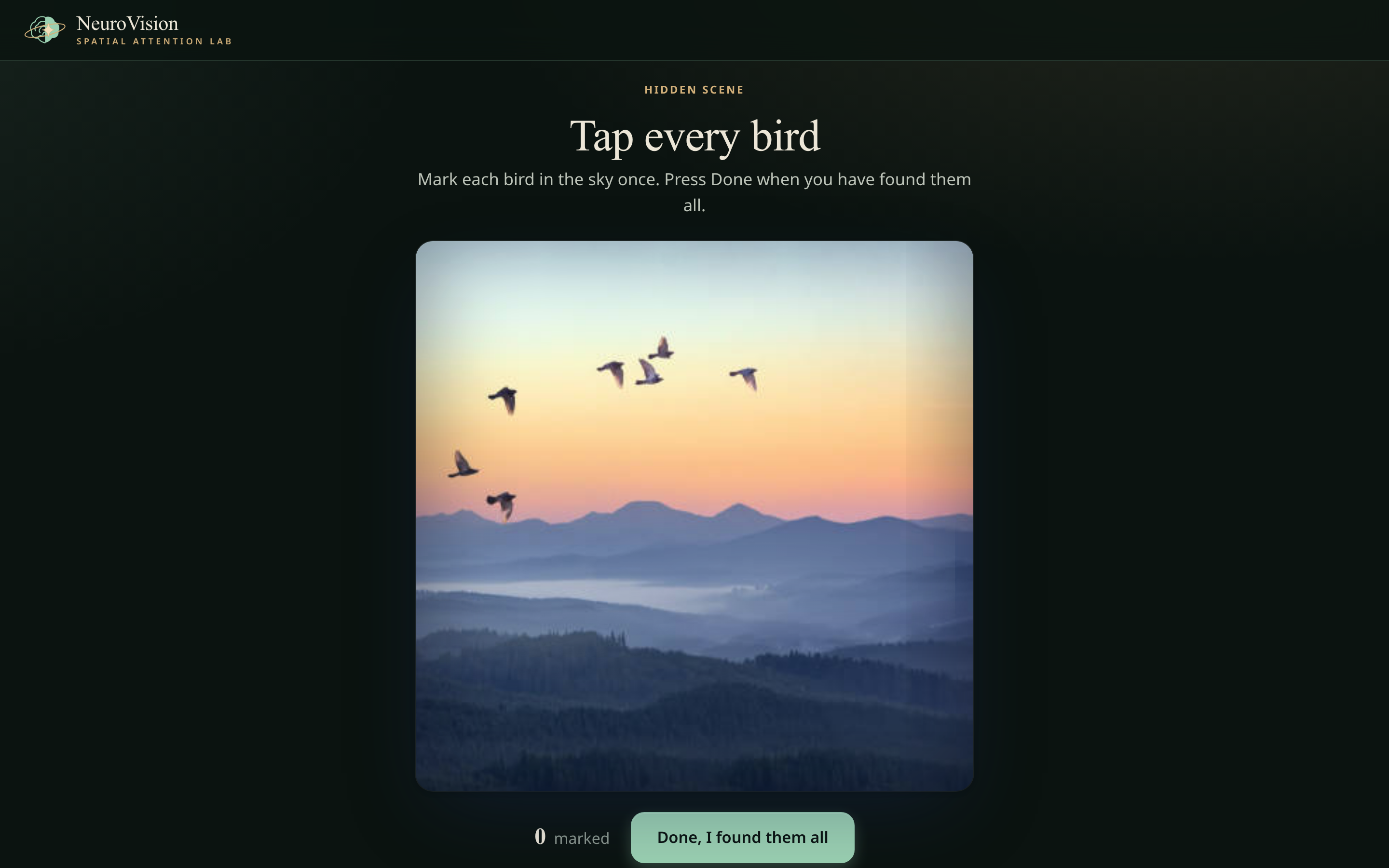
Neglect Demo
NeuroVision
A browser test for tracking spatial neglect after stroke, from home
Read the full technical paper → NeuroVision: A Lightweight Browser Battery and Probabilistic Evidence Model for Tracking Hemispatial Neglect at Home 16 pages · 35 verified references · pilot data from 20 volunteer hackers
Inspiration
NeuroVision started with a personal story. One of our teammates has a friend who lives with chronic seizures and involuntary muscle movements. Seeing what he deals with made us ask:
As computer science students, what can we build to make life easier for people living with neurological conditions?
That question led us to hemispatial neglect, a condition that often follows a stroke. Imagine being able to see but consistently failing to notice objects, people, or obstacles on one side of your world, and not realizing anything is wrong. People with neglect tend to overestimate their own spatial abilities, so they rarely report it. A test has to find it.
- About 29% of stroke survivors develop neglect, according to a systematic review of more than 6,000 patients.
- In one rehabilitation cohort, patients with neglect fell 6.5× more often than those without it.
- It's usually screened once, in a clinic, on paper, with tests that patients learn to compensate for and that record only what was missed, not how the person searched.
We wanted to know whether tracking spatial attention could be as simple as opening a browser and spending three minutes on a few tasks.
That question became NeuroVision.
What it does
NeuroVision is a lightweight, browser-based research prototype for repeated spatial attention assessment at home. The research literature agrees that no single test can rule out neglect, so we combine three complementary tests into one battery that takes about three minutes.
1. Starry Night: dynamic detection
Watch a field of flickering green dots and press a key whenever a red dot flashes. Targets are brief and unpredictably timed, which makes compensation hard. Studies show tasks like this catch deficits in patients who pass paper tests. The response is the same key press for both sides, so a weak arm can't masquerade as a spatial bias.
2. Hollow Rings: cancellation
Find every hollow ring on a board of 24 rings and 24 solid disks, mirrored left to right. Cancellation is the screen the European Academy of Neurology recommends first. Our digital version records what paper can't: the order, timing, and position of every selection. Research has found that where someone starts searching can be more sensitive than how many targets they miss.
3. Line bisection: spatial judgment
Mark the middle of five lines of different lengths. Bisection measures perceptual judgment of extent, a separate component of neglect. Healthy people aren't perfectly centered either; they show a small leftward bias called pseudoneglect. So we score against healthy norms, not against zero.
One interpretable result
Each test produces a signed left–right score with its own uncertainty. Our probabilistic evidence model treats all three as noisy views of one hidden "lean" and reports:
- The probability of a leftward lean, rightward lean, or balanced attention
- The estimated size of the lean, with a 90% interval
- Per-test evidence, so a clinician can see which test drives the result
- A discordance flag when one test disagrees with the others
Short tests are noisy, so weak evidence comes back "inconclusive" instead of being forced into a verdict. Disagreement between tests is clinically meaningful, so it's reported, not averaged away.
Also included
- Hidden scene, an unscored demo of what neglect feels like. Tap every bird in what looks like a complete picture. Only after you press Done does the missing left side fade in.
- Session history that only compares sessions run under the same protocol, scoring version, and board layout.
No installation. No headset. No webcam. No eye-tracker calibration. Just a browser.
NeuroVision is a prototype, we do not claim that it is currently a licensed diagnostic device.
Pilot study at HackPrinceton
On November 14, we ran NeuroVision with 20 healthy volunteers at the event and used their data to replace two of our three assumed norms with fitted ones.
- Hollow Rings: 18 of 20 found all 24 rings. Healthy performance is at ceiling, exactly what a cancellation screen should show in people without neglect.
- Line bisection: On average, volunteers marked slightly left of center, the direction of pseudoneglect, though the bias was smaller than we had assumed.
19 of 20 rated "balanced" · 1 "inconclusive" · 0 false "lean" verdicts
The highest probability of a lean in any volunteer was 0.21.
Honest caveats: This is an in-sample check, since norms were fitted to the same people. The event build displayed Starry Night results but didn't store them, so that test still uses an assumed norm. We merged a fix after the pilot.
Clinical feedback
During HackPrinceton, we presented the battery, the evidence model, and our validation plan to Dr. Taryn Zawady, MBBS. She is a physician and Safety & Pharmacovigilance Specialist at Technical Resources International. Before that she spent more than seven years in oncology drug safety at MSD, where she provided medical review of safety data across more than 30 oncology studies. She also has hands-on clinical experience in ICU and cardiac critical care.
She said the idea was worth pursuing, and noted that designing the clinical study itself falls outside her specialty.
Dr. Zawady isn't a stroke or neglect specialist, and one conversation isn't clinical validation. But her career has been spent reviewing safety data from clinical trials, and her feedback confirmed the order we'd planned: healthy norms and reliability first, then a supervised study with clinical partners.
How we built it
We approached NeuroVision as both a software engineering project and a research problem. Before writing code, we read the clinical literature on how neglect is assessed and which measurements a browser can capture meaningfully. Every design choice in our paper is tied to published studies, and every reference was checked against PubMed or Crossref.
Challenges we ran into
1. Turning neurological research into software. Neglect isn't one thing. It has separable components (perceptual, exploratory, object-centered), and different tests catch different ones. We had to understand why each test mattered before building it.
2. Balancing scientific accuracy with innovation. We didn't want features that looked impressive but had no scientific basis. We kept a strict line between what published studies support and what is our own design choice, and our paper labels every assumed value as assumed.
3. Webcam eye tracking. We first explored gaze tracking, but calibration means looking at targets across the whole screen, including the affected side. For someone with neglect, that step may itself fail. We switched to purely behavioral measures: key presses, pointer selections, and reaction times.
4. Combining measurements without misleading anyone. A simple average would ignore differences in reliability and hide disagreement. The probabilistic model forced us to think carefully about uncertainty, reference populations, and how to report results without making medical claims.
5. Designing for stroke survivors. Stroke often brings arm weakness, visual field loss, and fatigue. We kept the battery short and the detection response non-lateral. We also documented the confounds we can't remove yet, like pointer movement in two tests and the red/green distinction in Starry Night.
Accomplishments that we're proud of
- Three complementary, literature-backed tests in a three-minute browser session
- A probabilistic evidence model that reports uncertainty and flags disagreement instead of using arbitrary cutoffs
- A 20-person healthy pilot that replaced two of three assumed norms, with zero false lean verdicts
- Reproducible, event-based scoring: every response logged, any session re-scorable
- Encouragement from a physician with clinical trial and critical care experience
- A 16-page technical paper documenting methodology, statistics, pilot data, and limitations, with 35 verified references
Most importantly, we built something that connects computer science to a real clinical research problem.
What we learned
Healthcare technology takes more than working code and a clean interface. Tapping a ring or marking the middle of a line becomes a meaningful measurement only when it's designed carefully.
We learned why combining tests matters: someone can look normal on one test and show a clear asymmetry on another. On the technical side, we worked with Bayesian model comparison, small-sample standard errors, shrinkage estimation, and event-based behavioral analysis.
Our biggest takeaway: there's a difference between a system that works and a system that's proven to work.
We can show that NeuroVision records and analyzes performance, and that it behaves sensibly in healthy people. Whether it detects neglect can only be shown in patients. That distinction shaped how we built and presented the project.
What's next for NeuroVision
- Norm Starry Night using the fixed build that stores its results.
- Measure test–retest reliability to tell real change from day-to-day noise.
- Check false positives in a separate sample, and test sensitivity by artificially dimming one side of the screen.
- Ship the combined result in the live app. The posterior is computed in our scoring library. Next we'll show it on screen and switch the app to the fitted norms.
- Take it to stroke clinicians, and evaluate it in stroke survivors with a clinical partner and ethical approval.
- Expand accessibility and norms for motor and visual limitations and for older adults, since healthy bisection bias changes with age.
Our goal isn't to replace clinicians or claim a browser can diagnose a neurological condition. We want to find out whether accessible technology can make changes in spatial attention easier to see, measure, and understand.
Built With
- claude
- codex
- css3
- cursor
- docker
- fastify
- github
- grokbot
- html5
- node.js
- postgresql
- react
- tigercloud
- tigerdata
- typescript
- vite


