-
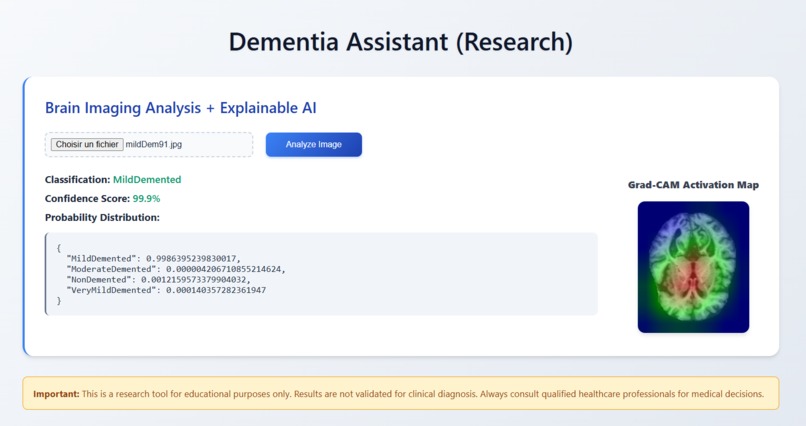
CogniScan Interface Demo: AI-Powered Brain Imaging Analysis

The growing prevalence of dementia and Alzheimer's disease presents one of the most pressing healthcare challenges of our time, with over 55 million people worldwide living with dementia creating an urgent need for better diagnostic tools and research platforms. Traditional diagnostic methods often rely on subjective assessments and can miss early-stage indicators, which inspired this project's potential to combine modern deep learning with explainable AI techniques to create a research tool that not only classifies brain imaging data but also provides transparent, interpretable results. The idea of using Grad-CAM (Gradient-weighted Class Activation Mapping) to visualize exactly which regions of brain images influence the model's decisions seemed particularly valuable for researchers who need to understand the "why" behind AI predictions.
Implementing a ResNet-18 architecture for medical image classification taught me about the specific challenges of medical imaging, including the importance of proper data normalization and the delicate balance between model complexity and interpretability, while building the Grad-CAM visualization system revealed how gradient-based attention mechanisms work in practice through the mathematical foundation of computing gradients of the target class score with respect to feature maps.

Log in or sign up for Devpost to join the conversation.