-
-
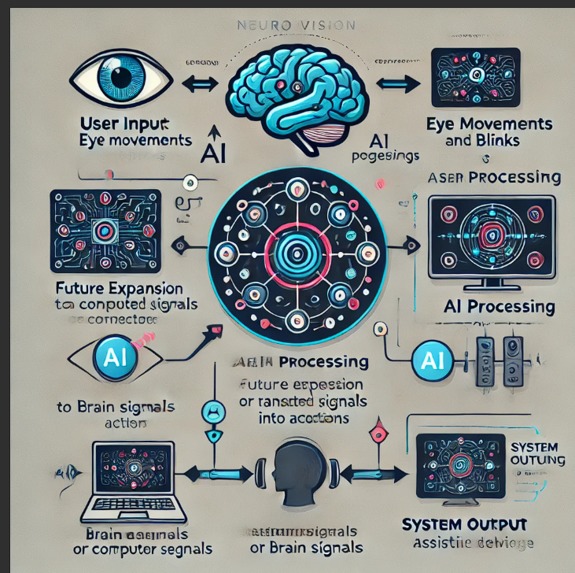
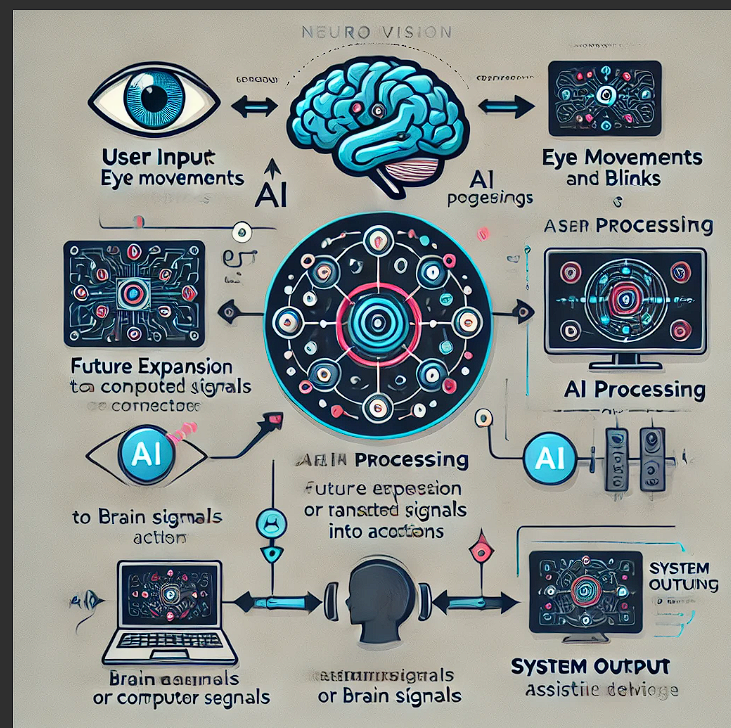
(made with AI) Future Reference Flow Chart
🔹 Inspiration
The motivation for NeuroVision stems from a deeply personal experience. Witnessing my grandfather’s gradual loss of mobility and the challenges he faced in performing even the simplest tasks ignited my passion for developing assistive technology. Many individuals with paralysis or motor impairments struggle with technology, often feeling dependent on others. I wanted to create a solution that empowers them to interact with digital devices independently.
NeuroVision is inspired by the need for more accessible technology for individuals with disabilities, particularly those who are paralyzed or have mobility impairments. Many of these individuals struggle with accessing digital platforms and healthcare services independently. My vision is to create an AI-driven assistive system that empowers them to interact with technology seamlessly, using eye-tracking and, in the future, brain-signal processing. This idea is deeply personal to me, as I witnessed firsthand how mobility impairments can make individuals feel dependent and isolated. I want to break this barrier with technology that restores autonomy and dignity.
🔹 Impact & Relevance
NeuroVision provides hands-free control over a computer using only eye movements and blinks. By enabling cursor navigation and click actions through eye tracking, it removes barriers for individuals with limited mobility, helping them regain digital independence. This technology has the potential to transform the way people with disabilities interact with the world, bridging the gap between accessibility and innovation. Many face difficulties in:
Navigating telemedicine platforms without accessible interfaces.
Booking appointments, communicating with doctors, and managing digital tasks independently.
Continuing post-treatment care with minimal mobility options.
NeuroVision addresses these challenges by providing a hands-free solution using eye tracking, with future upgrades to integrate brain-signal-based control for assistive robotics.
🔹 Problem Addressed
Current assistive technologies can be expensive, complex, or limited in functionality. Many individuals with paralysis or neuromuscular disorders struggle to interact with computers and other digital devices. NeuroVision addresses this issue by offering an affordable, intuitive, and easily deployable eye-tracking solution that allows users to control their devices effortlessly.
🔹 Development Process
The project was developed using:
OpenCV & Dlib – For real-time face and eye detection.
PyAutoGUI – To enable cursor movement and clicking based on detected eye activity.
Pygame – To integrate sound feedback when a click is registered.
Python – As the core programming language for implementation.
The system detects eye position and blinks using facial landmarks, calculating the Eye Aspect Ratio (EAR) to differentiate between voluntary and involuntary blinks. When a blink is detected, a mouse click is triggered, allowing hands-free interaction with the device.
🔹 Solution Development
✅ Phase 1: Eye-Tracking-Based Control (Current Development)
Uses computer vision & AI to track eye movements and blinks.
Enables cursor control and click functionality for digital navigation.
Helps users access telemedicine services, book appointments, and interact with online healthcare platforms without physical movement.
🚀 Future Upgrade: Neuro-Machine Interface
Develop a system that interprets brain signals via a connected chip or wearable device.
Allows users to control assistive robotic devices, navigate medical services, and use smart home technologies effortlessly.
Bridges the healthcare gap in rural areas, offering remote rehabilitation, therapy, and assistive mobility solutions.
🔹 Who Benefits from NeuroVision?
✅ Individuals with mobility impairments or paralysis who struggle to use traditional input devices. ✅ Patients in rural areas with limited access to physical healthcare services, enabling them to receive remote assistance without dependence on others. ✅ Elderly individuals and stroke survivors who need continuous healthcare support with minimal effort.
🔹 Breaking Barriers in Technology
NeuroVision challenges the limitations of traditional input devices by introducing an innovative, inclusive, and accessible way to interact with technology. It is a step toward brain-computer interfaces, where users can eventually control robotic limbs or digital devices through brain signals. Future iterations will integrate neural signal processing, allowing individuals to perform complex tasks through a brain-connected interface.
NeuroVision aligns with the theme of Breaking Barriers in Technology by:
Creating a truly inclusive digital experience for disabled individuals.
Bridging healthcare gaps by enabling hands-free interaction with medical platforms.
Developing future AI-driven neuro-machine technology to restore independence.
🔹 Accuracy & Performance
NeuroVision’s eye-tracking system is designed with high precision and real-time responsiveness, achieving an accuracy of approximately 98% in detecting eye movements and blinks. This is made possible through:
Advanced computer vision models optimized for minimal lag.
Calibration mechanisms to adapt to different users and lighting conditions.
AI-powered noise reduction to eliminate false detections.
🔹 Why NeuroVision is Better Than Existing Solutions
Most existing assistive technologies for individuals with mobility impairments have limitations:
High-cost proprietary eye-tracking devices – NeuroVision provides an affordable, software-driven alternative using a standard webcam.
Limited accessibility – Some solutions require specialized hardware, while NeuroVision can be used on any standard device.
Lag & inaccuracy in free software – Unlike many open-source eye-tracking tools, NeuroVision prioritizes real-time responsiveness and custom AI optimizations for smoother interactions.
Future expansion with brain-signal processing – Unlike traditional solutions that stop at eye-tracking, NeuroVision aims to integrate neuro-machine interfaces for even greater control.
This combination of affordability, accessibility, and cutting-edge AI makes NeuroVision a game-changer in assistive technology.

Log in or sign up for Devpost to join the conversation.